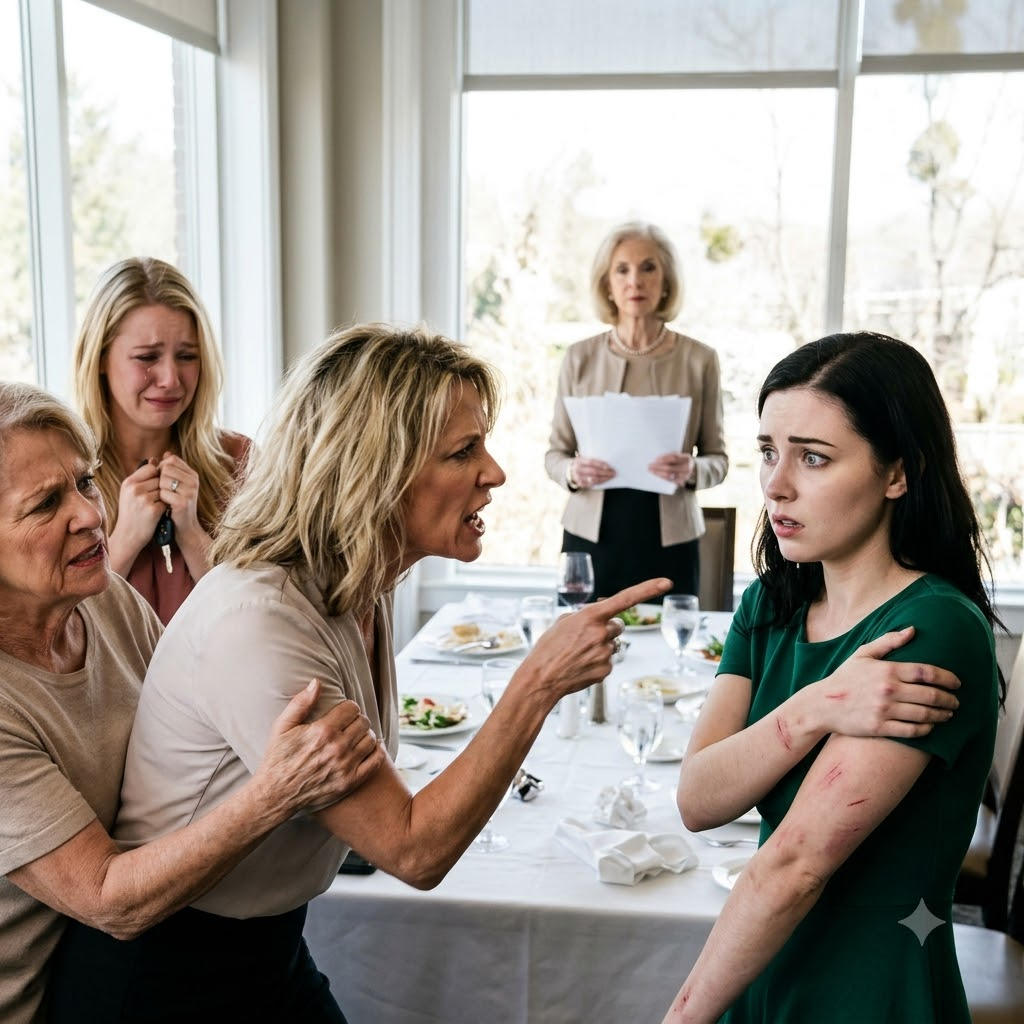
Grandma Eleanor stared at the appointment record.
Her name was clearly visible beneath my mother's and Charles Whitmore's.
For several seconds, she didn't move.
Then she slowly lowered herself into the chair.
"That's impossible."
I looked at her.
"Grandma, you were there?"
She shook her head.
"I don't remember attending any meeting about your account."
Mr. Collins took the phone from my hand and enlarged the photograph.
"Let's be careful. This is an appointment log, not a complete record of what happened inside the bank."
He pointed toward the three names.
"However, it does establish that these individuals were recorded as attending."
I looked at Grandma.
"Could you have forgotten?"
She looked hurt.
"Sweetheart, I may forget where I put my glasses, but I wouldn't forget signing away your future."
Nobody spoke.
I sat across from her, trying to reconcile the woman I knew with the name on the document.
Grandma had always been the person who protected me.
She had attended my graduation.
She had bought me my first car.
She had encouraged me to become financially independent.
Yet her name was now appearing on records connected to an account I had never known existed.
"Grandma," I said quietly, "I need you to tell me everything you remember about that day."
She closed her eyes.
Then she began.
Three years earlier, Grandma had been preparing for a medical procedure.
She remembered that period clearly because she had spent several weeks visiting specialists and arranging help around the house.
Charles Whitmore had been handling some administrative matters for her.
One afternoon, he called and explained that there were documents requiring her signature.
He told her the paperwork concerned the family financial arrangements established twelve years earlier.
Grandma remembered meeting him.
She remembered Patricia being present.
But she did not remember discussing the closure of my account.
"I thought we were reviewing the trust arrangements," she explained.
"Did you sign anything?"
"Possibly. Charles brought several documents. He said they were routine administrative updates."
Mr. Collins leaned forward.
"Do you remember reading them?"
Grandma shook her head slowly.
"I read the first pages. There were several documents, and he explained that some required signatures because of changes in the administration."
I felt my stomach tighten.
"Did you ask him whether my money would be affected?"
"Yes."
"What did he say?"
Grandma looked directly at me.
"He told me your account would remain protected until you turned twenty-five."
I stared at her.
"Then why was it closed when I was twenty-one?"
She looked devastated.
"I don't know."
Mr. Collins made a note.
"Do you remember signing anything specifically authorizing Patricia to act on Arya's behalf?"
Grandma thought for a moment.
"I remember signing an administrative acknowledgment. I don't remember approving an early withdrawal."
"Could that acknowledgment have been presented as authorization?"
"I cannot say without seeing the original."
I looked toward the appointment record again.
The date.
The three names.
The supposed family meeting.
It was beginning to look like someone had taken a real meeting and used it to support a completely different story.
"Grandma, did you know I was supposed to be there?"
She shook her head.
"No. Nobody told me you were expected."
"Did you know the bank recorded me as attending?"
Her expression hardened.
"Absolutely not."
Mr. Collins closed the folder.
"Then we need the bank's complete appointment records, not just the summary."
Grandma nodded.
"Get them."
At 11:30 a.m., Mr. Collins contacted the bank's legal department.
He requested the original appointment documentation, the account closure authorization, the transaction records, and any correspondence associated with the exception request.
He also asked whether the bank had retained identification records for the individuals who attended the appointment.
The representative told him that the request would require formal review.
Mr. Collins thanked her and ended the call.
"How long will it take?" I asked.
"Possibly several business days. Some older records may need to be retrieved from archived storage."
I sighed.
Several days.
After everything I had discovered, waiting felt unbearable.
Grandma noticed.
"Would you like some breakfast?"
I almost laughed.
It was nearly lunchtime.
But that was Grandma.
Even when the world around her was falling apart, she remembered whether I had eaten.
"Coffee would be nice."
She smiled.
"Coffee I can arrange."
While she went to the kitchen, I looked through the documents again.
There was a paragraph in the original family agreement that I hadn't noticed before.
It referred to a provision called the Independent Beneficiary Review.
I read it aloud.
"Upon reaching twenty-one years of age, the beneficiary shall receive independent notification of all assets administered on their behalf."
Mr. Collins looked up.
"That's important."
"Why?"
"Because it means your mother wasn't supposed to be the only person receiving information about the account."
I continued reading.
"The beneficiary shall have the right to request a full accounting of all funds administered under the arrangement."
I looked at him.
"So I could have requested the records myself?"
"Yes."
"At twenty-one?"
"Correct."
I sat back.
For three years, I had believed I was simply struggling financially because that was how adulthood worked.
I had never known I could ask for an accounting.
I had never known I had a right to see where the money went.
And I had never known that someone was supposed to notify me.
"Was the bank required to send me something?"
Mr. Collins nodded.
"According to this provision, an independent notice should have been provided. We need to establish whether that happened."
Grandma returned with two cups of coffee.
She placed one in front of me.
Then she looked at the paragraph.
"I specifically requested that provision."
I looked at her.
"Why?"
She sat beside me.
"Because I knew you were quieter than Madison. I knew you wouldn't demand things. I worried that if everything was left to your mother, your needs might be overlooked."
I stared at her.
"Grandma..."
She took my hand.
"I wanted you to have the information necessary to protect yourself."
My eyes began to sting.
"Then why didn't I receive it?"
She looked at Mr. Collins.
He had no answer.
At 12:15 p.m., Madison called.
I watched her name appear on my screen.
I wasn't sure whether I wanted to answer.
But I did.
"Hello?"
"Arya?"
Her voice sounded tired.
"Yes."
"Can we talk?"
"About what?"
"Everything."
I glanced at Grandma.
She nodded.
I accepted.
Madison spoke quietly.
"Derek and I had a huge argument last night."
I closed my eyes briefly.
"What happened?"
"He says everyone is trying to destroy our lives."
I remained silent.
"He says you should never have involved Grandma."
I looked at the documents on the table.
"I didn't involve Grandma. She asked me whether I had given you the car."
"I know."
"Madison, I didn't create this situation."
"I know."
Her voice cracked.
Then she continued.
"Mom came to our house this morning."
I sat straighter.
"What did she want?"
"She wanted to talk to Derek."
"About the company?"
"Yes."
I looked toward Mr. Collins.
He immediately began writing something down.
"What did they discuss?"
Madison hesitated.
"I couldn't hear everything. But I heard Mom say that the two-hundred-thousand-dollar transfer needed to happen before Grandma changed anything."
My stomach tightened.
"Before Grandma changed what?"
"I don't know."
"Madison, listen carefully. Did Mom say anything about Grandma's house?"
She went silent.
Then she whispered, "Yes."
"What?"
"She said the property arrangement had to be finalized."
I looked at Grandma.
Her expression became serious.
"What property arrangement?"
Madison took a breath.
"Mom said Grandma had already agreed to something involving the house."
Grandma immediately shook her head.
"That's not true."
I put the call on speaker.
"Madison, Grandma is here. Can you tell her exactly what you heard?"
My sister hesitated.
Then she repeated the conversation.
Grandma listened without interrupting.
When Madison finished, she asked one question.
"Did your mother say I had signed anything?"
Madison answered quietly.
"Yes."
Grandma looked at Mr. Collins.
He slowly closed his notebook.
"That's a serious allegation," he said.
Grandma nodded.
Then she turned toward the phone.
"Madison, did your mother show you a document?"
"No."
"Did Derek see one?"
"I think so."
"Can you ask him?"
Madison hesitated.
"I can try."
Grandma softened her voice.
"Sweetheart, I am not asking you to take sides. I am asking you to tell the truth."
Madison began crying.
"I don't know what to do anymore."
I looked at her.
For the first time, I realized that my sister might be discovering that she had been kept in the dark too.
But I couldn't let sympathy erase the things she had done.
"Madison," I said, "I need you to understand something. I want the truth, even if it makes everyone uncomfortable."
She whispered, "I understand."
Then the call ended.
Mr. Collins suggested that Grandma contact the attorney who had prepared her original estate documents.
Grandma agreed.
But she had another idea.
"Robert, I want to see the original property agreement."
He opened his briefcase.
"Do you remember where it was kept?"
"In my private study. There should be a copy in the blue folder."
Grandma stood.
"Come with me."
We followed her upstairs.
Her study was at the end of a long hallway.
It was a beautiful room with dark wooden shelves, a large desk, and framed photographs of family celebrations.
Grandma opened a cabinet.
She searched through several folders.
Finally, she found one with a blue cover.
She placed it on the desk.
"This is it."
Mr. Collins opened the folder.
Inside were property records, estate planning notes, and several financial schedules.
He examined the first page.
Then the second.
Suddenly, he stopped.
"What is it?" Grandma asked.
He turned the document toward her.
"Did you authorize this amendment?"
Grandma looked down.
Her expression changed immediately.
"No."
I leaned forward.
The document was titled:
REYNOLDS FAMILY PROPERTY MANAGEMENT AGREEMENT.
It contained several provisions concerning the management of Grandma's properties.
But one section was particularly important.
It identified Patricia Reynolds as the proposed manager of a property-holding entity.
Another section referred to the transfer of certain decision-making powers.
I looked at Grandma.
"Would Mom have been able to sell your house?"
Mr. Collins answered carefully.
"Not automatically. We need to review the full legal structure. But the amendment appears to give the proposed manager substantial authority over certain property decisions."
Grandma shook her head.
"I never approved this."
Mr. Collins examined the signature.
"Then we need to establish who prepared it and how it entered your records."
I looked at the date.
It was six months earlier.
The same period when Grandma had been recovering from her medical procedure.
I remembered visiting her during that time.
She had been tired.
She had needed help getting around.
My mother had insisted on managing several appointments.
Derek had also visited frequently.
I felt a chill.
"Grandma, did Mom ever ask you to sign documents while you were recovering?"
Grandma nodded slowly.
"Several times."
"Did you read them?"
"Some. Not all."
Mr. Collins looked up.
"Do you remember Charles Whitmore being present?"
"Yes."
"Daniel Mercer?"
Grandma shook her head.
"No."
He placed the amendment into a separate folder.
"We need to verify whether this was ever formally recorded or implemented."
Grandma looked at him.
"Can someone transfer my property without my knowledge?"
"That depends on the documents, the ownership structure, and the applicable legal requirements. But we can take steps to protect your interests while this is investigated."
Grandma nodded.
"Do that."
At 2:40 p.m., Mr. Collins received an email from the bank.
He opened it on his laptop.
The message contained a preliminary response to the records request.
The bank had located the account-opening file.
It had also found the original closure authorization.
However, the bank would not release the complete file until the identity of the requester and the beneficiary's rights had been verified.
Mr. Collins read the message twice.
Then he turned toward me.
"There's something here you should see."
He showed me the attached page.
It was a scanned copy of the original authorization.
The signature appeared exactly as it had in Helen's photograph.
But there was another detail.
The document included a handwritten note:
Beneficiary has requested immediate access due to urgent personal circumstances.
I stared at it.
"That's a lie."
Grandma looked at the page.
"What urgent circumstances?"
"I never requested anything."
Mr. Collins nodded.
"That's why we need the complete file."
I examined the signature again.
Then something caught my attention.
The document listed my address at the time.
It was my mother's house.
But I had moved out several months before my twenty-first birthday.
I looked at Mr. Collins.
"That's the wrong address."
He leaned closer.
"You're certain?"
"Yes. I was living in my college apartment."
He made a note.
"That may be relevant."
I pointed toward another section.
"There's a phone number too."
It was not mine.
It was my mother's.
I looked at Grandma.
"Why would my mother provide her phone number for my account?"
Grandma didn't answer.
Mr. Collins examined the page.
"Because she was listed as the administrative representative. But that doesn't establish that she had authority to sign on your behalf under the account restrictions."
I felt my heartbeat increase.
There were now multiple inconsistencies.
The address.
The phone number.
The supposed family meeting.
The signature.
The missing independent notice.
And the money.
It was no longer possible to dismiss everything as a misunderstanding.
At 3:25 p.m., Grandma asked me to help her bring another folder downstairs.
While we were walking through the hallway, she stopped beside an old photograph.
It showed her with my grandfather, my mother, and my aunt Linda.
I recognized the occasion.
My parents' wedding anniversary.
Grandma touched the frame.
"Your grandfather used to say that the hardest thing about loving people was knowing when to stop protecting them from the consequences of their decisions."
I looked at her.
"Did he know about the money?"
She shook her head.
"No. He passed away before the account was fully established."
She paused.
"But he knew Patricia could be controlling."
I looked toward her.
"Why didn't you tell me?"
"Because I wanted you to have a relationship with your mother without constantly questioning her motives."
I nodded.
I understood that.
But I also understood how much damage silence could cause.
Grandma looked at me.
"There's something else I need to tell you."
I waited.
"When your grandfather died, he left me a private letter."
I frowned.
"What did it say?"
"That I should protect the family assets from anyone who confused inheritance with entitlement."
I looked at her.
"Did you ever think Mom would do something like this?"
Grandma looked down.
"I hoped I was wrong."
She opened the folder she was carrying.
Inside was an envelope with my grandfather's handwriting.
My name was written on it.
Arya.
I stared.
"Why is that addressed to me?"
Grandma smiled faintly.
"Because he wanted you to receive it when you were old enough to understand why he had made certain decisions."
I reached for the envelope.
But before I could open it, Grandma stopped me.
"Not yet, sweetheart."
I looked at her.
"Why?"
"Because I believe there is another document we need to find first."
At 4:10 p.m., Mr. Collins called us back into the study.
He had received another email.
This one came from the office of Daniel Mercer.
It contained a formal response concerning the proposed two-hundred-thousand-dollar transfer.
Mr. Collins read it carefully.
Then he looked toward Grandma.
"They claim the payment was part of an estate planning arrangement you approved."
Grandma shook her head.
"I approved no such payment."
"Do you recognize the account listed as the recipient?"
She examined the page.
Then her eyes narrowed.
"That's not my account."
Mr. Collins looked up.
"What?"
"That account belongs to a company I used years ago to manage one of my rental properties. I closed that arrangement long ago."
I stared at him.
"Could someone still use it?"
"That depends on the current account status and who controls the receiving entity."
Grandma looked toward the window.
"Robert, I want the transfer stopped if it has not already happened."
"I'll contact the relevant institutions and seek urgent confirmation."
He began making notes.
I looked at the email.
There was a line near the bottom.
Payment scheduled upon completion of beneficiary consent documentation.
I frowned.
"Beneficiary consent?"
Mr. Collins read it.
"That appears to refer to a separate document."
Grandma shook her head.
"I never signed one."
I looked at the page again.
"Who was supposed to provide the consent?"
Mr. Collins pointed toward the final paragraph.
"The proposed beneficiary representative."
I felt my stomach tighten.
"Who is that?"
He turned the laptop toward me.
There were two names.
Patricia Reynolds.
And Derek Reynolds.
I stared at the screen.
They were listed as the individuals responsible for obtaining the required consent.
Grandma stood.
"That's enough."
Her voice was quiet.
But there was no uncertainty in it.
"Robert, I want every pending transaction reviewed. I want my estate documents secured. And I want all communications preserved."
Mr. Collins nodded.
"I'll handle it."
At 5:30 p.m., Madison arrived at Grandma's house.
She looked exhausted.
Her hair was pulled into a loose ponytail, and she was wearing the same clothes from the previous evening.
She carried a large brown envelope.
Grandma opened the door.
"Madison?"
My sister looked nervous.
"Can I come in?"
"Of course."
She entered slowly.
When she saw me, she stopped.
"Arya."
I nodded.
"Hi."
She looked toward Mr. Collins.
Then she held up the envelope.
"I found something at home."
Grandma invited her into the study.
Madison placed the envelope on the desk.
"Derek kept it in his office drawer. I wasn't looking for anything. I was trying to find Ethan's insurance papers."
She swallowed.
"Then I saw Grandma's name."
Mr. Collins opened the envelope carefully.
Inside were several printed emails and two documents.
He examined the first page.
Then he looked at Madison.
"Do you know what these are?"
She shook her head.
"Not really."
Grandma leaned closer.
Mr. Collins turned the first document around.
It was a communication between Derek and Charles Whitmore.
The subject line read:
RE: FAMILY ASSET DISTRIBUTION — FINAL APPROVAL.
I felt my heartbeat quicken.
Mr. Collins began reading.
Then he stopped.
He looked at Grandma.
"Eleanor, I think you need to see this."
Grandma examined the page.
Her expression became increasingly troubled.
I leaned forward.
"What does it say?"
Mr. Collins hesitated.
Then he read one sentence aloud.
"Once Arya's account is successfully closed and the remaining beneficiary restrictions are removed, the family will be in a position to proceed with the final transfer."
I stared at the page.
"Final transfer of what?"
Madison began crying.
"I don't know."
Mr. Collins turned to the second document.
His expression changed again.
This time, he didn't speak immediately.
He read the first paragraph.
Then the signature section.
Then he slowly placed the paper on the desk.
Grandma looked at him.
"What is it, Robert?"
He pointed toward the bottom.
There was a handwritten acknowledgment.
A date.
And two signatures.
One belonged to my mother.
The other belonged to Derek.
But beneath their names was a third line.
A line identifying the person who had supposedly approved the entire arrangement.
I leaned closer.
My eyes widened.
Because the third signature belonged to someone who had been dead for seven years.
My grandfather, Edward Reynolds.
Strengthen the final cliffhanger reveal Reach the requested 2000-word length






Comments 0