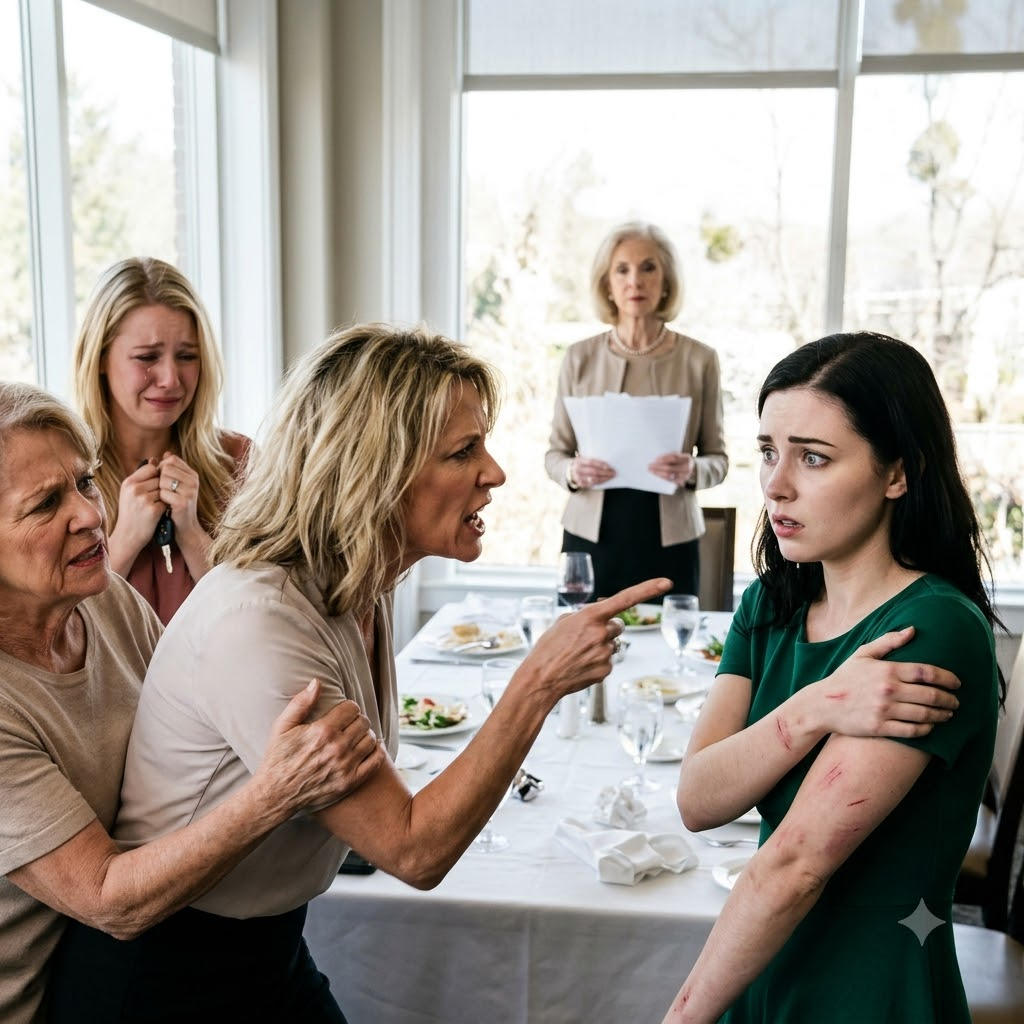
"This is the name of the person who helped Mom steal Arya's money."
Madison's voice trembled as she held the tiny folded paper.
Nobody moved.
The bracelet lay open in her palm.
For years, she had worn it without knowing that something was hidden inside its clasp.
Now, a secret written by our grandfather was about to change everything.
"Madison," Grandma Eleanor whispered, "please unfold it."
My sister looked at me.
I nodded.
She carefully opened the paper.
There were only three lines.
A name.
A date.
And a short handwritten instruction.
Madison read the name aloud.
"Martin Keller."
Mr. Collins immediately looked toward Victor Hayes.
Victor's expression darkened.
"Edward was right."
I frowned.
"Who is Martin Keller?"
Mr. Collins answered.
"He was the bank operations manager who approved the exception request that closed your account."
I stared at him.
"The same man Helen mentioned?"
"Yes."
Madison looked confused.
"But why would Grandpa hide his name in my bracelet?"
Victor took the paper carefully.
"Because Edward believed Martin was helping someone access financial accounts without proper authorization."
Grandma looked devastated.
"Then why didn't he tell me?"
Victor sighed.
"Because he wasn't certain who else was involved."
I looked at the date.
It was written beneath Martin's name.
Three years before my grandfather died.
The same year the original family financial arrangements had been revised.
I felt a chill.
"Grandpa knew about Martin before my account was closed."
Victor nodded.
"He suspected something was wrong long before the bank processed your withdrawal."
I looked at the bracelet.
"Then this wasn't just a keepsake."
"No," Victor replied. "It was evidence."
Mr. Collins asked everyone to remain calm.
He photographed the note, documented its condition, and placed it inside a protective sleeve.
"We need to preserve the original. Nobody should contact Martin Keller directly."
Grandma looked at him.
"Why not?"
"Because we don't know whether he is still connected to the people involved. Any communication should go through the appropriate legal channels."
I nodded.
But my mind was racing.
Martin Keller had approved the closure of my account.
Charles Whitmore had supposedly authorized it.
My mother had submitted the request.
Derek's company had received the money.
And now my grandfather's private records suggested that the bank manager had been involved years before the transfer occurred.
I looked toward Victor.
"Did Grandpa ever explain what Martin was doing?"
Victor opened the black ledger.
"Edward believed Martin had been facilitating transfers between accounts belonging to several family-related businesses."
"Was Derek's company one of them?"
Victor turned several pages.
Then he stopped.
He pointed toward a handwritten entry.
"Here."
I leaned closer.
The company name was clearly written.
Reynolds Family Consulting.
Beside it was a date.
Three months before my account was closed.
Underneath, my grandfather had written:
Transfer request disputed. No beneficiary authorization received.
I read it twice.
"Grandpa knew."
Victor nodded.
"He had already discovered an attempted transfer before the final closure."
"Then why didn't he stop it?"
Victor looked toward Grandma.
"Because the bank claimed the request had been withdrawn."
Grandma stared at the ledger.
"Charles told Edward everything had been corrected."
I felt anger rise inside me.
"So they told Grandpa the problem was fixed, then closed my account anyway?"
"That appears to be one possibility," Mr. Collins replied. "But we need the supporting records."
He examined another page.
There were several handwritten entries.
Dates.
Amounts.
Initials.
And references to documents that were no longer in the box.
I pointed toward one entry.
"What's that?"
Victor leaned closer.
His expression changed.
"That was the final amount Edward believed had been redirected."
"How much?"
He looked at me.
"Two hundred and fifteen thousand dollars."
I stopped breathing for a moment.
Two hundred and fifteen thousand.
The amount was larger than the money I had originally known about.
"Was that all mine?"
Victor shook his head.
"Not necessarily. Edward was tracking several family financial arrangements. Some money belonged to you, some to Madison, and some to the estate."
I looked toward my sister.
She was staring at the ledger.
For the first time, I realized that Grandpa might have been trying to protect both of us from something much bigger than the loss of my car.
Madison slowly sat down.
"I don't understand."
Grandma reached for her hand.
"What is it, sweetheart?"
Madison looked at the bracelet.
"Why would Grandpa give this to me?"
Victor pulled out another folder.
"Because he trusted you."
Madison shook her head.
"I was seventeen. I didn't understand anything about money."
"That may be precisely why he chose you."
He opened the folder.
Inside was a photograph of Madison and our grandfather sitting together in his garden.
She was holding a small birthday cake.
On the back, Grandpa had written:
Madison, never let anyone make you believe that being loved means owing them obedience.
Madison covered her mouth.
I remembered that day.
It had been her seventeenth birthday.
Grandpa had given her the bracelet shortly before dinner.
She had loved it immediately.
He had told her it was special because it had a secret.
We had laughed.
Madison had assumed he meant the tiny engraved message inside the clasp.
Now I understood.
There had been another secret.
Grandma looked at Victor.
"Did Edward tell you why he chose Madison?"
Victor nodded.
"He told me he believed someone would eventually try to use her identity without her knowledge."
Madison looked up.
"What?"
Victor continued.
"Edward said Patricia had begun involving you in financial arrangements you didn't understand."
My sister began crying.
"He knew Mom was doing that?"
"He suspected it."
I looked at Madison.
"Do you remember signing anything before Grandpa died?"
She shook her head.
"No."
"Anything at all?"
She thought for several seconds.
Then her expression changed.
"Actually..."
We all turned toward her.
"What?" I asked.
Madison looked at Grandma.
"Mom once asked me to write my name on a piece of paper."
Grandma frowned.
"When?"
"I think it was a few months before Grandpa died."
"What did she say?"
"She told me she was helping Grandpa organize his birthday cards and wanted my signature for a family scrapbook."
I felt my stomach tighten.
"Did you give it to her?"
Madison nodded.
"Yes."
Victor looked toward Mr. Collins.
Neither spoke.
I stared at my sister.
"Did you sign anything else?"
"No."
"Are you sure?"
Madison nodded.
Then she whispered:
"She took a photograph of my driver's permit too."
Grandma's face went pale.
"Why?"
"I don't know."
Mr. Collins wrote it down.
"That information may be relevant. We need to establish whether your identity was used in any of the disputed transactions."
Madison looked devastated.
"I thought she was just helping me."
I reached for her hand.
"I know."
And I meant it.
For the first time, I believed my sister might have been another person whose trust had been exploited.
But that didn't erase what had happened to me.
We both deserved the truth.
Victor returned to the black ledger.
"There's something else Edward wanted you to see."
He turned to the final pages.
A separate section was marked:
BENEFICIARY PROTECTION ARRANGEMENTS.
The first entry concerned my education reserve.
The second concerned Madison.
The third concerned Grandma's property.
I read the first page.
It explained that Grandpa had created separate financial protections for each of us.
My reserve was supposed to remain independent.
Madison's arrangement included a future education and housing fund.
Grandma's property was supposed to remain under her control.
None of the arrangements gave my mother unrestricted authority over the money.
I looked at Mr. Collins.
"Does this mean the company never had a right to receive the funds?"
"Based on these documents, there is no obvious authorization for the company to receive money from your protected account. We need the complete agreements before making a legal determination."
I nodded.
Then I turned to the next page.
There was a handwritten note from Grandpa.
If the separate accounts are ever combined without the beneficiaries' consent, investigate the administrative exception approved by Martin Keller.
I looked up.
"That's exactly what happened."
Victor nodded.
"Yes."
Mr. Collins photographed the page.
"That gives us a specific transaction to investigate."
I pointed toward another line.
"What does this mean?"
The note continued:
The original approval was not issued through the normal bank procedure. The supporting authorization was submitted separately.
Mr. Collins read it carefully.
"This is significant."
"Why?"
"It suggests the account closure may have relied on a separate authorization process rather than the ordinary beneficiary verification procedure."
"Can that be challenged?"
"Potentially. But we need the actual records and qualified legal review."
Grandma looked at the ledger.
"Edward was trying to warn us."
Victor nodded.
"He was."
She wiped her eyes.
"And we didn't listen."
At 11:40 a.m., Mr. Collins contacted the bank's legal department.
He explained that we had located original family records identifying a disputed account closure and requested an urgent review of the archived transaction.
He also provided the reference to Martin Keller.
The representative promised to escalate the matter.
While Mr. Collins was speaking, Victor quietly approached me.
"Can I speak with you privately?"
I followed him a few steps away.
He looked at the bracelet.
"Your grandfather was very proud of you."
I smiled faintly.
"He used to say that."
"He also worried about you."
"Why?"
"Because he thought you would spend your entire life trying to keep the family together."
I looked down.
"Maybe I did."
Victor nodded.
"Edward believed you were generous. But he didn't want your generosity to become a weakness other people could exploit."
I looked toward Madison.
"Do you think she knew?"
"About the money?"
"About the documents. The company. Everything."
Victor shook his head.
"I don't know. But I think she has been told a different version of events for years."
I sighed.
"She believed Mom needed the car more than I did."
Victor looked at me.
"That is not the same as understanding where the car came from."
I thought about the yellow sticker.
The car seat.
The way my mother had announced that I had donated my vehicle.
Madison had accepted it.
But perhaps she had never been told that the keys had been taken without my permission.
I still had questions.
But for the first time, I felt that my sister might be willing to answer them honestly.
At noon, the bank manager returned.
She carried a folder.
"Mr. Hayes, we've completed the preliminary review of the historical access records."
Victor turned.
"What did you find?"
The manager placed the folder on the table.
"Locker 214 had three recorded access attempts during the last five years."
Mr. Collins immediately looked up.
"Three?"
"Yes."
"Who made them?"
She opened the folder.
"The first was registered to Mr. Charles Whitmore."
The second was submitted under Madison Reynolds's name.
The third was recorded under a different identity.
I felt my stomach tighten.
"Who?"
The manager looked at the page.
"Patricia Reynolds."
Grandma closed her eyes.
"When?"
"Approximately six months ago."
The same period as the proposed property amendment.
I looked toward Mr. Collins.
"Did she get inside?"
The manager shook her head.
"No. The request was declined because the authorization was incomplete."
Victor looked troubled.
"Was there a reason?"
The manager turned the page.
"The applicant claimed to possess a valid key and presented a copy of a document granting access."
Mr. Collins asked to see it.
She handed him the paper.
He studied it.
Then his expression changed.
"Where did this document come from?"
The manager checked the reference.
"It was attached to the access request."
Mr. Collins turned toward Grandma.
"Eleanor, I think you should see this."
Grandma leaned closer.
The document was an authorization letter dated seven years earlier.
It appeared to have been signed by Edward.
But there was something unusual.
The letter granted Patricia permission to access the storage locker.
And the authorization was supposedly valid even after his death.
I stared at the page.
"Can someone give permission to access a locker after they die?"
Mr. Collins answered carefully.
"That depends on the contract and the bank's procedures. But we need to verify this document and determine whether it was valid."
Victor examined it.
Then he shook his head.
"Edward never gave Patricia that authority."
Grandma looked at him.
"Are you certain?"
Victor nodded.
"I was there when he signed the original storage agreement."
He pointed toward the bottom of the page.
"That isn't his signature."
I looked at the date.
Seven years earlier.
The month before my grandfather died.
The document had been created during the same period when he was already seriously ill.
Mr. Collins placed it beside the other disputed signatures.
"These documents need to be examined together."
At 1:15 p.m., Madison received a text.
She looked at the screen.
Then she slowly turned toward us.
"It's Mom."
Grandma asked, "What does she want?"
Madison showed us.
I know you are at the bank. Don't let them open anything else.
I felt my stomach tighten.
Another message arrived.
You don't know what your grandfather did to this family.
Grandma stood.
"What is she talking about?"
Madison shook her head.
A third message appeared.
Bring the bracelet home. It belongs to me.
I stared at the words.
The bracelet.
The one Grandpa had given Madison.
The one containing the hidden note.
I turned toward my sister.
"Don't respond."
She nodded.
Mr. Collins photographed the messages.
Then he asked Madison to preserve the original conversation.
Grandma looked toward Victor.
"How does Patricia know what we found?"
Victor shook his head.
"I don't know."
I looked at the bank manager.
"Did anyone else enter the storage area?"
She checked the access log.
"No."
Then she paused.
"Actually, there was a visitor who asked about your appointment this morning."
Grandma frowned.
"Who?"
The manager checked the visitor record.
"An individual who identified himself as a representative of the former Whitmore legal office."
Mr. Collins became alert.
"Did he enter the secured area?"
"No."
"Did he leave anything?"
The manager nodded.
"He left an envelope at reception."
She stepped outside and returned a moment later.
In her hand was a plain white envelope.
It was addressed to Eleanor Reynolds.
Grandma stared at it.
"Who delivered it?"
The manager shook her head.
"The receptionist didn't record his full name."
Mr. Collins carefully opened the envelope.
Inside was a single sheet of paper.
It contained only one paragraph.
Mrs. Reynolds, I strongly recommend that you stop examining the documents belonging to Edward. Some of the arrangements were made to protect you, not harm you. Continuing this investigation may expose information that your family has spent years trying to keep private.
At the bottom was a signature.
Charles Whitmore.
Grandma looked furious.
"He's threatening me."
Mr. Collins shook his head.
"We shouldn't characterize it that way until we establish the context. But the letter needs to be preserved."
Victor took a step forward.
"Charles knows we found the locker."
Grandma looked at him.
"Then he knows what's inside."
Victor nodded.
"Which means we need to move quickly."
At 2:00 p.m., Mr. Collins arranged for the bank to create certified copies of the relevant records.
The original box would remain under the bank's secure custody until the ownership and access questions were resolved.
Victor agreed.
Grandma looked disappointed.
"I wanted to take Edward's documents home."
"I understand," Mr. Collins replied. "But preserving the originals is more important right now."
I looked at the black ledger.
"Can we take copies?"
"Yes."
He turned toward the bank manager.
"We'll need a complete inventory of the contents, together with photographs of every document."
The manager agreed.
Madison sat beside me.
She was still holding the silver bracelet.
"Do you think Mom will come here?"
I looked at her.
"I don't know."
"What if she does?"
"Then we'll deal with it."
She looked down.
"I think Derek knows more than he's telling me."
I turned toward her.
"Why?"
"Because last night he asked whether I still had Grandpa's bracelet."
My stomach tightened.
"Before we found the note?"
She nodded.
"He said Mom wanted it back."
I stared at her.
"Did you ever give it to her?"
"No."
"Did you tell Derek about the hidden compartment?"
She shook her head.
"Until today, I didn't know it existed."
I nodded slowly.
Then Madison said something that made me uneasy.
"Derek also told me Grandpa had left a separate inheritance for him."
I frowned.
"For Derek?"
"Yes. He said Grandpa had promised to help him start a business."
I looked toward Victor.
"Is that true?"
Victor shook his head.
"Edward never established an inheritance for Derek."
Madison looked shocked.
"Then why would he say that?"
Nobody answered.
At 3:10 p.m., Mr. Collins received a call from the document examiner.
The examiner had reviewed the new photographs.
He wanted to arrange an in-person inspection of the original documents.
But he had also noticed something important.
Several signatures attributed to Edward appeared to contain identical defects.
The same unusual ink pattern.
The same slight interruption in the final stroke.
And the same pressure mark.
The examiner believed that some of the signatures might have been reproduced from a single source.
Mr. Collins listened carefully.
Then he asked:
"Are you saying they could have been copied?"
The examiner explained that the photographs alone were insufficient to establish that conclusion.
But the pattern justified further examination.
Mr. Collins thanked him.
When he ended the call, he looked toward Grandma.
"We may have a serious document-authenticity issue."
Grandma nodded.
"How serious?"
"Potentially involving several financial and property records."
I looked at the bracelet.
"Could the original signature have been taken from Grandpa's old documents?"
"That's one possibility."
Victor looked toward the ledger.
"Edward kept samples of his signature in several places."
Grandma suddenly looked up.
"The journal."
I turned.
"What?"
"The journal contains hundreds of his signatures."
Mr. Collins nodded.
"That could provide useful comparison material."
I remembered the letter.
The envelope.
The final entry.
And the handwritten note about protecting the family.
I looked at Victor.
"Could someone have used his journal to copy his signature?"
Victor was silent.
Then he answered:
"Yes."
At 4:00 p.m., we left the bank.
Grandma was quiet during the drive.
Madison sat beside me.
She kept looking at the bracelet.
After several minutes, she spoke.
"Arya?"
"Yes?"
"I'm sorry."
I looked at her.
"For what?"
"For the car. For everything."
I waited.
She continued.
"I should have asked you. I should never have accepted something that belonged to you without knowing whether you agreed."
I nodded.
"You're right."
She wiped her eyes.
"I don't expect you to forgive me immediately."
"Good."
She looked surprised.
I continued.
"Because I need you to understand that this isn't just about the car. I spent years believing my needs mattered less than yours. And Mom encouraged that."
Madison lowered her eyes.
"I know."
"I don't want us to keep doing that."
She reached for my hand.
"I don't either."
For a moment, I held it.
I wasn't ready to forget.
But perhaps we could start telling each other the truth.
When we arrived at Grandma's house, Mr. Collins received a notification.
It was from Daniel Mercer's office.
The email contained an urgent request for a meeting the following morning.
Daniel wanted to discuss the original estate documents.
Grandma agreed.
But before Mr. Collins could respond, another message arrived.
This one was from the bank.
The subject line read:
URGENT: ADDITIONAL DOCUMENT LOCATED IN ARCHIVED STORAGE FILE.
Mr. Collins opened it.
He read the message.
Then he slowly looked toward Grandma.
"What is it?" she asked.
He turned the laptop around.
The bank had found a second authorization associated with the original account closure.
Unlike the first document, this one contained a statement signed by someone claiming to have witnessed my consent.
I leaned forward.
The signature was clearly visible.
And beneath it was a printed name.
Eleanor Reynolds.
Grandma stared at the screen.
Then she whispered:
"I never witnessed Arya signing anything."
Mr. Collins enlarged the document.
There was a handwritten note in the margin.
Beneficiary consent confirmed in person.
I shook my head.
"I was never there."
Grandma looked at the date.
Then she suddenly stood.
"Robert, look at the appointment time."
He checked the record.
His expression changed.
The appointment had been recorded at 4:30 p.m.
I immediately remembered my old employment schedule.
That was the exact time I had been working my twenty-first birthday shift.
I reached for my phone and opened the photograph of my time card.
My name.
My employee number.
My clock-in time.
Everything matched.
But there was something else on the bank's document.
A second signature.
One that appeared beneath Grandma's.
I leaned closer.
It belonged to the person who had supposedly verified my identity that afternoon.
I recognized the name from the black ledger.
It was Martin Keller.
Then Mr. Collins read the final note attached to the file.
And his face went completely still.
"There's a problem," he whispered.
Grandma looked at him.
"What problem?"
He turned the laptop toward us.
The bank's archive showed that the original authorization had been approved using an identity document that was not mine.
Someone had attended the appointment pretending to be Arya Reynolds.






Comments 0