The handwriting belonged to my father.
Richard Bennett.
I stared at the signature on Harrison Cole's laptop.
For a moment, I couldn't breathe.
Five years earlier, my grandmother had signed a deed transferring her protected interest in the family property into a trust for my benefit.
My father had signed the accompanying agreement.
Then, several months later, someone had filed an amendment claiming that Grandma had changed her mind.
The amendment bore Dad's handwriting.
And a signature supposedly belonging to Grandma.
A signature dated after her death.
I slowly looked at Harrison.
"Tell me that isn't what I think it is."
His expression was grave.
"The amendment appears to have been submitted after your grandmother died. We need the certified recording history, but the dates are deeply concerning."
I stared at the screen.
"Did Dad forge it?"
"We can't establish who physically wrote every signature from this image alone."
I pointed at the document.
"But that's his handwriting."
"The accompanying statement appears to be in his hand."
My stomach twisted.
Five years.
Five years of paying the mortgage.
Five years of believing I was helping my parents keep their home.
Five years of being told I had no rights because the house belonged to Dad.
And all that time, Grandma had tried to protect an interest in that very property for me.
I stood.
"I need to talk to him."
Harrison closed the laptop.
"Then we'll do it properly."
The woman at my parents' house wasn't Victoria.
Her name was Elaine Foster.
She had once worked as a paralegal for the attorney who handled Grandma's estate.
Mom recognized her voice because Elaine had attended several meetings before Grandma died.
Elaine wasn't the new owner.
She had arrived with representatives of a company claiming authority under the disputed financing documents.
When Mom asked for proof, Elaine had challenged their paperwork.
The woman had then called me, hoping to force the family to confront the deed issue.
Her claim about ownership had been deliberate.
She wanted the men at the door to explain what they believed they had acquired.
They couldn't.
By the time Harrison and I arrived, the visitors had left.
Elaine stood in the living room holding a folder.
She looked at me.
"You must be Julian."
I nodded.
"Why did you disappear after Grandma's funeral?"
Her expression softened.
"I left the law firm. But I didn't forget your grandmother."
She handed Harrison a copy of an old letter.
"She was worried Richard would interfere with the trust."
I swallowed.
"Did she know he might forge documents?"
"She knew he was desperate. She asked us to preserve copies of everything."
Harrison examined the letter.
Elaine continued.
"When I heard about the foreclosure dispute, I contacted the successor custodian of the estate records."
I looked at her.
"And the deed?"
"The original trust conveyance was executed before your grandmother died. The later amendment was submitted without the required trustee approval."
My heart pounded.
"So the amendment wasn't valid?"
"That is what the estate records indicate," Harrison answered carefully. "A court will need to determine its legal effect."
I nodded.
For once, I wasn't looking for a shortcut.
I wanted the truth established properly.
And I wanted my name cleared.
Dad arrived twenty minutes later.
He stopped when he saw Elaine.
Then he saw the deed on the table.
His face went gray.
"Richard," Harrison said, "you should have your attorney present before discussing these documents."
Dad nodded.
His attorney joined us by telephone.
After a private conversation, Dad agreed to provide a written account of what had happened.
Then he looked at me.
"Julian, I signed the amendment."
I felt my chest tighten.
"Why?"
He swallowed.
"Vanessa told me the original trust would prevent us from refinancing."
I stared at him.
"So you changed it."
"I signed a statement saying your grandmother had approved the change."
"She was dead."
His eyes filled with tears.
"I know."
The room fell silent.
Dad looked down.
"Vanessa said it was correcting paperwork. I knew that wasn't true."
I felt my hands curl into fists.
"You knew."
He nodded.
"I knew."
I thought about every time he'd called me ungrateful.
Every time he'd said I had no claim to the house.
Every time he'd watched me hand over money.
"You let me believe Grandma left me nothing."
He began crying.
"Yes."
"And then you let me spend another hundred and fifty thousand dollars saving the house."
His voice broke.
"Yes."
I stared at him.
"Why did you hate me so much?"
Dad looked up sharply.
"I never hated you."
"Then why did you treat me like I was worth less than Cameron?"
He covered his face.
For a long time, he said nothing.
Then he whispered, "Because every time I looked at you, I saw the man I should have been."
I swallowed.
He continued.
"You worked hard. You kept your promises. You did everything I taught you to do."
His shoulders shook.
"And I couldn't stand that you were better at being responsible than I was."
I looked away.
He whispered, "I punished you for my failures."
I didn't answer.
There was nothing left to argue about.
He had finally said the truth aloud.
The following months were difficult.
There was no miraculous phone call that returned every dollar.
No judge waved a hand and erased five years of damage.
But the evidence Grandma preserved changed the direction of the case.
The original trust documents, estate correspondence, bank records, and disputed signatures were examined.
The court determined that the later deed amendment had not validly displaced the protected interest established under Grandma's trust.
The disputed collateral documents were challenged separately.
The private lender's attempt to enforce the contested arrangements was halted while the parties resolved the ownership and financing issues.
Victoria's network had created so many overlapping companies that even the attorneys needed charts to follow the transactions.
Meridian Capital Administration.
Crescent Ridge Asset Partners.
Whitmore Property Solutions.
Prairie Crest Investment Services.
Bennett Strategic Holdings.
Different names.
Different addresses.
The same small circle of people.
Investigators established that the woman we'd known as Victoria Cole had used multiple identities, including Vanessa Claire Whitmore and Eleanor Victoria Price.
The passport Cameron photographed had been genuine, but the identity information had been fraudulently obtained.
Her marriage to Cameron had been part of the deception.
Rebecca Price's records also helped establish that Victoria had previously participated in a marriage ceremony with Nathaniel Price while concealing significant details about her identity and financial activities.
The legal status of those relationships was addressed during the investigation.
Cameron's marriage was eventually annulled.
He cried when the order became final.
Not because he wanted Victoria back.
Because he finally understood that the woman he'd loved had been using him.
The one-way ticket to Switzerland had been purchased under the Eleanor Price identity.
Investigators found evidence that Victoria intended to leave the country after moving the remaining accessible funds.
She never boarded that flight.
The federal case proceeded through financial records, witness testimony, and cooperation agreements.
Victoria ultimately pleaded guilty to federal fraud and identity-related offenses.
Several associated accounts were forfeited or subjected to restitution proceedings.
Nathaniel Price's old records, preserved by Rebecca, helped investigators reconstruct transactions dating back years.
His involvement wasn't erased by his death.
But neither was his late attempt to document the wrongdoing.
Rebecca told me once that she wished he'd found the courage to tell the truth sooner.
I understood exactly what she meant.
Cameron cooperated with investigators.
His attorney helped him explain which documents he'd signed, what he'd been told, and which transactions he had personally authorized.
He faced serious scrutiny.
But the evidence did not establish that he had knowingly participated in Victoria's fraudulent scheme.
He wasn't charged.
That didn't mean he escaped consequences.
His company collapsed.
His reputation suffered.
His marriage ended.
And for the first time in his adult life, he had to build something without Dad's money.
He took a job managing inventory for a construction supplier.
The salary wasn't impressive.
The work wasn't glamorous.
He didn't have a fancy title.
But he showed up every morning.
He paid his bills.
And he stopped calling himself an entrepreneur.
One evening, he came to my apartment carrying two pizzas.
I opened the door.
He stood there awkwardly.
"Thought you might be hungry."
I looked at the boxes.
"What's the occasion?"
He shrugged.
"I got my first paycheck."
I stared at him.
Then stepped aside.
We ate at my kitchen table.
For a while, we talked about ordinary things.
Football.
Work.
The weather.
Then Cameron put down his slice.
"Julian?"
I looked up.
"Yeah?"
"I'm sorry I made you feel like you didn't belong in your own family."
I swallowed.
He continued.
"I spent years trying to prove I was better than you."
I looked at him.
"You didn't have to."
"I know."
He nodded slowly.
"I know that now."
We sat in silence.
Then he reached into his pocket.
He placed an envelope on the table.
Inside was a check.
Five hundred dollars.
I frowned.
"What's this?"
He looked embarrassed.
"The first payment."
"Payment for what?"
"What I owe you."
I stared at him.
"Cameron—"
"I know I can't repay everything."
His voice cracked.
"But I want to start."
I looked at the check.
Then at my brother.
For once, he wasn't asking me to rescue him.
He was trying to make something right.
I accepted it.
"Thank you."
His eyes filled with tears.
And for the first time in years, we hugged.
Mom changed too.
She retained her own attorney.
She provided the bank statements she'd hidden.
She acknowledged the instruction she'd written to keep me uninformed.
And she stopped allowing Dad to make financial decisions for her.
They began counseling.
At first, Dad resisted.
Then he went.
Every week.
He also signed a detailed statement acknowledging my financial contributions and the documents he'd improperly authorized.
His cooperation helped clarify the original transactions.
But it didn't erase what he'd done.
He faced legal and financial consequences arising from the false filings.
His attorney negotiated the appropriate resolution with the relevant authorities.
Dad accepted responsibility.
He didn't ask me to pay for his defense.
He didn't ask me to fix the house.
And he stopped calling me when something broke.
That last change mattered more than I expected.
The money took longer.
Some of Grandma's investment funds had been moved through accounts that no longer existed.
Other amounts had been transferred to entities controlled by Victoria.
Investigators traced a substantial portion of the more recent withdrawal.
Through recovery proceedings and a negotiated settlement involving the responsible financial parties, I received compensation for the unauthorized depletion of the account.
It wasn't instant.
And it wasn't every dollar the original investments might have earned.
But it was enough to restore the principal Grandma had intended to protect, along with an additional recovery toward my losses.
The exact amount mattered less than what it represented.
For the first time, money that belonged to me was finally under my control.
My documented $149,862.47 in household contributions became part of the property settlement.
Dad acknowledged the payments.
The trust's protected interest was recognized.
And the family agreed to sell the house through an orderly, court-approved process rather than continue fighting over it.
The valid debts and sale expenses were paid.
The remaining proceeds were distributed according to the settlement and the recognized interests.
I received compensation for my documented contributions.
Mom and Dad received enough to make a modest new beginning.
Cameron received nothing from the property.
He agreed that was fair.
The house was sold to a young couple expecting their first child.
They loved the old oak tree.
The backyard.
The wide front porch.
They said it felt like a place where children could grow up happy.
I didn't tell them everything that had happened inside those walls.
They didn't need our ghosts.
They deserved a home.
On the day the sale closed, I visited the house one last time.
The rooms were empty.
Sunlight stretched across the hardwood floors.
I walked through the living room.
Past the fireplace.
Down the hallway.
Into the bedroom that had once been mine.
The room where I'd studied for engineering exams.
The room where I'd worked late nights while Dad complained about the electricity bill.
The room Victoria had demanded for her office.
I stood in the doorway.
For years, I'd believed leaving that room meant losing my place in the family.
Now I understood that a bedroom wasn't belonging.
A mortgage payment wasn't love.
And being needed wasn't the same as being valued.
I walked downstairs.
Dad was waiting on the porch.
He looked older.
But calmer.
"Everything okay?" he asked.
I nodded.
"Yeah."
He looked toward the yard.
"I used to think this house was the only thing that made me a successful father."
I didn't answer.
He continued.
"I was so afraid of losing it that I almost lost you."
I looked at him.
"You did lose me for a while."
He nodded.
"I know."
We stood together.
Then he reached into his pocket.
He handed me a small key.
I frowned.
"What's this?"
"The spare key to our new apartment."
I stared at him.
He smiled sadly.
"Your mother wanted you to have one."
I looked at the key.
Then handed it back.
Dad's expression changed.
I said gently, "I appreciate it. But I don't need a key to prove I'm welcome."
He looked down.
Then nodded.
"You're right."
I took a breath.
"If you want me to visit, invite me."
His eyes filled with tears.
"I will."
"And if I say I can't, that's okay."
He nodded.
"That's okay."
For the first time in my life, my father accepted a boundary without arguing.
Then he held out his hand.
I looked at it.
And shook it.
He pulled me into a hug.
"I'm proud of you, Julian."
I closed my eyes.
I'd waited thirty-four years to hear those words without a condition attached.
This time, I believed he meant them.
Six months later, I bought my own house.
Not a mansion.
Not a luxury estate.
A beautiful three-bedroom home in a quiet Omaha neighborhood.
It had large windows.
A spacious kitchen.
A backyard with enough room for a garden.
And a small office overlooking the trees.
I paid for it with money I'd earned and money that had finally been returned to me.
The mortgage was manageable.
The title was clear.
And every document had been reviewed by my own attorney.
On moving day, Cameron arrived early.
He carried boxes.
Assembled furniture.
Helped me hang shelves.
He didn't complain once.
Mom brought homemade lasagna.
Dad arrived with a toolbox.
He asked before making changes.
I almost laughed.
Naomi came by that afternoon with a housewarming gift.
A framed photograph of the Omaha skyline.
She placed it on the mantel.
"Looks like you finally have a place of your own."
I smiled.
"Yeah."
She studied me.
"You look different."
"How?"
"Like you're not waiting for someone to ask you for something."
I laughed.
For the first time in years, the sound came easily.
That evening, after everyone left, I stood alone in the living room.
The house was quiet.
No arguments.
No demands.
No one telling me I owed them another sacrifice.
I walked into the kitchen and made coffee.
Then I opened the small velvet pouch Grandma had left me.
Her wedding ring rested inside.
Beside it was her note.
"Keep it until you find a promise worth making."
I placed the ring in a small wooden box on my bookshelf.
I wasn't ready to make promises to anyone else.
But I had made one to myself.
I would never again confuse love with surrendering my future.
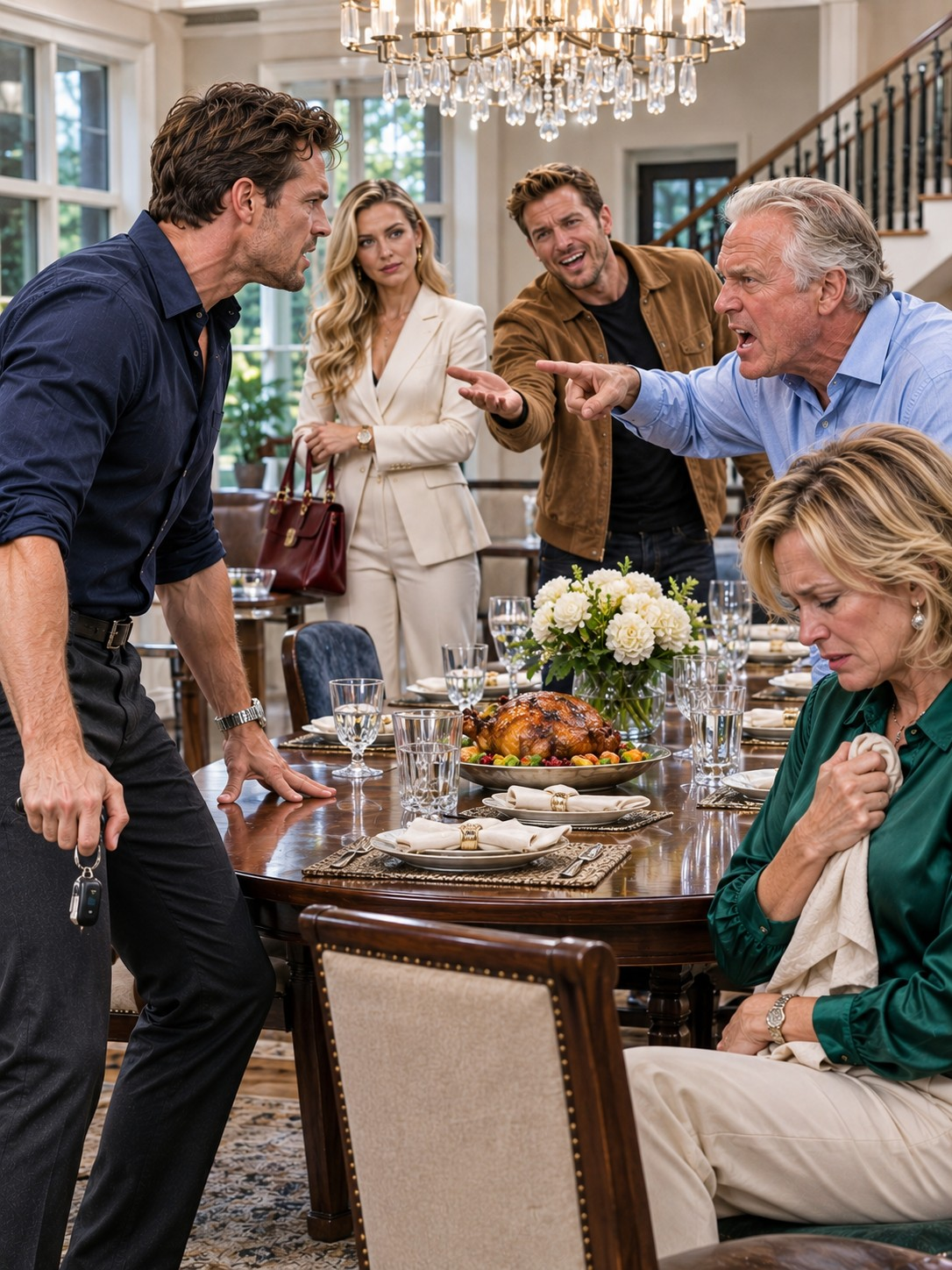
A year after Victoria's arrest, my family gathered at my house for Thanksgiving.
Mom cooked.
Dad helped.
Cameron brought dessert.
Naomi joined us.
We ate around a table I'd purchased myself.
There were no arguments about money.
No accusations.
No one demanding control.
Dad raised his glass.
"I'd like to say something."
Everyone looked at him.
He turned toward me.
"Last year, I told my son to leave the house he'd spent years helping us keep."
The room went quiet.
He swallowed.
"I was wrong."
I felt my throat tighten.
Dad continued.
"I thought being a father meant being in charge. But I learned that being a father means protecting your children, even when they're grown."
He looked at Cameron.
"Both of them."
Cameron lowered his eyes.
Dad turned back to me.
"Julian, you saved us more times than we deserved."
I swallowed.
"But the greatest thing you did was finally stop letting us take advantage of you."
Mom began crying.
Dad raised his glass higher.
"To Julian. And to the family we're learning to become."
Everyone raised their glasses.
I looked around the table.
My mother.
My father.
My brother.
Naomi.
People who had hurt me.
People who had helped me.
People who were finally learning how to love without demanding payment.
I smiled.
"To new beginnings."
We drank.
Then Cameron reached for another slice of pie.
Dad laughed.
Mom told him to save some for everyone else.
And the room filled with ordinary family noise.
The kind I'd missed.
The kind I'd once thought money could buy.
Later that night, after everyone had gone home, I stepped onto my back porch.
The air was cold.
The stars were bright.
Inside, the lights glowed warmly through the windows.
My windows.
My home.
My future.
I thought about the night Dad had thrown me out.
I remembered carrying my mattress down the stairs.
Cameron laughing.
Victoria smiling.
Mom looking away.
I'd felt like I was losing everything.
But I hadn't been losing everything.
I'd been leaving behind a life built around everyone else's needs.
The old house was gone.
The money had been fought over and finally accounted for.
The lies had been exposed.
The people responsible had faced consequences.
And my family had begun repairing what could be repaired.
Not because I'd rescued them again.
Because they had finally taken responsibility for themselves.
I looked at the wooden box visible through my living room window.
Grandma's ring was inside.
Her letter was safely stored with the other documents.
I smiled.
She'd called me her steady boy.
For years, I thought that meant I had to hold everyone else together.
Now I understood.
Being steady didn't mean standing still while people took everything from you.
It meant knowing what mattered.
Knowing when to help.
Knowing when to walk away.
And knowing you deserved a life of your own.
I went back inside.
Closed the door.
Turned the lock.
Then looked around my beautiful, quiet home.
For the first time in thirty-four years, I wasn't waiting for my father to tell me whether I belonged.
I already knew.
I had lost the house I spent five years saving.
But I had gained something no one could ever take from me again.
My freedom.
My dignity.
And a future that was finally mine.






Comments 0