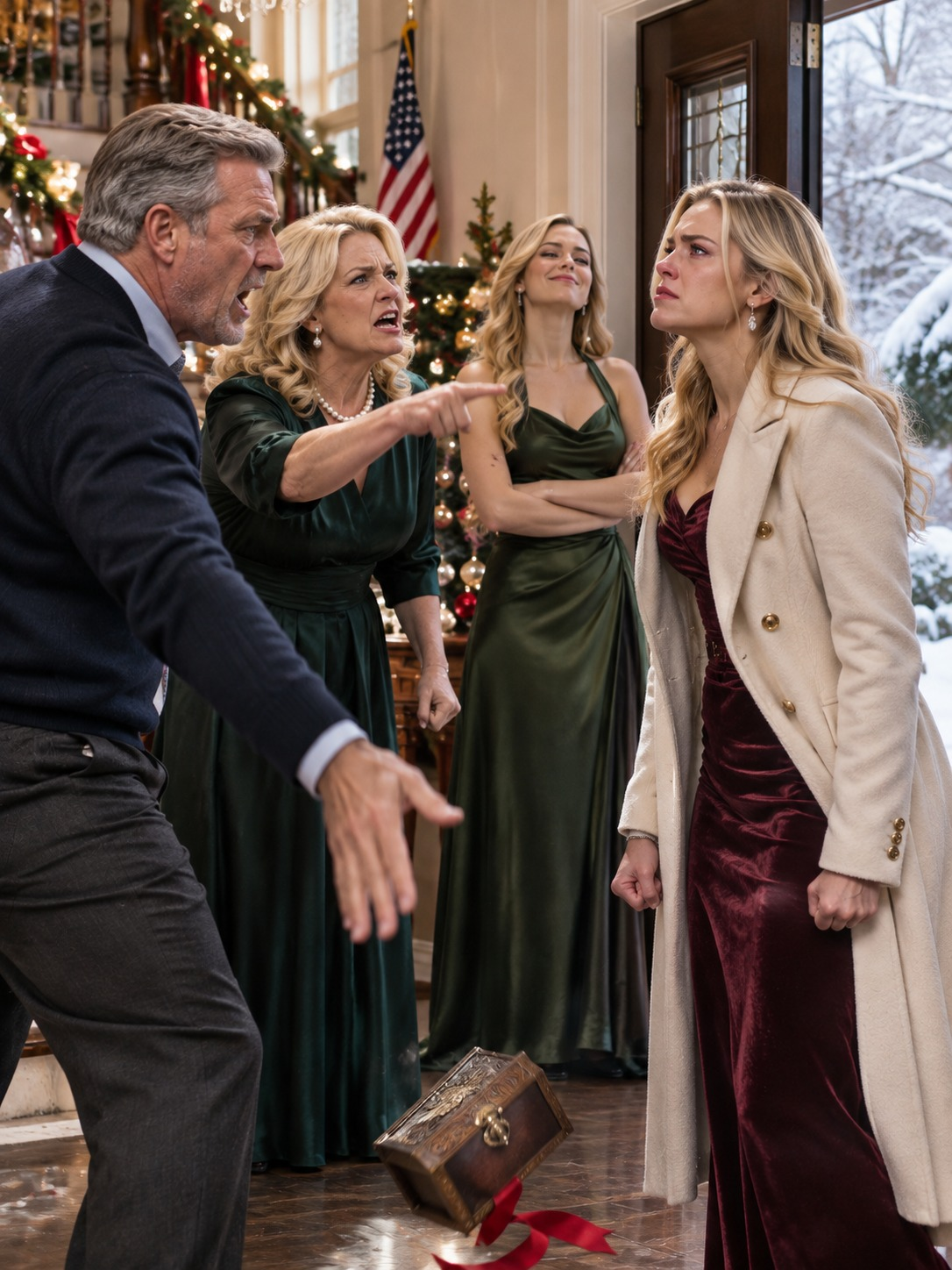
"Don't let him take that envelope!" I shouted.
Mrs. Callaway looked at me across her desk.
The thick cream-colored envelope sat between us, my grandfather's handwriting covering the front.
Outside the locked office door, my mother had arrived with a man claiming to possess legal authority over Grandpa's estate.
And he was carrying a document with my signature.
A signature I had never given him.
For several seconds, neither Mrs. Callaway nor I moved.
Then she reached across the desk, picked up Grandpa's envelope, and placed it inside a locked drawer.
"Matilda," she said quietly, "I need you to listen very carefully."
My heart was pounding.
"Who is that man?"
"I don't know yet."
"But he has my signature."
"That's what Emily reported."
"I never signed anything for my mother."
Mrs. Callaway's expression remained calm.
"Then we need to establish exactly what he's carrying before anyone makes assumptions."
She stood and walked toward the door.
I rose immediately.
"You're not going to let them in, are you?"
"No."
She turned toward me.
"You're an adult. Your mother has no automatic right to participate in your private banking matters. And no document presented at the front counter changes that without proper review."
I swallowed.
"Okay."
"Please stay here."
She unlocked the door.
Before leaving, she looked back.
"And Matilda?"
"Yes?"
"Do not sign anything your mother gives you today."
Then she stepped into the hallway.
The door closed behind her.
I stood alone in the office.
For the first time since Christmas morning, I felt something more powerful than grief.
Fear.
Not the ordinary fear of getting into trouble.
Not the familiar anxiety of disappointing my mother.
This was different.
Someone had brought my signature to a bank.
Someone was trying to interfere with instructions my grandfather had left specifically for me.
And my mother had arrived at exactly the moment I was about to receive his final documents.
That didn't feel like a coincidence.
I sat down and tried to breathe.
Through the office door, I could hear muffled voices.
A man's voice.
My mother's voice.
Mrs. Callaway's voice.
I couldn't make out the words.
I looked toward the locked drawer.
Grandpa's envelope was inside.
Three years earlier, he'd brought me to this same bank and asked me to sign a cream-colored card.
I'd trusted him.
I still did.
But now someone else apparently had a document bearing my name.
I thought about my mother's kitchen drawer.
She kept copies of everything.
Birth certificates.
School records.
Insurance forms.
Old tax returns.
When I applied for my first apartment after college, she'd insisted on keeping copies of my paperwork.
"You never know when you'll need something," she'd said.
I'd never questioned it.
Now I wondered how many documents with my signature were sitting in that house.
My phone vibrated.
Paige.
How's it going?
I stared at the screen.
Then typed:
Mom showed up at the bank with a man claiming he has legal papers signed by me.
Her response came almost instantly.
WHAT?
I typed:
Mrs. Callaway is handling it. I'm in her office.
Paige called.
I answered quietly.
"Mattie?"
"I'm okay."
"Are you sure?"
"No."
"What kind of papers?"
"I don't know yet."
"Do you want me to come?"
I hesitated.
My instinct was to say no.
I'd spent years convincing myself that needing help meant being a burden.
Then I remembered Christmas morning.
My parents had thrown me out.
Paige had opened her door.
Maybe I didn't have to do everything alone.
"Yes," I whispered.
"I'm on my way."
The call ended.
I placed my phone on the desk.
Then I heard my mother's voice rise in the hallway.
"That is my daughter!"
Mrs. Callaway answered.
"Mrs. Brian, please lower your voice."
"I have every right to know what she's doing!"
"No, ma'am. You do not."
A strange warmth moved through my chest.
Someone had finally told my mother no.
And the world hadn't ended.
Ten minutes later, Mrs. Callaway returned.
She closed the door but didn't lock it this time.
Her face was serious.
"Your mother has left the lobby."
I stared at her.
"Already?"
"Yes."
"What about the man?"
"He left with her."
"Who was he?"
She sat down.
"He introduced himself as Martin Hensley."
The name meant nothing to me.
"Is he an attorney?"
"He says he is."
"Do you believe him?"
"His professional status can be verified. But being an attorney doesn't automatically give him authority over your affairs."
I nodded slowly.
"What did he show you?"
Mrs. Callaway folded her hands.
"A document titled 'Acknowledgment and Waiver of Beneficiary Interest.'"
The words meant almost nothing to me.
"What does that mean?"
"In general, a document with that title may be intended to show that someone has acknowledged information about an estate or agreed to give up a particular interest. But the actual language matters."
I felt sick.
"Give up what?"
"That's something we would need to determine from the document itself."
I leaned forward.
"Did it have my signature?"
"Yes."
I stopped breathing.
She continued.
"Mr. Hensley displayed a photocopy. I did not accept it as proof of anything."
"Why not?"
"Because I couldn't verify the circumstances under which it was signed."
I stared at her.
"I never signed a waiver."
"Then that's important."
"Can I see it?"
"He declined to leave a copy."
My stomach dropped.
"Of course he did."
Mrs. Callaway watched me carefully.
"Matilda, do you remember signing any estate-related documents after your grandfather died?"
I thought back.
The funeral had been a blur.
Grandpa died on January nineteenth.
My mother called me at 6:12 that morning.
She didn't say hello.
She simply told me he was gone.
I'd driven to Pine Hollow in my pajamas.
By the time I arrived, his room had been cleared of personal belongings.
Mom said the staff had already packed everything.
I never saw his wallet.
His watch.
His glasses.
Not even the little pocket notebook he carried everywhere.
Two days later, Mom asked me to sign a form at the kitchen table.
I remembered that.
Suddenly, very clearly.
"There was something," I said.
Mrs. Callaway leaned forward.
"Tell me."
"Mom gave me paperwork after the funeral."
"What kind?"
"She said it was for the funeral home."
"Did you read it?"
I looked down.
"No."
"Do you remember how many pages?"
"Maybe three. Maybe four."
"What did your mother say it was for?"
"She said the funeral director needed confirmation that I was a family member."
Mrs. Callaway's expression changed slightly.
"Did you receive a copy?"
"No."
"Did anyone witness your signature?"
"My father was there."
"Anyone else?"
I shook my head.
She made a note.
I felt heat rising into my face.
"I know how stupid that sounds."
"Matilda."
Her voice was firm.
"Trusting your mother doesn't make you stupid."
I looked away.
For years, I'd signed whatever my parents put in front of me.
School forms.
Insurance paperwork.
Household agreements.
I'd never imagined my signature might be used against me.
Now I was beginning to understand why Grandpa had insisted I come to the bank in person.
Mrs. Callaway placed her pen down.
"Do you remember the date?"
"January twenty-third. I think."
She nodded.
"That's helpful."
I stared at her.
"Could that be the document?"
"Possibly. But we need evidence before reaching a conclusion."
I swallowed.
"What happens now?"
"First, you should preserve everything you have. Messages, photographs, the check, the card, and any paperwork connected to your grandfather."
I nodded.
"Second, you should consider consulting an independent attorney who has no connection to your parents."
"That sounds expensive."
"Some attorneys offer initial consultations. I can give you the name of someone outside this matter, but you would need to decide whom to retain."
I thought about the seventy-eight dollars I'd had in my account on Christmas morning.
The seven hundred dollars in rent I'd paid.
The four boxes in Paige's living room.
My parents had made sure I left with almost nothing.
Now I might need legal help just to understand what they'd done.
Mrs. Callaway seemed to read my expression.
"One thing at a time, Matilda."
I nodded.
Then I asked the question that had been burning inside me.
"Why did my mother come here?"
Mrs. Callaway was quiet.
"She wanted to know whether you had received any documents."
"From Grandpa?"
"Yes."
"And?"
"She also asked whether we would honor the waiver Mr. Hensley presented."
My hands curled into fists.
"Honor it how?"
"By treating it as evidence that you had relinquished certain rights."
I stared at her.
"But I don't even know what rights she's talking about."
Mrs. Callaway nodded.
"That's exactly why we won't rely on an unverified photocopy."
I looked toward the drawer.
"Is this about Grandpa's house?"
"His house may be part of the larger picture."
My heart jumped.
"Mom sold it."
"I understand."
"For two hundred thirty-six thousand dollars."
Mrs. Callaway didn't react.
"That may be relevant, but the sale records and estate documents would need to be examined."
I leaned forward.
"Did Grandpa leave me money?"
She hesitated.
"Your grandfather left instructions and records. I don't want to promise you an outcome before you've reviewed them."
It wasn't the answer I'd hoped for.
But it was honest.
And honesty had become something I valued more than reassurance.
At 10:42, Paige arrived.
Mrs. Callaway asked whether I wanted her to join us.
I said yes.
When Paige entered the office, she looked at me first.
Then at Mrs. Callaway.
Then at the closed drawer.
"Is everybody okay?"
I almost smiled.
"Mostly."
Paige sat beside me.
Mrs. Callaway briefly explained the situation without disclosing anything beyond what I authorized.
Paige listened carefully.
When she heard about the alleged waiver, her expression hardened.
"Matilda signed something after the funeral," she said.
I turned toward her.
"You remember?"
"Yes."
"How?"
"Because you called me afterward."
I stared at her.
Paige leaned forward.
"You were upset. You said your mother had made you sign paperwork before she'd let you take one of your grandfather's sweaters."
The memory hit me.
Grandpa's blue cardigan.
The one he wore on Sunday mornings.
I'd asked Mom if I could have it.
She told me I could take it after I finished the funeral paperwork.
I remembered sitting at the kitchen table.
Dad standing behind me.
Mom tapping her fingernails against the counter.
"Just sign it, Matilda. We have enough to deal with."
I'd signed.
Then Mom handed me the cardigan.
I still had it.
It was in one of the boxes upstairs at my parents' house.
My stomach turned.
"She made me sign before she'd give me his sweater."
Paige's face softened.
"Oh, Mattie."
Mrs. Callaway wrote something down.
"That detail may matter. Tell it to your attorney exactly as you remember it."
I nodded.
For the first time, I understood that the little humiliations I'd spent years dismissing might have been part of something much larger.
Mrs. Callaway opened the locked drawer again.
She removed Grandpa's thick envelope and placed it on the desk.
My pulse quickened.
"Can we open it now?"
"Almost."
She retrieved a printed acknowledgment form.
"This confirms only that you received the documents. It does not waive any rights or approve any transactions."
She turned the page toward me.
"Please read it before signing."
I did.
Every line.
Twice.
Then I signed.
Mrs. Callaway gave me a copy.
It was such a small thing.
But I nearly cried again.
Someone had actually encouraged me to read what I was signing.
She placed Grandpa's envelope in front of me.
"Your grandfather wanted you to open this yourself."
I stared at the handwriting.
For Matilda Brian. Personal delivery only.
My fingers trembled as I broke the seal.
Inside were several items.
A folded letter.
A small brass key.
A sealed packet labeled Property Records.
And a photograph.
I picked up the photograph first.
It showed Grandpa standing beside his fishing cabin at Norris Lake.
He was smiling.
One hand rested on the wooden porch railing.
The other held a fishing rod.
I recognized the picture immediately.
I'd taken it during the summer of 2021.
But there was something different.
Someone had written on the back.
I turned it over.
Grandpa's handwriting.
The truth is not in the house they sold.
I stared at the sentence.
Paige leaned closer.
"What does that mean?"
I shook my head.
"I don't know."
Mrs. Callaway remained silent.
I picked up the brass key.
It was small and old-fashioned.
A piece of masking tape was wrapped around the head.
On it, Grandpa had written:
Cabin. Lower drawer.
My breath caught.
The fishing cabin.
Grandpa's favorite place in the world.
The place where he'd taught me to bait a hook.
The place where he'd told me I was stronger than I knew.
I looked at Mrs. Callaway.
"Does my mother own the cabin?"
She hesitated.
"That question is addressed in the property records."
I reached for the sealed packet.
Then stopped.
There was something else inside the envelope.
A second, smaller envelope.
It was addressed in Grandpa's handwriting.
Open only after reading my letter.
I placed it aside.
Then unfolded the letter.
The first line made my chest tighten.
My dear Mattie,
If you're reading this, then I'm no longer there to explain things myself.
I covered my mouth.
Paige reached for my hand.
I kept reading.
I wish I could have told you everything while we were sitting on the dock, with our fishing lines in the water and that terrible instant coffee you always complained about.
Despite everything, I laughed through my tears.
Grandpa loved terrible instant coffee.
He said expensive coffee was a waste of perfectly good fishing money.
I wiped my face and continued.
There are things I should have handled differently. I trusted people because I wanted to believe they would do the right thing. I was wrong about some of them.
My heartbeat quickened.
You have always been the one who showed up without asking what you would get in return. I know that because I watched you do it, year after year.
I swallowed hard.
I also know that kindness can be used against a person. Especially when that person has spent her life trying to earn love from people who should have given it freely.
Tears slipped onto the paper.
I carefully moved the letter away from them.
What I am leaving you is not a reward for being obedient. It is not payment for the time you spent with me. It is simply something I want you to have because you are my granddaughter, and I love you.
I stopped reading.
For a moment, I couldn't see.
Paige squeezed my hand.
"Take your time."
I nodded.
Then I looked at the next paragraph.
There are records in this envelope that may be difficult to understand. Mrs. Callaway can explain what the bank holds. For anything involving the estate, find your own attorney. Do not let Margaret choose one for you.
My stomach tightened.
And whatever anyone tells you, do not believe that I stopped asking for you.
I pressed my hand against my mouth.
He knew.
Grandpa knew what Mom had been telling me.
He knew I'd been kept away.
I read the final paragraph.
There is one thing I could not safely put into this letter. I left it where only you would think to look. Remember what I told you about the summer we caught nothing but bluegill.
I stared at the words.
Bluegill.
The summer I turned eighteen.
Grandpa and I had spent three days at the cabin.
We caught almost nothing.
On the final afternoon, he'd shown me how to repair a loose board beneath the kitchen window.
"Always check what's underneath, Mattie," he'd said. "That's where people forget to look."
I remembered laughing.
"Under the floor?"
"Under everything."
I looked at the brass key.
The cabin.
The lower drawer.
The old floorboard.
Grandpa had left me a trail.
And he'd trusted me to follow it.
Mrs. Callaway gave me a few minutes to collect myself.
Then she opened the property packet.
Inside were copies of deeds, account summaries, and correspondence.
Some documents were older than I was.
Others were dated during Grandpa's final year.
I didn't understand most of them.
But one thing caught my eye.
The fishing cabin had a different legal description from Grandpa's house.
It was listed on a separate parcel.
I looked at Mrs. Callaway.
"Mom told me the cabin was included when she sold Grandpa's house."
Mrs. Callaway studied the document.
"The records suggest the properties were separately titled."
I stared at her.
"Then who owns the cabin?"
She turned another page.
"I would want a current title search before answering definitively."
Paige leaned forward.
"But it wasn't automatically part of the house sale?"
"Not simply because the house was sold."
I thought about Mom's words after Grandpa died.
Everything had to go, Matilda. There was nothing worth keeping.
She'd told me the cabin had been sold to cover medical bills.
She'd said the new owners didn't want visitors.
I'd believed her.
Now I wondered whether she'd ever had the right to sell it.
Mrs. Callaway reached for another document.
Then stopped.
Her eyes narrowed.
She looked at the page again.
"That's unusual."
I leaned forward.
"What?"
She examined the date.
Then checked a second page.
"These documents refer to a transaction your grandfather questioned shortly before his death."
My heart began pounding.
"What transaction?"
"I don't want to speculate before the records are reviewed."
She placed the papers together.
"But I do think you should speak with an attorney before contacting your family again."
Paige looked at me.
I looked back at the letter.
Grandpa had warned me not to let Mom choose my attorney.
Now I understood why.
At least partly.
By noon, I had copies of the documents Mrs. Callaway was authorized to release.
She gave me the name of an independent estate attorney.
I placed everything inside my folder.
The letter.
The key.
The photograph.
The property records.
The second sealed envelope.
I still hadn't opened that one.
Grandpa's instructions were clear.
Read the letter first.
Now I had.
But something about the smaller envelope made me hesitate.
Perhaps I was afraid of what it contained.
Perhaps I needed a few minutes before discovering another reason my mother had lied to me.
Mrs. Callaway walked us toward the office door.
Before opening it, she stopped.
"Matilda, there's one more thing."
I looked up.
"Yes?"
"Your mother came to this bank before Friday."
I stared at her.
"When?"
"Last February. A few weeks after your grandfather died."
My stomach dropped.
"What did she want?"
Mrs. Callaway's expression became serious.
"She asked whether the bank would release the documents your grandfather had reserved for you."
I felt cold.
"What did you tell her?"
"That we would follow his instructions."
"And she accepted that?"
Mrs. Callaway shook her head.
"No."
Paige stepped closer.
"What happened?"
"She returned with Mr. Hensley and claimed that you had signed away your interest in certain matters connected to the estate."
I stared at her.
"Last February?"
"Yes."
"But I didn't even know these documents existed."
"I understand."
My hands began shaking again.
"Then why did she need my signature?"
Mrs. Callaway looked at the folder in my arms.
"That's a question your attorney should investigate."
I nodded slowly.
Then I remembered something.
The paper I'd signed at the kitchen table after Grandpa's funeral.
The blue cardigan.
Mom telling me I couldn't have it until I signed.
My chest tightened.
I reached into my folder and pulled out the copy of the signature card Grandpa had arranged three years earlier.
I looked at my handwriting.
Then at the date.
October 2022.
Something about it bothered me.
I couldn't explain why.
Not yet.
But I remembered signing that card.
And I remembered signing the funeral paperwork.
Two different days.
Two different reasons.
Two signatures my mother might have been able to access.
I looked at Mrs. Callaway.
"Can I ask one last question?"
"Of course."
"Did you actually see the signature on the waiver?"
"Yes."
"Did it look like mine?"
She hesitated.
Then said, "At first glance."
I swallowed.
"At first glance?"
Mrs. Callaway reached for her glasses.
"There was something about the date that concerned me."
"What date?"
She looked toward the hallway.
Then back at me.
"The document was supposedly signed on January twenty-third, 2025."
I nodded.
"That's when Mom gave me the funeral paperwork."
Mrs. Callaway's expression tightened.
"But the acknowledgment on the copy Mr. Hensley showed me referred to a document that your grandfather didn't execute until later."
I stared at her.
"Later than January twenty-third?"
She nodded.
My heart began pounding.
"How much later?"
Mrs. Callaway reached for a folder.
Before she could answer, someone knocked on the office door.
Not Emily.
Not my mother.
A man's voice spoke from the hallway.
"Mrs. Callaway? This is Daniel Whitmore. I represent the estate of Leonard Ashby."
Mrs. Callaway froze.
The man continued.
"I've just reviewed the original waiver Mr. Hensley filed."
My breath caught.
There was a pause.
Then he said:
"And I need to speak with Matilda Brian immediately. Because the signature on that document belongs to someone who was already dead when it was supposedly witnessed."






Comments 0