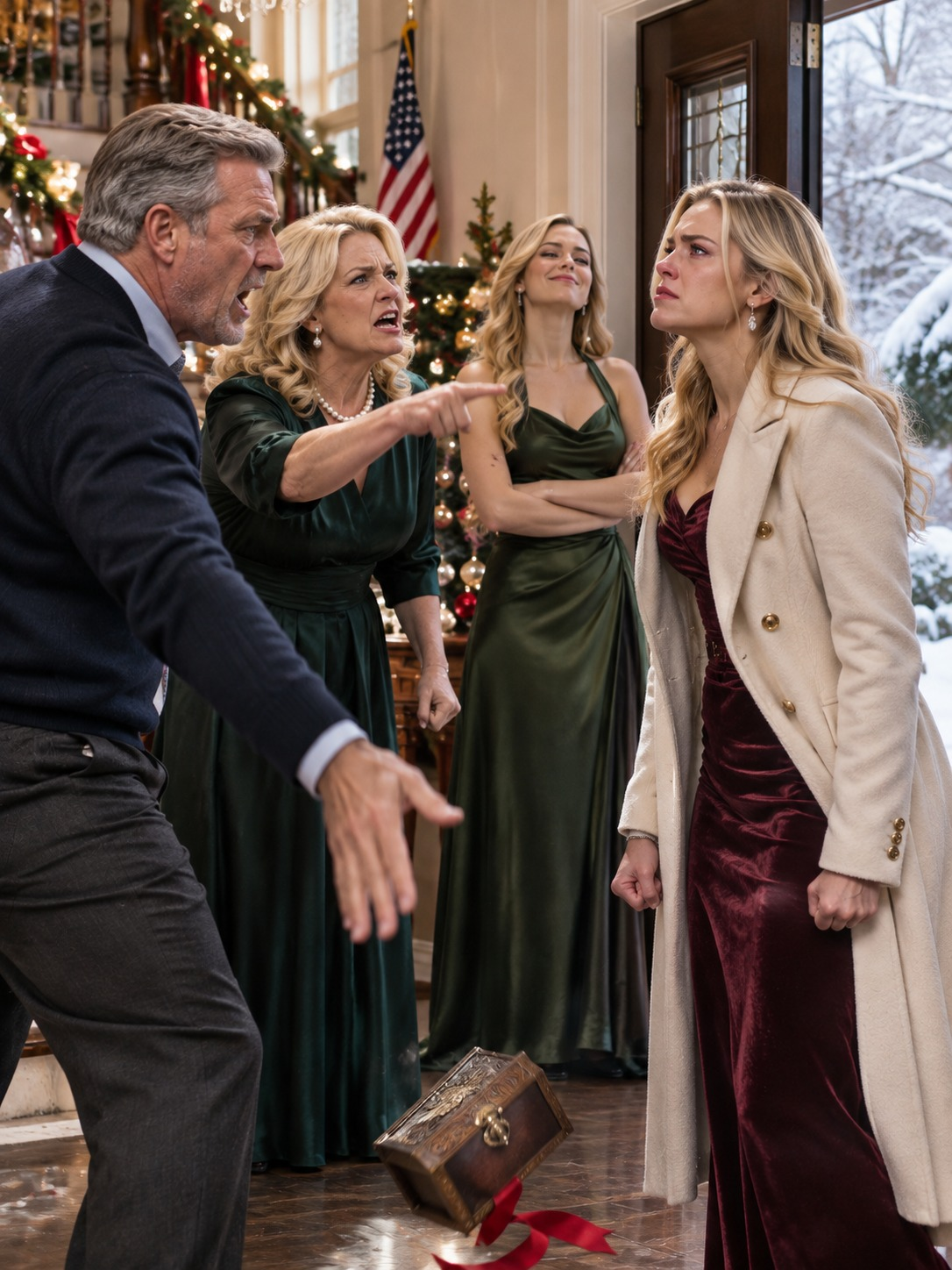
"Gary, if Matilda follows those instructions, she's going to find out about—"
My mother's voice stopped abruptly.
I stood at the bottom of the staircase, holding a cardboard box against my chest, waiting for her to finish.
Then I heard my father's chair scrape across the kitchen floor.
"Keep your voice down, Margaret."
I stopped breathing.
For thirty-two years, I'd known my father as a man who rarely raised his voice unless he was angry with me. He could sleep through my mother's shouting, ignore uncomfortable conversations, and pretend not to notice when Tiffany received special treatment.
But the voice coming from the kitchen wasn't indifferent.
It was frightened.
"She's still upstairs," Mom whispered.
"No, she's not."
My father's answer came immediately.
"Her car's in the driveway. She could be standing right outside that door."
I looked toward the kitchen entrance.
For one terrible second, I thought he was going to walk out and find me listening.
Then my mother spoke again.
"You shouldn't have given her the card."
"I didn't know what was inside."
"You knew Leonard never did anything without a reason."
A long silence followed.
I stared at the box in my arms.
My grandfather's photograph was inside, wrapped in an old sweatshirt. The corner of its wooden frame pressed against my wrist.
I wanted to walk into the kitchen.
I wanted to ask what they were hiding.
But something stopped me.
Maybe it was the way my mother had gone pale when she saw the envelope.
Maybe it was the sudden fear in my father's voice.
Or maybe, after spending my entire life trying to make those two people tell me the truth about anything, I'd finally learned that confronting them only gave them time to invent another lie.
I adjusted the box against my hip.
Then I walked toward the front door.
Quietly.
Without saying goodbye.
The first thing I did after leaving my parents' house was sit in my car and stare at the steering wheel.
My hands were shaking so badly I couldn't put the key into the ignition.
I had four cardboard boxes in the back seat, seventy-eight dollars in my checking account until payday, and no place to sleep that night.
Christmas morning.
Thirty-two years old.
Homeless.
I almost laughed at how ridiculous it sounded.
I wasn't technically homeless yet. I had a car. I had a job. I had friends.
But the house I'd called home for most of my life was suddenly a place I wasn't allowed to enter.
And the people who had raised me had watched me leave without asking where I would go.
My phone buzzed.
For one foolish second, I hoped it was Dad.
Maybe he'd come to his senses.
Maybe he'd tell me to come back.
Instead, it was a message from Tiffany.
Please don't make Mom feel guilty. She's already stressed enough with the baby coming.
I stared at the screen.
Then another message appeared.
Also, can you leave your bedroom key somewhere? Cody wants to start measuring the room this weekend.
I read both messages twice.
My sister had watched our mother tell me I wasn't a real daughter.
She'd watched our father throw Grandpa's final gift at my feet.
And her biggest concern was getting into my bedroom.
I typed three different replies.
Deleted all of them.
Finally, I wrote:
I'll arrange a time to collect the rest of my things. Please don't touch anything until then.
Tiffany responded almost immediately.
You don't have to be dramatic.
I turned off my phone.
Then I cried.
Not loudly.
Not the kind of crying where you collapse against the steering wheel.
Just tears slipping down my face while I sat in the driveway where I'd learned to ride a bicycle, where Grandpa had taught me to change a tire, and where I'd parked after hundreds of exhausting shifts.
I cried because I'd spent years believing that if I worked hard enough, contributed enough, and asked for little enough, my parents would eventually see me as someone worth loving.
I cried because they hadn't even waited until Christmas dinner to throw me out.
And I cried because the one person who would have opened his door without hesitation was buried in a cemetery with an unfinished headstone.
When the tears finally stopped, I wiped my face with a fast-food napkin from the glove compartment.
Then I called Paige.
She answered on the fourth ring.
"Merry Christmas, disaster girl."
Paige had called me that since veterinary school, when I'd accidentally spilled coffee over an entire semester's worth of handwritten notes.
I opened my mouth.
Nothing came out.
"Mattie?"
I tried again.
"Can I come over?"
Her voice changed immediately.
"Of course. What's wrong?"
"My parents kicked me out."
Silence.
Then she said, "Where are you?"
"In my car."
"Are you safe?"
"Yeah."
"Come here. Right now."
"I have boxes."
"I have a living room."
"I don't know how long I'll need—"
"Matilda."
I closed my eyes.
"What?"
"Drive to my apartment."
That was all.
No questions.
No conditions.
No speech about how families sometimes say things they don't mean.
Just an open door.
It was more kindness than I'd received all morning.
Paige lived in a second-floor apartment about fifteen minutes from the animal hospital.
By the time I arrived, she'd cleared a space beside her couch and put fresh sheets on the pullout bed.
She was standing in the parking lot wearing pajama pants, a Christmas sweatshirt, and fuzzy slippers.
When she saw my car, she hurried over.
I stepped out.
She took one look at my face.
"Oh, honey."
That nearly broke me again.
But instead of crying, I shook my head.
"Please don't ask yet."
She nodded.
"Okay."
Then she reached into the back seat and picked up a box.
"Let's get your stuff inside."
Paige had been my closest friend for almost nine years.
We met during our veterinary technician training, when she was working two jobs and I was commuting from home to save money.
She knew my parents.
Not well.
But well enough.
She'd watched my mother forget my birthday twice.
She'd listened when Tiffany borrowed money and never repaid it.
And she'd been there when Grandpa died.
She was the one who drove me home after the funeral because my parents had left early to meet with the estate attorney.
Inside her apartment, she put a mug of hot chocolate in front of me.
"Drink."
I obeyed.
She sat across from me.
"Now tell me."
So I did.
I told her about the missing stocking.
The headstone.
The argument.
The words my mother screamed.
The way my father laughed.
By the time I reached the envelope, Paige was sitting perfectly still.
"He threw your grandfather's last gift at you?"
I nodded.
"On Christmas?"
"Yep."
"Your father is unbelievable."
I looked down at the mug.
"Apparently Grandpa left me a dollar."
Paige blinked.
"A dollar?"
"One dollar."
"That's weird."
"That's what I thought."
"Was it a joke?"
"I don't know."
"Did you open it?"
I hesitated.
"No."
Paige stared at me.
"Matilda."
"What?"
"Your dead grandfather left you an envelope, your parents acted like lunatics, and you haven't opened it?"
"I was busy getting thrown out."
She leaned back.
"Fair point."
I reached into my coat pocket.
The envelope was still there.
Slightly bent now.
I held it between my fingers.
Grandpa's handwriting looked exactly as I remembered.
Careful.
Straight.
Every letter formed deliberately.
He'd been an accountant for most of his life, and even after retirement, he kept records of everything.
Gas receipts.
Fishing licenses.
Birthday cards.
He used to say that people forgot conversations, but paper remembered.
I turned the envelope over.
The flap was already open.
Dad must have looked inside before giving it to me.
I slid out the contents.
A Christmas card.
A red cardinal perched on a snow-covered branch.
Inside, Grandpa had written:
For my Mattie,
Never let anyone convince you that being kind makes you weak.
Love, Grandpa.
My throat tightened.
Paige said nothing.
I ran my thumb over his signature.
For a moment, I was back at his fishing cabin, sitting across from him at the kitchen table while he worked on a crossword puzzle.
He always used blue ink.
Always.
Even when every other pen in the house was black.
I turned the card over.
A check slipped out.
It landed on Paige's coffee table.
She picked it up carefully.
"Well," she said, "your dad wasn't lying about the amount."
The check was made payable to Matilda Brian.
Exactly $1.00.
Dated December 24, 2024.
I frowned.
"Wait."
Paige looked up.
"What?"
"That date."
She handed it back.
I stared at the numbers.
December twenty-fourth.
Grandpa had died on January nineteenth, 2025.
He'd written the check just twenty-six days before his death.
My stomach tightened.
"What's wrong?" Paige asked.
"Mom said Grandpa couldn't write anymore."
Paige leaned forward.
"What do you mean?"
"She said his hands were too weak. That he was confused. That he didn't recognize people."
I looked at the signature again.
Leonard Ashby.
Every letter steady.
Every line clear.
I'd seen Grandpa's handwriting thousands of times.
There was no mistaking it.
"He wrote this himself," I whispered.
Paige studied the check.
"Maybe he had a good day."
"Maybe."
But something felt wrong.
For the final five months of Grandpa's life, my mother had insisted he was deteriorating rapidly.
She told me he became agitated when people visited.
She claimed he cried whenever I mentioned the fishing cabin.
Then, in August, she'd arranged for my name to be removed from his approved visitor list at Pine Hollow Care Center.
I still remembered the receptionist's apologetic expression.
"I'm sorry, Miss Brian. Your name isn't on the authorized list."
"There must be a mistake."
"You'll have to speak with the family representative."
"My mother?"
"Yes, ma'am."
I'd called Mom from the parking lot.
She'd sounded irritated.
"Matilda, your grandfather doesn't need you upsetting him."
"I just want to see him."
"He barely remembers who you are."
I'd believed her.
For months.
Now I was holding a check written in the same precise handwriting Grandpa had used when he taught me long division at his kitchen table.
Paige pointed toward the bottom.
"What's that?"
I looked.
The memo line contained a message.
For Matilda. See Mrs. Callaway in person.
The last two words were underlined.
Twice.
I read them aloud.
Paige frowned.
"Who's Mrs. Callaway?"
"I don't know."
"Family friend?"
"Not that I remember."
"Attorney?"
"Maybe."
I studied the name of the bank printed in the upper corner.
Sharps Ridge Community Bank.
Something stirred in my memory.
A small brick building.
A parking lot with two maple trees.
Grandpa holding the door open for me.
I sat straighter.
"I've been there."
Paige looked at me.
"Where?"
"That bank."
"When?"
"Three years ago. Grandpa took me after lunch."
The memory came back in pieces.
We'd eaten at a diner near his cabin.
He ordered meatloaf.
I had grilled cheese.
Afterward, he drove us to Sharps Ridge Community Bank.
He told me he needed help with paperwork.
I remembered sitting at a desk while an older woman brought us coffee.
Grandpa had handed me a cream-colored card.
"Sign this for me, Mattie," he'd said. "In case I ever need you to fetch something."
I'd laughed.
"Like your fishing poles?"
"Something like that."
I signed.
Then he folded the card and handed it to the woman.
At the time, I hadn't thought anything of it.
Grandpa was always organizing things.
Now I couldn't stop thinking about it.
"Paige," I said slowly, "I signed something at that bank."
She set down her mug.
"What kind of something?"
"I don't know."
"You didn't read it?"
"No."
She stared at me.
I sighed.
"I trusted him."
Her expression softened.
"Of course you did."
I looked at the check again.
One dollar.
A bank I'd visited once.
A woman's name.
Two words underlined.
In person.
My father's laughter echoed in my memory.
One whole dollar.
But Grandpa wasn't careless with money.
He'd saved for decades.
He'd bought his fishing cabin with cash.
He'd taught me to balance a checkbook before I was old enough to drive.
He wouldn't have written a one-dollar check for no reason.
And he certainly wouldn't have underlined an instruction twice unless he wanted me to notice.
By late afternoon, Paige convinced me to sleep.
I lasted four hours.
When I woke, the apartment was quiet.
Christmas lights blinked in her living room.
My phone was charging beside the couch.
There were six unread messages.
Three from Tiffany.
Two from Mom.
One from an unfamiliar number.
I opened Tiffany's first.
Mom says you left without saying goodbye.
Then:
You really hurt her feelings.
And finally:
Can you please just apologize so we can move on?
I deleted the conversation without replying.
Mom's messages were worse.
You embarrassed this family today.
Don't expect us to keep storing your belongings indefinitely.
I stared at the second message.
Five years.
Eighty-four hundred dollars a year.
Forty-two thousand dollars in rent.
And now my belongings were an inconvenience.
I opened my banking app.
My latest rent payment had cleared three days earlier.
Seven hundred dollars.
I took a screenshot.
Then I opened the message from the unfamiliar number.
It was from Cody.
Hey, Matilda. Sorry about this morning. Things got out of hand.
I read it twice.
Then another message appeared.
For what it's worth, I didn't know they were making you leave today.
I considered responding.
Before I could, a third message arrived.
And I didn't know your grandfather's house sold for that much.
That caught my attention.
I sat up.
Cody had been at Thanksgiving when Mom announced Tiffany needed my bedroom.
He'd been there this morning when she threw me out.
He hadn't defended me.
But apparently, the amount from Grandpa's house had surprised him.
I typed:
What did you think happened to the house?
The typing indicator appeared.
Disappeared.
Appeared again.
Finally, he replied.
Margaret told us there wasn't much left after the medical bills.
I stared at the screen.
Grandpa had Medicare and supplemental insurance.
He'd also been meticulous about keeping emergency savings.
There could have been expenses I didn't know about.
But Mom had never mentioned financial trouble while he was alive.
And after his death, she'd sold his house quickly.
Very quickly.
I typed another question.
Did she tell you where the money went?
This time, Cody didn't answer.
I waited ten minutes.
Nothing.
Then my phone rang.
Mom.
I watched her name flash across the screen.
For a moment, I considered answering.
Maybe she wanted to apologize.
Maybe she'd realized what she'd done.
But I remembered her voice in the kitchen.
You shouldn't have given her that envelope.
I let the call go to voicemail.
A few seconds later, the notification appeared.
I pressed play.
"Matilda, this is your mother."
Her voice was clipped.
"I understand you've been discussing private family finances with Cody. That needs to stop."
I looked toward Paige's bedroom.
The apartment was silent.
Mom continued.
"And another thing. Whatever your grandfather left you was his decision. Don't start imagining there's something more to it."
My skin prickled.
She hadn't seen me open the envelope.
She didn't know I'd found the memo.
At least, she shouldn't have.
Her voice became sharper.
"That old card isn't worth embarrassing yourself over. I've already handled Daddy's affairs."
A pause.
Then:
"Don't make this harder than it needs to be."
The message ended.
Nineteen seconds.
No apology.
No Merry Christmas.
No concern about where I was sleeping.
Just a warning.
I replayed it.
Then again.
The third time, I noticed something.
Mom hadn't asked whether I'd opened the card.
She'd simply assumed I might follow whatever Grandpa had written.
I looked toward the coffee table.
The check lay beside the Christmas card.
See Mrs. Callaway in person.
I picked it up.
The paper felt ordinary.
Thin.
Slightly worn.
A dollar check that probably couldn't even be cashed anymore.
Yet my mother had called specifically to discourage me from doing anything with it.
I thought about Grandpa's final months.
The visitor restrictions.
The unanswered phone calls.
The cards I'd mailed that he supposedly never acknowledged.
The way Mom had rushed to sell his house.
And the unfinished date on his headstone.
For the first time, I allowed myself to consider a possibility I'd been too frightened to face.
What if Grandpa hadn't forgotten me?
What if he'd been trying to reach me?
I opened the Christmas card again.
His message was short.
Never let anyone convince you that being kind makes you weak.
I read it until the words blurred.
Then I carefully placed the card and check inside a clean folder.
Monday morning.
I would go to Sharps Ridge Community Bank.
I would ask for Mrs. Callaway.
And I would find out why my grandfather had left me instructions instead of an inheritance.
At 11:47 that night, just as I was turning off the lamp beside Paige's couch, my phone vibrated again.
A new voicemail.
This time, the caller had blocked their number.
I hesitated.
Then I pressed play.
For several seconds, there was only breathing.
Then an older woman's voice spoke.
"Matilda Brian?"
My entire body went still.
The woman sounded frightened.
"I don't know if this is still your number. I worked at Pine Hollow Care Center when your grandfather was there."
I sat upright.
She took a shaky breath.
"I've been trying to decide whether I should call you. Your grandfather asked me to give you something before he died."
A faint noise sounded in the background.
The woman stopped speaking.
Then she whispered:
"Someone's at my door."
I heard footsteps.
A lock turning.
And then a man's voice said her name.






Comments 0