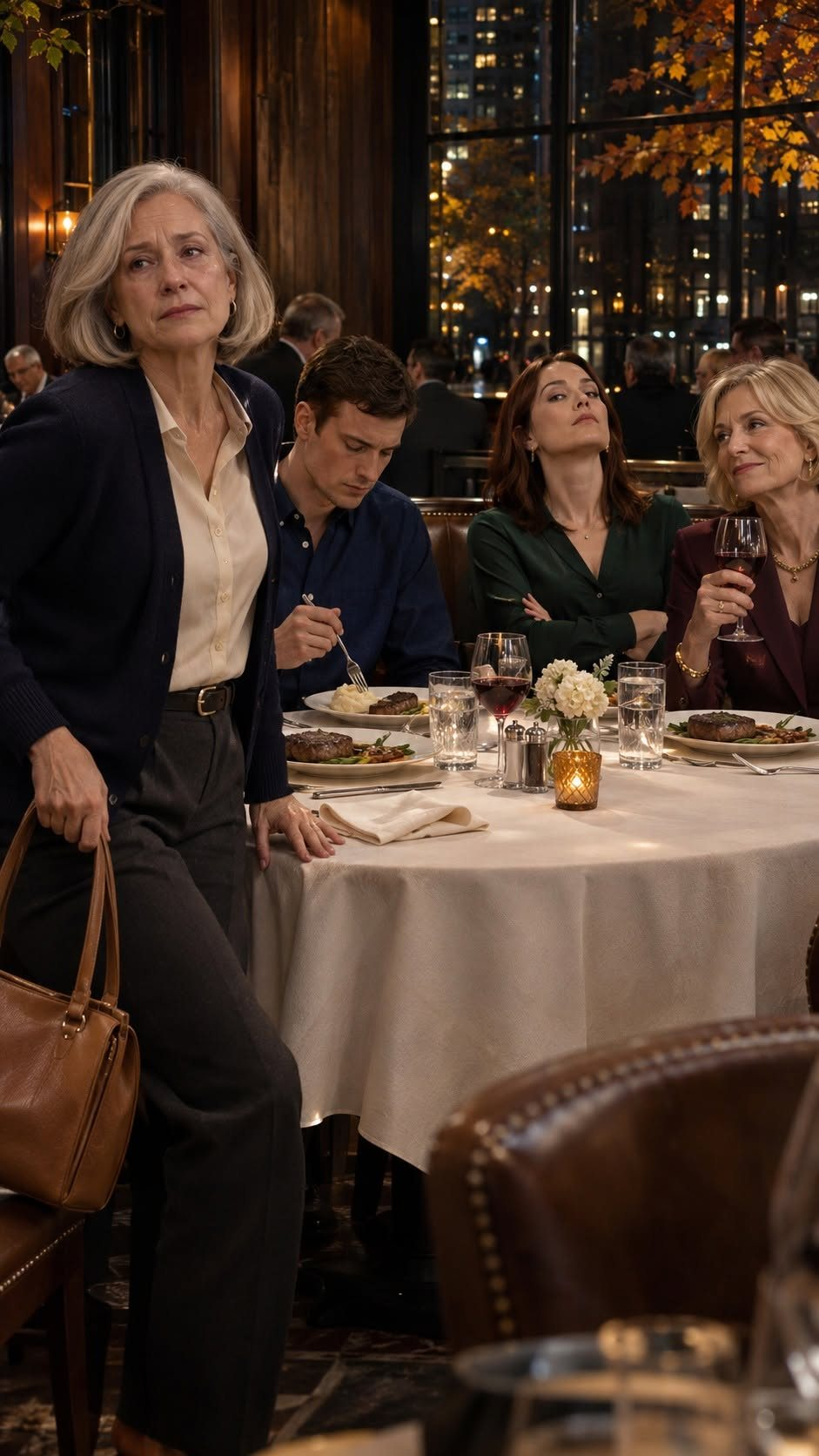
"On behalf of my mother, I confirm that she is no longer capable of managing her financial affairs."
I replayed the recording.
Then I replayed it again.
The voice was David's.
There was no mistaking it.
He spoke clearly, confidently, and without hesitation.
I sat at my desk, staring at the laptop screen.
A few minutes earlier, I had been reading my husband's letter, the one that confirmed the four hundred thousand dollars had been intended for my financial security.
Now I was listening to my own son describe me as incapable of managing my life.
I pressed the space bar.
The recording stopped.
I couldn't understand it.
David had been at my house the previous evening. He had apologized. He had held my hand and promised to make things right.
He had told me he wanted to protect me.
Yet someone had submitted a declaration bearing his name, claiming I could no longer make financial decisions.
I picked up my phone and called Michael.
"Georgia?"
"Michael, I've listened to the recording."
"I know. I received confirmation that the attachment opened successfully."
"That's David's voice."
"Yes."
"Why would he say that?"
Michael remained quiet.
"I don't know whether the recording is complete, whether it was made in the context described, or whether the declaration was submitted with his informed authorization. We need to establish those facts."
I looked at the screen.
"But it sounds like him."
"I understand."
"Can someone use a recording like that to take control of my money?"
"An audio statement alone does not establish legal incapacity. Any legitimate assessment would require appropriate evidence and legal procedures. We are challenging the submission."
I closed my eyes.
"Michael, I want to speak to my son."
"I understand. But I'd prefer that you preserve everything and avoid discussing the evidence until we've secured the relevant records."
I took a deep breath.
"All right."
After ending the call, I sat quietly.
I had defended David when Sarah and Brenda criticized him.
I had paid his bills.
I had helped him through difficult years.
I had never expected him to become wealthy.
I had never expected him to repay every kindness.
All I had wanted was honesty.
Now I was beginning to wonder whether my son had been involved in something far more serious than I had imagined.
At 8:35 the following morning, I received a message from David.
Mom, can we talk today? It's important.
I stared at the screen.
I didn't respond immediately.
A second message arrived.
Please don't believe everything Brenda tells you.
I read it twice.
Then I typed:
Come to my house at 10:00.
He replied:
I'll be there.
I printed the disputed declaration and placed it on the kitchen table.
Beside it, I placed the seventh page of my husband's agreement.
One document said I was incapable.
The other said my husband had established an account to protect my independence.
I wanted David to see both.
At 9:58, his car pulled into the driveway.
He knocked twice.
I opened the door.
"Good morning, Mom."
"Come in."
He entered and looked toward the kitchen.
When he saw the papers, he stopped.
"What are those?"
"Sit down."
He pulled out a chair.
I remained standing.
"David, I listened to the recording."
His face changed.
"What recording?"
I placed the declaration in front of him.
He looked at the heading.
Then he read the first paragraph.
His expression became confused.
"Where did you get this?"
"From the financial institution."
He continued reading.
Then he reached the signature section.
His face went pale.
"Mom, I didn't sign this."
I looked directly at him.
"That's your name."
"I know."
"That's your voice."
He stared at me.
"What?"
I opened the laptop.
I played the recording.
David listened without moving.
When it ended, he looked genuinely horrified.
"Mom, I never said that."
I felt my chest tighten.
"Then whose voice is it?"
He shook his head.
"It's mine, but that's not the complete conversation."
I sat down.
"What do you mean?"
He took a deep breath.
"About three weeks ago, Brenda asked me to record a statement."
"Why?"
"She said the bank needed confirmation that you were the beneficiary of Dad's account and that I understood the family arrangement."
I stared at him.
"That's not what the recording says."
"I know."
"What did you actually say?"
He rubbed his forehead.
"I said you were independent, that you managed your own affairs, and that Dad had wanted the money to protect you."
I looked at the screen.
"Then how did this version appear?"
David shook his head.
"I don't know."
I studied his face.
"Did you give Brenda permission to edit your recording?"
He looked down.
"No."
"Did you know she was submitting a medical assessment?"
"No."
"Did you sign the declaration?"
He shook his head firmly.
"No, Mom."
I remained silent.
He leaned forward.
"Please believe me."
I looked at him.
"I want to."
His eyes filled.
"Then let me explain."
David told me that Brenda had contacted him about three weeks earlier.
She had said that the bank was requesting additional information concerning the old family account.
According to her, the institution needed confirmation that the family understood the original agreement.
She told him that I was the intended beneficiary, but that I had become increasingly difficult to contact.
David said that sounded strange.
I was living in the same house.
He spoke to me regularly.
But Brenda explained that she needed a statement confirming the family understood the account's purpose.
She asked him to record a short video.
"Why didn't you tell me?"
David lowered his eyes.
"Because she said it was routine paperwork."
I looked at him.
"David, you knew there was a legal dispute."
"Not at the time."
"When did you record it?"
"Three weeks ago."
"And when did you discover what she had done?"
"Yesterday."
I frowned.
"Yesterday?"
He nodded.
"Sarah found the declaration in Brenda's email."
"What did Sarah tell you?"
"She said Brenda had submitted a different version of my statement."
I sat back.
"Did Sarah know about the medical assessment?"
David hesitated.
"I think so."
"Why?"
"Because she told me Brenda had asked her to sign something confirming that you needed assistance with financial decisions."
I felt cold.
"Did Sarah sign it?"
"I don't know."
I looked at him.
"Did you ask?"
"Yes."
"And?"
He swallowed.
"She said she had signed a document, but Brenda told her it was only to confirm that you were the account beneficiary."
I stared at the table.
It was becoming a pattern.
Brenda presented documents as harmless administrative formalities.
People signed or recorded things without understanding their actual purpose.
Then the documents appeared in financial applications with entirely different meanings.
"David, why didn't you ask your attorney to review the paperwork?"
He looked ashamed.
"Because I thought Brenda was helping us."
I shook my head.
"That is exactly what you said before."
"I know."
He lowered his head.
"I know, Mom."
I turned the laptop toward him.
"Listen to the beginning again."
He pressed Play.
The recording began.
"On behalf of my mother, I confirm that she is no longer capable of managing her financial affairs..."
David stopped it immediately.
"That's not how I started."
I looked at him.
"Then how did you start?"
He thought for a moment.
"I said, 'My mother is fully capable of managing her own financial affairs, and I understand that my father intended the account to remain under her control.'"
I stared at him.
The difference was enormous.
"Can you prove that?"
He nodded.
"I have the original video."
I sat upright.
"Where?"
"On my phone."
"Do you still have the original file?"
"Yes."
He opened his phone.
After several seconds, he found the recording.
He placed it on the table.
The video showed David sitting in a room I recognized.
It was Brenda's house.
He looked directly at the camera.
Then his voice came through.
"My mother, Georgia Owens, is fully capable of managing her own financial affairs. My father established the family account to protect her financial independence. I understand that she is the intended beneficiary, and I do not claim ownership of those funds."
I felt tears rise in my eyes.
The original recording continued.
David explained that he had not authorized anyone to use my house as security.
He also stated that he had never agreed to replace my name as beneficiary.
When the recording ended, I looked at him.
"Why did you keep this?"
"Because I never trusted Brenda with the only copy."
I was silent.
He looked at me.
"I thought she might try to change the wording."
I felt a strange mixture of relief and sadness.
My son had been careless.
He had been weak when I needed him to stand beside me.
But perhaps he had finally begun to recognize what Brenda was doing.
"Send that to Michael," I said.
David nodded.
He forwarded the original file.
Then he looked at me.
"Mom, there's something else."
I waited.
"Brenda told Sarah that she was going to use the medical assessment to get temporary control of the account."
My stomach tightened.
"How?"
"She said if the bank believed you were unable to manage your affairs, it would be easier for Brenda to act as your representative."
I stared at him.
"Did she actually have authority to do that?"
"No. But she said the bank would accept the supporting documents while the review was pending."
I immediately called Michael.
Michael arrived at my house less than an hour later.
He reviewed the original video, the altered recording, and the disputed medical assessment.
He placed everything into separate folders.
"This is important evidence," he said.
David sat across from him.
"Can I ask something?"
"Of course."
"If I gave Brenda the original recording, does that mean I am responsible for what she submitted?"
Michael considered his answer.
"Not automatically. We need to determine what you authorized, what you understood, and whether you knew the material would be altered or used for a different purpose."
David nodded.
"I didn't know."
"Then preserve the original file and any messages about how it was requested."
Michael turned toward me.
"Georgia, the medical assessment also needs independent verification. Have you ever met the physician named on this document?"
"No."
"Have you visited the clinic listed?"
"No."
"Have you signed any medical release allowing someone to obtain your records?"
I thought carefully.
"No."
Michael wrote that down.
"Good. We will formally dispute the document and request the institution preserve all supporting materials."
I looked at the report.
It contained several claims about my supposed memory problems.
One paragraph said I had become confused about financial matters.
Another claimed I was increasingly dependent on family members.
I felt insulted.
I had managed every aspect of my life for ten years.
I had paid my taxes.
Maintained my property.
Handled my husband's estate.
Managed my savings.
And now someone had created a report suggesting I could no longer make basic decisions.
"Michael, can the doctor be contacted?"
"Yes. We'll verify the assessment through the appropriate channels."
He closed the folder.
"Until then, don't sign any authorization related to the account."
I nodded.
David looked down.
"Mom, I'm sorry."
I turned toward him.
"I know."
"No, I mean it. I should never have trusted Brenda with that recording."
"You should have asked questions."
"I know."
"And you should have told me."
He nodded.
I reached across the table.
"David, I don't want you to spend the rest of your life feeling guilty. I want you to become someone who understands the consequences of his decisions."
He looked at me.
"I will."
That afternoon, Michael contacted the financial institution.
The disputed declaration was formally challenged.
The bank acknowledged receipt and confirmed that the beneficiary-change request would remain under review.
No transfer had been completed.
No new loan had been approved.
The account would be subject to additional verification before any further instructions were accepted.
I read the confirmation email twice.
For the first time, I felt that something concrete was being done.
But there was still the question of where the money had gone.
And Brenda had not yet explained the transfers.
At 3:20, Sarah called.
I answered.
"Hello?"
"Georgia, can I come over?"
I looked at David.
He was sitting across from me.
"Why?"
"I found something."
"What?"
"It's about the medical report."
I straightened.
"Go on."
Sarah lowered her voice.
"Brenda didn't get it from a doctor."
I felt my stomach tighten.
"What do you mean?"
"She asked someone to prepare it."
"Who?"
"I don't know the person's full name. I only saw the email."
"Sarah, did you know it was false?"
She began crying.
"I suspected something was wrong."
I closed my eyes.
"Then why didn't you tell me?"
"Because Brenda said it was temporary. She told me the bank only needed it to review the account."
I looked at David.
He had gone still.
"Sarah, did you sign anything?"
There was a long pause.
Then she whispered:
"Yes."
My fingers tightened around the phone.
"What did you sign?"
"A statement saying that you had been forgetting things and needed help managing your finances."
I stared at the wall.
"Did you believe that?"
"No."
"Then why?"
Sarah began sobbing.
"Because Brenda said she would take care of our debt if I helped."
David stood.
"What debt?"
Sarah continued crying.
"She promised to clear everything we owed."
I looked at David.
His face had turned pale.
"How much?" I asked.
Sarah answered quietly.
"Sixty-four thousand dollars."
I closed my eyes.
The same amount listed in the company's outstanding obligations.
Brenda had offered to erase their debt in exchange for a statement questioning my capacity.
I felt sick.
"Sarah, come here tomorrow. Bring every document you have."
She agreed.
Before ending the call, she said something else.
"Georgia?"
"Yes?"
"There's another reason Brenda wanted the account transferred."
I waited.
"She said she needed the money before the end of the month."
"Why?"
Sarah hesitated.
"Because the investment properties are being repossessed."
That evening, David stayed for dinner.
We ate quietly.
Afterward, he helped me clear the table.
For a few minutes, it felt like the ordinary evenings we used to have when he was younger.
Then he looked at me.
"Mom, I want to tell you something about Dad."
I stopped washing a plate.
"What?"
"He knew Brenda had financial problems before he died."
I turned off the water.
"How?"
David leaned against the counter.
"I remember hearing him talk to Richard. They were discussing money that had gone missing from the account."
I stared at him.
"When?"
"During his final week."
"What did your father say?"
David looked down.
"He said Brenda had to return the money before the family account was permanently transferred to you."
I felt my heartbeat quicken.
"Did Brenda hear him?"
"Yes."
"And what happened?"
David swallowed.
"She became angry. She told him the money had already been committed to an investment and couldn't be returned immediately."
I dried my hands.
"Why didn't Richard tell us this?"
"I don't know."
I looked at the old letter.
My husband had warned me.
He had written everything down.
Yet the people responsible for carrying out his instructions had allowed the problem to continue.
"David, do you remember how much money had gone missing?"
He shook his head.
"No. But I remember Dad saying one thing."
"What?"
David looked directly at me.
"He said, 'If Brenda doesn't return the money, Georgia will be the one who pays for it.'"
I felt a chill.
The next morning, Sarah arrived carrying a small black folder.
She looked frightened.
She placed it on my kitchen table.
"Georgia, I brought everything."
I opened it.
The first document was the medical declaration.
The second was a copy of the altered recording authorization.
The third was a printed email from Brenda.
I read the message.
Once the bank accepts the incapacity statement, we can request temporary management of the account. Georgia won't have to worry about the details, and the family can finally resolve the outstanding financial obligations.
I looked at Sarah.
"Did you receive this before signing?"
She nodded.
"Yes."
"Did you understand what it meant?"
"I thought it was temporary."
I closed the folder.
Then I noticed another page.
It was an email attachment from a medical office.
The document listed the name of the physician who had supposedly evaluated me.
I recognized the clinic.
It was a facility I had visited once, several years earlier, for a routine examination.
But the doctor's name was different.
I turned the page over.
There was a handwritten note.
Use the old patient information. It will be easier to verify.
I looked at Sarah.
"Who wrote this?"
She shook her head.
"I don't know."
I examined the handwriting.
It looked familiar.
Very familiar.
I pulled out the old note my husband had left me.
I placed the two documents side by side.
The writing on the medical instruction had the same narrow letters.
The same unusual capital B.
The same way of crossing the letter t.
It was Brenda's handwriting.
I looked up.
"Sarah, where did you get this?"
"From her desk."
I felt my hands go cold.
Then Sarah opened her phone.
"There was something else in the folder."
She showed me a photograph.
It was an email addressed to the medical office.
The subject line read:
Georgia Owens — Capacity Assessment.
Beneath it was a request for an evaluation.
The sender's name was visible.
But what made me stop breathing was the date.
The request had been submitted before Brenda ever brought the property proposal to my house.
And the person who had requested the assessment was not Brenda.
It was someone who had known my husband for more than thirty years.
Someone whose name appeared on our original estate documents.
Someone I had trusted completely.
Sarah enlarged the photograph.
Then she whispered:
"Georgia, I think your husband knew this person was going to betray you."
I stared at the sender's name.
It was Richard Coleman.
And beneath his name was a message sent just two days before my husband died:
Prepare the assessment. Georgia must never discover the original account until the transfer is complete.






Comments 0