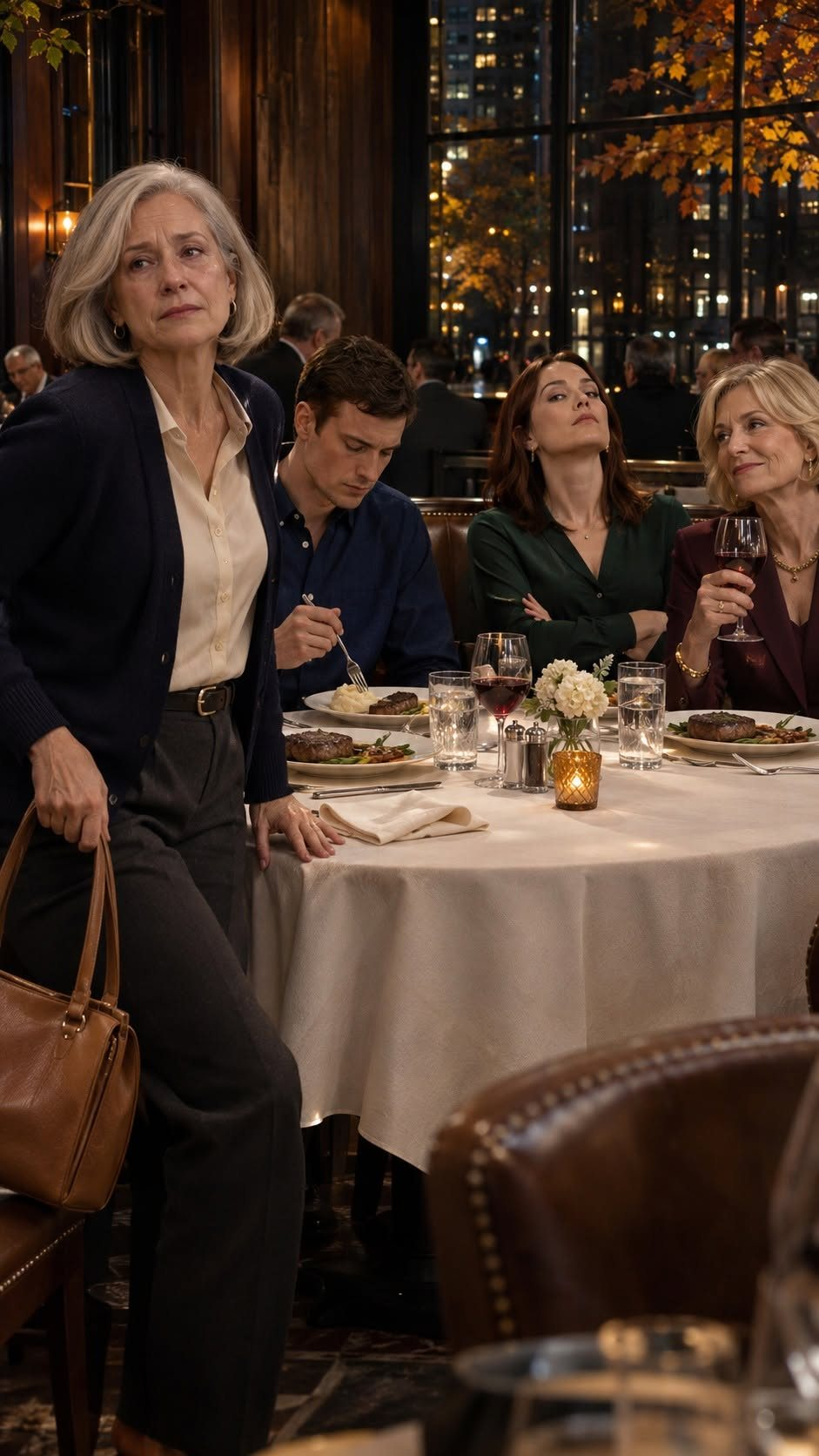
Brenda held the white envelope against the steel screen door.
"Take it, Georgia. You'll understand why we're here once you read it."
I looked at the envelope but made no move to accept it.
Behind her, Sarah shifted impatiently from one foot to the other. David stood with his shoulders slightly hunched, looking as though he wished he were anywhere else.
I had known my son long enough to recognize that expression.
It was the face he wore whenever he wanted a problem to disappear without having to make a decision.
"What exactly is inside?" I asked.
Brenda gave me a practiced smile.
"Some paperwork concerning the house."
I looked at her.
"My house?"
"Well, technically, yes. But we're discussing a family arrangement."
Sarah stepped forward.
"Georgia, just take it. We didn't drive all the way here to stand outside all morning."
I glanced at the clock above the hallway entrance.
It was 8:11.
I had been awake since six.
I had made coffee, watered the plants near the kitchen window, and checked my bank account. I had even spent fifteen minutes reading a book I had abandoned the previous evening.
I had not planned to spend my Saturday discussing my property with three people who had insulted me at dinner.
Still, I reached through the opening in the screen door and accepted the envelope.
It was heavier than I expected.
I opened the flap.
Inside were several printed pages, a handwritten note, and a document with a bold heading.
FAMILY PROPERTY TRANSFER PROPOSAL
I read the title twice.
Then I looked at Brenda.
"Who prepared this?"
She adjusted her sunglasses.
"A family friend. He handles real estate matters."
"An attorney?"
"Someone familiar with these things."
That was not an answer.
I removed the first page.
It contained a short introduction explaining that transferring ownership of my home to David would supposedly simplify future estate planning and help the younger generation establish financial security.
The second page was more specific.
It suggested that I consider adding David to the property's title.
The third page contained a list of possible financial advantages.
I read the figures carefully.
Then I reached the last page.
There was a blank line for my signature.
I looked up.
"Why is there a signature line?"
Sarah sighed.
"Because if you agree, we can move forward."
"Move forward with what?"
"Putting David's name on the house."
I looked at my son.
He finally met my eyes.
"Mom, nobody is asking you to move out tomorrow."
I held up the document.
"Then why does this proposal discuss transferring ownership?"
David looked uncomfortable.
"It's just an option."
"An option you discussed without me?"
Brenda stepped in.
"We wanted to make things easier. You know how complicated inheritance can become."
I lowered the papers.
"Have you spoken to an attorney who represents me?"
She hesitated.
"Well, no. But—"
"Have you asked me whether I want to change the ownership of my home?"
Sarah interrupted.
"Georgia, you're making this sound like some kind of legal attack."
I looked at her.
"I haven't accused anyone of anything. I'm asking simple questions."
Brenda sighed.
"You're taking everything personally."
I almost laughed.
A document concerning my house had appeared on my porch less than twenty-four hours after I refused to give it away.
Yet somehow, I was the one taking things personally.
I returned to the first page.
There was a small paragraph near the bottom that I had initially overlooked.
It described the possibility of granting David an ownership interest while allowing me to continue occupying the property.
I read it again.
"Does this mean I would no longer own the entire house?"
Brenda nodded.
"Not necessarily. You would still have your rights."
"What rights?"
She looked toward Sarah.
Sarah looked toward David.
Nobody answered.
That silence told me more than the document did.
I folded the papers carefully and placed them back inside the envelope.
"Thank you for bringing this."
Brenda smiled.
"So you'll consider it?"
"I'll have it reviewed."
Sarah's expression hardened.
"Reviewed by whom?"
"An attorney of my choosing."
Brenda shook her head.
"That really isn't necessary. The proposal is straightforward."
"Then an attorney should have no difficulty reviewing it."
David stepped closer.
"Mom, I don't want this to turn into some big legal thing."
I looked at him.
"Neither do I."
"Then why can't we just talk like a family?"
I held his gaze.
"Because last night, when your wife told me to pay the bill and leave, you didn't speak up. This morning, when you came to my home, you brought a property proposal instead of an apology."
David's face reddened.
"That's not fair."
I waited.
He opened his mouth, then closed it.
Sarah crossed her arms.
"You're making him feel guilty."
"No," I said. "I'm telling him how I feel."
Brenda moved closer to Sarah.
"Let's go. She's clearly not ready to have a reasonable conversation."
I almost corrected her.
I was ready to have a reasonable conversation.
I simply wasn't ready to sign away something my husband and I had spent decades earning.
David looked at the envelope.
"Can you at least promise to read everything?"
"I already have."
"And?"
"I won't sign it."
Sarah's eyebrows rose.
"You haven't even had it reviewed."
"I don't need a lawyer to know that I don't want to give away my house."
Brenda's expression changed.
The pleasant smile disappeared.
"Georgia, you should be careful. Sometimes holding on too tightly to property creates problems for the people you love."
I looked directly at her.
"Then perhaps the people I love should stop trying to take it."
For several seconds, nobody spoke.
Then David turned toward the driveway.
"Come on, Sarah."
Sarah looked as though she wanted to argue, but Brenda touched her arm.
They started walking toward the car.
David remained behind for a moment.
"Mom?"
"Yes?"
He looked at the envelope in my hand.
"I really hope you think about what you're doing."
I nodded.
"I hope you do too."
He turned away.
I watched the three of them leave.
Their car disappeared around the corner.
Only then did I close the inner door.
I placed the envelope on the hallway table.
For several minutes, I stood there looking at it.
I had expected complaints about the phone bills.
I had expected Sarah to accuse me of being unfair.
I had even expected Brenda to return with another speech about how much space I had in my house.
But I had not expected a property transfer proposal.
That was different.
And I wanted to understand exactly what I was dealing with.
At 9:20, I called the attorney who had helped my husband and me prepare our estate documents years earlier.
His name was Michael Bennett.
He had been recommended to us by a neighbor, and we had worked with him for nearly fifteen years.
Michael was in his early sixties, with a calm voice and a habit of listening without interrupting.
When his assistant answered, I explained that I needed an appointment concerning a document involving my home.
She asked whether the matter was urgent.
"I would prefer to have it reviewed before Monday."
She placed me on hold.
A few moments later, Michael came on the line.
"Georgia? It's been a while."
"Yes, Michael. I hope you're doing well."
"I'm fine. What's going on?"
I glanced toward the envelope.
"My son and his wife brought me a proposal this morning. They want me to consider transferring part of my house to him."
There was a brief silence.
"Did you ask them to prepare it?"
"No."
"Have you signed anything?"
"Absolutely not."
"Good. Don't sign anything until we've reviewed it."
His voice had become more serious.
I felt my shoulders relax slightly.
"I was hoping you'd say that."
"Can you bring me the complete document?"
"I can."
"Let's meet Monday morning. And Georgia, keep every page, including the envelope and the handwritten note."
"I will."
After we ended the call, I placed the papers in a folder.
Then I wrote the date and time on a small label.
It was a habit my husband had taught me.
Whenever something involved money, property, or an important agreement, he always said to keep a record.
"Memory gets unreliable when people start arguing," he used to tell me. "Paper doesn't."
I smiled faintly at the thought.
Then I carried the folder into my office.
My laptop was still on the desk.
I opened it and returned to my banking application.
The monthly expenses appeared in neat rows.
Electricity.
Water.
Property taxes.
Insurance.
Groceries.
My own phone service.
My own internet.
Then I opened the separate list of recurring payments I had been covering for David and Sarah.
I began writing them down.
Phone plan: two additional lines.
Townhouse internet: monthly payment.
Warehouse-club membership: annual premium fee.
Occasional grocery deliveries.
Emergency transfers.
There were more than I remembered.
I opened my old banking statements.
One payment led to another.
A car repair.
A medical insurance premium during a job transition.
A deposit when they moved into their townhouse.
A replacement appliance.
None of those transactions had been made under pressure.
I had chosen to help.
But the total surprised me.
I reached for a calculator.
Then I began adding.
The numbers accumulated faster than I expected.
When I finished, I leaned back in my chair.
I had spent considerably more than I had imagined.
And that was only what I could easily find.
I thought about the restaurant.
The way Brenda had spoken about my home.
The way Sarah had looked at me.
The way David had avoided my eyes.
Perhaps the most painful part was not the money.
It was the assumption that I would continue providing it regardless of how they treated me.
I closed the banking application.
Then I opened a blank spreadsheet.
At the top, I typed:
HOUSEHOLD SUPPORT RECORD
I created four columns.
Date.
Expense.
Amount.
Recipient.
I began entering the payments.
I was not preparing a bill to send them.
I was documenting my own finances.
For years, I had kept track of my retirement accounts, insurance policies, taxes, and household expenses.
There was no reason to ignore the money I had been spending on someone else's household.
By noon, the spreadsheet contained dozens of entries.
I saved it.
Then I made a second copy on an external drive.
I felt better.
Not because I intended to confront anyone.
Because I finally had an accurate picture of my own generosity.
At 12:37 p.m., my phone rang.
David.
I watched the screen for several seconds before answering.
"Hello?"
"Mom."
His voice sounded tired.
"Hi, David."
"Can we talk?"
"Of course."
There was a pause.
Then he asked, "Did you really cancel everything?"
"Yes."
"Even the internet?"
"Yes."
He exhaled.
"That's going to cause problems."
I looked at the spreadsheet on my screen.
"I'm sorry for the inconvenience."
"Mom, I don't think you understand. Sarah works from home several days a week."
"I understand."
"And I have meetings on Monday."
"Then you should arrange your own service."
He went quiet.
I waited.
Finally, he said, "You could have at least given us a warning."
I looked out the office window.
The maple tree moved gently in the breeze.
"David, I have been paying those bills for years. You knew the accounts were in my name."
"That doesn't mean you had to cancel them overnight."
I thought about that.
Perhaps I could have given them notice.
Perhaps I could have handled the transition differently.
But then I remembered the previous evening.
Sarah's voice.
Her expression.
Her certainty that I would simply pay and leave.
"You're right," I said.
He seemed surprised.
"What?"
"I could have discussed the changes with you first."
There was a brief silence.
Then I continued.
"But I also could have been treated with basic respect before any of this happened."
David sighed.
"Mom, Sarah didn't mean it the way it sounded."
"Then what did she mean?"
"I don't know. She was frustrated."
"And Brenda?"
"She's just outspoken."
I closed my eyes briefly.
There it was again.
An explanation for everyone except me.
"David, I don't want to argue."
"Neither do I."
"Then let's leave it here for today."
He hesitated.
"Are you still angry?"
I considered his question.
"No. I'm disappointed."
He said nothing.
I could hear a television playing somewhere in the background.
Then he spoke more quietly.
"Can I come by alone tomorrow?"
I looked at the envelope on my desk.
"Why?"
"I just want to talk to my mother."
For the first time since the previous evening, his voice sounded almost sincere.
I wanted to believe him.
I wanted the conversation to be about the years we had shared, rather than money or property.
"All right," I said. "Come by in the afternoon."
"Thanks, Mom."
We ended the call.
I put the phone down.
For a moment, I allowed myself to feel hopeful.
Then a message appeared.
It was from Sarah.
We need to talk about the phone situation. This is affecting both of us.
I read it.
A second message arrived.
Also, Mom thinks the property proposal would protect your interests. You should stop assuming everyone is against you.
I placed the phone beside the keyboard.
I did not respond.
Instead, I returned to the spreadsheet.
That afternoon, I went through a small wooden cabinet in the office.
It contained old insurance documents, property-tax receipts, bank statements, and the estate papers my husband and I had prepared.
I found the deed to the house.
My husband's name and mine appeared together on the original paperwork.
After his death, the ownership had been updated according to the estate arrangements we had established.
Everything had been handled properly.
I placed the deed in a separate folder.
Then I found an old photograph.
David was about twelve years old.
He stood beside his father in the front yard, holding a paintbrush.
Both of them were laughing.
The porch behind them was half-painted.
I remembered that afternoon.
David had spilled an entire can of paint on his shoes.
His father had laughed so hard that he had to sit on the steps.
I held the photograph for a long time.
It was difficult to reconcile that boy with the man who had stared at his dinner plate while his wife ordered his mother to leave.
But perhaps people changed.
Perhaps I had changed too.
I returned the photograph to the drawer.
Then I noticed a small brown envelope tucked beneath the estate documents.
It was addressed in my husband's handwriting.
My name was written across the front.
I recognized it immediately.
He had given it to me shortly before his final hospital stay.
I had read it many times during the first year after his death.
But I had not opened it in years.
I sat down.
For a moment, I simply held it.
Then I carefully unfolded the paper.
The letter was short.
My husband's handwriting had become uneven near the bottom.
He had written about the house, the garden, and the life we had built together.
One sentence made me stop.
Georgia, never let anyone make you feel guilty for keeping what we worked so hard to build.
I read it again.
Then again.
I placed the letter beside the property proposal.
Two pieces of paper.
One written by the man who had helped me earn the home.
The other brought by people who believed I should give it away.
My eyes filled slightly.
But I did not cry.
I folded my husband's letter and returned it to the envelope.
Then I put both documents in the locked drawer.
At 7:15 that evening, I received a call from an unfamiliar number.
I almost ignored it.
But something made me answer.
"Hello?"
A woman's voice came through.
"Good evening. Is this Mrs. Georgia Owens?"
"Yes."
"My name is Laura Mitchell. I'm calling from your property insurance office."
I straightened in my chair.
"Is there a problem?"
"Not necessarily. We received an inquiry concerning your property earlier today."
I frowned.
"What kind of inquiry?"
There was a pause.
"Someone contacted us to ask about adding another interested party to the property record."
My stomach tightened.
"Who?"
"I can only provide the details after completing a few verification steps."
I answered her questions.
Then she returned to the call.
"The inquiry listed David Owens as the proposed additional party."
I looked at the folder on my desk.
David.
My son.
I took a slow breath.
"Did anyone authorize that change?"
"No change has been made, Mrs. Owens. We simply received an inquiry."
"Can you tell me when it was submitted?"
"Yesterday afternoon."
I looked at the clock.
Yesterday afternoon.
Before the steakhouse dinner.
Before Brenda suggested that I give David the house.
Before Sarah told me to pay the bill and leave.
I thanked Laura for informing me.
She advised me to speak with my attorney if I had concerns.
I promised I would.
After the call ended, I sat completely still.
The proposal had not been a spontaneous idea.
Someone had been thinking about my property before the dinner.
Perhaps before Brenda had even arrived in town.
I opened my laptop again.
I checked my email.
There was a message from the home insurance company dated the previous afternoon.
I had overlooked it.
The subject line read:
Property Inquiry — Additional Interest Request
I opened it.
The message contained a short summary of the inquiry and a reference number.
My hands remained steady as I copied the number into my notes.
Then I checked the date.
Friday.
The same day as the dinner.
I sat back.
For the first time, I began to wonder whether the humiliating conversation at the steakhouse had been designed to prepare me for something.
I did not know what.
I did not want to assume the worst.
But I was no longer willing to ignore details simply because the people involved were family.
I saved the email.
Then I called Michael Bennett's office again and left a message asking him to review the insurance inquiry alongside the property proposal.
It was nearly nine when I finally shut down the computer.
I went upstairs, changed into comfortable clothes, and prepared for bed.
My phone vibrated on the nightstand.
A message from David.
Mom, I'll come alone tomorrow. I promise.
I read it.
Then another message appeared.
This one came from an unknown number.
Georgia, please don't sign anything Brenda gives you. I know what they are planning.
I sat upright.
I read the message again.
There was no name.
No explanation.
Before I could reply, another message appeared.
Check your email. There is something you need to see before David arrives.
I reached for my laptop.
The screen illuminated the dark bedroom.
And when I opened my inbox, I saw an email with an attachment from an address I had never seen before.
The subject line contained only five words.
YOUR HOUSE WAS NEVER THE REAL PLAN.






Comments 0