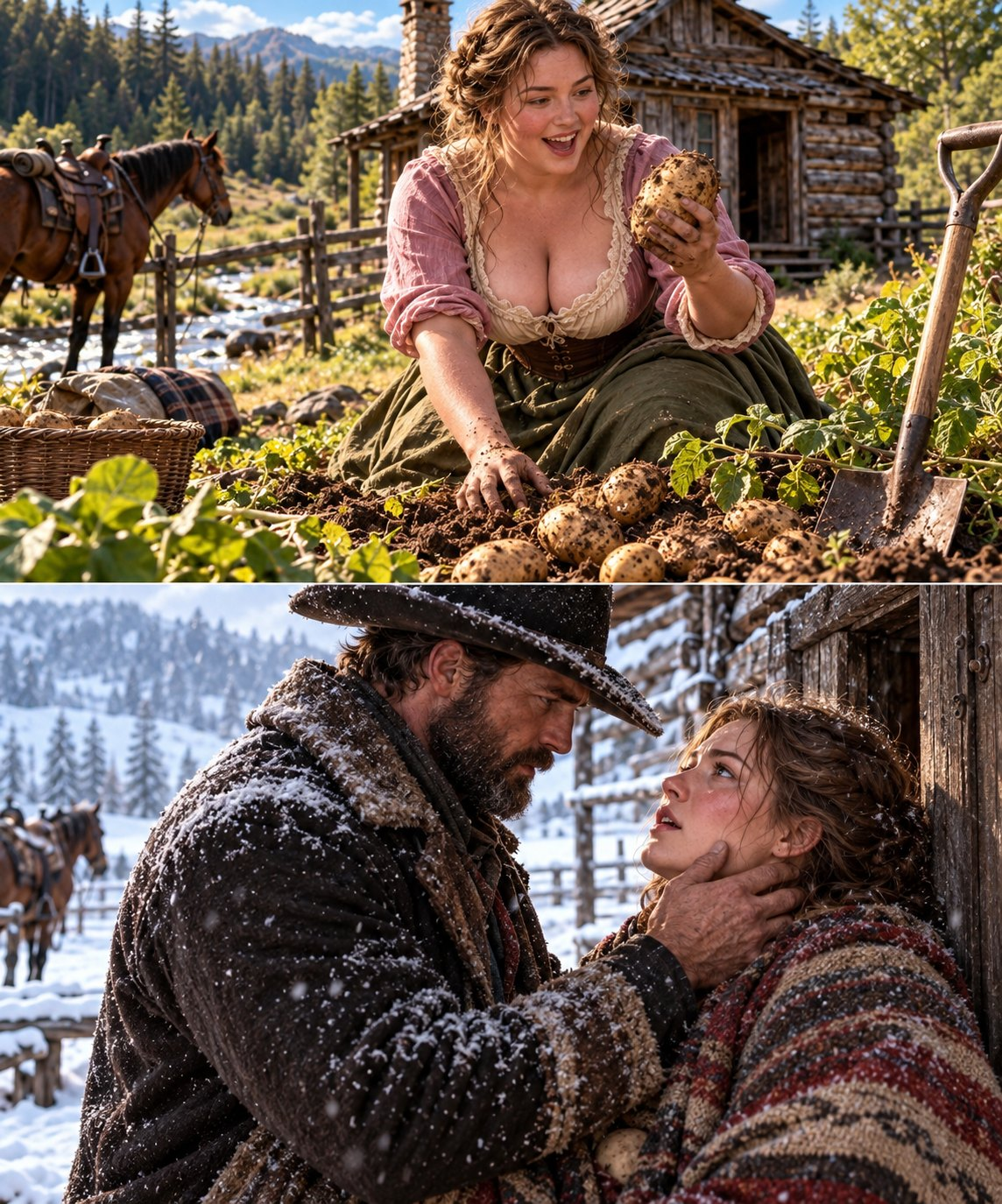
A young woman was digging through frozen soil when an old man suddenly appeared at her cabin door.
"Where did you find that name?" he whispered.
Clara Whitmore held a weathered piece of wood against her chest.
Three words had been scratched into its back.
The old man recognized every one of them.
And he had been searching for them for thirty years.
But Clara had no idea who he was.
Or why he was crying.
Three months earlier, she had arrived in Willow Creek Valley with six dollars and forty cents, an iron spade, a wool blanket, and nowhere to sleep.
She had not come looking for a mystery.
She had come looking for water.
And, if the Lord was willing, enough food to survive another winter.
"Henry says we're leaving for Kansas."
Clara stopped kneading the biscuit dough.
She had flour on both hands, a little on her cheek, and a bowl of warm water sitting beside the kitchen stove.
For a moment, she thought she had misunderstood.
"Leaving when?"
Henry Wallace leaned against the kitchen doorway. He was wearing his good brown trousers and the blue waistcoat he usually reserved for Sundays.
"Friday."
Clara looked at the calendar hanging beside the pantry.
It was Tuesday.
She pressed her fingers into the dough.
"That's three days."
"That's right."
"Why?"
Henry shrugged.
"My brother has found better opportunities out east. Says there's money to be made if a man gets there before the others."
Clara glanced through the window.
The garden was thriving.
Beans climbed the wooden supports she had built herself. Tomatoes hung heavy on their vines. The cabbage heads were beginning to tighten.
She had planted every row.
She had carried every bucket of water.
She had spent eighteen months making that patch of ground productive.
"And the house?" she asked.
"Margaret and the children are coming with me."
Clara wiped her hands on her apron.
"What about my wages?"
Henry looked uncomfortable.
"We'll settle everything before we go."
She understood then.
He had not come into the kitchen to discuss her future.
He had come to tell her that she no longer had one under his roof.
For eighteen months, Clara had risen before sunrise.
She cooked breakfast, scrubbed floors, washed clothing, mended torn sleeves, carried water, and tended the garden.
When the youngest Wallace boy developed a fever the previous winter, she had sat beside his bed for three nights.
She had never asked for extra money.
She had never complained about the hours.
She had believed that working honestly would at least earn her the courtesy of being told when her employment was ending.
Apparently, she had been mistaken.
"All right," she said.
Henry nodded as though the matter had been settled fairly.
"Margaret will speak with you before we leave."
He turned and walked away.
Clara remained beside the kitchen table.
The dough had become too firm beneath her hands.
She started kneading again.
It was the only thing she could think to do.
Friday morning came with a pale blue sky and the sound of wagon wheels.
Margaret Wallace entered the kitchen carrying a small envelope.
She was a thin woman with tired eyes and a habit of twisting her wedding ring whenever she felt uncomfortable.
"Clara."
Clara looked up from the bread she was wrapping.
Margaret held out the envelope.
"I wish we could do more."
Clara accepted it.
Inside were six dollars.
A few additional coins brought the total to six dollars and forty cents.
She counted them twice.
Not because she expected the amount to change.
Because she needed to be certain she had understood.
"That's everything?"
Margaret looked down.
"Henry has expenses for the journey."
Clara folded the envelope.
She thought about the boy whose fever she had helped break.
She thought about the garden.
She thought about the dozens of shirts she had repaired by candlelight.
Then she looked at Margaret.
"Do you wish you could do more?"
Margaret flinched.
"I truly do."
Clara almost apologized.
Almost.
But she had learned something about apologies during her years working for other people.
They were easiest to offer when the person receiving them had a warm bed waiting.
"I understand," Clara said.
She did not.
But there was no reason to argue.
By eleven o'clock, the wagon had disappeared down the road.
Clara stood beside the empty house.
The dust settled.
The kitchen was quiet.
The garden remained behind her, full of vegetables she would never harvest.
She could have cried.
Instead, she went to the shed.
Henry had told her she could take the old iron spade if she ever needed it.
She collected it, tied her wool blanket across her shoulders, packed her few belongings into a canvas sack, and walked away.
She did not look back until she reached the end of the lane.
The house was already becoming small.
Then the trees swallowed it.
Clara had six dollars and forty cents.
She calculated her money while walking.
A night in a boardinghouse would cost more than she could afford for very long.
Food would take the rest.
And winter was coming.
She had no family nearby.
Her father had died several years earlier, and her mother had followed him the previous spring.
There was no brother waiting in another town.
No aunt with a spare room.
No friend who could take her in.
There was only the road.
Her father had once told her that a person could survive almost anything if she remembered three things.
Water first.
Shelter second.
Food third.
He had been a practical man.
He never pretended that life was fair.
"Good land can be repaired," he used to say. "A roof can be patched. A fence can be rebuilt. But a place without water will kill you while you're still making plans."
Clara remembered those words as she reached the first line of hills.
She decided she would look for a creek.
If she found one, perhaps she could find a place to sleep nearby.
If she found a place with enough ground to plant something, she might have a chance.
It was not much of a plan.
But it was better than standing beside an empty house.
The first night, Clara slept beneath a cedar tree.
She spread her wool blanket over the ground and placed the canvas sack beneath her head.
The forest was unfamiliar.
Branches creaked overhead.
Insects chirped from the undergrowth.
Somewhere in the distance, an owl called.
She ate half a piece of bread and drank the last of the water in her flask.
Then she lay still.
The darkness seemed enormous.
She had slept in barns before.
She had slept in kitchens and spare rooms.
She had even spent one night in a hayloft during a terrible storm.
But never had she felt so far from another human being.
She pulled the blanket closer.
"Tomorrow," she whispered.
She did not know what tomorrow would bring.
She only knew she had to reach it.
Sometime after midnight, she heard a sound.
At first, she thought it was wind.
Then she listened again.
A steady trickling.
Water.
Not rain.
Running water.
Clara raised her head.
She held her breath.
There it was again.
A clear, continuous sound coming from somewhere beyond the trees.
She sat up.
For several minutes, she listened to it.
Then she quietly gathered her things.
"All right," she whispered.
She did not know why she said it.
Perhaps because the sound felt like an answer.
At dawn, Clara followed the creek.
It took almost two hours.
She climbed over fallen branches, pushed through blackberry vines, and descended a narrow slope where the earth was slippery with moss.
Several times she nearly lost her footing.
Her skirt caught on thorny branches.
Her boots filled with damp leaves.
But the sound grew louder.
Eventually, she reached the water.
The creek was narrow, perhaps six feet across, and moved over flat gray stones.
Clara crouched beside it.
She put her fingers into the current.
Cold.
Clean.
Constant.
She watched the water for a long time.
Then she drank.
It was the best water she had tasted in months.
She filled her flask and followed the creek downstream.
The forest gradually opened.
The trees became less crowded.
Sunlight fell across the ground.
Then, without warning, the valley appeared.
Clara stopped walking.
Four acres of uneven land stretched between the surrounding hills.
Fir and cedar trees protected three sides.
The creek curved along the fourth.
The ground was dark and rich.
Near the center stood an old wooden cabin.
Its roof sagged.
Moss covered the shingles.
One shutter hung loose.
A split-rail fence had collapsed into the grass.
Clara stared.
"Of course," she muttered.
She had followed water through half a mountain and found a ruin.
But the cabin was still standing.
The chimney was intact.
And there was something else.
The ground around the cabin looked strange.
She stepped closer.
Beneath the tall grass, she noticed long, straight lines.
She knelt and pulled away a handful of weeds.
Dark soil appeared.
Raised into neat rows.
Garden beds.
Old ones.
Clara looked toward the next row.
Then the next.
Someone had shaped this ground deliberately.
Someone had planted here.
And whoever it was had known what they were doing.
She touched the soil.
It crumbled easily between her fingers.
A faint smile appeared on her face.
For the first time since leaving the Wallace property, she felt something other than fear.
Possibility.
The cabin door resisted when she pushed it.
She leaned her shoulder against the wood.
It opened with a long groan.
Inside, the air smelled of old ash, dry timber, and dust.
Clara waited for her eyes to adjust.
There was an iron stove near the center of the room.
A rope bed leaned against one wall.
A small wooden table stood beside the window.
A fireplace occupied the far corner.
The floor looked surprisingly solid.
She walked slowly through the cabin.
The roof did not appear to be leaking.
The chimney had not collapsed.
And the stove, although rusty, seemed usable.
She placed her canvas sack on the floor.
Then she noticed something above the stove.
A small cloth-covered notebook.
She reached up and took it down.
The cover was worn.
One corner had been burned.
She opened it carefully.
The first pages contained recipes.
Pickled cucumbers.
Tomato preserves.
Dried beans.
Carrots packed in sand.
Cabbage preserved with salt.
Clara turned another page.
Planting dates.
Frost warnings.
Instructions for storing potatoes.
There were two different handwritings.
One was neat and careful.
The other was loose and slanted.
Sometimes the second handwriting added comments in the margins.
Plant the beans after the last hard frost.
Do not harvest the carrots too early.
Keep the potatoes dry.
Clara sat on the floor.
She read every page.
The notebook was not merely a collection of recipes.
It was a record of someone who had lived here.
Someone who understood this particular land.
Someone who had taken considerable care to make sure the garden would produce enough food.
She turned to the final page.
There was a short sentence written in faded ink.
If the creek continues to run, the valley will never be entirely lost.
Clara read it twice.
Then she closed the notebook.
Outside, the creek continued its steady movement.
She looked toward the window.
The light was fading.
She had found water.
She had found shelter.
And perhaps she had found a place where she could begin again.
That night, she slept on the rope bed.
For the first time since the Wallace wagon disappeared, she allowed herself to imagine being somewhere the following morning.
But she did not yet know whose home she had entered.
Or why the person who had kept that notebook had left without taking it.
She woke before sunrise.
The cabin was cold, but the blanket had kept most of the chill away.
Clara sat up and listened.
Birds were beginning to stir outside.
The creek continued running.
She got dressed, tied her hair back, and stepped outside.
The valley looked different in the morning light.
The garden beds were easier to see.
She walked between them, studying the soil.
There were signs of old cultivation everywhere.
A few dried vines remained tangled around wooden stakes.
Near the fence, she found a rusted watering can.
Beside the cabin stood a small woodpile, mostly covered with moss.
Someone had once intended to return.
Clara picked up the iron spade.
She had no seeds, no livestock, and very little food.
But she had land.
And she had water.
That was enough to begin.
She spent the morning clearing weeds from the nearest garden bed.
By noon, her palms were blistered.
She stopped only long enough to drink from the creek.
Then she returned to work.
She removed thistles, pulled tangled roots, and loosened the upper layer of soil.
The work was exhausting.
But unlike the work she had done for the Wallaces, this labor belonged to her.
No one would take credit for it.
No one would tell her that she had no right to harvest what she planted.
She could decide what happened next.
When the afternoon sun began to lower, Clara returned to the cabin.
She placed the notebook on the table and opened it again.
Something bothered her.
The first pages began with recipes.
There was no introduction.
No name.
No date indicating when the notebook had been started.
She turned the pages carefully.
Near the back, several sheets had been removed.
Not fallen out.
Removed.
The torn edges were clean and deliberate.
Clara ran her finger along them.
Whoever had owned the notebook had taken something away before leaving.
She examined the cover.
Under the cloth, near the spine, she noticed a faint impression.
Letters.
She tilted the notebook toward the window.
The afternoon light revealed part of a name.
The first letter appeared to be an M.
The second might have been an A.
She leaned closer.
Then a gust of wind pushed the cabin door shut.
Clara jumped.
She turned toward it.
Nothing.
Only the empty doorway and the long shadows stretching across the floor.
She returned to the table.
There was no reason to be frightened.
She was alone.
She had found a place to sleep.
Tomorrow, she would continue clearing the garden.
She would worry about the notebook another day.
But as she reached to close it, she noticed something else.
A small folded piece of paper had become trapped between the back cover and the final page.
It was old and brittle.
Clara carefully pulled it free.
There was only one sentence written on it.
Whatever happens, never let them take Willow Creek.
She read it once.
Then again.
Outside, the creek moved quietly through the valley.
Clara looked toward the abandoned garden.
For the first time, she wondered whether the homestead had been abandoned at all.
And who, exactly, had been expected to come back.
END OF CHAPTER 1
The remaining chapters will continue in the same narrative sequence, preserving the original events and building toward the mystery of the homestead, the old man's arrival, the land dispute, and Clara's eventual happy ending.






Comments 0