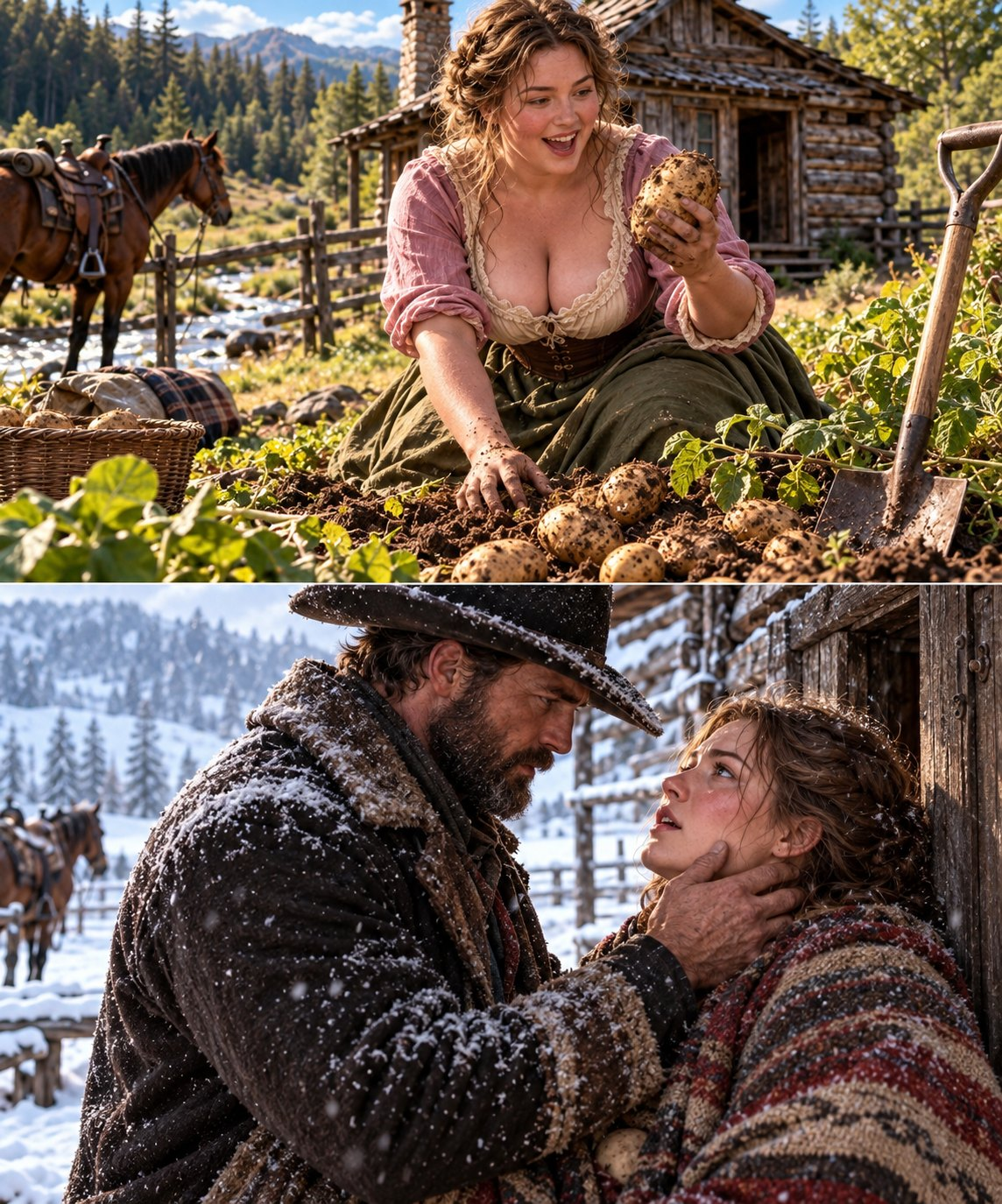
Clara Whitmore stood frozen beside the wooden table.
The iron spade trembled slightly in her hands.
Outside, someone was waiting.
Inside, something had moved beneath the floor.
"Miss Whitmore?" the man called again. "I know you're in there."
Clara looked toward the cellar hatch.
It was closed.
She was certain she had heard it move.
A scraping sound.
Then a faint metallic click.
Now there was silence.
She turned toward the door.
"Who are you?"
"My name is Samuel Briggs. I represent the people who hold the legal claim to this property."
Clara tightened her grip on the spade.
"Which people?"
A pause.
"The Whitaker family."
She did not recognize the name.
"I don't know any Whitakers."
"That doesn't change the ownership of the land."
His voice was calm, but there was something unpleasant beneath it.
Clara moved closer to the door.
"I found this place abandoned."
"Abandoned isn't the same as unclaimed."
She looked toward the window.
A shadow passed across the glass.
Then another.
There was more than one person outside.
Clara stepped away from the door.
"How many of you are there?"
"That depends on how long you intend to make this conversation."
The answer was not reassuring.
She looked at the iron spade.
Then at the cellar hatch.
If someone was hiding underneath the cabin, she needed to know who it was.
But opening the hatch while strangers stood outside seemed like a foolish idea.
She had six dollars and forty cents.
No neighbors.
No weapon worth trusting.
And apparently, no legal right to the only roof she had found.
Clara took a slow breath.
"Mr. Briggs, I suggest you explain exactly what you want."
The man laughed quietly.
"That's a sensible beginning."
Then he knocked again.
"Open the door, Miss Whitmore."
Clara did not move.
She had learned something during her eighteen months with the Wallaces.
A person who spoke gently was not necessarily a person who meant well.
Henry Wallace had rarely raised his voice.
He had not needed to.
He could dismiss her with a few careless words and leave her standing outside a house she had helped maintain.
Clara had no intention of allowing another man to decide her future simply because he had arrived wearing better clothes.
She placed the iron spade against the wall.
Then she moved a chair beneath the door handle.
It was an old chair, but the wooden legs were sturdy.
Only after securing it did she approach the window.
She lifted the curtain slightly.
A middle-aged man stood outside.
He wore a dark brown coat, a black hat, and polished boots that looked entirely unsuited to the muddy valley.
His face was narrow.
His mustache was carefully trimmed.
He held a leather document case beneath one arm.
Behind him stood a younger man leading a brown horse.
The younger man appeared to be in his twenties.
He kept glancing toward the cabin.
Clara watched them for several seconds.
The older man looked directly at the window.
She lowered the curtain.
"Miss Whitmore," he called, "I can see you."
Clara returned to the door.
"I'll speak with you from here."
"That is hardly a proper way to conduct business."
"Then perhaps you should have arrived during daylight."
Silence.
For the first time, the man seemed irritated.
"Very well. I have no intention of wasting the evening."
He opened his leather case.
"I have documents establishing the Whitaker family's ownership of Willow Creek Valley. The property has been under their administration for many years."
Clara looked toward the notebook.
Willow Creek.
The warning had mentioned the name.
Whatever happens, never let them take Willow Creek.
She felt a chill that had nothing to do with the night air.
"Who lived here before?"
"That is not relevant."
"It is to me."
"The previous occupants left."
"When?"
"Years ago."
"Why?"
Briggs sighed.
"Miss Whitmore, you appear to misunderstand your position. You are an unauthorized occupant. The family has been generous enough to allow this matter to be settled without involving the county authorities."
Clara stared at the door.
"Generous?"
"You should be grateful."
She almost laughed.
She had heard that word before.
It had been used when Margaret Wallace handed her six dollars and forty cents after eighteen months of work.
She had no intention of hearing it again.
"Show me the documents."
"Open the door."
"Pass them underneath."
Another pause.
Then she heard the sound of paper.
Something slid beneath the door.
Clara waited until the footsteps moved away before retrieving it.
There were three sheets.
The first appeared to be a property record.
The second contained a rough description of the valley.
The third carried a signature.
She brought the papers closer to the lamp.
The document was old.
Much older than Briggs's polished boots.
A date near the bottom read 1878.
The name beneath it was difficult to make out.
Clara tilted the paper.
Then she noticed the seal.
A small circle.
The same circle she had seen on the garden stakes.
Her stomach tightened.
She looked at the signature again.
It appeared to begin with the letter M.
Before she could examine it further, a voice came from outside.
"Now you understand?"
Clara looked toward the door.
"No."
Briggs sounded impatient.
"That document establishes the family's claim."
"It establishes that somebody signed something in 1878."
"That is precisely what it does."
"Where is the original?"
"The county office."
"Then I would like to see it."
Briggs laughed.
"You are in no position to make demands."
Clara folded the document.
"Then I suppose we're finished."
The silence that followed was different.
Longer.
Colder.
"Miss Whitmore," Briggs said, "you are making a serious mistake."
Clara looked at the cellar hatch.
Another faint scraping sound came from beneath the floor.
This time, she knew she had not imagined it.
Briggs did not leave.
Instead, he walked toward the side of the cabin.
Clara followed his movement through the window.
The younger man remained near the horse.
Briggs examined the northern wall.
He touched the logs.
Then he looked toward the garden.
Clara watched his expression change.
For a moment, he seemed genuinely surprised.
He walked toward the old potato beds.
His polished boots sank into the dark soil.
Then he stopped beside the canvas sack.
Clara had forgotten to bring it inside.
The potatoes were visible beneath the open top.
Briggs looked down.
He picked up one of them.
Then he turned toward the cabin.
"Miss Whitmore!"
She remained silent.
"How long have you been digging?"
Clara frowned.
"Why?"
"Answer the question."
"Several days."
He stared at the garden.
"Where did you find those?"
"In the ground."
"Which ground?"
Clara felt her patience disappearing.
"The garden."
Briggs looked toward the younger man.
They exchanged a glance.
It was brief.
But Clara noticed it.
The younger man shook his head almost imperceptibly.
Briggs placed the potato back into the sack.
"Have you found anything else?"
Clara said nothing.
The question was too specific.
He was not interested in whether she had repaired the roof or cleaned the cabin.
He wanted to know what she had uncovered.
"No," she answered.
Briggs studied her through the window.
For several seconds, neither moved.
Then he smiled.
It was not a friendly smile.
"I'll return tomorrow."
"With the county sheriff?"
"Perhaps."
"Bring the original documents."
His smile disappeared.
"You seem determined to make this difficult."
Clara looked at him.
"I seem determined to know who is trying to take my home."
Briggs adjusted his coat.
"It isn't your home."
He turned and walked toward his horse.
The younger man followed.
Before mounting, however, he looked back at the cabin.
His expression was strange.
Not angry.
Not threatening.
Almost apologetic.
Clara watched until both riders disappeared between the trees.
Then she locked the door again.
She waited.
One minute.
Two.
Five.
Only when the sound of hoofbeats had completely vanished did she allow herself to breathe normally.
But the danger outside was not the only thing troubling her.
Someone had been inside the cellar.
And that person might still be there.
Clara returned to the center of the room.
She picked up the oil lamp.
The cellar hatch sat beneath the rope bed.
Its iron ring reflected a small circle of light.
She moved the bed aside.
Then she knelt.
"Is someone down there?"
No answer.
She waited.
"Mr. Briggs has left."
Silence.
Clara touched the iron ring.
It was cold.
She lifted the hatch.
The hinges creaked.
A draft rose from below.
She leaned forward.
"Hello?"
A faint sound answered her.
Not a voice.
A breath.
Clara froze.
Someone was definitely down there.
She reached for the lamp and began descending.
The wooden steps creaked beneath her weight.
At the bottom, she turned slowly.
The cellar looked exactly as she had left it.
The shelves were undisturbed.
The baskets remained against the wall.
The storage pit was covered.
But something had changed.
One of the old crates had been moved.
It stood several feet away from its original position.
Clara approached it.
The lid was loose.
She lifted it.
Inside were several pieces of folded cloth, a broken wooden spoon, and an old leather satchel.
She took out the satchel.
It was empty.
Almost.
A small scrap of paper had been tucked into the inner pocket.
Clara pulled it free.
The writing was faded.
Only a few words remained legible.
...not trust Briggs.
Her heart began beating faster.
She looked toward the dark corner.
"Who is here?"
A sudden movement came from behind the shelves.
Clara turned.
The lamp shook in her hand.
Something small ran across the floor.
A rat.
She let out a breath.
"Good Lord."
She almost laughed at herself.
But then she noticed a section of stone wall behind the shelves.
One stone was slightly displaced.
She pushed the shelf aside.
The stone moved.
Behind it was a narrow opening.
Not large enough for a person to enter comfortably.
But large enough to conceal a small object.
Clara reached inside.
Her fingers touched metal.
She pulled it out.
An old tin box.
It was about the size of a man's hand.
Its surface was scratched.
A small lock held the lid shut.
Clara examined it.
The keyhole was unusually narrow.
She thought of the key in her apron.
Seventeen.
She retrieved it.
For a moment, she hesitated.
Then she inserted it.
The key turned.
The lock opened.
Clara lifted the lid.
Inside was a folded piece of paper, a small brass button, and a photograph.
She picked up the photograph first.
It showed a young woman standing beside the creek.
The woman wore a simple dark dress.
Her hair was pinned loosely behind her head.
One hand rested on a wooden fence post.
The photograph was old, but the woman's face remained clear.
She was smiling.
Clara looked at her for a long time.
There was something familiar about her features.
The shape of her eyes.
The slight curve of her mouth.
The way her hair fell across one cheek.
Clara turned the photograph over.
Three words had been written on the back.
For the valley.
She looked again at the woman.
Then at the paper inside the box.
She unfolded it carefully.
The handwriting was the same loose, slanted script she had seen in the notebook.
Only one sentence had been written.
If Samuel Briggs returns, the truth must be found before the first snow.
Clara read it twice.
Samuel Briggs.
The man outside.
Her hands began to tremble.
This was not an ordinary property dispute.
Someone had known he would return.
Someone had hidden a warning.
And someone had concealed the photograph in the cellar.
She placed everything back into the tin box.
Then she heard a sound above her.
A floorboard creaked.
Clara looked toward the stairs.
She had closed the hatch before descending.
She was certain of it.
Another creak followed.
Slow.
Deliberate.
Someone was walking across the cabin.
Clara extinguished the lamp.
Darkness swallowed the cellar.
She stood motionless.
Then a man's voice came from above.
"Miss Whitmore?"
It was not Briggs.
It was younger.
Closer.
Clara covered her mouth.
The voice continued.
"Please don't be frightened."
She recognized it.
The younger man who had accompanied Briggs.
A moment later, the hatch began to open.
Clara stepped behind the stone shelves.
A narrow beam of light entered the cellar.
The younger man leaned over the opening.
"Miss Whitmore?"
She did not answer.
He descended one step.
Then another.
His boots made the old wood groan.
He carried a small lantern.
When he reached the bottom, he looked around.
His eyes settled on the tin box.
Clara realized she had left it open.
The young man saw the photograph.
His expression changed immediately.
He stepped toward it.
"Where did you find that?"
Clara emerged from behind the shelves.
"Who are you?"
He jumped.
Then he raised both hands.
"My name is Thomas Reed."
"You were with Briggs."
"I know."
"Why did you come back?"
Thomas looked toward the stairs.
"Because he doesn't know what you're living over."
Clara held the iron spade she had brought down with her.
"That isn't an answer."
He swallowed.
"I wanted to warn you."
"About what?"
"About Samuel Briggs."
Clara stared at him.
"You seem to know an awful lot about a man you claim to be warning me against."
Thomas lowered his hands.
"I worked for him for nearly two years."
"And now?"
"Now I don't."
"Why?"
He looked at the photograph.
For several seconds, he seemed unable to speak.
Then he said, "Because I found out what he was planning to do with this place."
Clara stepped closer.
"What was he planning?"
Thomas glanced toward the cellar ceiling.
His voice dropped.
"He wants the land cleared before anyone discovers what's buried beneath it."
Clara felt a chill run down her spine.
"What is buried?"
Thomas looked directly at her.
"Not what you think."
He reached into his coat.
Clara raised the spade.
"Don't."
He stopped immediately.
Slowly, he withdrew a folded piece of paper.
"I found this in Briggs's office."
He held it out.
Clara did not take it.
"What is it?"
"A copy of the property survey."
"I already saw one."
"Not this one."
He unfolded the paper.
The drawing showed the cabin, the creek, the garden, and the surrounding hills.
A red line marked the western boundary.
Another line crossed the valley near the old cedar trees.
But Clara's attention went to the center.
Beneath the cabin, someone had drawn a small square.
Inside it was a number.
Seventeen.
She looked at the key.
Then at Thomas.
"What does that mean?"
Thomas shook his head.
"I don't know. But Briggs does."
Clara felt the cellar grow colder.
"Why did you bring this to me?"
Thomas hesitated.
Then he looked at the photograph again.
"Because I recognize that woman."
Clara picked up the picture.
"Who is she?"
Thomas's face became pale.
He looked toward the stairs.
Then back at Clara.
"Her name was Margaret Whitaker."
Clara's fingers tightened around the photograph.
"Was?"
Thomas nodded.
"She disappeared thirty years ago."
Clara looked at the smiling young woman.
The same woman whose handwriting might have filled the old notebook.
The same woman whose warning had been hidden beneath the cellar floor.
She felt as though the cabin had suddenly become much smaller.
"Why did she disappear?"
Thomas opened his mouth.
Before he could answer, a loud crash shook the cabin above them.
Dust fell from the cellar ceiling.
Someone had slammed the front door.
Thomas turned toward the stairs.
His face changed.
"That's Briggs."
Clara grabbed the tin box.
Thomas extinguished the lantern.
A heavy footstep crossed the floor above.
Then another.
Briggs was no longer outside.
He was inside the cabin.
And he was calling Clara's name.
"Miss Whitmore!"
She looked toward the narrow staircase.
Thomas moved closer and whispered something that made her blood run cold.
"Whatever you do, don't let him see that photograph."
Then a second voice came from the cabin.
An older voice.
A voice Clara had never heard before.
"Samuel, the girl has already found it."
And from directly above them, someone began lifting the cellar hatch.
Clara looked at the photograph one last time. The woman smiling beside the creek had the same unmistakable birthmark as the stranger now standing above her.






Comments 0