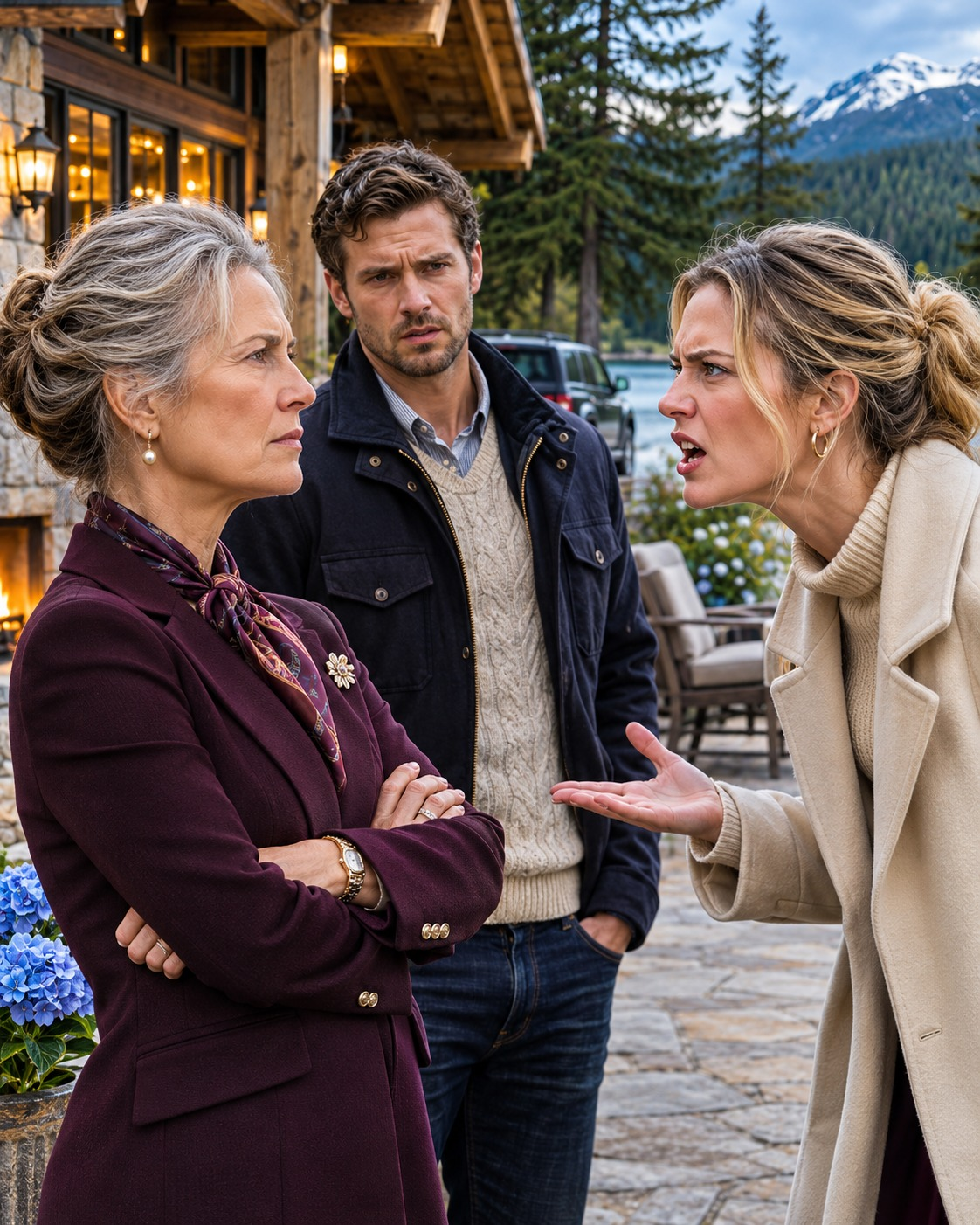
"Mrs. Harper, please don't let that woman inside your house."
The voice on my phone belonged to Richard Bennett, Clare's father.
I stood beside my SUV, staring at the security camera notification on my screen.
The woman in the gray business suit was still waiting on my porch, holding a document labeled NOTICE OF PROPERTY CLAIM.
"Richard?" I asked. "How did you get my number?"
"Caleb gave it to me a while ago. Evelyn, listen carefully. I need to speak with you before Clare does."
His voice sounded strained.
I had met Richard Bennett only a handful of times since Caleb married Clare. He was a quiet man in his early sixties, with thinning brown hair and a habit of speaking only after everyone else had finished.
His wife, Patricia, was considerably more outgoing.
At family dinners, Patricia usually dominated the conversation while Richard listened.
I had always assumed he was simply reserved.
Now, hearing the fear in his voice, I wondered whether there was another reason for his silence.
"Richard, there's a woman standing on my porch with some kind of property claim. Do you know anything about that?"
He inhaled sharply.
"She's already there?"
"Yes."
"Oh, God."
I looked toward the cabin.
"Richard, what is going on?"
He didn't answer immediately.
Then he said something that made me grip the phone more tightly.
"Evelyn, Clare told us you were selling the property."
For several seconds, I couldn't speak.
"What?"
"She said you were planning to move into a retirement community and that Caleb would be handling the land."
I stared across the meadow.
My meadow.
The same meadow where I had planted wildflowers every spring.
The same meadow where Robert and I had watched deer gather at sunset.
"Richard, I have absolutely no intention of selling my property."
"I know that now."
"Who told you otherwise?"
"Clare."
I closed my eyes.
Of course.
"She said you had already discussed everything with Caleb," he continued. "She said the guest house was just the first part of the arrangement."
I felt something cold settle in my stomach.
"The first part?"
He lowered his voice.
"Evelyn, I think you need to hear what she's been telling people."
Before I could respond, the woman on my porch pressed the doorbell again.
I watched her through the security camera.
She glanced at her watch, then looked toward the driveway.
She appeared professional.
Impatient, perhaps.
But not threatening.
Still, I had no intention of inviting a stranger inside without understanding why she had come.
"Richard, I need to deal with someone at my house."
"Please don't sign anything."
"I won't."
"And Evelyn?"
"Yes?"
"I'm sorry."
I stood very still.
"For what?"
He hesitated.
"For believing what we were told."
The call ended.
I stared at the screen.
Then I placed my phone in my pocket and walked toward the porch.
The woman turned when she heard my footsteps.
"Mrs. Harper?"
"Yes."
She offered her hand.
"My name is Andrea Walsh. I'm a field representative with Western Property Resolution Services."
I shook her hand briefly.
"What can I do for you?"
She held up the document.
"I'm here to deliver a notice concerning a proposed property transaction."
I looked at the paper.
"Proposed by whom?"
She checked her folder.
"According to our instructions, the Harper family."
I felt my jaw tighten.
"I'm the only legal owner of this property."
Andrea nodded.
"That's why we needed to contact you."
I studied her face.
She didn't appear surprised.
In fact, she looked almost relieved that I was speaking with her directly.
"May I ask who hired your company?"
She hesitated.
"I'm authorized to provide the name of the referring organization, but I can't discuss confidential details beyond the notice without verifying the relevant parties."
"Then please tell me what you can."
She opened her folder.
"Our company was asked to conduct preliminary document verification related to a proposed financing and property-use arrangement."
I looked at her.
"Financing?"
"Yes."
"Using my property?"
"That's what the submitted paperwork indicates."
I took a slow breath.
"Andrea, I haven't authorized any financing arrangement."
She nodded.
"Then it's important that you review this notice and contact the organization listed here."
She handed me the document.
I read the first page carefully.
It wasn't a court order.
It wasn't proof that anyone owned my land.
It was a formal notice that a claim or proposed interest had been asserted in connection with a pending transaction.
The language was complicated, but one thing was clear.
Someone had submitted documents suggesting that my property could be involved in a financial arrangement.
I looked up.
"Has anything been recorded against my property?"
Andrea shook her head.
"I can't confirm that. My assignment is limited to delivering the notice and documenting whether the owner disputes the proposed arrangement."
"I dispute it completely."
She nodded.
"I'll note that."
I handed her the document long enough for her to write down my response.
Then she returned it.
"Mrs. Harper, I recommend speaking with your attorney promptly."
"I already have one."
"Good."
She closed her folder.
Before leaving, she glanced toward the guest house.
"Is that the secondary residence?"
"Yes."
She nodded.
"That's the building referenced in the initial proposal."
I looked at her carefully.
"Initial proposal?"
She hesitated.
"That's how it's described in the documents."
"And the later proposal?"
She paused.
"I'm sorry, Mrs. Harper. I can't discuss documents I haven't been authorized to release."
I understood.
She was doing her job.
But her wording confirmed something I had begun to suspect.
The guest house wasn't the entire plan.
It was only the beginning.
After Andrea left, I returned to the kitchen.
I placed the notice beside the envelope Caleb had brought the night before.
Then I called Margaret.
She answered immediately.
"Evelyn?"
"Margaret, a woman just delivered a property claim notice."
There was a brief silence.
"Who delivered it?"
I gave her Andrea's name and company.
Margaret asked me to photograph the notice and send it to her office.
I did.
She reviewed it while we remained on the phone.
"All right," she said after a moment. "This appears to be a notice associated with a proposed transaction, not a determination that anyone has a valid claim to your land."
I felt some relief.
"So nobody owns part of my property?"
"Your ownership records still show you as the sole owner. But we need to investigate whether any documents have been submitted or recorded that could create problems."
I nodded.
"Richard Bennett just called me."
"Clare's father?"
"Yes."
"What did he say?"
I told her.
Everything.
That Clare had apparently told her parents I intended to sell the property.
That Caleb would supposedly handle the land.
That the guest house was only the first part of a larger arrangement.
Margaret listened carefully.
Then she asked:
"Did Richard say whether he had signed anything?"
"No."
"Did he mention a lender?"
"No."
"Then we need to speak with him."
I looked toward the window.
"Do you think Clare has been planning to sell my property?"
"I don't want to speculate," Margaret said. "But someone appears to have made representations about your intentions that you say are false. We need the complete documents."
I appreciated her caution.
It was one of the reasons I trusted her.
She didn't leap to conclusions.
She didn't promise dramatic outcomes.
She focused on facts.
"Can you still come to the office?" she asked.
"Yes."
"Good. Bring everything."
I gathered the documents.
The mattress delivery receipt.
The contractor information.
The moving company details.
The proposed occupancy agreement.
The questionable signature.
The property claim notice.
And the note someone had slipped beneath the guest house door.
I placed everything into a large folder.
Then I drove into town.
During the drive, I kept thinking about Richard's words.
Clare told us you were selling the property.
I had never discussed selling.
Not with Clare.
Not with Caleb.
Not with anyone.
I had built my retirement around remaining in that cabin for as long as I was able.
I had no reason to leave.
And yet someone had apparently been telling people that I was preparing to move away.
I wondered how many people had heard that story.
I wondered whether Clare had told the contractors.
The moving company.
The consultant.
Perhaps even the lender.
And I wondered what she expected would happen when I refused.
By the time I reached Margaret's office, I had made another decision.
I wasn't going to argue about what Clare believed.
I was going to establish what she had actually done.
Margaret greeted me at the door.
She looked serious.
"Evelyn, come in."
I followed her into the conference room.
Thomas Reed was already connected through a video call.
He appeared on a large screen at the end of the table.
He was a middle-aged man with glasses and a carefully trimmed beard.
"Mrs. Harper," he said, "thank you for meeting with us."
"Thank you for calling me."
Margaret sat beside me.
"Thomas, let's begin with the documents you received."
He nodded.
"I was contacted approximately three weeks ago by Clare Harper regarding a proposed residential arrangement involving a secondary dwelling on family-owned land."
I listened carefully.
"She represented herself as someone coordinating the arrangement on behalf of the property owner."
Margaret asked:
"Did she claim to have written authorization?"
"Yes."
He opened a file.
"She provided a document identifying Caleb Harper as an authorized family representative."
I felt my stomach tighten.
Thomas continued.
"Later, we received a separate document bearing what appeared to be Evelyn Harper's signature."
I leaned forward.
"Did you verify that signature?"
"No. The document was submitted as part of preliminary information gathering. We had not completed verification."
Margaret nodded.
"That's important."
Thomas continued.
"The proposed arrangement initially concerned occupancy of the guest house."
I looked at him.
"Initially?"
"Yes."
He hesitated.
"Then the scope changed."
I felt my heart begin beating faster.
"How?"
He adjusted his glasses.
"Clare asked whether the property could support a broader financial proposal."
Margaret leaned forward.
"What kind of proposal?"
Thomas looked down at his notes.
"One involving the estimated value of the land and improvements."
I stared at the screen.
"The entire nine acres?"
"Yes."
For a moment, I couldn't speak.
I had spent thirty-seven years saving for that land.
And Clare had apparently been discussing its value with strangers.
Without asking me.
Thomas continued.
"She asked whether the property's estimated equity could be considered in connection with a proposed loan."
Margaret's expression became serious.
"Was an application submitted?"
"Not through my office. I was asked to help assemble preliminary documentation and coordinate verification."
I took a slow breath.
"Did you tell her she could use my property?"
"No, Mrs. Harper. I explained that any actual transaction would require appropriate ownership authorization and verification."
I nodded.
That distinction mattered.
Thomas wasn't telling me that Clare had successfully borrowed money against my property.
He was telling me she had been trying to arrange something that might eventually involve it.
That was frightening enough.
Margaret asked him to explain the documents in order.
He shared his screen.
The first was the proposed occupancy agreement.
The second was the renovation estimate.
The third was a property information sheet.
Then he opened another document.
I recognized the address.
My address.
But the heading was different.
PRELIMINARY PROPERTY VALUE SUMMARY
Below it was an estimated value for the entire property.
I stared at the number.
It was substantially higher than what I had paid years earlier.
I knew land values had increased.
But seeing the estimate on a document prepared without my knowledge made me feel exposed.
It was as though someone had opened my bank account and begun calculating how much they could take.
Margaret asked:
"Who requested this valuation?"
Thomas checked his records.
"Clare Harper."
"Did she identify the purpose?"
"She said the family was exploring options to consolidate obligations and provide long-term housing for her parents."
I looked at him.
"Consolidate obligations?"
"That was the phrase she used."
Margaret wrote something down.
"Did she specify whose obligations?"
Thomas shook his head.
"Not in the documents I received."
I leaned back.
The picture was becoming clearer.
Clare's parents had financial problems.
They needed somewhere to live.
Clare had decided my guest house would solve the housing problem.
Then she had apparently begun exploring whether my property's value could help solve their financial problems as well.
All without my permission.
I looked at Margaret.
"Can she do that?"
"She can ask questions and gather information," Margaret explained. "But she cannot simply transfer your ownership or create a valid financial obligation against your property without the necessary legal authority. Our concern is whether false documents were used or whether someone attempted to proceed improperly."
I nodded.
That was the difference between fear and fact.
I didn't want to imagine disasters that hadn't happened.
I wanted to prevent the ones that might.
Thomas continued reviewing the file.
Then he stopped at another document.
"This is the part that concerned me most."
He enlarged the screen.
It was a draft letter.
The heading read:
OWNER'S STATEMENT OF INTENT
My name appeared at the top.
Evelyn Harper.
The letter stated that I intended to reduce my responsibilities as a property owner and transition toward a different living arrangement.
I stared at the words.
They described a woman I didn't recognize.
A woman who supposedly found nine acres too difficult to maintain.
A woman who wanted her son to take a larger role in managing the property.
A woman who was willing to consider long-term arrangements involving the land.
I had never said any of those things.
Not once.
Then I reached the final paragraph.
It stated that I was prepared to review options for transferring certain property-management responsibilities to Caleb.
I looked up.
"That is completely false."
Thomas nodded.
"That's why I wanted to speak with you directly."
Margaret asked:
"Was this letter signed?"
Thomas hesitated.
"The version I received contains a signature image."
I felt my hands go cold.
Another signature.
Another document.
Another attempt to make it appear that I had agreed.
Margaret leaned forward.
"Please send us the original electronic file, including whatever submission records you have."
Thomas agreed, subject to his company's procedures.
I sat quietly while they discussed the details.
I had spent my career working in an environment where documents mattered.
Patient charts.
Medication orders.
Consent forms.
Every signature represented a decision.
Every date mattered.
And now I was looking at documents that seemed designed to make decisions for me.
I felt angry.
Deeply angry.
But I didn't raise my voice.
I didn't need to.
I looked at Thomas.
"Mr. Reed, I want you to understand something."
He nodded.
"I have never authorized Clare or Caleb to sell, mortgage, lease, renovate, or otherwise control my property."
"I understand."
"I have no plans to move into a retirement community."
"Understood."
"And I have no intention of allowing Clare's parents to move into my guest house."
He nodded again.
"I'll make sure your position is documented."
Margaret added:
"We'll also send formal written notice to the relevant parties."
The meeting continued for another half hour.
We discussed preserving documents.
Checking public records.
Contacting the organizations involved.
And ensuring that no further representations were made in my name.
Margaret explained that we should proceed carefully.
If a signature had been used without authorization, the matter might require additional investigation.
But she wanted the original files before drawing conclusions.
I agreed.
I wasn't interested in making accusations I couldn't prove.
I wanted the truth.
When the meeting ended, Thomas thanked me.
Then he said something unexpected.
"Mrs. Harper, may I ask you a personal question?"
I looked at him.
"Of course."
"Did your daughter-in-law ever mention a plan for you to move into assisted living?"
I stared at him.
"No."
He looked uncomfortable.
"She told me that was one of the family's considerations."
I felt my stomach tighten.
"Assisted living?"
"Yes."
I looked at Margaret.
She was watching Thomas carefully.
I turned back to the screen.
"Mr. Reed, I'm sixty-nine years old. I'm healthy, independent, and fully capable of managing my own affairs."
He nodded.
"I understand."
"Then why would Clare tell you that?"
He hesitated.
"I can't answer that."
I sat back.
For the first time, I understood how Clare might have been explaining her plans to other people.
Perhaps she had portrayed me as an elderly woman preparing to give up her property.
Perhaps she had suggested that Caleb was simply helping manage a difficult transition.
Perhaps she had made it sound as though everyone was acting in my best interests.
It was a convenient story.
A story that made her actions appear reasonable.
A story that explained why she was arranging renovations and discussing property values.
And a story that had nothing to do with reality.
After Thomas disconnected, Margaret remained quiet for several seconds.
Then she looked at me.
"Evelyn, I want you to take this seriously, but I don't want you to panic."
"I'm not panicking."
"I know."
She folded her hands.
"We need to determine exactly what was submitted, where it was submitted, and whether anyone relied on it."
I nodded.
"And Caleb?"
She looked at me sympathetically.
"Your son may have information we need."
I thought about his visit the night before.
His tired eyes.
His apology.
His fear.
I wanted to believe he had been manipulated.
But I couldn't ignore that he had knowingly signed a statement saying I had agreed to something when I hadn't.
"I'll speak with him," I said.
Margaret nodded.
"Just remember that you don't have to resolve this alone."
I thanked her.
Then I gathered my documents.
As I stood to leave, my phone vibrated.
A message from Richard Bennett.
Evelyn, I need to meet you. Alone. There's something Clare hasn't told either of us.
I stared at the screen.
Margaret noticed my expression.
"What is it?"
"Clare's father."
"What does he want?"
"To talk."
She considered that.
"Would you like me to be present?"
I thought for a moment.
"Not yet. I want to hear what he has to say."
Margaret nodded.
"Then meet somewhere public and keep a record of the conversation afterward."
I agreed.
I called Richard from the parking lot.
He answered immediately.
"Evelyn?"
"Richard, where are you?"
"At a diner outside town."
"Can you meet me there in twenty minutes?"
"Yes."
He paused.
"Please don't tell Clare."
I looked at the phone.
"Why?"
His voice dropped.
"Because she thinks I don't know what she's been doing."
I felt a chill.
"What has she been doing?"
He hesitated.
"Just come, Evelyn."
The call ended.
I drove to the diner.
It was a small place beside the highway, with red booths and a faded sign.
I had stopped there many times after hospital shifts.
The coffee was strong.
The food was simple.
And the waitresses remembered regular customers.
Richard was sitting in a booth near the back.
He stood when he saw me.
"Thank you for coming."
I sat across from him.
He looked exhausted.
His hands trembled slightly as he lifted his coffee cup.
"Richard, what's going on?"
He stared at the table.
"Patricia and I have been having financial trouble."
"I understand."
"No, Evelyn. I don't think you do."
I waited.
He took a breath.
"We made some bad decisions. We borrowed money. We tried to keep up appearances. And things got worse."
I felt sympathy for him.
He looked like a man who had been carrying a heavy secret for a long time.
"Why didn't you ask for help?"
He gave a bitter laugh.
"Because Patricia was embarrassed. Clare was embarrassed. Everyone wanted to pretend things were fine."
I nodded.
I had seen that kind of pride before.
It could destroy families.
Richard continued.
"When Clare suggested your guest house, I thought she had already spoken to you."
"She hadn't."
"I know that now."
He rubbed his forehead.
"She told us you were planning to downsize. She said you didn't want the responsibility of maintaining the property anymore."
I shook my head.
"That's not true."
"I believe you."
He looked directly at me.
"She also told us Caleb would eventually inherit everything."
I remained silent.
That was possible someday.
But inheritance was not ownership.
And I was very much alive.
Richard seemed to understand what I was thinking.
"I told her that didn't mean the property was his now."
I looked at him.
"What did she say?"
He hesitated.
"She said you were being difficult because you didn't understand how much the land was worth."
I felt my jaw tighten.
Richard continued.
"Then she started talking about loans."
I leaned forward.
"What loans?"
He looked down.
"She said there might be a way to use the property to help us get back on our feet."
I stared at him.
"Did you agree?"
He shook his head.
"Not at first."
"Then what happened?"
He swallowed.
"Patricia believed her. She thought Clare had everything arranged."
I looked toward the window.
Cars moved along the highway.
Ordinary people going about ordinary days.
Meanwhile, I was sitting in a diner discovering that my family had apparently been discussing my retirement, my property, and my future as though I weren't part of the conversation.
"Richard," I said quietly, "what exactly did Clare promise you?"
He looked at me.
Then he said:
"She promised we wouldn't have to worry about housing again."
I felt a cold weight settle in my chest.
"For how long?"
He hesitated.
"She said permanently."
I closed my eyes.
There it was.
The truth I had suspected.
Six months had never been the real plan.
I opened my eyes.
"Did she tell you I had agreed to that?"
He nodded.
I looked down at my hands.
For several seconds, I couldn't speak.
Then I asked:
"Did she tell you anything else?"
Richard looked toward the diner entrance.
He seemed nervous.
"Yes."
"What?"
He lowered his voice.
"She said there was a way to make sure the arrangement couldn't be changed later."
I stared at him.
"What way?"
He swallowed.
"Something involving legal paperwork."
I leaned forward.
"Richard, I need you to be very clear."
He nodded.
"Clare said that once everything was finalized, you wouldn't be able to simply change your mind."
I felt my heart begin beating faster.
"What exactly was she trying to finalize?"
Richard opened his mouth.
Then stopped.
He looked toward the entrance again.
His expression changed.
I turned slightly.
A woman had just entered the diner.
She wore a dark coat and carried a large handbag.
I recognized her immediately.
Patricia Bennett.
Clare's mother.
She stood near the door, scanning the room.
Then her eyes found Richard.
And me.
Her face went pale.
Richard whispered:
"Oh, no."
Patricia began walking toward our booth.
Her expression was furious.
She stopped beside the table.
For several seconds, nobody spoke.
Then she looked directly at Richard.
"You told her?"
Richard lowered his eyes.
Patricia turned toward me.
Her voice was cold.
"Evelyn, you have no idea what you've just done."
I looked up at her.
"Then perhaps you should explain it."
She opened her handbag.
Richard suddenly reached for her wrist.
"Patricia, don't."
She pulled away.
Then she placed a folded document on the table.
I looked at it.
There was a familiar address printed at the top.
My address.
Beneath it was a heading I had never seen before.
PROPOSED TRANSFER OF BENEFICIAL INTEREST
I stared at the words.
Patricia leaned closer.
Then she said quietly:
"Clare wasn't trying to borrow against your property, Evelyn."
I looked at her.
"What?"
She placed one finger on the document.
"She was trying to make sure someone else would eventually own it."
My breath caught.
"Who?"
Patricia looked toward Richard.
Then back at me.
She unfolded the final page.
There were two names printed beneath the heading.
One was Caleb Harper.
The other name was hidden beneath her hand.
I stared at the paper.
Patricia slowly moved her fingers.
And just as the second name began to appear, Richard grabbed my arm.
"Evelyn," he whispered, "before you read that, there's something you need to know about what your son signed..."






Comments 0