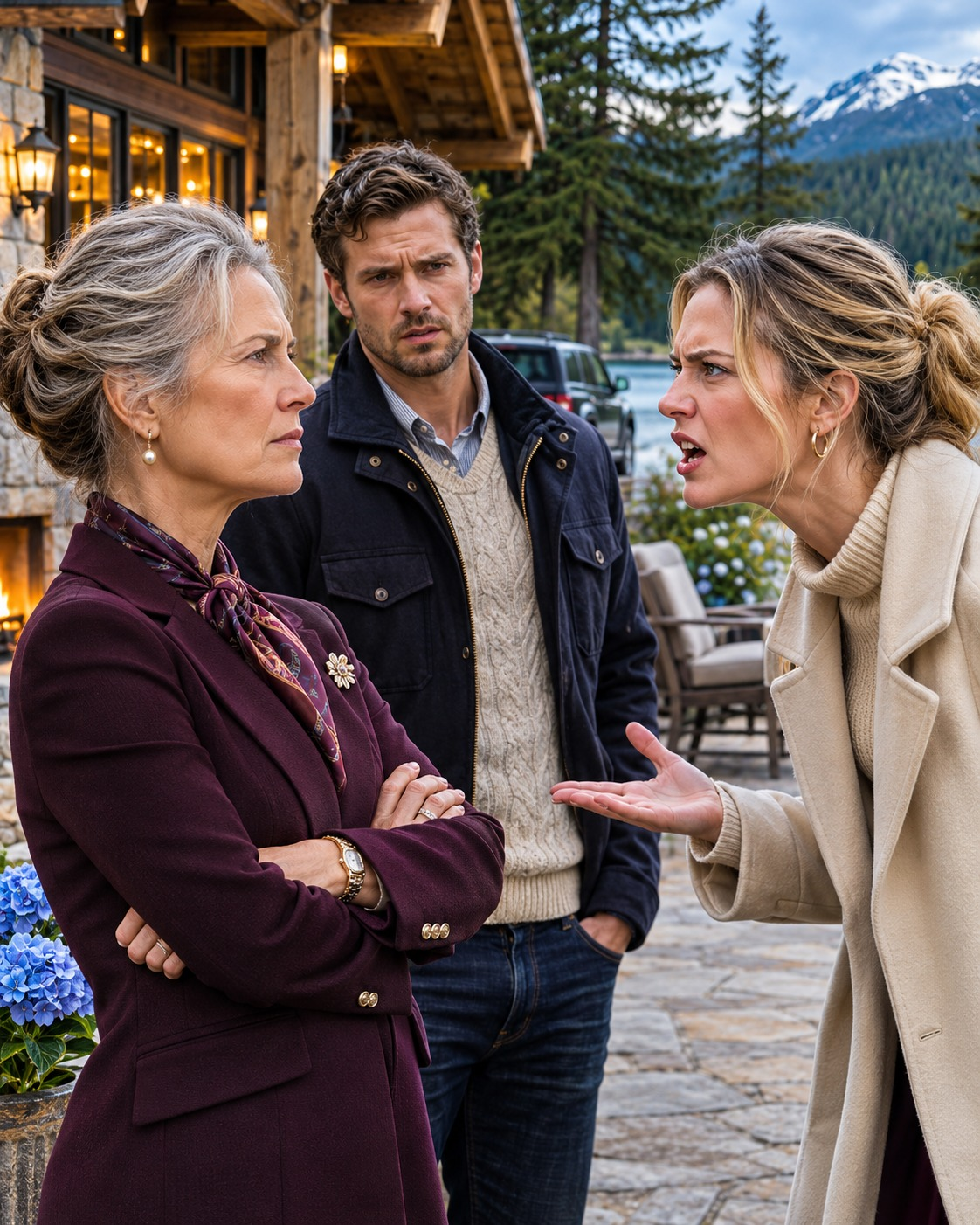
The man standing in Margaret Collins's doorway was Victor Hale.
For one terrible second, nobody moved.
Clare had gone pale. Margaret stood beside her desk, one hand resting on the computer mouse. And I remained frozen in front of the monitor, staring at a document that claimed I had transferred an interest in my nine acres.
Victor looked from Margaret to me.
"Mrs. Harper," he said, "I'm glad you're still here."
I didn't answer.
My eyes moved to the paper in his hand.
Then back to the signature on Margaret's screen.
"Mr. Hale," I said, "why is your name on that document?"
He stopped.
"What document?"
Margaret turned the monitor toward him.
He stepped closer.
I watched his expression change as he read the heading.
TRANSFER OF PROPERTY INTEREST
Then his eyes reached the witness section.
He went completely still.
"That's my name," he said.
"Yes," Margaret replied.
He leaned forward.
"But I didn't witness this."
Clare made a small sound behind us.
Victor looked at her.
"Clare, what have you done?"
She shook her head.
"I didn't know he was going to submit it."
My stomach tightened.
"Who?"
Clare covered her mouth.
Margaret spoke before anyone else could.
"Victor, why did you come here?"
He held up the papers in his hand.
"Because I received a notice that a document had been submitted using my professional information. I wanted to make sure Mrs. Harper knew."
He looked at the screen again.
"I didn't sign this. I didn't witness Evelyn Harper signing anything. And I certainly didn't authorize anyone to use my name."
I felt my knees weaken.
For days, I had been watching people use my name, my husband's documents, and my son's future as pieces in a financial arrangement.
Now someone had tried to use Victor's identity too.
Margaret reached for her phone.
"We need to contact the recorder immediately."
She looked at me.
"Evelyn, the document has been submitted for recording. That does not mean the transfer is valid, and we need to verify whether it has actually been recorded."
I nodded.
"Please."
She made the call while Victor examined the submission details.
Clare sat motionless.
I looked at her.
"Who submitted it?"
Her eyes filled.
"Martin Voss."
I stared at her.
"Melissa's husband?"
She nodded.
"He works with private property transactions. He said he could finish the paperwork."
Victor turned sharply.
"Finish what paperwork?"
Clare began crying.
"The arrangement."
I looked at the document.
"You mean the arrangement I refused?"
She lowered her head.
"Yes."
I took a long breath.
"And you knew he was preparing another document?"
She nodded.
"I knew he was working on something. I told him to stop after our conversation."
I watched her carefully.
"When?"
"This afternoon."
"And what did he say?"
"He said it was already too late."
Margaret ended her call.
Her expression was serious, but steady.
"The recorder's office has flagged the submission for review because of the objections already on file. They have not confirmed a completed recording."
I exhaled.
She continued.
"We're sending Victor's written denial of the witness signature, along with Evelyn's sworn statement that she never signed or authorized the transfer."
Victor nodded immediately.
"I'll sign whatever statement accurately reflects what happened."
Margaret looked at Clare.
"And you need your own attorney. You should preserve every communication with Martin Voss."
Clare nodded through her tears.
"I will."
I looked toward the office window.
Outside, the Montana sky was turning pink.
The sun was setting behind the mountains.
I had spent the last several days fighting to protect a home that had belonged to me all along.
And somehow, standing there in Margaret's office, I understood something important.
The people who had tried to take control of my property had depended on confusion.
They had depended on urgency.
They had depended on my love for my son.
And most of all, they had depended on me being too frightened or too exhausted to keep asking questions.
But I was still asking.
And this time, the answers were finally coming.
The following weeks were not easy.
I won't pretend they were.
Real problems don't disappear simply because someone admits the truth.
There were interviews with investigators.
Meetings with attorneys.
Financial records to examine.
Documents to compare.
And painful conversations that should have happened months earlier.
But the situation changed once people stopped treating Clare's promises as facts.
Margaret worked with the county recorder's office and the appropriate authorities to address the attempted transfer.
The submission was not accepted as a valid conveyance of my property. The signatures and purported witness information were disputed, and the matter was referred for investigation.
A subsequent title examination confirmed that I remained the sole owner of the nine acres.
No authorized sale had occurred.
No valid subdivision had been completed.
No enforceable mortgage against my property had been established through the papers Clare had submitted.
The proposed five-year occupancy agreement had never been accepted by me.
And neither Caleb nor Clare had any authority to give away my guest house.
I remember the morning Margaret called with the updated title findings.
I was standing on my porch, holding a cup of coffee.
Exactly where I'd been when Clare first told me I was too old to need nine acres.
"Evelyn," Margaret said, "the title review is complete."
I held my breath.
"And?"
"The property remains yours."
I closed my eyes.
I had known that.
Legally, I had known it.
But hearing those words after everything that had happened brought tears to my eyes.
"All nine acres?"
"All nine acres."
I looked toward the meadow.
The morning sun was spilling across the grass.
Beyond the pines, the lake glittered.
"Thank you, Margaret."
She laughed softly.
"You did the hard part."
I shook my head.
"No. Robert did some of it years ago."
There was a pause.
"Yes," she said. "He certainly helped."
I thought about the blue envelope.
The original trust agreement.
The memorandum he'd left with Helen Crawford.
The letter he'd written to Caleb.
Robert had understood something I hadn't fully appreciated when we were younger.
Good intentions were not enough to protect a family.
Sometimes love needed clear boundaries.
Sometimes those boundaries needed to be written down.
And sometimes the most loving thing a person could do was refuse to let someone else make decisions that weren't theirs to make.
Caleb's situation took longer to untangle.
He had signed a genuine personal guarantee connected to Clare's borrowing.
He had also signed a statement falsely claiming that I had approved the guest-house arrangement.
Those were his choices.
He couldn't blame Clare for making them.
And to his credit, he eventually stopped trying.
He hired his own attorney.
He provided the documents he'd signed.
He disclosed the emails he'd found.
And he cooperated with the investigation into the altered signatures.
The disputed loan amendment bearing his name was examined separately.
The lender ultimately acknowledged that the amendment could not be treated as an authenticated agreement signed by Caleb without further proof.
That did not erase his legitimate obligations.
He still had debts to address.
He still faced consequences for the false statement he'd signed.
But he no longer had to accept every amount Clare or her advisers claimed he owed.
His attorney helped him negotiate a repayment arrangement for the obligations that were actually his.
It wasn't painless.
He sold his expensive truck.
He cut his expenses.
He took extra work.
And for the first time in years, he began living according to what he could afford instead of what he hoped someone else would provide.
One evening, he came to the cabin carrying two grocery bags.
I opened the door.
"What's all this?"
He smiled awkwardly.
"Dinner."
I looked inside.
Chicken.
Potatoes.
Green beans.
And a small apple pie.
I raised an eyebrow.
"Are you cooking?"
He laughed.
"I'm going to try."
I stepped aside.
"Then come in."
We worked together in the kitchen.
He peeled potatoes while I prepared the chicken.
For a while, we talked about ordinary things.
His job.
The weather.
A neighbor's new dog.
Then he set down the peeler.
"Mom?"
I looked at him.
"Yes?"
"I need to apologize again."
I sighed softly.
"Caleb—"
"No. Please."
I waited.
He looked directly at me.
"I signed a statement saying you'd agreed when I knew you hadn't."
I nodded.
"I know."
"I let Clare use my expectations about inheriting this place as though they were rights."
I remained silent.
"And when you said no, I acted like you were the one hurting everyone."
My throat tightened.
He swallowed.
"I was wrong."
I looked at my son.
For once, there was no excuse.
No mention of pressure.
No attempt to make his mistakes sound smaller.
Just the truth.
"Thank you for saying that," I whispered.
He nodded.
"I don't expect you to trust me immediately."
"Good," I said gently. "Because trust takes time."
He smiled sadly.
"I know."
I reached across the counter and touched his hand.
"But I want us to rebuild it."
His eyes filled.
"So do I."
That evening, we ate dinner at the old oak table Robert had built.
Caleb told me he was seeing a counselor.
He was learning to recognize when his desire to keep everyone happy led him to avoid difficult conversations.
I told him I was glad.
Then he asked whether I was planning to change my will.
I studied him carefully.
"Yes."
He nodded.
"That's your right."
I waited.
He continued.
"I don't need to know what's in it."
I felt a small, unexpected warmth.
For the first time, my son was speaking about my future without treating it as his property.
"Thank you," I said.
He smiled.
Then he reached for another piece of pie.
And for a little while, we were simply mother and son again.
Clare and Caleb separated.
It wasn't a dramatic scene.
There were no shouting matches on my porch.
No midnight confrontations.
Just a difficult decision made after weeks of painful conversations.
Caleb told me he still cared about her.
But he couldn't continue a marriage in which financial decisions were hidden, signatures were misused, and the truth only emerged after someone discovered another document.
Clare began working with her own attorney to address the financial arrangements and her involvement in the false paperwork.
She also agreed to cooperate with investigators.
The document-preparation service's records helped establish how my signature sample had been supplied and used.
Martin Voss's involvement in the attempted transfer was examined separately.
Melissa's unauthorized entry into the workshop remained part of the investigation, along with the return of Robert's original papers.
I wasn't present for every interview or legal discussion.
I didn't need to be.
What mattered to me was that the evidence was preserved, the false property claims were challenged, and the people involved could no longer pretend the arrangements had been authorized.
Several months later, Clare wrote me a letter.
It arrived in an ordinary white envelope.
No legal language.
No proposed agreement.
No demand for my signature.
Just her handwriting.
I sat at the kitchen table and opened it.
She apologized for telling her parents they could move into my guest house.
She admitted that she had known I hadn't agreed.
She acknowledged that she'd treated my property as a solution to problems that belonged to her and Caleb.
And she wrote something I hadn't expected.
I thought that if I could make everyone dependent on the plan, you would have no choice but to accept it.
I stared at that sentence.
It was the clearest explanation she'd ever given.
She continued.
I was wrong to use Caleb's love for you against both of you. I was wrong to make your age an excuse for taking away your choices. And I was wrong to believe that my parents' fear gave me the right to take something from you.
I read the letter twice.
Then I folded it.
I didn't cry.
I didn't feel triumphant.
I felt sad.
Because so much pain could have been avoided if Clare had simply asked for help honestly.
I wrote back.
My letter was brief.
I thanked her for acknowledging what she'd done.
I told her I hoped she continued taking responsibility for her choices.
And I wished her a healthier future.
I didn't offer her the guest house.
I didn't promise forgiveness on a schedule.
I didn't invite her to begin again as though nothing had happened.
But I didn't wish her harm.
That was enough.
Richard and Patricia Bennett found a small rental apartment in town.
It wasn't the home they'd hoped for.
It didn't have a mountain view.
There was no guest house.
No meadow.
No lake.
But it was a place they could afford while they worked through their debts.
Richard found part-time work.
Patricia began selling some of the belongings they'd accumulated over the years.
They met with a nonprofit financial counselor and started making a realistic plan.
One afternoon, Richard called.
"Evelyn?"
"Hello, Richard."
"I wanted to thank you."
I frowned.
"For what?"
"For not letting us move in."
I was silent.
He continued.
"I know that sounds strange."
"A little."
He sighed.
"But if we'd moved into your guest house, we'd have kept pretending someone else could fix our problems."
I looked toward the cedar building.
"Perhaps."
He paused.
"Patricia and I have had some hard conversations."
"I'm sure."
"We should have asked you directly. We should have questioned the paperwork. And we should never have let Clare make promises on your behalf."
I nodded.
"Thank you for saying that."
He hesitated.
"Would you ever be willing to have coffee with us?"
I thought about it.
Then I said, "Perhaps someday."
He understood.
There was no pressure.
No argument.
Just a quiet acceptance.
And that, more than anything, made me believe they were beginning to change.
Spring arrived slowly in Montana.
The snow retreated from the lower slopes.
The meadow turned green.
The lake thawed.
And the first wildflowers appeared near the fence Robert had built.
I spent several weekends working outside.
I repaired a loose board on the porch.
I cleaned the workshop.
I organized the filing cabinet.
And I placed Robert's original documents in secure storage, with certified copies and clear instructions about where they could be found.
Margaret helped me review my estate plan.
We made sure it reflected my wishes.
We clarified who could act on my behalf if I ever became unable to manage my affairs.
We also made clear that no anticipated inheritance gave anyone authority over my property while I was alive.
I didn't make those decisions out of anger.
I made them because I wanted my future to be orderly.
And because I had learned that uncertainty could become dangerous when people were willing to exploit it.
Then I made another decision.
The guest house would remain mine to use as I chose.
But I wanted it to serve a purpose.
So I contacted a former colleague from the hospital.
Her name was Susan Miller.
We had worked together for nearly twenty years.
She was now helping coordinate temporary housing for traveling nurses who came to work in rural Montana.
When I explained my idea, she sounded delighted.
"Evelyn, are you serious?"
"Completely."
"You'd be willing to let visiting nurses stay in your guest house?"
"For short periods. With proper agreements and clear boundaries."
She laughed.
"That sounds exactly like you."
I smiled.
"I've had enough informal arrangements for one lifetime."
Susan laughed harder.
We worked out the details carefully.
Margaret reviewed the documents.
I made sure insurance and local requirements were addressed.
And when everything was ready, I welcomed my first guest.
Her name was Hannah.
She was twenty-eight, a registered nurse from Oregon, and she had accepted a six-week assignment at a nearby hospital.
She arrived on a sunny Monday afternoon carrying two suitcases and a potted basil plant.
I met her beside the guest house.
"Welcome to Montana."
She smiled.
"Thank you for letting me stay."
I handed her the key.
A real key.
Given by the actual owner.
With permission.
I almost laughed at how wonderful that simple moment felt.
Hannah looked around.
"This place is beautiful."
I smiled.
"My husband built most of it."
She looked toward the cabin.
"He must have been very talented."
"He was."
I opened the guest house door.
Inside, the sunlight fell across the wooden floor.
The study was exactly as I'd left it.
Robert's old desk stood beneath the window.
My books remained on the shelves.
The photographs were still in their frames.
Nobody had removed the partition wall.
Nobody had converted the study into another bedroom.
Nobody had erased the memories that made the place special.
Hannah stepped inside.
"Oh, Evelyn. It's lovely."
I smiled.
"I'm glad you like it."
She looked at the desk.
"Would you mind if I used that for studying?"
"Not at all."
I paused.
"Robert would have liked that."
She smiled.
And for the first time in months, the guest house felt peaceful again.
By summer, Caleb was visiting regularly.
Not because he wanted something.
Not because Clare had sent him.
Not because he needed me to sign a document.
He came because he wanted to see me.
Sometimes he brought groceries.
Sometimes he helped with repairs.
Sometimes we simply sat on the porch and watched the sun set over the meadow.
One Saturday, he arrived with a small wooden birdhouse.
I stared at it.
"What's this?"
He smiled.
"Remember the one I made with Dad when I was eight?"
I laughed.
"The one with the crooked roof?"
"That's the one."
He held up the new birdhouse.
"I thought I'd try again."
I examined it.
The roof was straight.
The edges were smooth.
The little entrance hole was perfectly centered.
I smiled.
"Your father would be proud."
Caleb looked down.
"I hope so."
I touched his arm.
"I know so."
We hung the birdhouse near the edge of the meadow.
Then we sat on the porch.
For a while, neither of us spoke.
Finally, Caleb looked at me.
"Mom?"
"Yes?"
"Do you ever wish you'd just let them move in?"
I turned toward him.
"No."
He nodded.
"I didn't think so."
I smiled.
"Do you?"
He was quiet for a moment.
Then he shook his head.
"No."
I looked toward the guest house.
"Your grandparents used to say that helping someone doesn't always mean giving them what they ask for."
Caleb smiled faintly.
"Dad used to say something like that."
"He did."
We sat quietly.
Then he looked at me.
"Mom, I want you to know something."
I waited.
"I don't expect this place to be mine someday."
I studied his face.
He continued.
"I hope you live here as long as you want. And if you ever decide to leave, I hope it's because you want to."
My throat tightened.
"Thank you, sweetheart."
He smiled.
"And if you decide to stay until you're a hundred, I'll still come fix the fence."
I laughed.
"You'd better."
He laughed too.
And in that moment, I felt something I hadn't felt in a long time.
Trust beginning to return.
Not all at once.
Not because the past had disappeared.
But because my son was finally learning that love didn't require control.
On the first anniversary of the morning Clare told me her parents were moving into my guest house, I stood on the porch with a cup of coffee.
The air was cool.
The mountains were beautiful.
The meadow shimmered beneath the morning sun.
Nine acres.
Every inch of them still mine.
The cabin.
The workshop.
The cedar guest house.
The old fence.
The pine trees.
The narrow path to the lake.
I looked toward the guest house.
Hannah had finished her assignment months earlier, but other visiting nurses had stayed since then.
The place had become exactly what I wanted it to be.
A welcoming home for people I chose to invite.
Not a permanent arrangement forced upon me.
Not a financial asset controlled by someone else.
Not a reward for people who believed my age made me powerless.
I took a sip of coffee.
Then I walked down the porch steps.
The gravel crunched beneath my shoes.
I passed the workshop and stopped beside the old wooden bench Robert had built.
For a moment, I imagined him sitting there.
His sleeves rolled up.
His work boots dusty.
That familiar smile on his face.
"Well, Robert," I whispered, "we made it."
The breeze moved through the pines.
I smiled.
I thought about the three decisions I'd made.
I had protected my ownership.
I had refused to surrender management of my property.
And I had chosen my own future.
Those decisions hadn't destroyed my family.
They had forced us to stop pretending.
Caleb was rebuilding his life.
Clare was facing the consequences of hers.
Richard and Patricia were learning to live within their means.
And I was still here.
In the home Robert and I had built.
I walked back toward the cabin.
On the porch table sat a photograph of Robert and me from our twenty-fifth wedding anniversary.
We were standing beside the lake.
His arm was around my shoulders.
I was laughing at something he'd said.
I picked up the frame.
For a moment, I held it against my chest.
Then I placed it back on the table.
"Thank you," I whispered.
Not because he had saved me.
He hadn't needed to.
He had simply trusted that I could take care of myself.
And he had left behind the truth when other people tried to change it.
I sat in my favorite chair.
The same chair I'd occupied on the morning Clare announced her plans.
I looked out across the meadow.
I remembered her words.
You're too old to need nine acres.
I smiled.
Perhaps I didn't need nine acres.
Perhaps nobody truly needed that much land.
But needing something and having the right to keep it were two different things.
I had earned this home.
I had loved it.
I had cared for it.
And I had every right to decide what happened here.
My phone vibrated.
A message from Caleb.
Morning, Mom. Coming by Sunday. Want me to bring anything?
I smiled and typed:
Apple pie.
His reply came almost immediately.
Only if you promise to save me a piece.
I laughed.
Then I set the phone down.
The sun climbed higher.
A bird landed on the little house Caleb had built.
The wind stirred the grass.
And somewhere beyond the trees, the lake caught the light.
I lifted my coffee cup.
For the first time in a long while, there was nothing I needed to defend.
No moving truck in the driveway.
No stranger with a key.
No document waiting for my signature.
Just my home.
My family finding its way back to honesty.
And the life I had chosen.
I took another sip of coffee and smiled toward the mountains.
Nine acres.
One lifetime of memories.
And a future that belonged to me.






Comments 0