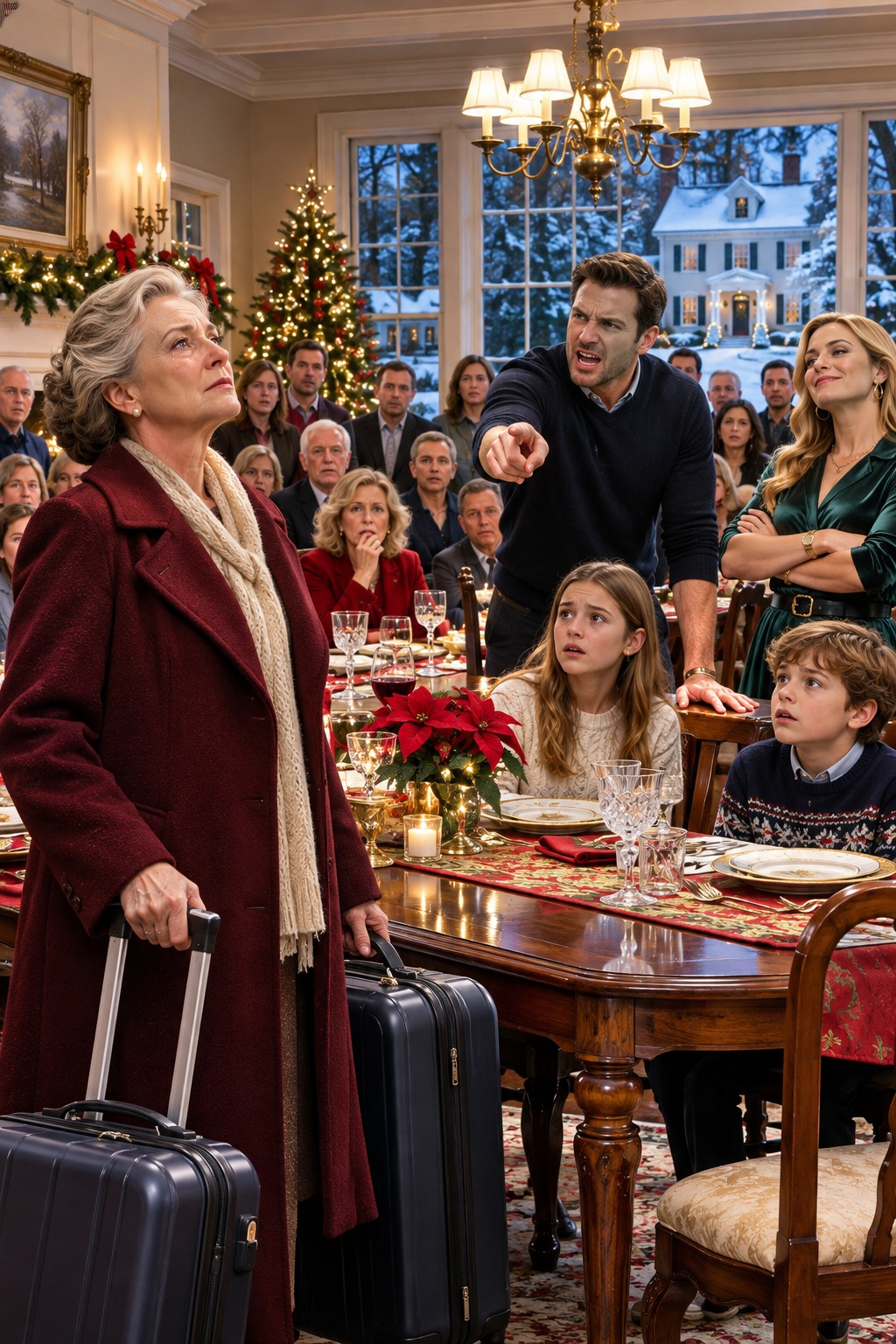
"Starting January first, you pay eighteen hundred dollars a month, or you get out!"
My son Daniel slammed his palm against my Christmas dinner table.
Beside my plate sat a folded napkin with a tiny embroidered letter R.
Robert's initial.
My late husband's initial.
And suddenly, I understood something Daniel had forgotten.
He was threatening to throw me out of a house that had never belonged to him.
The crystal glasses rattled.
Someone gasped.
My twelve-year-old granddaughter, Sophie, froze with her fork halfway to her mouth. Her younger brother, Ethan, stopped chewing and stared at his father with an expression I had never seen on that little boy's face before.
Fear.
Not fear of a stranger.
Fear of his own father.
Twenty-two members of my family had gathered in my dining room that Christmas evening. A few minutes earlier, everyone had been laughing about Linda's terrible attempt at making homemade cranberry sauce.
Now nobody moved.
My name is Margaret Whitaker.
I was seventy-two years old that Christmas, and until that moment, I had believed the worst day of my life was the afternoon I buried my husband.
Robert and I had been married for forty-six years.
We had built a life together, raised our only son, survived illnesses, arguments, financial troubles, and the ordinary disappointments that come with growing older.
When cancer took Robert, I thought grief had already taught me everything there was to know about losing someone I loved.
I was wrong.
Because there is something especially cruel about watching a child you raised become someone you no longer recognize.
"Daniel," I said quietly. "Sit down."
He laughed.
Not because anything was funny.
It was the kind of laugh people use when they want everyone in the room to know they believe they have won.
"No, Mom. I'm done sitting down and pretending everything is fine."
He stood at the opposite end of my polished mahogany dining table, wearing the navy sweater Melissa had bought him for his birthday.
I remembered the sweater because I had paid the credit-card bill that covered it.
That was the sort of detail I had spent years teaching myself not to notice.
Daniel pointed toward the kitchen.
"Do you have any idea how much it costs to run this house?"
I looked at him.
"Yes."
He blinked.
"Excuse me?"
"I know exactly how much it costs."
Melissa shifted in her chair.
My daughter-in-law had always been beautiful in the polished, deliberate way some women are. Her honey-blonde hair fell in perfect curls over an emerald-green dress. Gold earrings caught the chandelier light every time she moved her head.
She smiled at me.
I had learned to distrust that smile.
"Margaret," she said, "Daniel is trying to have an adult conversation."
"Then perhaps he should lower his voice."
Daniel's face reddened.
"There! That's exactly what I'm talking about. Every time we try to discuss responsibilities, you act like we're attacking you."
My sister Linda, sitting three chairs away, slowly placed her wineglass on the table.
I saw the movement from the corner of my eye.
Linda knew more than anyone else in that room.
Not everything.
But enough.
"Daniel," she said, "this is Christmas."
"Exactly!" he snapped. "And maybe Christmas is the perfect time for everyone to hear the truth."
Several relatives exchanged uncomfortable looks.
My cousin Richard stared at his plate.
My niece Caroline reached for her waterglass and then changed her mind.
Nobody wanted to be the first person to intervene.
Daniel took their silence as encouragement.
"Melissa and I buy groceries. We handle maintenance. We pay utilities. We take care of everything around here while Mom acts like we're her personal servants."
I felt something cold settle inside my chest.
It was not surprise.
That realization hurt almost as much as his words.
Because I had heard versions of this accusation before.
Never in front of twenty-two relatives.
Never on Christmas.
But the idea had been growing inside my son's mind for years.
He had begun treating every small favor as evidence of a great sacrifice.
Driving me to a doctor's appointment became proof that I could not manage my life.
Helping me reset an online password became proof that I was incapable of handling money.
Changing a lightbulb became another example of how much I supposedly depended on him.
Meanwhile, the monthly transfers leaving my bank account had continued without interruption.
I looked toward the windows.
Snow was falling across the front lawn.
Beyond the glass stood the white colonial house across the street, its porch decorated with warm Christmas lights.
Robert used to admire that house.
He would stand beside me with a cup of coffee and joke that its owners were trying to compete with our decorations.
For thirty-one years, this had been our home.
We had bought it when Daniel was seventeen.
He learned to drive in the long driveway.
He brought his first girlfriend through the front door.
We celebrated his graduation in the backyard.
When his construction business failed, he came back here with his wife and children because he said he needed somewhere safe to start over.
I had opened the door without hesitation.
Now he wanted to charge me rent.
In my own home.
"Mom, are you listening?"
I turned back toward him.
"Every word."
"Good. Because I'm not repeating myself."
Melissa leaned forward.
"Frankly, Margaret, eighteen hundred dollars is reasonable. You couldn't rent a place this nice for that amount anywhere around here."
I looked at her.
"You're asking me to pay rent to live in a house I own."
She gave a small, impatient sigh.
"Ownership isn't the only thing that matters. Somebody has to keep the place running."
I almost smiled.
Not because her words amused me.
Because I knew something she did not.
For three months, I had been preparing for a conversation like this.
I simply hadn't expected it to happen over Christmas dinner.
"Grandma?"
Sophie's voice was barely audible.
I looked toward her.
She was wearing the cream sweater I had bought her at the beginning of December. Her long brown hair fell over one shoulder.
"Yes, sweetheart?"
"Are you going somewhere?"
Before I could answer, Daniel spoke.
"Nobody's going anywhere if Grandma starts being reasonable."
Ethan looked down at his plate.
My heart broke a little more.
Children understand more than adults like to believe.
They might not understand mortgages or insurance premiums, but they recognize humiliation.
They know when someone is being cruel.
And they remember who stays silent.
I reached for my napkin.
The white linen felt soft beneath my fingers.
Robert had chosen that set for our twenty-fifth wedding anniversary.
He had insisted on having our initials embroidered in the corners.
I remembered teasing him that nobody needed fancy napkins just to eat roast turkey.
He had smiled and told me that ordinary days deserved beautiful things too.
I folded the napkin carefully.
Then I placed it beside my plate.
"Daniel," I said, "I want to ask you something."
He crossed his arms.
"Go ahead."
"Are you absolutely certain you want me to leave?"
He stared at me.
"What?"
"If I refuse to pay eighteen hundred dollars a month, you want me out of this house?"
"That's what I said."
"Even though it's Christmas?"
"Don't make this emotional."
"Even though Sophie and Ethan are sitting right here?"
He glanced toward the children.
Only briefly.
Then he looked back at me.
"Stop using the kids to manipulate me."
I nodded.
"And if I leave, you understand that I'll be living somewhere else?"
Melissa rolled her eyes.
"Margaret, that's generally what leaving means."
A few relatives shifted uncomfortably.
I ignored her.
My eyes remained on Daniel.
"Is that truly what you want?"
He didn't hesitate.
"Yes."
One word.
After fifty years of loving my son, protecting him, and finding excuses for his mistakes, I discovered how much damage one word could do.
I waited.
Some foolish part of me still expected him to soften.
To look at his children.
To remember his father.
To say he had gone too far.
Instead, he added, "Maybe being on your own for a while will teach you how much we do for you."
Melissa smiled.
Then she lifted her wineglass.
"Let's see how you survive without us."
I heard Linda draw in a sharp breath.
My cousin Richard whispered something under his breath.
But I felt strangely calm.
For years, I had feared this moment.
I had feared that saying no to Daniel would mean losing him.
I had feared that protecting my savings would make me a selfish mother.
I had feared that refusing another emergency payment would somehow hurt my grandchildren.
Now the thing I feared most was happening anyway.
And I was beginning to understand that I had spent six years paying for the privilege of being mistreated.
"Very well," I said.
Daniel frowned.
"What does that mean?"
"It means I've heard you."
"Good."
"And I've made my decision."
He leaned back, looking satisfied.
For one brief moment, I think he believed I was about to agree to his demand.
Perhaps he imagined I would apologize.
Perhaps he expected me to ask whether I could pay in installments.
Perhaps he thought I would cry.
I had cried enough after Robert died.
I was not going to cry for Daniel's benefit.
I pushed my chair back.
The wooden legs scraped softly against the floor.
Every head turned toward me.
"Where are you going?" Daniel demanded.
"To get something."
"What something?"
I did not answer.
I walked toward the hallway.
Behind me, I heard Melissa whisper, "She's being dramatic."
I continued past the framed photographs of Daniel's childhood.
There he was at eight years old, missing his front teeth.
There he was at seventeen, standing beside Robert after his high-school graduation.
There he was on his wedding day, smiling at Melissa as though the world had finally given him everything he wanted.
I stopped beside the coat closet.
My burgundy wool coat hung on the hook nearest the door.
I reached into its pocket.
My fingers closed around something small and cold.
A brass key.
I held it in my palm for a moment.
Three months earlier, I had received that key from a real-estate agent in Lancaster.
Only Linda and my attorney knew what it opened.
Daniel had no idea.
Neither did Melissa.
I returned to the dining room.
The conversations had not resumed.
Everyone was still waiting.
Daniel stood with his arms crossed.
"Well?"
I walked to the head of the table.
Then I raised the brass key.
The chandelier caught its polished surface.
"I'm leaving, Daniel," I said. "And I'm going to my new home in Lancaster."
For the first time that evening, my son had nothing to say.
Melissa lowered her wineglass.
"Your what?"
"My new house."
Daniel stared at the key.
His eyes moved from my hand to my face.
Then back again.
"That's impossible."
I looked at him calmly.
"No, Daniel. It isn't."
He stepped around the table.
"Where did you get the money?"
And that was when I realized his first question wasn't whether I would be safe.
It wasn't whether I would be lonely.
It wasn't even why I had kept such a major decision secret.
He wanted to know about my money.
I slipped the brass key back into my palm.
"There's something else you need to understand," I said.
Daniel opened his mouth.
But before he could speak, Linda stood abruptly.
Her chair scraped against the floor.
She was staring at the hallway.
"Margaret," she whispered, "I think you need to see who's at the front door."
I turned.
The doorbell rang again.
And through the frosted glass, I recognized a figure I had not expected to see that Christmas night.






Comments 0