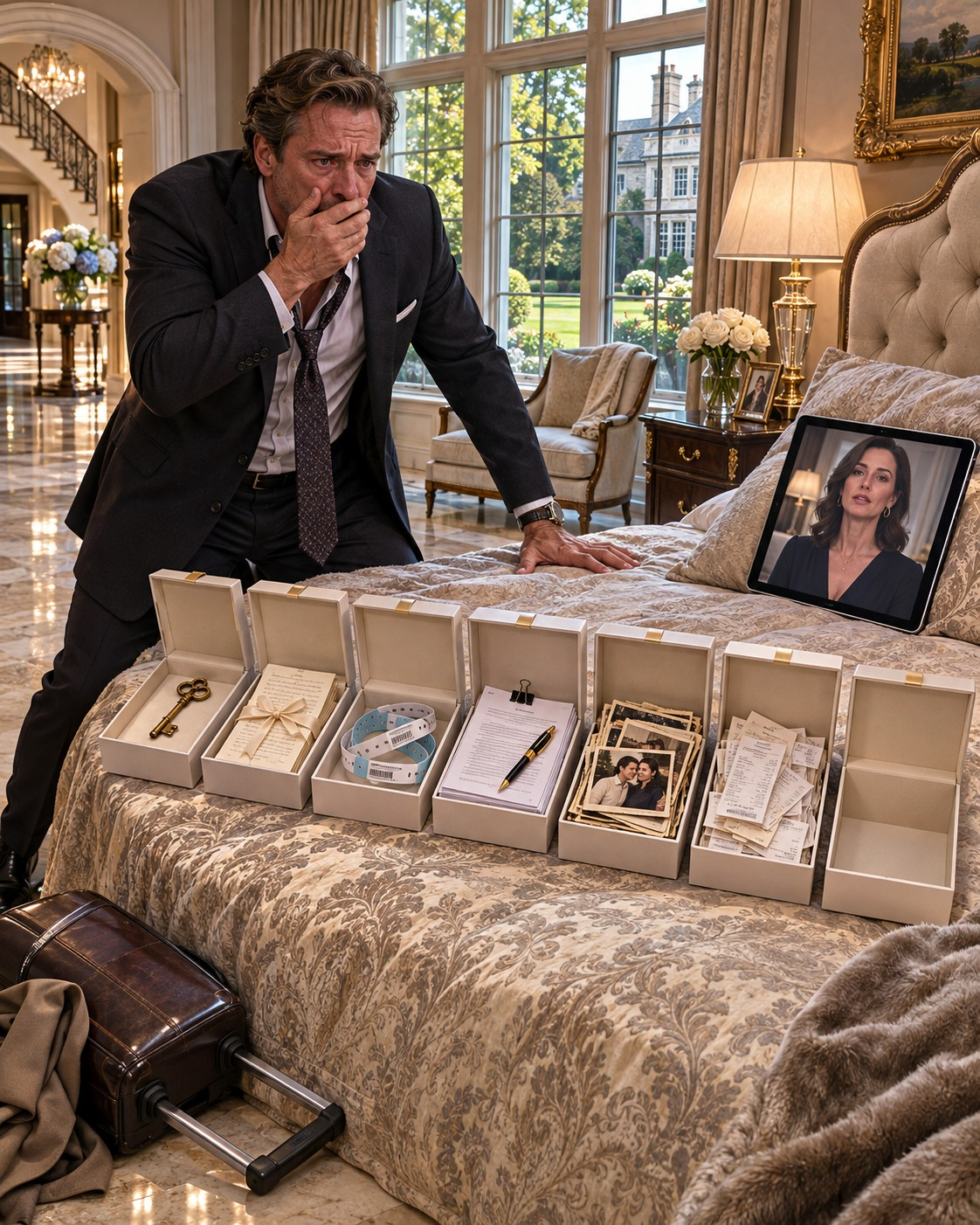
The notification arrived at 4:38 p.m.
I read it three times before I understood what it meant.
Someone had formally requested Isabelle's removal as the beneficiary of Meridian Holdings Trust.
Eleven minutes earlier.
I looked at Richard.
"Who submitted this?"
He leaned over my shoulder and examined the document.
"Martin Kessler."
"You're sure?"
"The electronic submission carries his authorization credentials."
I laughed bitterly.
"Of course it does."
Richard didn't react.
I walked toward the windows, trying to organize the thoughts racing through my head.
Martin had been my chief financial officer for eleven years. He had attended my father's funeral. He had stood beside me during the company's most difficult acquisitions. He had been present at my wedding anniversary celebrations and had even joined Isabelle and me for Christmas dinner.
I had trusted him with everything.
Now he was attempting to remove my wife from a trust established by my father.
And he had done it while she was missing.
"How quickly can this removal happen?" I asked.
Richard closed the document.
"Under normal circumstances, it would require verification and approval from the independent trustee."
"How long?"
"Several business days."
"And under these circumstances?"
His expression darkened.
"If someone has compromised the original authorization records, the process could be much faster."
I turned toward him.
"Then stop it."
"I need Isabelle's cooperation."
"She isn't here."
"I know."
"Then use mine."
Richard shook his head.
"That's exactly what your father designed the agreement to prevent."
I stared at him.
"You're telling me I can't protect my own wife?"
"I'm telling you that the trust was designed to protect her from anyone who might try to control her financial interests."
The words irritated me because I knew what he meant.
My father had anticipated a situation in which someone might attempt to manipulate the company.
Apparently, he had also anticipated that I might not be capable of protecting the people closest to me.
I looked toward the bed.
The seven white boxes were still arranged in their perfect row.
I had spent the afternoon opening them one by one, discovering pieces of my marriage that I had forgotten.
Now I wondered whether the boxes were also a warning about something much larger.
I picked up the original incorporation papers.
"Richard, explain the $180,000."
He looked at me.
"What specifically?"
"Everything. I want to know exactly what Isabelle invested, what she owned, and why my father considered her more trustworthy than his own son."
Richard pulled a chair closer to the bed.
"Then we need to start at the beginning."
In 2009, Hartwell Infrastructure was barely a company.
It was an ambitious idea with an office that smelled of cheap coffee, three employees, and a business plan that most investors considered unrealistic.
My father had helped me establish the first corporate structure.
But he refused to finance the entire operation.
He believed I needed to prove that I could build something without depending entirely on his reputation.
At the time, I had been furious with him.
I thought he was being unnecessarily difficult.
I was thirty-five years old and desperate to succeed.
I wanted the world to recognize me as more than Edward Hartwell's son.
I wanted my own company.
My own money.
My own name.
But the business nearly collapsed before it had properly begun.
We had contracts waiting for approval, employees expecting salaries, and a bank account that was almost empty.
I remembered one particular evening.
I had been sitting at our kitchen table in Boston, staring at the numbers.
Isabelle walked in carrying two cups of coffee.
She placed one beside me.
"How bad is it?"
I didn't answer.
She pulled out a chair.
"Julian?"
"We're finished."
She looked at the spreadsheet.
"How much do you need?"
I laughed.
"More than we have."
"How much?"
I hesitated.
"One hundred and eighty thousand."
She looked down at her hands.
Then she stood up and walked toward the bedroom.
I thought she was upset.
Instead, she returned carrying a folder.
Inside were the documents for her inheritance.
Her grandmother had left her $180,000.
It was the only substantial financial security she had ever received.
I immediately shook my head.
"No."
She sat opposite me.
"Listen first."
"I'm not taking your inheritance."
"Julian, we need the money."
"I'll find another investor."
"You've been trying for six months."
"I'll find someone."
She reached across the table.
"Look at me."
I reluctantly raised my eyes.
"I believe in you."
I looked at the documents.
"This is your grandmother's money."
"And she would have wanted me to use it for something meaningful."
"What if the company fails?"
"Then it fails."
"You could lose everything."
She squeezed my hand.
"We'll figure it out."
I remembered kissing her forehead.
I remembered promising that I would never forget what she had done.
And I remembered how sincerely I meant those words.
Richard interrupted my thoughts.
"There's something else about that investment."
I looked up.
"What?"
"The original agreement wasn't structured as a simple loan."
I glanced at the documents.
"Then what was it?"
"Your father insisted that Isabelle's contribution be protected through a founding ownership arrangement."
I frowned.
"Why?"
"Because he believed she was taking a greater personal risk than anyone else involved."
Richard turned the document toward me.
"Your father understood that if the company failed, you would still have family resources and professional connections. Isabelle had put nearly all her available capital into the business."
I looked at the agreement.
The wording was complicated, but one paragraph stood out.
Her contribution was classified as a protected founding investment.
"What did that mean?"
"It meant that her financial interest couldn't simply disappear because the company became successful or changed ownership."
I studied the page.
"How much did she own?"
"Initially, a substantial minority interest in the founding structure."
"How substantial?"
Richard hesitated.
"Your father allocated her twenty percent of the original protected ownership pool."
I looked at him.
"Twenty percent?"
"Yes."
I calculated the figures in my head.
Hartwell Infrastructure had grown into a company with a multibillion-dollar valuation.
Even a fraction of the original ownership structure could represent an extraordinary amount of money.
"How much is that worth today?"
Richard shook his head.
"We can't calculate it accurately until we establish the current trust valuation."
"Give me an estimate."
"Depending on the assets attached to the original structure, it could be worth several hundred million dollars."
I sat down.
Several hundred million.
Isabelle had invested $180,000 when we were struggling to pay our bills.
And I had spent years behaving as if every dollar in our life had come from my intelligence and ambition alone.
"Does she know?"
Richard nodded.
"She knows."
"How long?"
"She reviewed the original ownership agreement several years ago."
I stared at him.
"She never told me."
Richard's response was quiet.
"Perhaps she didn't want you to feel indebted to her."
I looked away.
That sounded exactly like Isabelle.
She had never been interested in using money to control me.
Even when we were poor, she had never reminded me of what she had sacrificed.
She had simply wanted me to remember that we were building something together.
And I had forgotten.
I picked up the fifth box.
The photographs were still scattered across the bed.
I began sorting through them again.
There was a photograph from our first company celebration.
We were standing outside a small restaurant in Boston.
I was wearing an inexpensive suit.
Isabelle had borrowed a dress from a friend.
We were laughing.
Behind us stood the three original employees of Hartwell Infrastructure.
I recognized all of them.
Two had retired.
The third, Thomas Reed, had become one of our senior regional directors.
I turned the photograph over.
A date was written on the back.
June 18, 2010.
Then I noticed another photograph.
It had been taken one year later.
Isabelle was standing beside my father.
They were in the garden of his old house.
Both were smiling.
I had rarely seen the two of them together without me.
I examined the back.
There was a handwritten note.
Edward finally admitted that Julian might actually succeed.
I almost smiled.
Then I noticed a second sentence beneath it.
He also said we needed to keep something safe.
I looked at Richard.
"Did my father and Isabelle have a separate agreement?"
He leaned closer.
"Possibly."
"What does that mean?"
"Your father trusted Isabelle with certain original records."
"Which records?"
"I don't know."
I returned to the photographs.
There was another picture of Isabelle holding a large envelope.
The photograph had been taken in the same garden.
I recognized the envelope.
It was the kind used by the law firm that had handled my father's estate.
"Richard, do you know this attorney?"
He examined the photograph.
"That's Nathaniel Price."
"The man I spoke to earlier?"
"Yes."
I looked again.
Nathaniel was standing beside Isabelle.
He was holding a document.
Something was written across the envelope.
FOUNDING TRUST — ORIGINALS.
My pulse quickened.
"Why would Isabelle have those records?"
Richard slowly shook his head.
"I think we need to ask Nathaniel."
I called him.
He answered immediately.
"Mr. Hartwell."
"I found a photograph of Isabelle with you."
"Where?"
"In our garden. She's holding an envelope marked Founding Trust."
There was a pause.
"That was several years ago."
"What did you give her?"
"The original ownership certificate."
I gripped the phone.
"Why?"
"Because your father requested it."
"What did he want her to do with it?"
"Keep it safe."
"From whom?"
Nathaniel's answer was direct.
"From anyone who might attempt to alter the founding ownership records."
I looked toward Richard.
"Was there a threat?"
"Not at that time."
"Then why?"
"Your father had become concerned about changes in the company's internal governance."
I felt my stomach tighten.
"Changes made by whom?"
Nathaniel paused.
"Several senior executives had been attempting to consolidate voting authority."
I thought about Martin.
"Was Martin involved?"
"I can't say without reviewing the original correspondence."
"Was Edward aware of his activities?"
"Yes."
I closed my eyes.
My father had known something.
Something serious enough to make him create a separate arrangement with Isabelle.
And he had never told me.
"Why did you let her keep the documents?"
"Because she was the protected beneficiary."
I looked at the brass key in the first box.
"Does the Boston deposit box contain the originals?"
Nathaniel went quiet.
"Yes."
"What else?"
"I believe your father placed several private letters inside."
"Letters to whom?"
"One to you. One to Isabelle. And one to the independent trustee."
I felt a strange pressure in my chest.
"Can we open it?"
"Only if both authorized parties are present."
"Me and Isabelle."
"Correct."
"Then find her."
"I have already told you that she asked me not to disclose her location."
I tightened my jaw.
"She could be in danger."
"I know."
"Then why are you protecting her secrecy?"
Nathaniel's voice became firm.
"Because she specifically told me that if you came looking for her, I was to make sure you understood something first."
"What?"
"She is not missing, Julian."
I stared at the tablet.
"Then where is she?"
"She left because she chose to."
The words hurt more than I expected.
I lowered the phone.
For fifteen years, I had believed Isabelle's life revolved around mine.
Now I was beginning to understand how little I knew about the woman I had married.
Richard moved toward the tablet.
"I've recovered another section of Sienna's recording."
I turned.
"Play it."
He connected the USB drive.
The video opened.
Sienna was still sitting in the conference room.
Martin was no longer beside her.
She looked tired.
Her makeup was slightly smudged, and she kept glancing toward the door.
"Julian, I don't know how much time I have."
She took a breath.
"I need to explain what happened after you left for Rome."
I leaned closer.
"Martin told me the transfer was part of a restructuring plan. He said the money belonged to an inactive investment vehicle and that the transaction had already been approved."
She looked down.
"But when I reviewed the supporting documents, I found something strange."
She lifted a sheet of paper.
"The original beneficiary wasn't a company."
She turned it toward the camera.
It was Isabelle's name.
I felt my throat tighten.
Sienna continued.
"Martin told me Isabelle had agreed to transfer her interest voluntarily. He said you knew about it."
I shook my head.
"That's a lie."
Richard placed a hand on my shoulder.
"Keep watching."
Sienna's voice became quieter.
"I asked him why Isabelle's electronic signature had been applied before the final verification. He told me not to concern myself with it."
She looked directly into the camera.
"Then he said something I couldn't ignore."
A long pause followed.
"He told me that if Isabelle returned to the company, she would destroy everything."
I stared at the screen.
Sienna continued.
"He said she had access to the original ownership certificate. He said she could stop the transfer."
She swallowed.
"Then he told me the only way to prevent that was to remove her from the trust before she could exercise her rights."
The video shifted.
A second file appeared.
It showed Martin sitting at his desk.
He was speaking to someone outside the camera's view.
"Once the beneficiary is removed, the remaining authorization becomes automatic."
A voice responded.
I couldn't identify it.
"What about Julian?"
Martin leaned back.
"He won't notice until the transaction is complete."
I felt my hands go cold.
Then Martin said something that made me step away from the tablet.
"He's too busy enjoying Rome to read his own documents."
Richard froze the video.
Neither of us spoke.
For several seconds, I could hear nothing except the sound of my own breathing.
I looked at the man who had worked beside me for eleven years.
The man who had attended my father's funeral.
The man who had once helped me negotiate my first major infrastructure contract.
He had been laughing behind my back while preparing to take millions from the company.
I turned toward Richard.
"We need to go to Boston."
Richard nodded.
"Tonight?"
"Now."
He began collecting the documents.
I placed the brass key inside my jacket pocket.
Then I picked up the photograph of Isabelle and me outside our first apartment.
I didn't know why I took it.
Perhaps because I needed to remember the person I had been before money became the most important thing in my life.
Or perhaps because I needed to remember the woman who had believed in that person.
My phone vibrated.
A message from an unknown number appeared.
Mr. Hartwell, this is Margaret. I need to speak with you privately.
Margaret had been Isabelle's personal assistant for nine years.
I immediately called her.
She answered on the second ring.
"Julian?"
"Margaret, where are you?"
"I can't tell you that."
I closed my eyes.
"Not you too."
"Please listen. I know you've discovered the boxes."
I looked at Richard.
"How?"
"Isabelle asked me to wait until you found the seventh one."
My grip tightened.
"Why?"
"Because she wanted you to understand what she had lost before you discovered what someone was trying to take from her."
I swallowed.
"Where is my wife?"
"She's safe."
"Then let me speak to her."
Margaret hesitated.
"Not yet."
"Why?"
"Because she received a warning this afternoon."
My stomach dropped.
"What warning?"
Margaret's voice became almost inaudible.
"Someone knows where she is."
I stood completely still.
"Who?"
Before she could answer, I heard a man's voice in the background.
It was familiar.
Terribly familiar.
Then Margaret whispered:
"Julian, there's something else. The person who found Isabelle wasn't Martin."
A door slammed on her end.
The phone went silent.
And a second later, a photograph arrived on my screen.
It showed Isabelle standing outside a small building.
Beside her was a man I had believed was dead for eleven years.
My father.






Comments 0