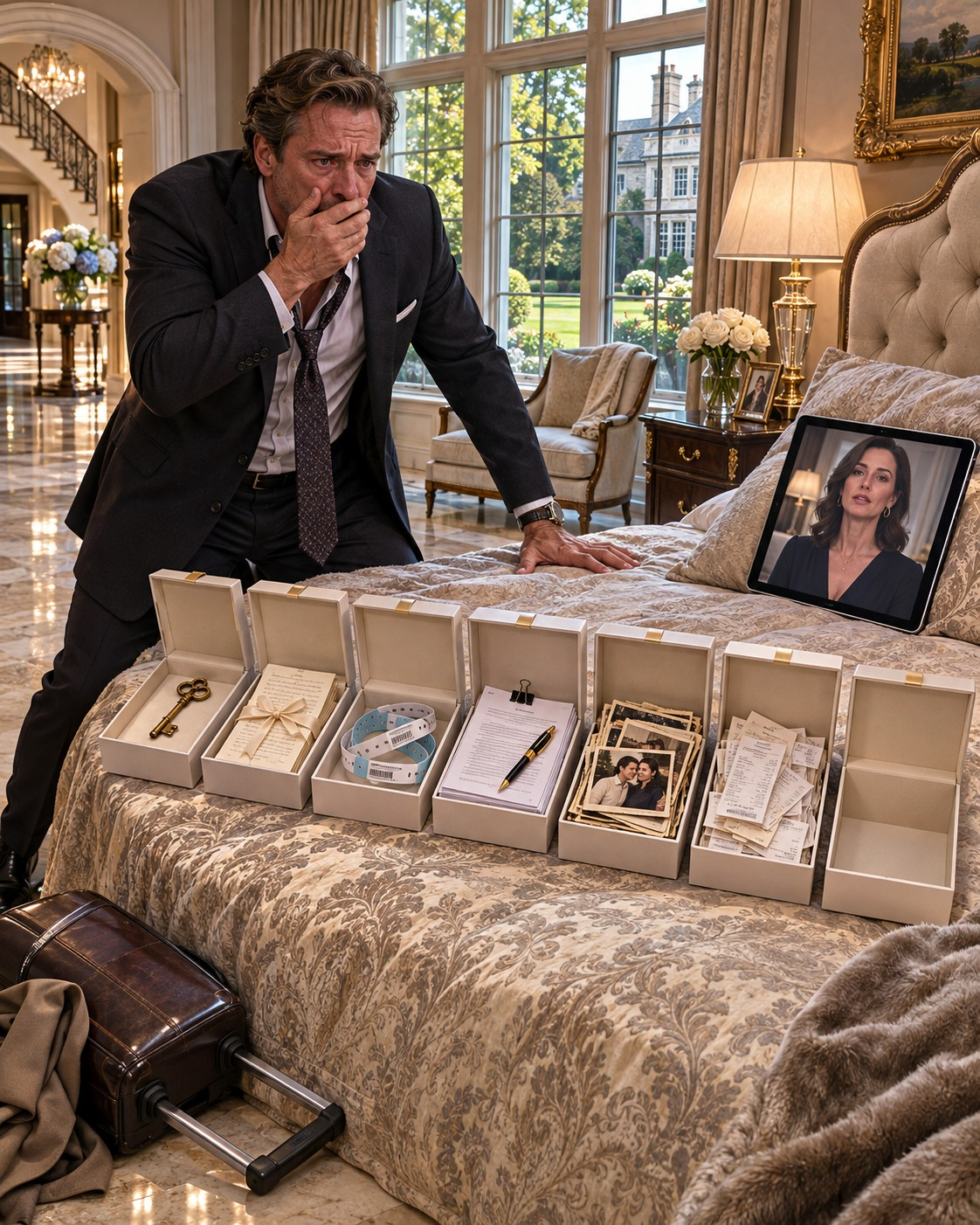
I dropped my suitcase when I saw the seven white boxes.
"Isabelle?"
My voice echoed through the bedroom.
There was no answer.
I stood in the doorway, one hand still gripping the handle of my suitcase, staring at the perfectly arranged boxes sitting on our king-sized bed.
Seven.
Not six.
Not eight.
Seven identical white boxes, each with a number written across its lid in Isabelle's elegant handwriting.
ONE.
TWO.
THREE.
FOUR.
FIVE.
SIX.
SEVEN.
For several seconds, I couldn't understand what I was looking at.
Then I laughed.
It was an automatic reaction, the kind of dismissive laugh I had developed over fifteen years of marriage whenever Isabelle did something I didn't immediately understand.
"Very funny," I muttered.
I expected her to step out of the dressing room.
Perhaps she was hiding behind the bathroom door, waiting for me to apologize for being away.
Maybe she wanted to make a point about the vacation.
I could already imagine the conversation.
She would tell me I had embarrassed her again. I would explain that business required certain sacrifices. She would remain distant for a few days, and eventually I would arrange something expensive enough to make the tension disappear.
A weekend in the Caribbean.
A new necklace.
Perhaps a house renovation.
I had become very good at repairing problems without actually fixing them.
But Isabelle didn't appear.
The bedroom remained silent.
I looked toward her side of the bed.
Her pearl earrings weren't on the bedside table.
Her favorite perfume was missing.
The framed photograph from our tenth anniversary had disappeared from its usual position.
I walked toward the dressing room.
"Isabelle, I'm serious."
Nothing.
I opened the door.
Her wardrobe looked strangely empty.
The expensive dresses she had worn to charity galas, business dinners, and family celebrations were gone.
So were most of her shoes.
I stared at the empty hangers.
My stomach tightened.
This was no ordinary argument.
I returned to the bed and placed my phone beside the boxes.
I called her.
The call didn't connect.
I tried again.
Disconnected.
"Come on, Isabelle."
I called her assistant, Margaret.
Straight to voicemail.
That was when I finally noticed the tablet resting against the pillows.
Its screen was dark.
I ignored it for the moment and reached for the first box.
The lid opened easily.
Inside lay a small brass key.
I picked it up.
For an instant, I didn't recognize it.
Then I turned it over.
The tiny scratch near the handle brought everything back.
Boston.
Our first apartment.
A narrow one-bedroom with a radiator that barely worked and windows that rattled whenever the wind became strong.
Fifteen years ago, I had been a man with an ambitious business plan, two suits, and a bank account that never seemed to contain enough money.
I remembered sitting on the kitchen floor with Isabelle.
We had been eating cereal because we couldn't afford groceries until my next consulting payment arrived.
I had apologized.
I remembered the shame in my voice.
"I promised you a better life."
Isabelle had taken my hand.
"We have each other, Julian. That's enough."
I placed the key back inside the box.
For some reason, I didn't want to look at it anymore.
I opened box two.
Our wedding vows.
The original sheets of paper were still folded together, their edges yellowed slightly with age.
I recognized my handwriting immediately.
I had written the words myself.
I promised loyalty.
I promised honesty.
I promised that no amount of money, professional success, or personal ambition would ever become more important than the woman standing beside me.
I read the final paragraph twice.
Then I closed my eyes.
A memory came back.
Isabelle standing beneath the wedding arch, holding my hands while I promised her a lifetime.
I remembered how she had looked at me.
As if I were the only man in the world.
I placed the vows beside the brass key.
The third box contained three hospital bracelets.
I recognized the date.
It was the year I collapsed from exhaustion while negotiating the acquisition that eventually transformed Hartwell Infrastructure into one of the largest infrastructure companies in the country.
I had spent four nights in the hospital.
Isabelle had stayed beside me.
She had slept in a chair, refused to leave when the nurses encouraged her to go home, and held my hand whenever I woke.
I remembered opening my eyes one morning and finding her asleep beside me.
Her hair had fallen across her face.
Her fingers were still wrapped around mine.
I had promised her that things would change once the company became successful.
I would take more vacations.
I would come home earlier.
We would finally have time to enjoy the life we had built.
Three weeks later, I was back in the office.
I had forgotten that promise almost immediately.
I placed the hospital bracelets back inside the box.
My hands were beginning to feel cold.
Then I opened number four.
The documents inside were neatly organized.
Original incorporation papers.
Bank statements.
Early investment agreements.
I recognized the company name before I even picked up the first sheet.
Hartwell Infrastructure.
My company.
My empire.
I smiled faintly.
For a moment, I thought Isabelle had simply decided to remind me of our shared history.
Then I saw the line near the bottom of the original investment agreement.
INITIAL CAPITAL CONTRIBUTION:
ISABELLE LAURENT HARTWELL — $180,000.
My smile disappeared.
I read it again.
One hundred and eighty thousand dollars.
Her inheritance.
The money her grandmother had left her.
I remembered that period very clearly.
The company was nearly bankrupt.
Two investors had withdrawn.
A bank had rejected my application.
Payroll was due in eleven days.
I had spent an entire night sitting in our apartment, staring at spreadsheets and wondering whether I should give up.
Isabelle had entered the room carrying a folder.
Inside were the documents for transferring her inheritance into the company.
I had refused at first.
I told her I couldn't take her family's money.
She had looked directly at me.
"Then don't think of it as my money, Julian. Think of it as our future."
I had accepted.
And somehow, over the years, I had gradually erased that sacrifice from my public version of the story.
At conferences, I spoke about determination.
In interviews, I described the risks I had taken.
When journalists asked how I built the company, I talked about my instincts, my strategy, and my ability to recognize opportunities before anyone else.
I never mentioned Isabelle's inheritance.
Not once.
I sat down on the edge of the bed.
The fourth box remained open in front of me.
For the first time since entering the room, I felt genuinely ashamed.
But shame was an unfamiliar emotion.
I had spent years finding ways to avoid it.
So I reached for box five.
Photographs.
Dozens of them.
I began turning them over one by one.
Our wedding.
Our first Christmas.
A cheap weekend in Maine.
Isabelle laughing in our Boston apartment.
A birthday dinner at a restaurant so small that the waiter had to move another table to let us sit together.
Then came photographs from later years.
Corporate celebrations.
Charity galas.
Luxury vacations.
Private jets.
A photograph of Isabelle standing beside me at an awards ceremony.
I looked carefully.
She was smiling.
But I wasn't looking at her.
I was looking toward the cameras.
Another photograph showed us sitting together at a restaurant.
I was checking my phone.
In another, she was holding my arm while I spoke to a group of investors.
I was looking away again.
I placed the photograph down.
A terrible realization began forming.
I had spent fifteen years building a life that looked extraordinary from the outside.
But the photographs revealed how little attention I had given the woman who made that life possible.
I turned toward box six.
I hesitated.
There was something about its position that made me uncomfortable.
The lid was slightly different from the others.
I lifted it.
Hotel receipts.
Restaurant bills.
Photographs.
Printed screenshots of private conversations.
My throat tightened.
I recognized the first hotel immediately.
Rome.
The second photograph showed Sienna Cole sitting across from me at a restaurant.
Her hand was resting on mine.
I remembered that evening.
We had ordered expensive wine.
She had laughed at something I said.
I had felt young, successful, and admired.
The next receipt was from Paris.
Then Chicago.
Then another hotel in Rome.
Eight months of lies.
Every meeting I had called a business dinner.
Every overnight trip I had described as unavoidable.
Every message I had deleted.
All of it was here.
Organized by date.
I lifted one of the printed conversations.
It was a message I had sent Sienna three months earlier.
I wish I could spend more time with you. Isabelle is too comfortable with our arrangement to notice anything.
I stared at the words.
I remembered writing them.
I remembered believing them.
And now I understood that Isabelle had seen every one.
"She knows," I whispered.
The words sounded strange in the empty bedroom.
I looked at the sixth box again.
There were no accusations.
No angry notes.
No dramatic photographs of Isabelle crying.
Only evidence.
Precise.
Organized.
Impossible to deny.
I should have felt devastated.
Instead, some arrogant part of my mind immediately began calculating how to fix the situation.
I could explain that the affair meant nothing.
I could tell her I had been lonely.
I could promise to end things with Sienna.
I could buy us another house.
A bigger one.
Something in Switzerland.
Something on the coast.
I had enough money to make almost any problem disappear.
That was what I believed.
Until I opened box seven.
It was empty.
Completely empty.
I checked the corners.
I lifted the white lining.
Nothing.
Then I noticed a small card resting at the bottom.
I picked it up.
Six words.
Written in Isabelle's handwriting.
"This is what you left me."
I read them once.
Then again.
My fingers tightened around the card.
I looked at the empty box.
For fifteen years, Isabelle had collected the small things that made our marriage meaningful.
Photographs.
Letters.
Keepsakes.
Even the ridiculous little objects from our first apartment.
Now there was nothing.
I looked toward her side of the bed.
The space where her jewelry box had stood was empty.
The drawer where she kept her personal documents was open.
Her wedding ring wasn't on the bedside table.
I stood up abruptly.
"Isabelle!"
My voice was louder this time.
Still nothing.
I reached for my phone.
I called her assistant again.
No answer.
I was about to contact the security director when the tablet illuminated.
A single notification appeared.
FOR JULIAN — WATCH ALONE.
I stared at the screen.
The video thumbnail showed Isabelle.
She was sitting in front of a neutral background.
Her dark eyes looked directly toward the camera.
She wore a navy blouse.
Her hair was pulled back neatly.
There was no visible anger in her expression.
No tears.
No desperation.
That calmness frightened me more than any argument could have.
I pressed play.
"Hello, Julian."
Her voice was steady.
I sat down.
"If you're watching this, I am safe. Do not send security after me."
I opened my mouth.
No words came out.
She continued.
"I know you're going to have questions. I know you'll want to call Margaret, your lawyers, and probably half the people who work for you."
She paused.
"But I need you to listen before you do anything."
I leaned closer to the screen.
Isabelle looked down briefly, then returned her eyes to the camera.
"For fifteen years, I believed that the man I married was still somewhere beneath the businessman you became."
My jaw tightened.
"I kept waiting for you to come home. Not to the mansion, Julian. To our marriage."
She paused.
"I waited through missed birthdays. Through canceled anniversaries. Through promises that became meaningless before the words had even left your mouth."
I looked away.
"And I waited while you began believing that my forgiveness was something you were entitled to."
The room seemed smaller.
"I know about Sienna. I know about Rome. I know about the other trips."
Her expression didn't change.
"But that is not why you need to be careful now."
My eyes returned to the screen.
She leaned slightly toward the camera.
"And before you call Sienna, you need to understand why she wanted you in Rome for exactly seven days."
I froze.
"What?"
Isabelle continued.
"Open the folder marked MERIDIAN."
The video ended.
For several seconds, I couldn't move.
Then I noticed a folder on the tablet.
MERIDIAN.
I touched it.
A document appeared.
TRANSFER AUTHORIZATION.
I opened it.
The amount was displayed near the top.
$38,000,000.
I blinked.
Thirty-eight million dollars.
I moved my finger down the document.
The transaction appeared to authorize the transfer of funds connected to one of our company's private investment structures.
At the bottom was an electronic signature.
ISABELLE LAURENT HARTWELL.
I stopped breathing.
I knew the signature.
I had seen it thousands of times.
But something was wrong.
The date.
The authorization code.
The transaction reference.
I studied every detail.
Then I realized something that made my hands go numb.
My wife had never signed that document.
I looked at the seven white boxes.
Then at the tablet.
Then at the transfer authorization.
For the first time in fifteen years, I had no idea what Isabelle was doing.
And I had an even more frightening question.
If she hadn't authorized the transfer, who had?
My phone vibrated.
An incoming message appeared.
The sender was Sienna.
I opened it.
There were only nine words.
Julian, don't open that folder again. Call me immediately.
I stared at the screen.
Before I could respond, another message arrived.
They know you found it.
Then my office security director called.
I answered.
"Julian, you need to come downstairs."
"What happened?"
He hesitated.
"Sir, there's someone waiting in the entrance hall."
"Who?"
A pause.
Then he said a name I hadn't heard in months.
"Mr. Richard Vale."
My blood ran cold.
Richard Vale was the former financial director of Hartwell Infrastructure.
The man who had disappeared from the company after a confidential investigation eighteen months earlier.
And he was standing inside my house.
I looked at the seventh box.
The empty one.
Then I heard the security director speak again.
"Sir, he says he has something that belonged to your wife."
I tightened my grip on the phone.
"What is it?"
The security director lowered his voice.
"Her original signature."
And then the call disconnected.






Comments 0