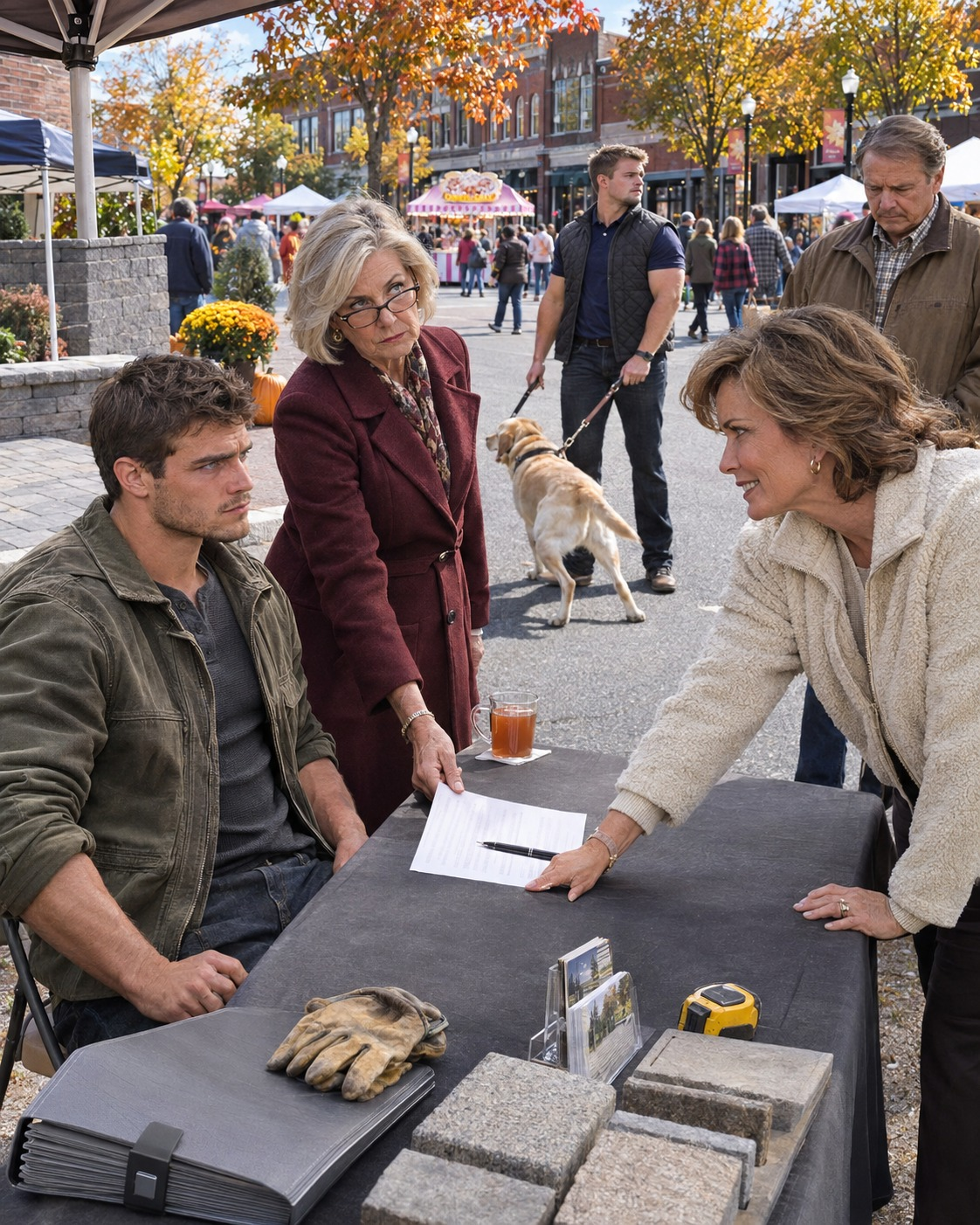
I stared at the photograph on my laptop.
My father sat beside Colton.
Between them was a document carrying my name.
The date was November 3, 2010.
One week after my grandmother's funeral.
And beneath Colton's signature was a sentence written in blue ink.
"Wyatt will never be told what we agreed to."
I enlarged the photograph.
The document appeared to be several pages long.
My father's handwriting was visible in the margin. Colton had signed the final page, and someone had placed a small yellow tab beside a paragraph near the bottom.
I downloaded the attachment.
Then I called Nate.
He answered immediately.
"Did you see it?"
"Yes."
"What do you think it means?"
"I don't know yet."
"Wyatt, my father said he remembers that meeting."
"Your father wasn't at this meeting."
"No. But he told me something else. He said your grandfather had specifically warned everyone not to sign anything involving your future property without your consent."
I looked at the photograph.
"Apparently, they did anyway."
Nate went quiet.
Then he asked, "Are you going to call Colton?"
I stared at my brother's signature.
"Not yet."
I forwarded the photograph to Daniel Reeves.
A few minutes later, Daniel called.
"Wyatt, where did you get this?"
"Colton emailed it."
"Have you received any explanation?"
"No."
"Don't contact him about the document until I've examined it."
I leaned back.
"Can you tell what it is?"
"Not from this photograph. I can see that it appears to be an agreement, but I need the complete document."
I looked at the yellow tab.
"There's something marked on the last page."
"Send me a close-up."
I did.
Daniel was quiet for several seconds.
Then he said:
"Wyatt, the date is important."
"Because it was after Grandma died?"
"Yes. If this agreement relies on authority she previously held, we need to determine whether that authority passed to someone else after her death."
I looked at the document again.
"Can you investigate?"
"I will. But I want you to understand something. Even if your father and brother agreed to something privately, that doesn't automatically give them rights over property you own."
I nodded.
"Understood."
"Send me the original email too. Preserve the attachment exactly as you received it."
We ended the call.
I saved the message in three places.
Then I printed the photograph.
I placed it beside the original 2010 acknowledgment.
There were similarities.
The same handwriting.
The same date range.
The same references to the workshop.
But something was different.
The original acknowledgment stated that Colton understood he had no ownership rights until the approved conditions were fulfilled.
The new photograph appeared to show a separate agreement.
An agreement that might have changed those conditions.
I looked at the final page.
There was a reference number.
MH-2010-11.
I recognized the initials.
Margaret Halverson.
My grandmother.
I picked up my phone and called Eleanor Whitcomb.
She answered after three rings.
"Wyatt?"
"I need to ask you something about November 2010."
Her voice changed.
"What happened?"
"Colton sent me a photograph of a document signed one week after Grandma's funeral."
There was silence.
"Can you describe it?"
I explained the photograph.
Then I mentioned the reference number.
Eleanor inhaled sharply.
"Where did you get that number?"
"From the document."
She didn't answer.
I continued.
"Do you know what MH-2010-11 means?"
"Yes."
I sat forward.
"What is it?"
Eleanor lowered her voice.
"It's the reference number for a document your grandmother specifically instructed us not to release."
I felt my stomach tighten.
"Why?"
"Because it was never supposed to become effective without an independent review."
I looked at the photograph.
"Did my father and Colton sign it?"
"I don't know."
"Can you check?"
Eleanor paused.
Then she said something I hadn't expected.
"Wyatt, I have a copy of the original."
My heart started beating faster.
"Where?"
"In the records box your grandmother left with me."
"Can I see it?"
"Yes. But I need to find something else first."
"What?"
"The accompanying letter."
I waited.
Eleanor continued.
"Your grandmother wrote instructions explaining why that agreement had to remain sealed."
I stared at the document.
"Does the letter mention me?"
"Yes."
"What does it say?"
She took a breath.
"It says that you must never be made responsible for a promise your father made without your knowledge."
I closed my eyes.
For a moment, I couldn't speak.
Then I asked:
"When can I come?"
"Tomorrow morning."
The next day, I arrived at Eleanor's house at nine.
She had already placed two boxes on the living room table.
The first contained ordinary estate records.
The second was smaller.
It had a blue label.
MARGARET — PRIVATE CORRESPONDENCE.
Eleanor opened it carefully.
Inside were several letters, a notebook and a sealed envelope.
She removed the notebook first.
"Your grandmother was meticulous," she said.
"She wrote everything down."
I sat beside her.
She opened to a page dated October 2010.
The handwriting was unmistakable.
There were notes about the community workshop, the reserve account and the proposed development.
Then I noticed Colton's name.
Beside it, my grandmother had written:
"Robert continues promising Colton an ownership interest that does not exist."
I read the sentence twice.
Eleanor turned the page.
Another note appeared.
"Colton believes the building and surrounding land will eventually belong to him. He has not been informed that the trust prohibits private transfer."
I looked at her.
"Did Colton know?"
"Apparently not."
"Why would Dad tell him that?"
"Because Robert wanted him involved in the development."
I looked down.
The next entry was dated November 2, 2010.
The day before the photograph.
My grandmother had written:
"Robert requested a meeting with Colton to discuss a revised arrangement. I have refused to approve it."
I turned the page.
There was another sentence.
"Wyatt must not be used as a substitute beneficiary."
I stared at the words.
"What does that mean?"
Eleanor looked at me.
"Your grandfather had designated you as the future beneficiary of the protected parcel. Your father wanted to redirect part of that arrangement to Colton."
I felt my chest tighten.
"Could he do that?"
"No."
"Then why did he try?"
"Because he believed that if Colton received a business interest in the property, he could eventually control the development."
I looked at the photograph again.
"Was that what the agreement was about?"
Eleanor nodded slowly.
"I believe so."
She opened the sealed envelope.
My name was written on the front.
This time, the handwriting was my grandmother's.
Inside was a short letter.
I began reading.
"Dear Wyatt,
If you are reading this, something has happened that I hoped would never happen.
Your father has been making promises about land, money and buildings that do not belong to him.
He believes he is helping your brother.
But helping someone does not mean taking another person's future.
I have watched you grow up.
You work hard. You rarely complain. You often accept less than you deserve because you don't want to upset anyone.
I need you to understand something.
Your future is not a family resource.
Your name is not something another person can use to make their plans easier.
If Robert and Colton have entered into an agreement concerning the protected property without your knowledge, do not accept it simply because they are your family.
Ask for the original records.
Ask for the accounting.
And remember that your grandfather and I made certain arrangements for a reason.
You deserve the opportunity to build something that belongs to you."
I lowered the letter.
My eyes were burning.
I had spent years thinking my grandmother's silence meant she had accepted what my parents were doing.
Now I understood that she had been trying to protect me in ways I had never seen.
Eleanor placed a hand on the table.
"She loved you very much."
I nodded.
Then I noticed something written at the bottom.
A final instruction.
"The original agreement must be reviewed by the third-party trustee before any transfer can occur."
I looked up.
"Who was the third-party trustee?"
Eleanor opened another document.
She pointed to a name.
Harold Bennett.
I had never heard of him.
"Who is he?"
"A retired attorney. Your grandfather trusted him."
"Is he still alive?"
Eleanor nodded.
"Last I heard, he was living near Green Bay."
I took out my phone.
I sent the name to Daniel.
He replied almost immediately.
I'll investigate. Don't contact him until we verify his role.
I put my phone away.
Then Eleanor showed me the original agreement.
It was six pages long.
The first five described the proposed development arrangement.
The sixth contained the conditions.
Colton would receive an opportunity to operate a workshop.
Dennis Keller would manage the development company.
My father would coordinate construction.
But the agreement explicitly stated that no ownership transfer could occur without the approval of the trustee and the designated property beneficiary.
My name appeared in that section.
Wyatt Halverson.
I read the final paragraph.
It stated that if the approved project was not completed within the specified period, all temporary access privileges would expire.
Colton had signed beneath it.
So had my father.
And Dennis.
But there was something else.
A separate signature line remained blank.
The property beneficiary's consent.
Mine.
I looked at Eleanor.
"So they knew I hadn't agreed."
She nodded.
"Yes."
"Then why did they tell people the arrangement was already approved?"
She closed the document.
"Because they hoped nobody would ask to see the original."
I met Daniel at his office that afternoon.
He examined the agreement carefully.
Then he compared it with the photograph Colton had sent.
He placed the pages side by side.
"These appear to be related documents, but I want a handwriting specialist to examine the signatures and the dates."
I nodded.
"Does the original agreement help me?"
"It helps establish what the parties understood at the time. More importantly, it shows that your consent was required."
He pointed to the blank signature line.
"You never signed this."
"No."
"Then we have no evidence of your approval."
I leaned forward.
"What about the agreement Colton sent?"
Daniel looked at the photograph.
"That document appears to modify the original arrangement."
"Can it?"
"Not without following the amendment provisions."
He turned to the final page.
"Here."
I looked.
The agreement required approval from the third-party trustee and the designated beneficiary.
The same two approvals.
Harold Bennett.
And me.
Neither signature appeared.
Daniel made several notes.
"Wyatt, this may explain why your father has been trying to obtain your signature now."
I looked at him.
"Because the original agreement was never completed?"
"Possibly. If the old arrangement expired and the amendment was never properly approved, they may be trying to create a new document that gives them the rights they wanted."
I stared at the paperwork.
"Could the forged access agreement do that?"
"Not automatically. But it may have been intended to support their financing application."
I nodded.
Then I asked about the loan.
"Have you heard from the lender?"
"Yes."
He opened his laptop.
"The lender has temporarily suspended the application pending clarification of the collateral documents."
I felt relieved.
"Can they withdraw it?"
"Potentially. We have formally disputed your consent and supplied supporting records."
He paused.
"But there's another matter."
I waited.
"The lender also asked for clarification regarding a previous financing arrangement involving Keller Property Holdings."
"What previous arrangement?"
"A commercial loan from several years ago."
I stared at him.
"Was my property involved?"
"Not directly, according to the initial records. But the old agreement references the same reserve account."
I felt my stomach tighten.
"How much?"
Daniel turned the screen toward me.
The amount was $186,000.
The exact figure Eleanor had found in the old ledger.
I looked at the transaction dates.
Several payments had been made over a period of years.
Some were marked as development expenses.
Others were listed as equipment purchases.
Then I noticed a payment dated November 2010.
The amount was $42,000.
The recipient was Keller Property Holdings.
I looked at Daniel.
"That's the transaction from Grandma's notebook."
He nodded.
"Yes."
"Was it authorized?"
"We don't know yet."
I leaned forward.
"Can we find out?"
"That's why I want to speak with the original trustee."
I looked at the name.
Harold Bennett.
Daniel closed the file.
"I'm going to try to locate him."
That evening, I called Colton.
He answered after several rings.
"What?"
"I saw the photograph."
Silence.
Then he said:
"Good."
"What is that document?"
"An agreement."
"Between you and Dad?"
"Among the people involved in the project."
"Why is my name on it?"
He laughed.
"Because Grandpa wanted you included."
"Then why did you sign it without telling me?"
"Because you weren't involved."
I closed my eyes.
"That's exactly the problem, Colton."
He sighed.
"Wyatt, you need to understand something. Dad was trying to build something for the family."
"Using my property?"
"Nobody was stealing your property."
"Then why did you submit an access agreement with my signature?"
He went quiet.
I continued.
"Why did you show people a document I never signed?"
"That was Dad's decision."
I almost laughed.
"So now it's Dad's decision?"
"Don't start."
I lowered my voice.
"Colton, what did you agree to in 2010?"
He hesitated.
Then he said:
"I agreed to help with the workshop."
"Did Dad promise you ownership?"
Another pause.
"Yes."
"Did Grandpa approve?"
"No."
"Did Grandma approve?"
"No."
"Then why did you sign?"
He sounded irritated.
"Because Dad told me everything would be handled later."
I stared at the kitchen table.
There it was.
The same pattern.
My father made promises.
Colton believed them.
And everyone else was expected to adjust.
"What happened to the money?" I asked.
"What money?"
"The reserve account."
He exhaled.
"You're still on about that?"
"Yes."
"Grandpa wanted me to have an opportunity."
"That isn't an answer."
Colton lowered his voice.
"Wyatt, I don't know everything that happened."
"Then tell me what you do know."
He didn't respond.
I waited.
Finally, he said:
"Dad told me the money would be transferred once the agreement was signed."
"Was it?"
"Part of it."
"How much?"
"I don't remember."
"Sixteen thousand?"
Silence.
"Colton?"
He ended the call.
I stared at my phone.
A few seconds later, a message arrived.
Colton: Stop digging into something you don't understand.
I put the phone down.
Then another message appeared.
Colton: You have no idea what Dad promised Dennis.
I read it twice.
Before I could respond, a third message arrived.
Colton: And you don't know what Dennis promised him in return.
I immediately took a screenshot.
I sent it to Daniel.
Then I called Nate.
He answered.
"What's happening?"
I explained the conversation.
Nate was quiet.
Then he said:
"My father remembered something about Dennis."
"What?"
"He said Dennis was supposed to receive a development commission if the project went through."
"How much?"
"I don't know."
I looked at the $42,000 transfer.
"Could that be it?"
"Possibly."
I felt a cold sensation move through my chest.
If Dennis had received money from the reserve account, and my father had promised Colton ownership of the workshop, the entire arrangement might have been built around a private business deal.
One that had never been approved by the people who actually controlled the property.
The following morning, Daniel called.
"I found Harold Bennett."
I sat down.
"Where?"
"He's living outside Green Bay. I spoke with him briefly."
"What did he say?"
"He confirmed that he was the independent trustee named in your grandmother's agreement."
I exhaled.
"Does he have the original records?"
"He says he has some of them."
"Can we meet him?"
"Yes. He agreed to see us tomorrow."
I looked at the gray folder.
"Did he say anything about the agreement Colton signed?"
Daniel paused.
"Yes."
"What?"
"He said that the photograph you received was not the final version."
I frowned.
"What does that mean?"
"He believes there was another document prepared afterward."
I sat forward.
"Another agreement?"
"Possibly. He wants to examine the original before discussing it."
I thought about the handwritten note.
Wyatt will never be told what we agreed to.
"Daniel, did he say who signed the final version?"
"He wouldn't tell me over the phone."
I stared at the window.
"Why?"
"He said he wanted to explain it in person."
I thanked him.
Then I called Eleanor.
She was surprised when I told her.
"Harold is still alive?"
"Yes."
She sounded relieved.
"Then perhaps we can finally resolve what happened."
I hoped she was right.
At 3:17 that afternoon, a delivery driver knocked on my door.
He handed me a large envelope.
There was no return address.
Inside was a photocopy of a contract.
It was dated November 10, 2010.
The title read:
FAMILY DEVELOPMENT AND PROPERTY BENEFIT AGREEMENT.
I sat down.
The first page described the proposed workshop.
The second described the reserve account.
The third listed the parties.
Robert Halverson.
Colton Halverson.
Dennis Keller.
And one additional name.
I stared at it.
Wyatt Halverson.
My name appeared as a beneficiary.
But beneath it was a paragraph stating that I had agreed to surrender any future claim to the protected parcel in exchange for a financial settlement.
The settlement amount was $25,000.
I felt my stomach tighten.
I had never received $25,000.
I had never signed that agreement.
And I had never agreed to surrender anything.
I turned to the final page.
There were four signatures.
My father's.
Colton's.
Dennis's.
And mine.
The signature looked remarkably similar to my handwriting.
But I knew it wasn't mine.
I turned the page over.
There was a handwritten note.
"Payment to Wyatt deferred until property transfer is complete."
I read it twice.
Then I noticed another line.
Witnessed by: Margaret Halverson.
I checked the date again.
November 10, 2010.
My grandmother had died on October 27.
The witness signature was dated fourteen days after her death.
I felt my hands go cold.
Someone had used her name.
Someone had used mine.
And someone had created a contract that made it appear I had accepted money in exchange for giving up my future property rights.
I immediately photographed every page.
Then I called Daniel.
He answered.
"Wyatt?"
"I received another agreement."
"Send it to me."
I did.
He opened the attachment while we were speaking.
For several seconds, he said nothing.
Then his voice became very serious.
"Wyatt, this changes things."
"What does it mean?"
"I need to compare it with the original trustee records."
I looked at the final page.
"Is it valid?"
"I cannot determine that yet. But the signatures and dates raise serious concerns."
I swallowed.
"Can someone make a claim against my property using this?"
"They can attempt to. Whether the document has any legal effect is a separate question."
I looked at my grandmother's forged witness signature.
"Daniel, she was already dead."
"I see that."
"And I never signed it."
"I understand."
He paused.
"Keep the original envelope. Don't show this to your family yet."
I nodded.
Then I asked:
"Why would they make me a beneficiary if they were trying to take my property?"
Daniel was quiet.
Finally, he answered.
"Because the document appears designed to make it look as though you voluntarily surrendered your rights."
I lowered the phone.
For years, I had believed I had simply been the son who never received as much as his brother.
Now I was discovering that someone had created paperwork suggesting I had willingly given up things I had never even known existed.
I placed the contract inside the gray folder.
Then I looked at the handwritten note.
The $25,000 settlement.
Deferred until the property transfer.
I had never received a cent.
I had never known about the agreement.
And I had certainly never agreed to it.
My phone buzzed.
An email from Harold Bennett.
The subject line read:
URGENT — DO NOT DISCUSS THE NOVEMBER AGREEMENT WITH ROBERT.
I opened it.
There was only one sentence.
"Wyatt, I have the original signed copy, and the person who authorized the payment to you was not your father."
I stared at the screen.
A second email arrived.
This one contained an attachment.
The filename was:
FINAL BENEFICIARY AUTHORIZATION — NOVEMBER 2010.
I opened the document.
At the bottom was the name of the person who had approved the entire arrangement.
I read it once.
Then again.
It wasn't Colton.
It wasn't my father.
It wasn't Dennis Keller.
It was someone who had been standing beside me at the family dinner when my parents first demanded that I sign the new access agreement.
My mother, Linda Halverson.






Comments 0