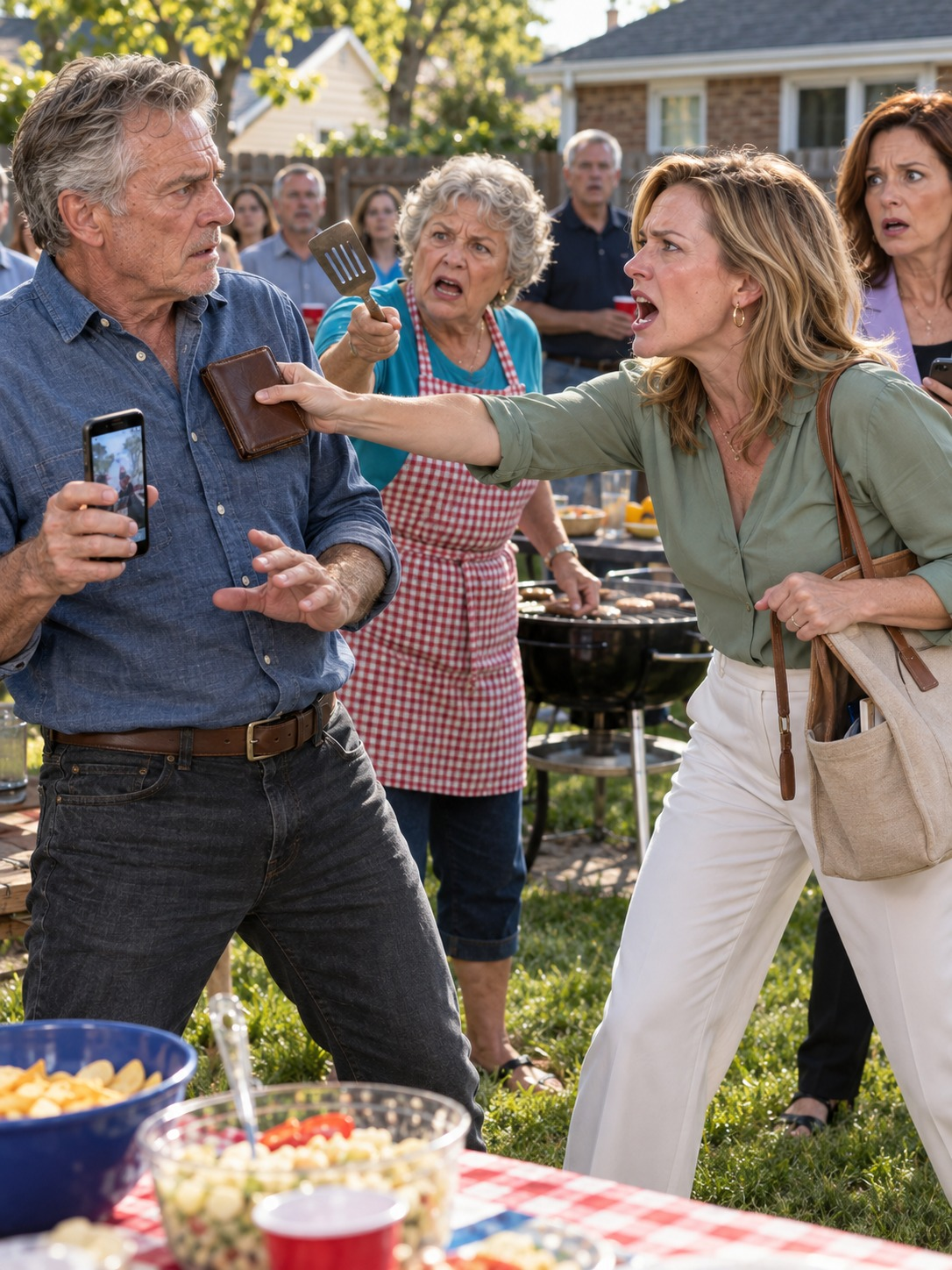
"JOSIE! GET AWAY FROM HIM!"
My daughter's voice cut through the Easter afternoon as sharply as a blade against steel.
Josie jumped.
The plastic Easter egg slipped from her fingers, bounced against the patio, and rolled beneath a wicker chair.
I turned toward the glass door.
Dani stood inside Aunt Maureen's house, one hand gripping the handle, her face tight with something I couldn't immediately identify.
Anger, certainly.
But there was something else.
Fear.
Not the kind a mother feels when her child is in danger.
The kind a person feels when a secret is about to escape.
"She's talking to her grandfather," I said.
Dani pulled the door open.
"Josie, I told you to stay inside."
Josie lowered her eyes.
"I just wanted to say hi."
"Then you've said hi. Go find your cousins."
The little girl hesitated.
I could see the conflict on her face.
She wanted to obey her mother.
She also wanted to finish telling me something.
I gave her a small smile.
"It's okay, sweetheart. Go have some fun."
She looked at me for one more second.
Then hurried past Dani into the house.
Dani watched her disappear before turning back toward me.
"What were you two talking about?"
"School. Easter. Things grandfathers and granddaughters talk about."
Her eyes narrowed.
"Don't play games with me, Dad."
I stood slowly.
At sixty-two, my knees weren't what they had been at forty, but they still worked well enough.
"I'm not playing games."
"Josie's been upset lately."
"I'm sorry to hear that."
"She's confused about what's happening."
"Then you and Greg should explain it to her."
Dani folded her arms.
"That's difficult when you keep changing everything."
I looked past her into Maureen's living room.
Shelby Slade was standing near the fireplace with her phone in her hand.
Two cousins were pretending not to watch us.
I lowered my voice.
"Not here, Dani."
"Why? Afraid somebody might hear the truth?"
"The truth about what?"
"About how you've abandoned your family."
There it was again.
Abandoned.
A word large enough to cover almost anything if you said it with enough emotion.
I had stopped paying the mortgage on a house I didn't own.
Stopped sending monthly transfers to two employed adults.
Given them time to arrange their own insurance and phone service.
And somehow that had become abandonment.
"I haven't abandoned anybody," I said.
"Tell that to Josie."
My stomach tightened.
"Leave her out of this."
"She's part of this family."
"She's ten."
"She's old enough to understand when somebody stops caring."
I stepped closer.
Not threateningly.
Just close enough that she couldn't pretend not to hear me.
"Don't you ever tell that little girl I stopped loving her because I stopped paying your bills."
For a moment, Dani looked startled.
Then her expression hardened.
"You've changed."
"Maybe."
"Mom wouldn't recognize you."
I felt the familiar ache beneath my ribs.
Carol had been gone four years, and Dani had learned exactly how to use that absence.
I looked at her.
"Your mother knew me better than anybody."
Dani opened her mouth.
I continued before she could speak.
"And she knew the difference between helping somebody and letting them use you."
Her face flushed.
"Are you calling me a user?"
"I'm telling you this conversation is over."
I walked past her into the house.
I didn't look at Shelby.
I didn't look at the cousins.
I found Maureen in the kitchen, thanked her for inviting me, and told her I wasn't feeling well.
She touched my arm.
"Ray, honey, Dani's just worried."
I looked at my sister-in-law.
Maureen was sixty-eight, silver-haired, and had been part of my life since before Dani was born.
She loved Carol.
She loved Dani.
And she was trying to keep peace in a room where peace had already been replaced by performance.
"Maureen, did Dani tell you how much money I've given her household?"
She blinked.
"What?"
"Over the last six years."
"No."
"Did she tell you I gave them notice before changing the insurance and phone arrangements?"
Maureen looked toward the dining room.
"She said you cut everything off."
"I didn't."
"Ray—"
"One hundred ninety-eight thousand three hundred dollars."
Her mouth opened slightly.
"Excuse me?"
"That's what I can document."
She stared.
I continued.
"I don't regret helping them. But I am retiring, and I'm not going to keep working so they can maintain a household they can't afford."
Maureen looked down at the dish towel in her hands.
"I didn't know."
"I figured."
I kissed her cheek.
Then I left.
I had almost reached my truck when the front door opened behind me.
"Grandpa!"
Josie came running down the walkway.
Dani wasn't with her.
She stopped a few feet away, breathing hard.
"Did I make you mad?"
The question hurt more than anything her mother had said.
I crouched.
"No, sweetheart."
"Mom looked mad."
"Your mom and I are having a disagreement."
"Because I talked to you?"
"No."
She studied my face.
"Promise?"
"Promise."
Her eyes filled.
I took her hands.
"Listen to me. Nothing that's happening between the grown-ups is your fault."
She nodded, but I could tell she wasn't convinced.
"Is Grandma's trailer safe?"
I felt my throat tighten.
"Yes."
"Even if Mom wants it?"
"Even then."
She leaned forward and hugged me.
I held her carefully.
For a few seconds, she was just my granddaughter again.
Not a witness.
Not a messenger.
Not a child caught between adults who should have known better.
When she pulled away, she whispered, "I don't want Mom mad at me."
I brushed a loose strand of hair away from her forehead.
"She won't hear what you told me from me."
"Okay."
"Now go find those Easter eggs."
She gave me a tiny smile.
Then ran back toward the house.
I watched until she disappeared inside.
Only then did I get into my truck.
I sat behind the wheel for several minutes without starting the engine.
My hands were trembling.
I kept hearing Josie's words.
Mom said if she could make you believe you were getting old and forgetful, you'd sign something.
And then:
It's about Grandma's trailer.
I looked at the empty passenger seat.
Carol used to sit there with a paper map folded across her knees, insisting she knew a better route than the GPS.
She had been wrong half the time.
I would have driven every wrong road in Ohio to hear her argue with me again.
The trailer wasn't worth a fortune.
A 1968 Shasta.
Silver and turquoise.
Old cabinets.
A narrow bed.
Yellow gingham curtains.
We'd bought it cheap from an estate sale the summer before Carol's diagnosis.
It needed work.
A lot of work.
We spent weekends sanding wood, polishing aluminum, replacing worn fabric, and arguing over whether the curtains made it look cheerful or ridiculous.
Carol called it our second honeymoon waiting to happen.
We were supposed to take it to the Smoky Mountains.
Then Michigan.
Then Vermont in the fall.
We never made those trips.
Cancer changed everything.
After she died, I kept the trailer.
Not because I couldn't let go of the past.
Because some promises deserve to be carried forward.
Now my granddaughter was telling me Dani wanted me to sign it away.
I started the truck.
Drove home.
And went straight to the garage.
The Shasta sat beneath its protective cover, its rounded shape familiar even in the dim light.
I pulled back one corner.
The turquoise paint caught the light.
For a moment, I could almost hear Carol laughing.
"Ray, that thing is going to outlive both of us."
I rested my hand against the aluminum siding.
Then I noticed something.
The hitch lock looked different.
Not broken.
Not missing.
Just turned slightly from the position I remembered.
I crouched beside it.
There were fresh scratches near the key opening.
Small marks.
Nothing dramatic.
The sort of thing a person might overlook.
But thirty-eight years of working with metal had taught me to notice marks.
I touched one with my thumb.
It was bright.
New.
I stood slowly.
I couldn't prove anybody had touched the lock.
Maybe I'd scratched it myself.
Maybe it happened when I last moved the trailer.
I wasn't going to accuse anybody based on a mark.
But I took a photograph.
Then another.
And one of the entire hitch assembly.
Afterward, I went inside and called Vern.
He answered on the fourth ring.
"Somebody die?"
"No."
"Then why are you calling during the ballgame?"
"I need a favor."
"That sounds expensive."
"I need somewhere secure to store the Shasta."
Silence.
Then Vern said, "What happened?"
I told him about Easter.
About Dani's accusations.
About Josie's warning.
I didn't repeat every word my granddaughter had said.
She had trusted me.
I intended to protect that trust.
But I explained enough.
When I finished, Vern was quiet for several seconds.
Then he said, "Bring it to my shop tomorrow morning."
"Are you sure?"
"I've got room behind the gate."
"I can pay you."
"Buy me lunch."
"Vern—"
"Ray, listen to me."
His voice changed.
No joking.
No teasing.
"Steel is good. Paper is better."
"What?"
"Bring the trailer. Then make sure your title, insurance, and ownership records are in order."
I looked toward the garage.
"Why?"
"Because if somebody wants to claim you gave something away, you want proof you didn't."
I sat down.
For the first time, the situation felt bigger than a family argument.
"Do you think Dani would really try something?"
"I think you should stop guessing and start protecting what belongs to you."
That was Vern.
He could reduce a complicated problem to one sentence and make you feel foolish for not seeing it yourself.
We agreed to meet at eight.
After hanging up, I went into my office.
I opened the file cabinet.
Found the folder marked SHASTA.
Inside were the title, insurance documents, purchase paperwork, and photographs from the restoration.
Carol had written little notes on some of the pictures.
One showed me standing beside the camper holding a paintbrush.
On the back, she'd written:
Ray pretends he hates the curtains. He doesn't.
I smiled despite everything.
Then I scanned the title.
Saved copies to my computer.
Printed another copy.
And put the originals in a fireproof document box.
The title was in my name.
Mine alone.
Carol and I had arranged it that way when we bought the trailer because she wanted the paperwork simple.
I had never transferred ownership.
Never promised it to Dani.
Never signed anything giving her control over it.
Still, Josie's warning wouldn't leave me alone.
Mom said if she could make you believe you were getting old and forgetful...
I looked at the title.
Then at my retirement paperwork.
Then at the old estate documents in the cabinet.
A thought occurred to me.
After Carol died, I'd updated some things.
Bank beneficiaries.
Life insurance.
A few accounts.
But I hadn't reviewed every legal document.
I remembered signing a durable power of attorney years earlier.
Carol had been my first choice.
That much I knew.
But who had been listed after her?
I opened another drawer.
Found the estate folder.
And began searching.
There were wills.
Medical directives.
Insurance records.
Documents I'd signed years ago and barely thought about since.
I found the power of attorney near the bottom.
The paper was slightly yellowed.
I read the first page.
Then the second.
Carol's name appeared where I expected.
But the document also named a successor agent.
My daughter.
Danielle Kesler.
I stared at the page.
I remembered signing it.
Carol had been healthy then.
Dani was younger.
We trusted her completely.
It had seemed natural.
If something happened to Carol, our daughter would help.
I turned to the next page.
The document described the circumstances under which the successor could act and the authority granted.
Financial accounts.
Property transactions.
Administrative matters.
I wasn't a lawyer.
I didn't know exactly what the language meant or whether the document would operate the way I feared.
But I knew enough to understand I needed professional advice.
Immediately.
I put the papers back into the folder.
Then I called the attorney who had handled a neighbor's estate.
Her name was Rebecca Sloan.
Her office was closed.
I left a message explaining that I needed an appointment to review my estate documents and financial authority arrangements.
I didn't mention Dani's name.
Not yet.
Then I sat at the kitchen table.
The house was quiet.
The apple pie still sat in the refrigerator.
I opened it.
Cut a slice.
Took one bite.
It tasted exactly the way I remembered.
Cinnamon.
Butter.
Sweet apples.
And somehow that made everything worse.
I put the fork down.
The next morning, Vern arrived at seven forty-five.
He inspected the hitch.
Looked at the scratches.
Then shrugged.
"Could be anything."
"That's what I thought."
"But we're moving it anyway."
We connected the Shasta to my truck.
Checked the lights.
Secured the safety chains.
Then drove to his workshop off Dorothy Lane.
Vern's place was an old industrial building surrounded by a chain-link fence and a locked gate.
Inside were tools, welding equipment, and enough spare metal to rebuild half the county.
We parked the Shasta behind the building.
Vern installed a stronger hitch lock.
Then closed the gate.
He handed me a key.
"Now it's boring."
"What?"
"Anybody wanting that trailer has to work a lot harder."
I laughed.
"Thanks."
He wiped his hands on a rag.
"Call the lawyer."
"I already did."
"Good."
Then he looked at me.
"Ray, don't let this turn you into somebody you don't recognize."
I frowned.
"What do you mean?"
"You're angry. You should be. But don't start playing games back."
I nodded.
"I won't."
"Keep records. Tell the truth. Let people make their own choices."
I looked at the Shasta.
"And Dani?"
Vern sighed.
"She's your daughter. That doesn't mean she gets your checkbook."
I drove home alone.
For the first time since Sunday dinner, I felt I'd taken a step that wasn't simply reacting to Dani.
I had protected something.
Something Carol loved.
Something I loved.
Something that belonged to me.
At noon, Rebecca Sloan's office returned my call.
Her assistant offered an appointment for Tuesday morning.
I accepted.
Then I spent the afternoon organizing documents.
Bank statements.
Insurance notices.
The green ledger.
The spreadsheet Dani had sent.
The power of attorney.
I made copies.
Labeled folders.
Wrote dates.
Not because I expected a courtroom battle.
Because I wanted facts.
Facts had always been easier for me than feelings.
Around four, my phone buzzed.
A message from Maureen.
"Ray, can we talk?"
I called her.
She answered quietly.
"Hi, honey."
"Everything okay?"
She hesitated.
"I've been thinking about what you told me yesterday."
"About the money?"
"Yes."
I waited.
"Ray, I owe you an apology."
"You don't owe me anything."
"I do. I let Dani tell me what was happening, and I didn't ask you."
I looked at Carol's photograph.
"She was upset."
"That's not an excuse."
I said nothing.
Then Maureen lowered her voice.
"There's something else."
My stomach tightened.
"What?"
"Dani's been telling people you're forgetting things."
I closed my eyes.
"Like what?"
"Appointments. Conversations. Where you put things."
"None of that's true."
"I know."
"How?"
"Because she told me you forgot we talked about your retirement last Christmas."
I frowned.
"We didn't talk about retirement last Christmas."
"Exactly."
I sat down.
Maureen continued.
"She said you'd agreed to keep working two more years, but now you don't remember."
I stared at the wall.
That was new.
Not simply concern.
A claim that I'd made a promise and forgotten it.
"Maureen, I never agreed to that."
"I believe you."
I swallowed.
"Thank you."
She hesitated again.
"There's one more thing."
"What?"
"She asked whether I knew where you kept your important papers."
I went still.
"When?"
"Saturday. Before Easter."
My eyes moved toward the office.
The file cabinet.
The estate documents.
The power of attorney.
"What did you tell her?"
"Nothing. I said I didn't know."
I exhaled slowly.
Maureen's voice trembled.
"Ray, what's going on?"
I looked at the green ledger on my desk.
"I wish I knew."
We spoke a few more minutes.
Then I thanked her and hung up.
I sat motionless for a long time.
Dani had asked about my papers.
She had told relatives I was forgetful.
She had created a spreadsheet assuming two more years of my income.
And Josie had overheard her talking about getting me to sign away the camper.
Each fact, standing alone, might have had an innocent explanation.
Together, they frightened me.
I wasn't going to confront Dani without understanding what was happening.
But I was no longer willing to pretend nothing was wrong.
That evening, I went outside to take the trash to the curb.
Hattie Mullins was watering flowers two houses down.
She waved.
"Evening, Ray."
"Evening, Hattie."
She turned off the hose.
"Everything okay?"
I almost laughed.
Apparently everybody in Dayton had started asking me that question.
"Fine."
She studied me.
Then said, "Your daughter was here yesterday."
I stopped.
"What?"
"White SUV. Around four."
My stomach tightened.
"Yesterday?"
"Saturday. I saw her pull into your driveway."
I looked toward my house.
I'd been home most of Saturday.
But I'd gone to the hardware store in the afternoon.
Only for about forty minutes.
"What did she do?"
Hattie shrugged.
"Didn't pay much attention. Thought she was visiting."
I nodded slowly.
"Was she alone?"
Hattie thought for a moment.
"No. That friend of hers was with her."
"Shelby?"
"That's the one."
I felt something cold settle in my stomach.
"Did they go inside?"
Hattie frowned.
"I don't know. I was carrying groceries."
I thanked her.
Then went back into the house.
I checked the front door.
Locked.
The back door.
Locked.
The windows.
All secure.
Nothing seemed disturbed.
I told myself not to overreact.
Dani had a spare key.
She'd had one for years.
For emergencies.
Maybe she'd stopped by and left when I wasn't home.
Maybe she wanted to talk.
Maybe there was an explanation.
I went into my office.
Opened the file cabinet.
The folders looked exactly as I'd left them.
Then I noticed something.
The estate folder was sitting slightly forward.
Not much.
Maybe an inch.
I remembered pushing it all the way back after copying the documents.
I stood there staring at it.
Then I heard my phone ring.
Dani.
I let it go to voicemail.
A moment later, a text appeared.
"Dad, I think we need to sit down and talk about your future."
I read it.
Then another message arrived.
"I found something that might make this easier for everyone."
Before I could respond, she sent a photograph.
It showed a document lying on a table.
At the top were the words:
PROPERTY TRANSFER AGREEMENT.
Below them was my name.
Raymond Kesler.
And on the signature line, someone had already written...






Comments 0