"MR. KESLER, DON'T OPEN THAT ENVELOPE YET."
Daniel Mercer's voice came through my phone as I stood in my office holding a sealed white envelope.
I looked at the words printed beneath my name.
CONFIDENTIAL — FOR FAMILY CAPACITY REVIEW.
"What did you just say?"
"Please listen to me before you do anything."
I set the envelope on my desk.
"Then start talking."
There was a long pause.
I heard a door close on his end.
Then Daniel spoke again.
"Your daughter didn't ask me to call you because she was worried about your health."
I stared at Carol's photograph beside my computer.
"Then why did she?"
"Because Greg told her I could help convince you to reconsider your retirement."
I pulled out my chair.
"Who are you, Mr. Mercer?"
"I'm an insurance and financial-services consultant. I know Greg through business."
"Are you qualified to evaluate somebody's mental capacity?"
"No."
"Then why did you question mine?"
He exhaled.
"Because I was given a very different version of what was happening."
I sat down.
The envelope remained in front of me.
"What version?"
"Greg said you had suddenly stopped paying bills you'd legally agreed to cover. He said you were making impulsive decisions, refusing to discuss them, and putting your family at financial risk."
"Did he mention those bills belong to him and my daughter?"
"No."
"Did he mention I've given them nearly two hundred thousand dollars?"
"No."
"Did he mention I'm retiring after thirty-eight years at the same company?"
"He said you were considering leaving your job."
I almost laughed.
Considering.
My retirement paperwork had already been approved.
My coworkers were planning a party.
And Greg had made it sound as though I'd woken up one morning and decided to abandon my responsibilities.
"Mr. Mercer, why are you calling now?"
Another pause.
"Because I saw something yesterday that bothered me."
I looked at the envelope.
"What?"
"Greg showed me a draft letter. It described you as increasingly confused and unable to manage important financial decisions."
My stomach tightened.
"Who wrote it?"
"He said Dani prepared it."
"What was it for?"
"He wanted to know whether it could help establish that someone else should handle your finances."
I looked toward the hallway.
The camera.
The table where my wallet and glasses had disappeared.
Suddenly, those two missing objects seemed even more important.
"Did you tell him it would work?"
"No. I told him I wasn't qualified to answer that question."
"Good."
"He wasn't happy."
I leaned back.
"Why tell me?"
Daniel's voice softened.
"Because I have a father about your age, Mr. Kesler. And when I saw the video from the block party, I realized I might have helped somebody who wasn't telling me the truth."
I went still.
"You saw the video?"
"Someone sent it to Greg. He showed me."
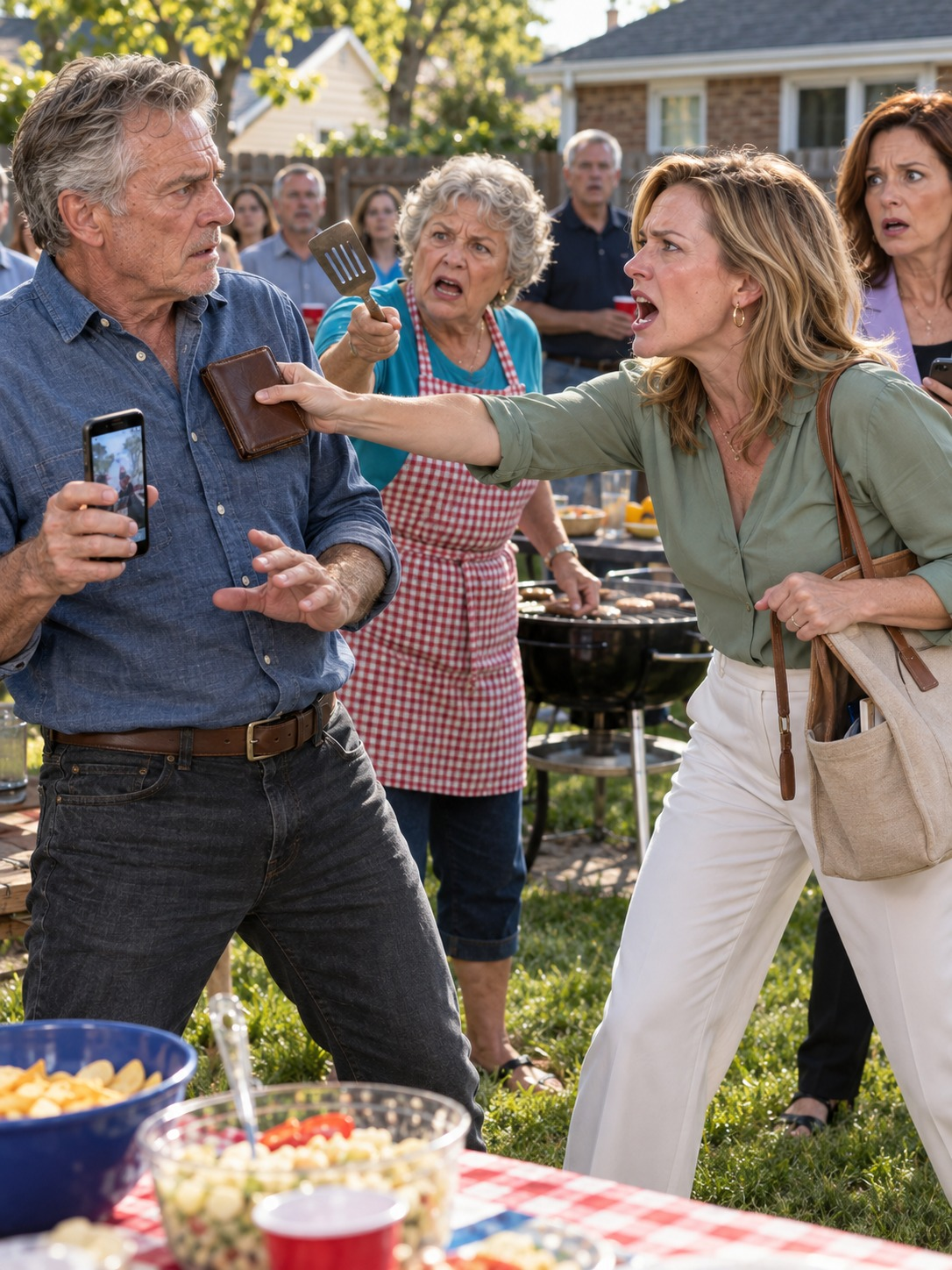
I thought about Shelby holding her phone.
About the neighbors standing around Hattie's driveway.
About Dani pulling my wallet from her tote while everybody watched.
"Then you know what happened."
"I know what the recording showed."
"That makes two of us."
Daniel hesitated.
"There's something else."
I waited.
"The document Greg showed me had a title."
I looked down at the envelope.
"Family Capacity Review?"
"Yes."
My fingers tightened around the phone.
"How do you know that?"
"Because he asked whether I would sign a statement supporting it."
I stared at the envelope.
"Did you?"
"No."
"Did anybody?"
"I don't know."
I closed my eyes.
For several seconds, neither of us spoke.
Then Daniel said, "I thought you deserved to know."
I thanked him.
He gave me his business number and said he would confirm the substance of our conversation in writing if needed.
I didn't ask him to take sides.
I didn't ask him to accuse Dani or Greg of anything.
I simply wrote down what he had told me.
When the call ended, I sat alone in my office.
The envelope lay on the desk.
White paper.
Black lettering.
My name.
A few days earlier, I would have opened it immediately.
Now I took out my phone and photographed both sides.
Then I called Rebecca Sloan.
Her assistant answered.
"Ms. Sloan is with a client."
"Tell her Ray Kesler called. I found something in my house that I think she needs to see."
"Is it urgent?"
I looked at the envelope.
"Yes."
Rebecca called back twenty minutes later.
I explained everything.
The conversation with Daniel.
The envelope.
The hallway recording.
The fact that Dani had entered my office while I was preparing coffee.
Rebecca listened carefully.
"Don't destroy or alter anything," she said.
"I haven't."
"Photograph the envelope before opening it."
"Already did."
"Good. You can bring it to my office, and we'll review it together."
I looked toward the window.
It was almost five.
"Can I come tomorrow?"
"Nine o'clock."
"I'll be there."
After hanging up, I placed the envelope inside a clean folder.
Then I locked the office door.
I stood in the hallway for a moment, looking at the small table where my wallet and glasses normally sat.
It was strange how ordinary everything looked.
The same family photographs.
The same worn runner.
The same oak furniture Carol had picked out twenty years earlier.
Nothing in that hallway suggested my daughter had been trying to manufacture evidence against me.
But the camera had recorded what my eyes hadn't seen.
And I was beginning to understand why facts mattered so much.
The next morning, Rebecca opened the envelope in front of me.
Inside were four pages.
The first was a typed summary.
The second contained a list of alleged incidents.
The third was a proposed family statement.
The fourth was a blank signature page.
Rebecca read the first paragraph.
Then stopped.
"Ray, have you ever been diagnosed with a cognitive impairment?"
"No."
"Have you been hospitalized for confusion or memory problems?"
"No."
She continued reading.
The document described me as a widowed older adult experiencing increasing difficulty with everyday decisions.
It claimed I'd forgotten appointments.
Misplaced important belongings.
Become unusually attached to possessions associated with my late wife.
And made sudden financial changes that endangered my family.
I stared at the page.
"Unusually attached to possessions?"
Rebecca looked up.
"That's the language here."
"My wife and I restored that camper together."
"I understand."
"Keeping something your dead wife loved is evidence you're losing your mind?"
"No."
She said it firmly.
I appreciated that.
Then she turned to the second page.
The alleged incidents were listed by date.
One said I'd lost my wallet.
Another said I'd misplaced my glasses.
A third claimed I'd left a stove burner on.
I leaned forward.
"That last one never happened."
Rebecca nodded.
"Do you have anything supporting that?"
"Hattie Mullins. She publicly denied making the accusation."
"Good. We'll note that."
She continued reading.
Another entry claimed I'd forgotten a conversation about delaying retirement until age sixty-four.
I shook my head.
"That conversation never happened."
"Did you ever agree in writing to delay retirement?"
"No."
"Did you ever agree verbally?"
"No."
Rebecca made a note.
Then she reached the third page.
Her expression changed.
"What is it?" I asked.
She turned the document toward me.
The proposed family statement asked relatives to support a review of my ability to manage financial and property matters.
It also recommended that I temporarily avoid making significant decisions until the family could arrange an evaluation.
I read the words slowly.
Temporarily avoid making significant decisions.
I thought about my retirement.
My bank accounts.
The Shasta.
The property transfer agreement.
"Does this have any legal authority?"
"Not by itself," Rebecca said. "It's an unsigned family document, not a court order or medical assessment."
I exhaled.
"But it could be used to pressure me."
"Yes."
She looked at me carefully.
"And that's why we're going to make sure your actual wishes are documented."
We spent the next hour reviewing my estate documents.
Rebecca prepared the steps to revoke the old power of attorney and establish a new arrangement.
We discussed updating my will.
My medical directives.
My property records.
I signed nothing until she'd explained every section.
At one point, she asked whether I wanted to disinherit Dani.
I looked at her.
"No."
"All right."
"I'm angry with her. I'm not pretending otherwise. But she's still my daughter."
Rebecca nodded.
"Then we'll make decisions based on what you want, not on what you're feeling today."
I appreciated that more than she knew.
Because anger can make a person careless.
And I had spent my working life avoiding careless decisions.
Before I left, Rebecca asked about the Shasta.
"Where is it now?"
"At my friend Vern's workshop."
"Secure?"
"Locked gate. Hitch lock. Cameras."
"Good."
"Should I sell it?"
The question came out before I could stop it.
Rebecca looked surprised.
"Do you want to?"
"No."
"Then why would you?"
I stared at the desk.
"Because I'm tired of fighting."
She was quiet for a moment.
Then she said, "You don't have to surrender something you love to prove you're reasonable."
I nodded.
And for the first time since Easter, I felt tears behind my eyes.
That afternoon, I drove to Vern's workshop.
He was welding a bracket when I arrived.
Sparks scattered across the concrete floor.
He lifted his helmet.
"Well?"
I told him about the envelope.
The alleged incidents.
The proposed family statement.
Daniel Mercer's call.
Vern listened without interrupting.
When I finished, he set down his welding gloves.
"Your daughter really put your wallet on a list of things you forgot?"
"Yes."
"After she took it?"
"Yes."
He stared at me.
Then shook his head.
"That's a special kind of stupid."
I laughed.
I couldn't help it.
Vern wiped his hands on a rag.
"Come on."
"Where?"
"Your camper."
We walked behind the workshop.
The Shasta sat beneath its cover, safe behind the locked gate.
Vern pulled the cover back.
"Look at that."
I smiled.
The turquoise paint gleamed.
"Still ugly," he said.
"Carol would have hated you."
"Carol loved me."
"She tolerated you."
"Same thing."
I opened the camper door.
The familiar smell greeted me.
Old wood.
Clean fabric.
A little lemon polish.
I stepped inside.
Everything was exactly as we'd left it.
The yellow curtains.
The tiny table.
The narrow bed.
The cabinet Carol insisted on painting cream.
I ran my fingers across the countertop.
There was a small scratch near the sink.
I remembered how it happened.
Carol had dropped a screwdriver while replacing a faucet.
She'd looked at the mark and said, "Well, now it's officially ours."
I sat on the bench.
Vern remained outside.
He knew better than to follow me into that moment.
I looked around.
This wasn't a valuable collector's item.
It wasn't a luxury trailer.
It was a forty-foot dream squeezed into a little aluminum shell.
And it belonged to me.
Not because the title said so.
Because Carol and I had put ourselves into it.
I opened the overhead cabinet.
Inside was a small tin box.
Blue flowers.
A dented corner.
Carol's recipe tin.
She used to keep index cards in it.
Chicken soup.
Apple crisp.
Banana bread.
A handwritten recipe for peach cobbler that she claimed came from her grandmother.
I lifted the tin.
It felt lighter than I remembered.
I opened it.
The cards were gone.
Every one.
For a moment, I simply stared.
Then I checked the cabinet again.
Nothing.
I looked beneath the cushions.
Inside the drawers.
Under the table.
Nothing.
My heart began pounding.
I carried the empty tin outside.
"Vern."
He turned.
"What?"
"Did you move anything in here?"
"No."
"Anybody else been inside?"
"Not since we parked it."
I showed him the tin.
"Carol's recipes were in here."
He looked at it.
"Maybe you moved them before we brought the trailer over."
"Maybe."
I wanted that to be true.
I really did.
But I remembered opening the tin two months earlier.
I'd been looking for Carol's peach cobbler recipe.
The cards had been there.
I was certain.
Then I remembered something else.
Dani had visited the house the previous Saturday.
The day before Easter.
Hattie had seen her SUV.
Shelby had been with her.
And the trailer had still been in my garage.
I closed the tin.
Vern watched me.
"Ray?"
I shook my head.
"I don't know."
He didn't press.
We searched the camper together.
Every cabinet.
Every drawer.
Every storage compartment.
The cards were gone.
I sat on the step outside the door.
Vern lowered himself beside me.
"Maybe Dani took them because she wanted copies."
I looked at him.
"Then why not ask?"
He had no answer.
Neither did I.
That evening, I called Maureen.
"Do you remember Carol's recipe tin?"
"Of course."
"The blue one?"
"With the little flowers."
"That's it."
She sounded pleased.
"Carol carried that thing everywhere. Why?"
"The cards are missing."
Silence.
Then she said, "Missing?"
"Every one."
"Oh, Ray."
I rubbed my forehead.
"Did Carol ever give Dani copies?"
"Some, yes. But not the originals."
"Are you sure?"
"Positive. Carol was particular about those cards."
I looked at the empty tin.
"Did she ever tell you what she wanted done with them?"
Maureen was quiet.
Then she said, "She wanted Josie to have them someday."
My throat tightened.
"Josie?"
"Yes. Carol said she hoped the little girl would learn to cook from the same recipes."
I closed my eyes.
Carol had been sick when Josie was small.
She knew she might not live long enough to teach her granddaughter everything she wanted.
So she'd saved the cards.
For Josie.
I swallowed.
"Thanks, Maureen."
"Ray, do you think Dani took them?"
"I don't know."
"Would you ask her?"
"Not yet."
I looked at the tin.
"I want to be sure."
After hanging up, I searched the house.
Kitchen drawers.
Pantry shelves.
The old cookbook cabinet.
The box of Christmas decorations.
Nothing.
I checked the garage.
Nothing.
Then I sat at the kitchen table with the empty tin.
I remembered Carol writing recipes on index cards.
Her handwriting was small and neat.
She always underlined ingredients she thought I might forget.
Salt.
Butter.
Vanilla.
And sometimes she added little notes.
Ray likes extra cinnamon.
Dani hates onions.
Josie will love this someday.
I held the tin in both hands.
For the first time, I felt something close to despair.
Money could be replaced.
Insurance could be transferred.
Legal documents could be rewritten.
But Carol's handwriting couldn't.
If those cards were gone, there would never be another set.
The next morning, I went to work early.
Tom was already there.
He looked at me.
"You look like hell."
"Thanks."
"You're welcome."
I told him about the missing recipes.
He listened.
Then said, "Have you checked online?"
I frowned.
"What?"
"People sell old recipe collections. Vintage cards. Handwritten stuff."
I stared at him.
"Why would anybody buy somebody else's recipes?"
Tom shrugged.
"People buy everything."
I thought about Shelby.
About her phone.
About the way she always seemed to know where to find a bargain.
After work, I went home and opened my laptop.
I searched local marketplace listings.
Vintage recipe cards.
Handwritten recipe collection.
Old kitchen tin.
Blue floral recipe box.
There were hundreds of results.
Most were ordinary.
Some were expensive.
Some were ridiculous.
I kept scrolling.
Then I saw a familiar blue tin.
Dented corner.
White flowers.
The same small scratch near the lid.
My heart stopped.
The listing price was two dollars.
Two dollars.
I clicked the photograph.
The seller had arranged several handwritten recipe cards beside the tin.
I recognized Carol's handwriting immediately.
The listing description read:
Vintage handwritten recipe cards and decorative tin. Estate cleanout. Pickup in Kettering.
I stared at the screen.
Estate cleanout.
Carol had been dead four years.
And somebody was selling her recipes as though they were unwanted junk.
I enlarged the photograph.
There was her peach cobbler recipe.
Her chicken soup.
Her apple crisp.
And one card with a little note at the bottom.
For Josie, when she's big enough to stir.
My eyes filled.
I took screenshots.
Saved the listing.
Then looked at the seller's name.
It wasn't Dani.
It wasn't Greg.
It was an account called Shelby's Second Chance Finds.
I sat back.
For several seconds, I couldn't move.
Then I called Vern.
He answered.
"What's wrong?"
"I found the recipe cards."
"Where?"
"Online."
"Good."
"Somebody's selling them."
Silence.
Then he said, "Who?"
I looked at the seller's profile.
"Shelby Slade."
Vern let out a long breath.
"Ray."
"I know."
"Don't go over there angry."
"I'm not."
But my voice was shaking.
He heard it.
"Where are you?"
"Home."
"Stay there. I'm coming."
I hung up.
Then I opened the listing again.
The price was still two dollars.
I clicked the seller's profile.
There were dozens of listings.
Old lamps.
Children's toys.
Kitchenware.
Clothing.
Then I saw another item.
A small framed photograph.
Carol and me standing beside the Shasta.
The same photograph that had been in the camper's overhead cabinet.
I clicked it.
The listing said:
Vintage camping couple photo. Great retro decor. $5.
I stared at the picture.
My wife was smiling.
Her hand rested on my shoulder.
I remembered the day it was taken.
The sun had been bright.
She'd been wearing her favorite yellow blouse.
We'd just finished painting the camper.
I had kissed her cheek after the photograph.
And now somebody was selling that moment for five dollars.
I felt something break inside me.
Not loudly.
Not dramatically.
Just a quiet snap.
Like a worn wire finally giving way.
I opened a message to the seller.
My fingers hovered over the keyboard.
I wanted to write:
Those belong to my dead wife.
I wanted to demand an explanation.
I wanted to ask how anybody could look at a stranger's family photograph and decide it was merchandise.
But Vern's words returned.
Don't go over there angry.
So I typed something else.
Hi. I'm interested in the recipe tin and the framed camping photograph. Are both still available?
I pressed send.
A reply arrived almost immediately.
Yes! Pickup tomorrow. Cash only.
I stared at the message.
Then another appeared.
Actually, someone else has asked about the photo. If you want it, I can hold both for $10.
Ten dollars.
My wife's handwriting.
Our photograph.
Ten dollars.
I typed:
I'll take them.
The seller sent an address.
Then a pickup time.
I copied both into my notebook.
When Vern arrived, I showed him everything.
He looked at the listings.
Then at me.
"That's Carol's writing?"
"Yes."
"And that's your photograph?"
"Yes."
He shook his head.
"Unbelievable."
I sat down.
"Vern, how did Shelby get these things?"
He looked at me.
We both knew the most likely answer.
But neither of us said it.
Not yet.
Because accusing Dani wouldn't bring Carol's recipes home.
And I wanted those cards back before anything else happened.
We agreed Vern would come with me.
We would buy the items.
Keep the messages.
Take photographs.
And leave.
No confrontation.
No accusations.
Just get the things back.
That night, I barely slept.
I kept thinking about Carol.
About the way she wrote little notes on recipe cards.
About how she'd wanted Josie to have them.
About the photograph beside the Shasta.
And about how easily somebody had turned those memories into a ten-dollar sale.
The next morning, Vern picked me up at nine.
We drove to the address Shelby had sent.
It was a small house on a quiet street.
A white SUV sat in the driveway.
I recognized it immediately.
Dani's.
Vern slowed the truck.
"Ray."
"I see it."
He parked across the street.
We sat for a moment.
Then I took out my phone.
There was a new message from Shelby.
Come around back. The items are ready.
I looked at the house.
Then at Dani's SUV.
Vern turned toward me.
"You still want to do this?"
I thought about Carol's handwriting.
About Josie's future.
About the photograph.
"Yes."
We got out.
Walked up the driveway.
And went around the side of the house.
The back door stood partly open.
I heard voices inside.
Shelby's voice.
Then Greg's.
Then Dani's.
I stopped.
Vern stood beside me.
Through the opening, I heard my daughter say:
"Once Dad signs the trailer over, we won't need to worry about the mortgage anymore."
Greg answered quietly.
"Only if he doesn't find out what we already did."
I felt the blood drain from my face.
Vern looked at me.
Neither of us moved.
Then a fourth voice spoke.
A voice I recognized from the phone.
Daniel Mercer.
And he said:
"Before anybody signs anything, you need to explain why Raymond Kesler's name is already on the ownership paperwork..."






Comments 0