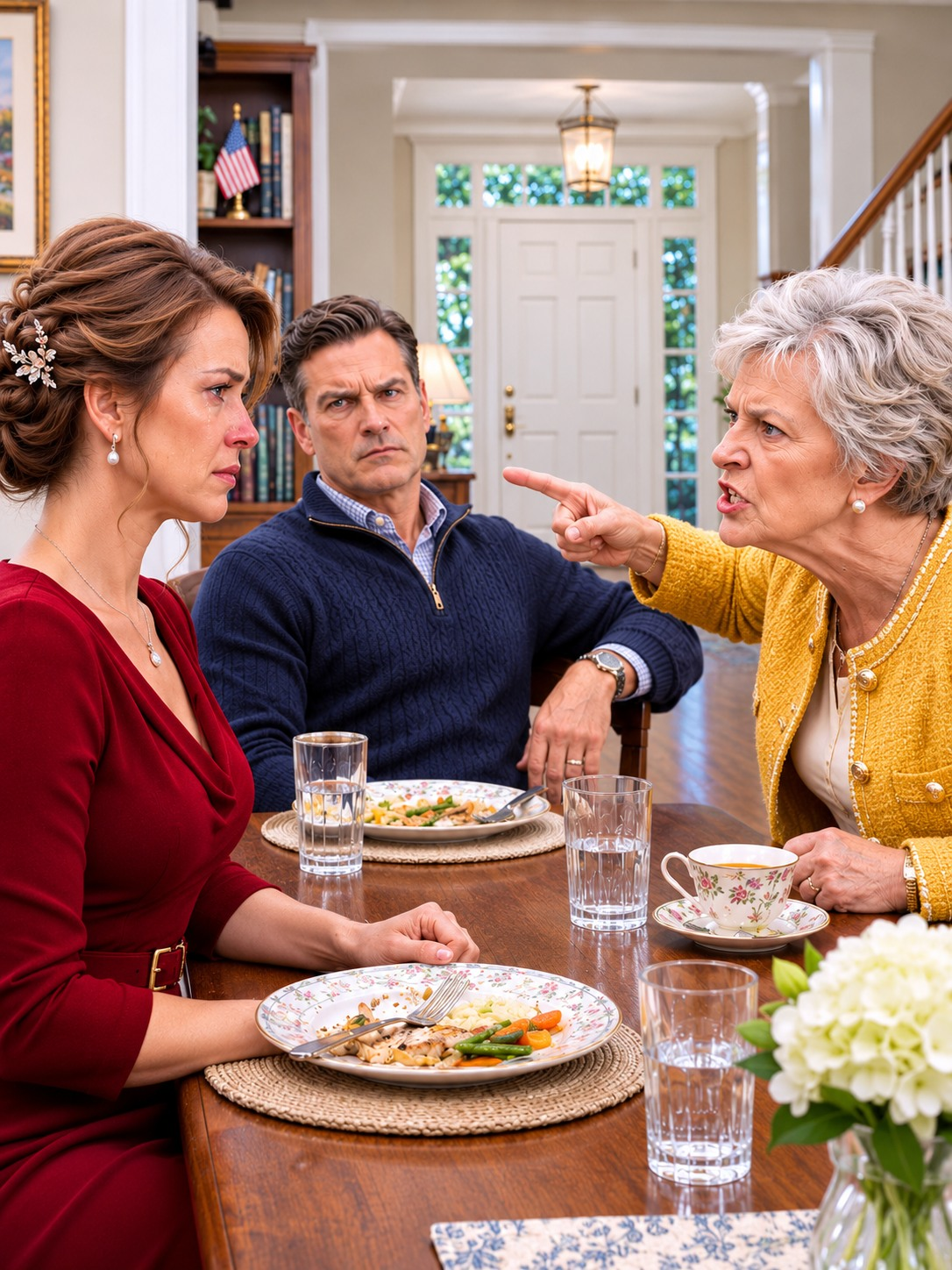
"The person who signed the original deed was your father, Claire!"
Helen Mercer's voice carried through the glass beside our front door.
Behind me, Marcus stopped breathing for what seemed like an entire second.
"Don't open it," he said.
I turned toward him.
"Why?"
"Because that woman has no business coming here."
Outside, Helen stood beneath the porch light, holding a thick envelope against her chest. She appeared to be in her late sixties, with silver hair, a dark wool coat, and the determined expression of someone who had spent a long time deciding whether to knock on a particular door.
I had never seen her in person.
But I recognized her immediately.
She was the woman from the photograph.
The woman whose face someone had deliberately concealed.
"Claire," Marcus said, lowering his voice, "I'm telling you to leave that door closed."
I looked at him.
For twenty-four years, that tone had been enough to make me obey.
Not because he shouted.
Because he spoke with the certainty of someone who believed his wishes were rules.
But this time, the woman outside was holding something connected to my father.
And my father had been dead for seven years.
I reached for the lock.
Marcus moved closer.
"Claire."
I opened the door.
Helen looked past my shoulder.
Her expression changed when she saw Marcus.
"Hello, Marcus."
He didn't answer.
She looked back at me.
"Mrs. Whitmore, I'm sorry to come without an appointment."
"How did you find me?"
She gave a small, humorless smile.
"I was here twenty-four years ago."
Marcus stepped beside me.
"You need to leave."
Helen's eyes remained on mine.
"I have information concerning the original property transaction. I believe you should review it with your attorney."
"There's nothing to review," Marcus snapped.
I turned toward him.
"Then why are you so upset?"
He stared at me.
"I'm not upset."
"You're trying to stop me from speaking to someone who knew my father."
"Because she's interfering in our marriage."
Helen adjusted the envelope in her hands.
"I'm not here to discuss your marriage, Marcus."
"Then what are you here to discuss?"
"The records."
His jaw tightened.
I noticed his hands.
He was gripping the edge of the door so tightly that his knuckles had turned pale.
For the first time, I wondered whether Marcus was afraid of something other than losing control of me.
Helen spoke quietly.
"Claire, your father asked me to preserve certain information if questions ever arose about the original transaction."
I felt my throat tighten.
"Why would he do that?"
"Because he was concerned about how the arrangement might be described in the future."
Marcus laughed sharply.
"This is ridiculous."
Helen looked at him.
"Then you shouldn't object to your wife having an attorney examine the records."
Silence.
I could hear a car passing along our street.
Somewhere inside, Teresa's television was still playing.
The ordinary sounds made the confrontation feel even stranger.
I stepped onto the porch and pulled the door partly closed behind me.
Marcus immediately objected.
"Claire, get back inside."
I ignored him.
Helen lowered her voice.
"I don't want to create a scene."
"Then tell me what's happening."
She glanced at the envelope.
"I worked for the title company involved in your purchase. Your father contributed substantial funds toward acquiring this property."
"I know he helped us."
"Yes. But he wanted the contribution documented in a particular way."
"What way?"
She hesitated.
"That's something your attorney needs to determine from the recorded instruments and the original closing file."
I studied her face.
"Why can't you tell me?"
"Because I no longer work for that company, and I don't want to give you an incomplete legal explanation based on records I haven't reviewed in years."
That answer was more reassuring than a dramatic declaration would have been.
She wasn't promising that I owned the house.
She wasn't claiming Marcus had committed a crime.
She was telling me to verify the documents.
I could respect that.
"Did you send me the photograph?" I asked.
Helen's expression changed.
"What photograph?"
I showed her my phone.
She examined the image.
Her eyes widened slightly.
"Where did you get this?"
"An anonymous message."
She looked toward the front door.
"That picture was taken on the day we finalized the original transaction."
"Why was your face covered?"
"I don't know."
"Did you send the other messages?"
"No."
She answered immediately.
I believed her, though I couldn't have explained why.
"Someone accessed my private documents," I continued. "The access report showed my mother-in-law's name."
Helen frowned.
"Then you should tell your attorney. And consider having someone qualified examine your computer."
She handed me the envelope.
"This contains copies of correspondence and notes I retained from the transaction. I also included the contact information for the current records custodian."
I looked at the handwriting across the front.
My father's signature appeared beneath a short note.
For Claire, if questions arise.
My eyes burned.
"Why didn't you contact me sooner?"
Helen's expression softened.
"Because until recently, I had no reason to believe there was a problem."
"What changed?"
She glanced toward the door again.
"Someone contacted me asking whether the original file could be destroyed."
My stomach tightened.
"Who?"
Before she could answer, the front door opened.
Marcus stepped onto the porch.
"That's enough."
Helen straightened.
"I've given Mrs. Whitmore the information she needs."
"You've given her a bunch of old papers that mean nothing."
"Then there should be no difficulty verifying them."
Marcus took a step forward.
I moved between them.
"Marcus, go inside."
He stared at me.
"What?"
"Please."
His expression shifted from anger to disbelief.
I had never spoken to him that way in front of another person.
Not once.
Helen watched silently.
For several seconds, nobody moved.
Then Marcus turned and walked back into the house.
He shut the door hard enough to rattle the glass.
I looked at Helen.
"I'm sorry."
"You don't need to apologize for his behavior."
The words struck me unexpectedly.
I had spent so much of my marriage apologizing for Marcus that I'd forgotten it was possible not to.
Helen reached into her coat pocket and handed me a business card.
"If your attorney needs to contact me, she can use this number."
I took it.
"Thank you."
She nodded.
Then she paused.
"Claire, your father was very careful about protecting you."
My throat tightened.
"He was."
"He asked questions other people found inconvenient."
I looked down at the envelope.
"That sounds like him."
Helen stepped toward the porch stairs.
"Please have someone review everything before making decisions."
I watched her walk to her car.
Then I returned inside.
Marcus was waiting in the foyer.
"What did she give you?"
"Documents."
"Give them to me."
I held the envelope against my side.
"No."
His expression hardened.
"Claire, don't be childish."
"They're addressed to me."
"Anything involving this house involves me."
"Then you can discuss it with my attorney."
The words escaped before I had time to reconsider them.
Marcus went completely still.
"Your what?"
I looked at him.
"My attorney."
His face changed.
Not into anger.
Not immediately.
First came surprise.
Then something colder.
"So you have been talking to a lawyer."
"I scheduled a consultation."
He laughed bitterly.
"Unbelievable."
I waited.
"After everything I've done for you, you're secretly preparing to divorce me?"
I stared at him.
"You've been threatening divorce for years."
"That's different."
"How?"
He opened his mouth.
Then closed it.
For the first time, he couldn't find an answer quickly enough.
I walked past him.
He followed me into the hallway.
"Claire, we need to talk."
"We will."
"Now."
"Not tonight."
He caught up with me near the stairs.
"You don't get to decide when this conversation happens."
I turned.
"Actually, I do."
He stopped.
I could see the anger gathering in his face.
But beneath it was something I hadn't noticed before.
Uncertainty.
I continued upstairs without another word.
Inside the bedroom, I locked the door.
Then I sat on the edge of the bed and opened Helen's envelope.
There were photocopies of old correspondence, a handwritten list of closing expenses, and several pages containing legal descriptions of the property.
I recognized my father's handwriting on two pages.
One note referred to a contribution toward the purchase.
Another mentioned the importance of preserving the original records.
There was also a copy of a letter addressed to the title company.
I read it twice.
The language was formal and careful.
My father had requested confirmation that the funds he provided would be reflected accurately in the transaction records.
He had also asked that any later changes involving ownership be properly documented.
I didn't understand every detail.
But I understood his concern.
He hadn't wanted a handshake agreement.
He'd wanted proof.
At the bottom of the envelope was a small folded note.
I opened it.
Claire, if you ever need these papers, remember that knowing the truth is not the same as starting a fight.
I pressed the note against my chest.
For several minutes, I cried.
Quietly.
Not because Marcus had threatened divorce.
Not because Teresa wanted me out.
Because my father had apparently understood something about my marriage long before I was willing to admit it.
And he'd tried to leave me a way to protect myself.
The following morning, I called Amanda Ross's office.
I explained that additional documents had surfaced and that someone connected to the original title transaction had contacted me.
The receptionist offered to move my appointment forward.
A cancellation had opened a slot that afternoon.
I accepted immediately.
At work, I told Patricia I needed to leave early for a personal appointment.
She didn't ask questions.
"Take whatever time you need."
I thanked her.
Then I spent the morning handling the most urgent operational issues.
There was a delayed refrigerated shipment in Wisconsin.
A vendor had submitted an incorrect invoice.
Two drivers needed schedule adjustments.
I resolved each problem.
The routine helped.
At noon, I placed the documents in my locking case and drove downtown.
Amanda Ross's office occupied the seventh floor of a brick building near the Chicago River.
The waiting room was quiet, with pale walls, comfortable chairs, and a small table holding magazines nobody appeared to read.
I checked in.
A receptionist offered water.
Then Amanda came out to greet me.
She was in her early fifties, with short dark hair and a calm, professional manner.
"Claire Whitmore?"
"Yes."
"I'm Amanda Ross. Come on back."
Her office had large windows overlooking the street.
A framed law degree hung beside a bookshelf filled with legal reference materials.
She invited me to sit.
Then she opened a notebook.
"Before we discuss the property, I'd like to understand what brought you here."
I took a breath.
"My husband keeps threatening divorce."
"How long has that been happening?"
"Most of our marriage."
"How long have you been married?"
"Twenty-four years."
She wrote something down.
"And what prompted you to seek advice now?"
I explained Marcus's demand that I resign from my job to become his mother's full-time caregiver.
I told her about Teresa's ultimatum.
About Marcus ordering me to leave.
About the years of threats.
Amanda listened without interrupting.
When I finished, she asked, "Has your husband filed anything?"
"Not that I know of."
"Has he given you written notice to leave the property?"
"No."
"Has there been physical violence?"
"No."
"Has he threatened your physical safety?"
"Not directly."
She nodded.
"All right. I want to be clear about something. A spouse saying 'get out' during an argument does not automatically determine either person's legal right to occupy a marital residence."
I felt my shoulders loosen.
Amanda continued.
"Property rights depend on the relevant documents, the circumstances of acquisition, contributions, and applicable Illinois law. We need to examine the facts carefully."
I nodded.
"That's why I'm here."
"Good."
She held out her hand.
"Let's start with the records."
I opened the case.
For the next forty minutes, Amanda reviewed the documents.
She compared dates.
Examined signatures.
Made notes.
Asked questions about my father's contribution.
She wanted to know whether the money had been a gift, a loan, or part of another arrangement.
I explained that my father had helped us before the wedding, but I had never been involved in the details.
Amanda didn't speculate.
Instead, she separated the papers into categories.
Recorded documents.
Correspondence.
Financial records.
Unverified materials.
She placed the anonymous messages in the last category.
"These may be important," she said, "but we shouldn't assume they're authentic until we establish their source."
I appreciated that.
For days, I'd felt as though everyone around me was making declarations.
Marcus insisted the house was his.
Teresa insisted I had no right to challenge him.
The anonymous sender insisted someone was hiding something.
Amanda was the first person who seemed interested in proving anything.
She examined the old photograph.
"Do you know who this woman is?"
"Helen Mercer. She worked for the title company."
"Have you spoken with her?"
"Last night."
I gave Amanda Helen's card.
She added it to the file.
"With your permission, I'd like to contact her and request any records she can properly provide."
"Of course."
Amanda then turned to the scanned deed.
She compared it with the current property record I'd printed.
Her pen stopped moving.
She looked at the dates again.
Then she opened another document.
"Claire, did your husband ever tell you that the property was originally acquired before your marriage?"
"Yes. We bought it shortly before the wedding."
"Did he explain how ownership was recorded?"
"He always said the house was his because he handled the mortgage."
Amanda nodded slowly.
"Those are two different questions."
I stared at her.
"What do you mean?"
"Being responsible for a mortgage and holding title to property aren't necessarily the same thing. And neither question, by itself, resolves how a court would classify or divide the property."
I looked down at my hands.
For years, Marcus had treated his version of the facts as unquestionable.
Now, sitting in a lawyer's office, I was discovering that the truth might be considerably more complicated.
Amanda continued reviewing the documents.
Finally, she removed her glasses.
"Claire, I want to ask you something that may seem unrelated."
"All right."
"When your father contributed money toward the purchase, did Marcus ever ask you to sign a document afterward?"
I thought carefully.
"We signed a lot of paperwork."
"Do you remember signing anything that changed ownership?"
"No."
"Anything your husband described as a routine correction?"
I frowned.
A memory surfaced.
A kitchen table.
Marcus standing beside me.
A stack of papers.
He'd said the bank needed something updated.
I couldn't remember the year.
"Maybe," I admitted.
Amanda leaned forward.
"Tell me what you remember."
I closed my eyes.
"It was after we were married. I think Daniel was still little."
"Did you read the document?"
"I don't remember."
"Did anyone explain it to you?"
"Marcus said it was paperwork for the mortgage."
Amanda wrote something down.
"Do you have a copy?"
"No."
"All right."
She looked at the current record again.
"Then we'll need to obtain the complete chain of title and any related instruments."
I felt a tightening in my chest.
"Is something wrong?"
"I don't know yet."
She spoke gently but firmly.
"And I don't want to frighten you with conclusions before we have verified records."
I nodded.
Amanda closed the file.
"There's another issue we should discuss."
"My job?"
"Yes."
I sat straighter.
"My husband wants me to resign by the end of the month."
"Do you want to resign?"
"No."
"Then I would strongly recommend that you not make a major employment or financial decision solely because of his ultimatum, at least until you've received advice about your circumstances."
I felt an unexpected wave of relief.
She continued.
"Your income, benefits, retirement accounts, and future earning capacity are important. Giving up employment can have long-term consequences."
"I know."
"Good. Then protect your ability to make an informed choice."
I looked toward the window.
For fifteen years, I'd worked to become financially independent.
For twenty-four years, I'd allowed Marcus to convince me that independence was somehow disloyal.
Now a stranger was telling me that protecting my livelihood was reasonable.
I wished I could go back and tell my younger self.
Amanda asked about our children.
"Daniel is twenty-six. Chloe is twenty-two."
"Do they live at home?"
"No. But they visit often."
"Are they aware of the conflict?"
I hesitated.
"I thought I'd hidden most of it."
"And now?"
I remembered Chloe's message.
Was Dad threatening divorce again?
"They know more than I wanted them to."
Amanda nodded.
"Adult children often understand family dynamics more clearly than their parents realize."
I looked down.
"I thought staying quiet protected them."
"Perhaps you were doing the best you knew how to do at the time."
Her tone was matter-of-fact.
Not pitying.
I appreciated that.
She returned to the property documents.
"Claire, I also want you to preserve any communications about the house, your employment, and your husband's threats. Don't alter or delete anything."
"I won't."
"And don't access accounts or records you're not authorized to use."
"Understood."
She looked at the screenshot of the alleged file access.
"For this, consider an independent technology professional who can assess your device and accounts. We don't yet know whether the report is genuine."
I nodded.
Amanda placed the papers into a folder.
"Now, I'd like to discuss one final detail."
I looked up.
She pointed to a line on the oldest document.
"Do you recognize this signature?"
I leaned forward.
It was my father's.
"Yes."
"And this one?"
I examined the second signature.
At first, I thought it belonged to Marcus.
But the handwriting was different.
The first letter was unmistakable.
A large, looping T.
I frowned.
"No."
Amanda studied my expression.
"Are you certain?"
"I don't recognize it."
She turned the page slightly.
"Claire, this document appears to have been witnessed by someone with a connection to your family. We need to verify the identity and the circumstances."
I stared at the signature.
Then I remembered something Mom had said.
My father had come home upset after the closing.
Marcus had questioned an arrangement.
And there had been a woman present.
I looked at Amanda.
"Could someone have changed the ownership records without telling me?"
She considered the question.
"Changes to recorded title generally require formal documentation. Whether a particular instrument is valid depends on its execution and the surrounding facts. That's why obtaining certified copies matters."
I nodded slowly.
Amanda wrote down the instrument number.
Then she looked at me.
"Claire, I want you to answer one question as honestly as you can."
"All right."
"If your husband discovered that you had a stronger legal position concerning the house than he believed, how do you think he would react?"
I stared at her.
I thought about Marcus's threats.
His anger.
His insistence that everything belonged to him.
His sudden suspicion when I mentioned records.
"I don't know," I whispered.
Amanda nodded.
"Then until we understand the documents, I recommend that you avoid confronting him about ownership."
I looked at the folder.
"Do you think the house might actually belong to me?"
She shook her head slightly.
"I think we have enough questions to justify a careful investigation. But I won't tell you something we haven't established."
I appreciated her honesty.
We discussed next steps.
Amanda would request certified records.
She would contact Helen Mercer.
She would review the historical ownership documents and financial contributions.
And I would continue working, preserving records, and avoiding unnecessary confrontation.
When the appointment ended, I stood.
For the first time in weeks, I felt as though I had a plan.
Not a guarantee.
Not a victory.
A plan.
Amanda walked me to the door.
"Claire?"
I turned.
"Yes?"
"One more thing."
She held up the oldest scanned document.
"Did your father ever tell you why he insisted on keeping the original?"
I thought about his handwritten note.
Claire must always know.
"No," I said.
Amanda nodded.
"Then we may need to ask your mother."
I left the office carrying my document case.
Outside, Chicago traffic moved through the late afternoon.
People hurried along the sidewalks.
Cars honked.
A delivery truck blocked part of the street.
The world continued as though nothing had changed.
But something had.
For the first time, I wasn't waiting for Marcus to decide what happened next.
I was gathering the information I needed to decide for myself.
I reached the parking garage and unlocked my car.
My phone vibrated.
A message from Mom.
Claire, I found another letter in your father's box.
I opened it.
It's addressed to you.
A second message followed.
I think he wrote it after he discovered something about Marcus.
I stared at the screen.
Then my phone rang.
Amanda Ross.
I answered immediately.
"Hello?"
Her voice was different.
Still controlled.
But urgent.
"Claire, I'm sorry to call you so soon after our appointment."
"What's wrong?"
"I just received a preliminary response concerning one of the historical property records."
I gripped the phone.
"And?"
"There is an additional document associated with the original transaction that wasn't included in the copies you brought me."
My heart began pounding.
"What kind of document?"
Amanda paused.
"A document that may explain why your father was so concerned about preserving the original records."
I looked toward the garage exit.
"Can you tell me what it says?"
"Not until I verify the complete copy. But I need to ask you something first."
"Anything."
"Has your husband ever mentioned a property transfer involving his mother?"
I went cold.
"Teresa?"
"Yes."
"No."
Amanda took a breath.
"Claire, the record identifies a transaction involving someone with her name."
I stood motionless beside my car.
Then Amanda continued.
"And there's something else. The document appears to have been submitted for recording on a date when you were hospitalized after Daniel's birth."
I felt the blood drain from my face.
"That's impossible."
"Claire, I need you to listen carefully."
I pressed the phone against my ear.
Amanda's voice lowered.
"The filing contains a signature represented as yours."
I couldn't speak.
"And according to the preliminary record, the person who presented the document for recording was—"






Comments 0