I stared at my father's handwriting until the words began to blur.
"Keep the original. Claire must always know."
Seven words.
Written in blue ink beneath a document I hadn't looked at in more than two decades.
My father had never been a sentimental man. He didn't leave notes in birthday cards or write long letters about his feelings. If he wrote something down, it was because he believed someone might need it later.
And now, sitting alone in my bedroom while my husband watched television downstairs, I wondered what he had been trying to tell me.
I reached for my phone.
My thumb hovered over my mother's number.
It was nearly ten o'clock in Chicago, which meant it was almost eleven in Ohio. Mom was seventy-three, and she had an early cardiology appointment scheduled for the following week. I didn't want to frighten her with questions about paperwork from twenty-four years ago.
But I couldn't stop looking at those seven words.
Claire must always know.
Know what?
I enlarged the scanned page again.
The document appeared to concern the property Marcus and I had purchased shortly before our wedding. I recognized our old address, the legal description of the lot, and my father's signature.
I also recognized the date.
It was three weeks before Marcus and I exchanged vows.
I remembered that period vividly, though not for the reasons most brides would.
I remembered being exhausted.
I remembered working two jobs while helping plan a wedding we could barely afford.
And I remembered Marcus telling me that once we were married, I wouldn't have to worry so much about money.
"That's my job," he'd said.
At twenty-nine, I'd thought those words sounded romantic.
At fifty-three, I heard something entirely different.
I closed the document and leaned back against the headboard.
There was a time when Marcus hadn't frightened me with threats of divorce.
There was a time when he'd made me feel like the most important person in his world.
That was the part of our marriage people never understood.
They saw the man he'd become and assumed he must have always been that way.
But he hadn't.
Or perhaps he'd simply been better at hiding it.
We met at a friend's birthday dinner in downtown Chicago.
I was twenty-seven, working in an administrative position for a small transportation company. Marcus was thirty, charming, ambitious, and already convinced he would become a successful businessman.
He made everyone laugh.
He remembered people's names.
When the waiter accidentally spilled water near my chair, Marcus immediately moved his jacket out of the way and helped clean up.
Later, he walked me to my car.
"You seem like someone who doesn't let people push her around," he said.
I laughed.
"Is that supposed to be a compliment?"
"Absolutely."
He smiled.
"I like strong women."
For years afterward, I remembered that sentence whenever he criticized me for being too independent.
I wondered when strength had stopped being something he admired and become something he wanted to eliminate.
Our courtship moved quickly.
Marcus sent flowers to my office.
He called during lunch breaks.
He drove forty minutes to bring me soup when I caught the flu.
When my father needed help replacing a broken garage door, Marcus showed up with tools before anyone asked.
Dad liked him.
At least, he seemed to.
My mother was less certain.
One evening, after Marcus left our house, she asked whether he ever became angry when I disagreed with him.
I remember laughing.
"Mom, everyone gets angry sometimes."
"That's not what I asked."
I told her Marcus was passionate.
She looked at me for a long moment.
"Passion and control aren't the same thing, Claire."
I dismissed her concern.
I was in love.
And love has a remarkable ability to make warnings sound like insults.
The first serious argument happened six months after our wedding.
We were deciding whether to replace my car.
Mine was old but reliable. Marcus wanted us to purchase a larger vehicle, something expensive enough to impress his business associates.
I told him we should wait.
He accused me of questioning his ability to provide.
I tried explaining that I was worried about the monthly payments.
He walked out of the kitchen.
An hour later, he returned carrying a suitcase.
"If you don't trust me, maybe we made a mistake getting married."
I panicked.
I followed him into the bedroom.
I told him I trusted him.
I apologized for making him feel criticized.
He put the suitcase away.
The following weekend, we bought the vehicle he wanted.
For years, I remembered that argument as a misunderstanding.
Now I recognized it as the first time he'd discovered how effectively the threat of leaving could silence me.
The second time came after Daniel was born.
I was exhausted, recovering from childbirth, and sleeping in stretches of barely two hours.
Marcus wanted to attend a weekend conference.
I asked whether he could postpone the trip.
He said I was being unreasonable.
When I cried, he told me perhaps he'd married someone who wasn't prepared for motherhood.
Then came the familiar words.
"Maybe we should separate."
I begged him not to say things like that.
He kissed my forehead.
"Then stop making everything difficult."
And somehow, I ended up apologizing.
I was beginning to understand that the problem wasn't any individual argument.
It was the pattern.
Marcus created a crisis.
I became frightened.
I surrendered.
Then he acted as though nothing unusual had happened.
Over time, the crises became smaller.
The consequences became larger.
When Chloe was five, I wanted to visit my parents for Thanksgiving.
Marcus preferred spending the holiday with Teresa.
We argued.
He threatened to spend the holidays apart permanently.
We went to Teresa's house.
When Daniel was twelve, Marcus purchased an expensive motorcycle without discussing it with me.
I questioned the expense.
He suggested we divide our assets and end the marriage.
I stopped questioning the purchase.
When I was offered my first management promotion, Marcus complained that the new schedule would interfere with dinner.
I almost declined.
My supervisor, a woman named Patricia, asked me why.
"Is the salary too low?"
"No."
"Are you worried about the responsibilities?"
"No."
"Then what's stopping you?"
I couldn't answer.
Patricia looked at me over her glasses.
"Claire, you don't need to apologize for being good at your job."
I accepted the promotion.
Marcus barely spoke to me for three days.
On the fourth, he announced that he'd forgiven me.
I remember standing in our kitchen, wondering what exactly I had done that required forgiveness.
But I didn't ask.
I had learned that questions extended arguments.
Silence ended them.
At least temporarily.
A sound from the hallway interrupted my thoughts.
Footsteps.
Marcus.
I quickly minimized the document folder.
The bedroom door opened.
He stood in the doorway, holding his phone.
"You're still awake?"
"Obviously."
He frowned.
"There's no need for that attitude."
I looked at him.
"I answered your question."
He walked toward the dresser and placed his watch beside the jewelry box.
"Mom's upset."
I waited.
"She thinks you were deliberately disrespectful tonight."
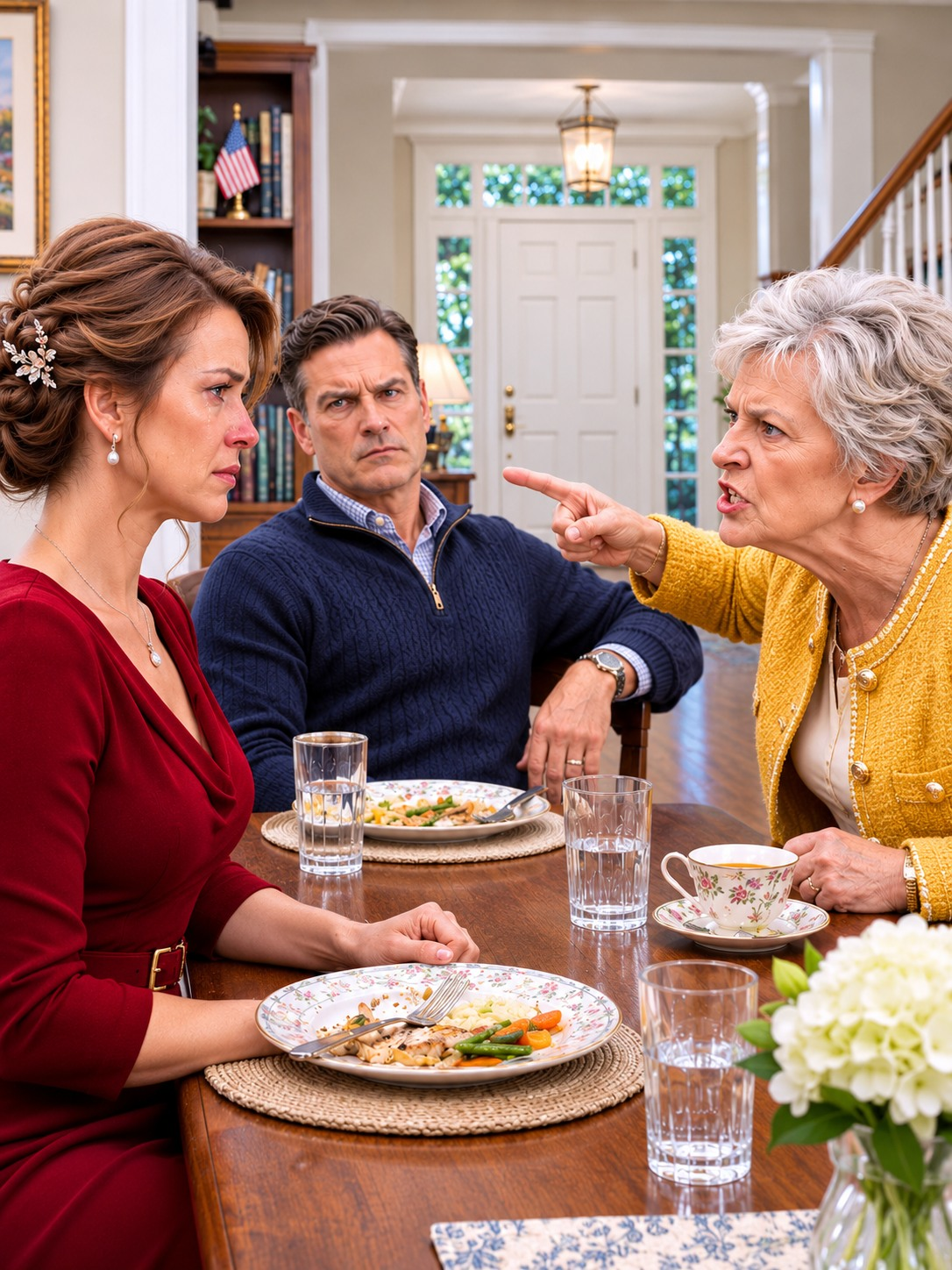
"Teresa told me to leave my own home."
"She was frustrated."
"So was I."
He loosened his collar.
"You're missing the point."
I almost smiled.
That sentence had appeared in our marriage more often than birthday candles.
Whenever Marcus didn't like my response, I was missing the point.
Whenever Teresa insulted me, I was too sensitive.
Whenever I asked for help, I was creating unnecessary conflict.
And whenever Marcus threatened divorce, I was supposed to understand that he didn't really mean it.
"What's the point, Marcus?"
He looked genuinely surprised.
"The point is that Mom needs us."
"She needs assistance. I agree."
"Then why are you fighting me?"
"Because you're asking me to resign from a job I've spent fifteen years building."
"You're making it sound like I'm asking you to sacrifice your life."
I stared at him.
"You're asking me to give up my income, my career, my professional relationships, and my financial independence."
He rolled his eyes.
"Financial independence? We're married."
"Exactly. Which is why we should be making this decision together."
He picked up his phone again.
"You're being dramatic."
I didn't respond.
He seemed to expect an argument.
When none came, he continued.
"I've supported this family for twenty-four years."
"So have I."
His expression hardened.
"Don't start keeping score."
I thought about the mortgage payments I'd contributed to.
The insurance premiums.
The children's tuition expenses.
The groceries.
The renovations.
The countless hours I'd spent managing the household while also working full-time.
Apparently, acknowledging those contributions was keeping score.
Claiming he'd supported everyone alone was simply stating a fact.
Marcus moved toward the bathroom.
"We'll talk when you're ready to be reasonable."
The door closed.
I waited until the shower started.
Then I reopened the scanned document.
For the first time in years, I didn't feel compelled to follow him and repair the disagreement.
I didn't feel responsible for restoring his good mood.
I felt something else.
Curiosity.
What would happen if I simply stopped surrendering?
The next morning, I woke before six.
I prepared coffee, organized Teresa's medications, and made breakfast.
The familiar routine steadied me.
Teresa entered the kitchen at seven, leaning on her cane.
She looked at the table.
"Scrambled eggs again?"
"You can have oatmeal if you'd prefer."
She sat.
"Never mind."
I placed her medication beside her plate.
She examined the pills.
"Did you remember the new dosage?"
"Yes. I confirmed it with the pharmacy yesterday."
She nodded without thanking me.
Then she looked at my work bag.
"You're going to the office?"
"Yes."
"After what happened last night?"
I poured coffee into my travel mug.
"What happened last night doesn't change my work schedule."
She pursed her lips.
"Marcus was very hurt by your behavior."
I turned toward her.
"Teresa, Marcus threatened to divorce me."
"He was trying to make you understand the seriousness of the situation."
"I understood him."
"Then why are you being stubborn?"
I placed the coffee pot down.
"Because disagreeing with someone isn't the same as being stubborn."
She stared at me.
I could see her searching for a response that would put me back into the familiar position of defending myself.
Before she found one, Marcus entered.
He kissed his mother's cheek.
"Morning, Mom."
Then he looked at me.
"Have you thought about what I said?"
"Yes."
"And?"
"I'm still thinking."
He smiled.
It was almost affectionate.
"Good. I knew you'd come around."
I didn't correct him.
Not because I agreed.
Because I was beginning to understand the value of keeping my plans private.
At the office, I arrived twenty minutes early.
Our distribution center was already busy.
Trucks were leaving for grocery stores throughout northern Illinois, and my inbox contained three urgent messages about delayed shipments.
Normally, the moment I entered that building, I became someone different.
Confident.
Decisive.
Capable.
That morning, however, I found myself staring at my computer screen.
I kept hearing Marcus's voice.
See how long you last without me.
It was such a strange threat to make to a woman who earned her own salary.
Yet for years, it had worked.
Why?
I knew the answer.
Because financial independence wasn't the only thing I'd been afraid of losing.
I was afraid of breaking our family.
Afraid of disappointing our children.
Afraid of being judged.
Afraid of admitting that the marriage I'd spent so long protecting might not be the marriage I believed I had.
A knock sounded at my office door.
Patricia stood outside.
She'd retired from her previous leadership role but still consulted for our company several days a month.
"You're here early."
"Couldn't sleep."
She studied my face.
"Everything all right?"
I almost gave my usual answer.
Fine.
Instead, I said, "I'm dealing with something at home."
Patricia stepped inside.
"Anything I can help with?"
I hesitated.
Then I told her about Marcus's demand that I resign.
I didn't tell her everything.
Not the old threats.
Not the years of apologies.
Not the document I'd found.
Just the latest argument.
She listened without interrupting.
When I finished, she asked one question.
"Do you want to leave your job?"
"No."
"Then don't."
I looked at her.
"It's complicated."
"Most important decisions are."
She pulled out a chair.
"Claire, you've spent fifteen years becoming one of the most dependable people in this company. If you decide to retire someday, that should be your choice. Not a punishment for disagreeing with your husband."
I swallowed.
Hearing someone describe the situation so plainly made it harder to pretend it was normal.
Patricia continued.
"Have you spoken to an attorney?"
I shook my head.
"Not yet."
"Then perhaps you should. You don't have to decide anything today. But understanding your options isn't the same as ending your marriage."
That sentence stayed with me.
Understanding my options.
For years, Marcus had presented every disagreement as a choice between obedience and divorce.
I'd accepted those as the only possibilities.
But perhaps there were others.
Perhaps I could refuse to resign.
Perhaps I could insist on a fair arrangement for Teresa's care.
Perhaps I could stop allowing threats to dictate every decision.
And perhaps I needed to know exactly what would happen if Marcus followed through.
During lunch, I closed my office door and called Amanda Ross.
Her receptionist answered on the third ring.
"Ross Family Law. How may I help you?"
I explained that I wanted a confidential consultation concerning marital property and a possible divorce.
The word divorce felt strange in my mouth.
Not because Marcus hadn't said it hundreds of times.
Because this was the first time I had spoken it while taking action rather than begging him to reconsider.
The receptionist offered me an appointment the following Tuesday.
I accepted.
She asked whether there were any immediate safety concerns.
I told her there had been no physical violence, but I was facing repeated threats and pressure to give up my employment.
She explained that I could discuss those concerns privately with Amanda.
After the call, I sat motionless for several minutes.
Then I opened my notebook and wrote three words.
Do not resign.
Underneath, I wrote another sentence.
Find out the truth.
That evening, I returned home at my usual time.
Marcus was in the living room.
Teresa was watching television.
Neither mentioned the argument.
It was another familiar part of our marriage.
After Marcus made a threat, he often behaved as though the matter had been resolved.
He assumed silence meant agreement.
And for years, it usually had.
At dinner, he discussed a colleague's new car.
Teresa complained about a neighbor.
I asked whether she had experienced any dizziness since her medication adjustment.
She said no.
Everything appeared normal.
But I noticed Marcus watching me whenever I mentioned work.
After dinner, he followed me into the kitchen.
"Claire."
I turned.
"Yes?"
"I've been thinking."
I waited.
"Maybe I was a little harsh yesterday."
For one brief moment, I felt the old hope rise.
Perhaps he was going to apologize.
Perhaps he'd finally recognized that demanding my resignation was unreasonable.
Then he continued.
"But you have to understand that you pushed me."
The hope disappeared.
He stepped closer.
"I don't want a divorce. I just need you to cooperate."
I looked at him.
"Then stop threatening one."
His expression tightened.
"Don't twist my words."
"I'm not."
He shook his head.
"You've changed."
I thought about that.
Perhaps I had.
Or perhaps I was finally becoming the woman I'd been before I learned that every disagreement carried a punishment.
Marcus sighed.
"Just tell me you'll contact HR next week."
"No."
His face went cold.
"You're going to regret making this difficult."
He walked away.
I stood alone in the kitchen, listening to his footsteps disappear down the hallway.
For the first time, his warning didn't send me rushing after him.
Instead, I reached into my handbag and touched the small notebook containing Amanda's appointment details.
Then my phone vibrated.
A message from an unfamiliar number appeared on the screen.
It contained no greeting.
Only one sentence.
Before you meet with the attorney, you need to ask your mother what happened the day your father signed those papers.
I stared at the message.
A second message arrived.
This one contained a photograph.
It showed my father standing outside a building I recognized from our early married years.
Beside him stood Marcus.
And between them was a woman whose face had been deliberately covered with black ink.
At the bottom of the photograph was a handwritten date.
Three weeks before my wedding.
I enlarged the image.
Then I noticed something in the woman's hand.
It was a document envelope.
Across the front, in my father's unmistakable handwriting, were the words:
FOR CLAIRE — ORIGINAL DEED.
Before I could examine it further, my phone rang.
The caller ID displayed my mother's name.
I answered immediately.
"Mom?"
For several seconds, I heard nothing but her breathing.
Then she whispered, "Claire, whatever Marcus told you about that house, don't believe him."
I gripped the edge of the counter.
"Mom, what are you talking about?"
Her voice began to tremble.
"There's something your father made me promise never to tell you unless your marriage was in danger."
I looked toward the hallway.
Marcus was coming back.
His footsteps grew louder.
My mother took a shaky breath.
And then she said, "The woman standing beside your father in that photograph was..."






Comments 0