Mary Brooks read the four words again.
He knows where it is.
The lantern trembled in her hand.
Beneath those words was a name she had spent eight years trying to forget.
Edgar Mallow.
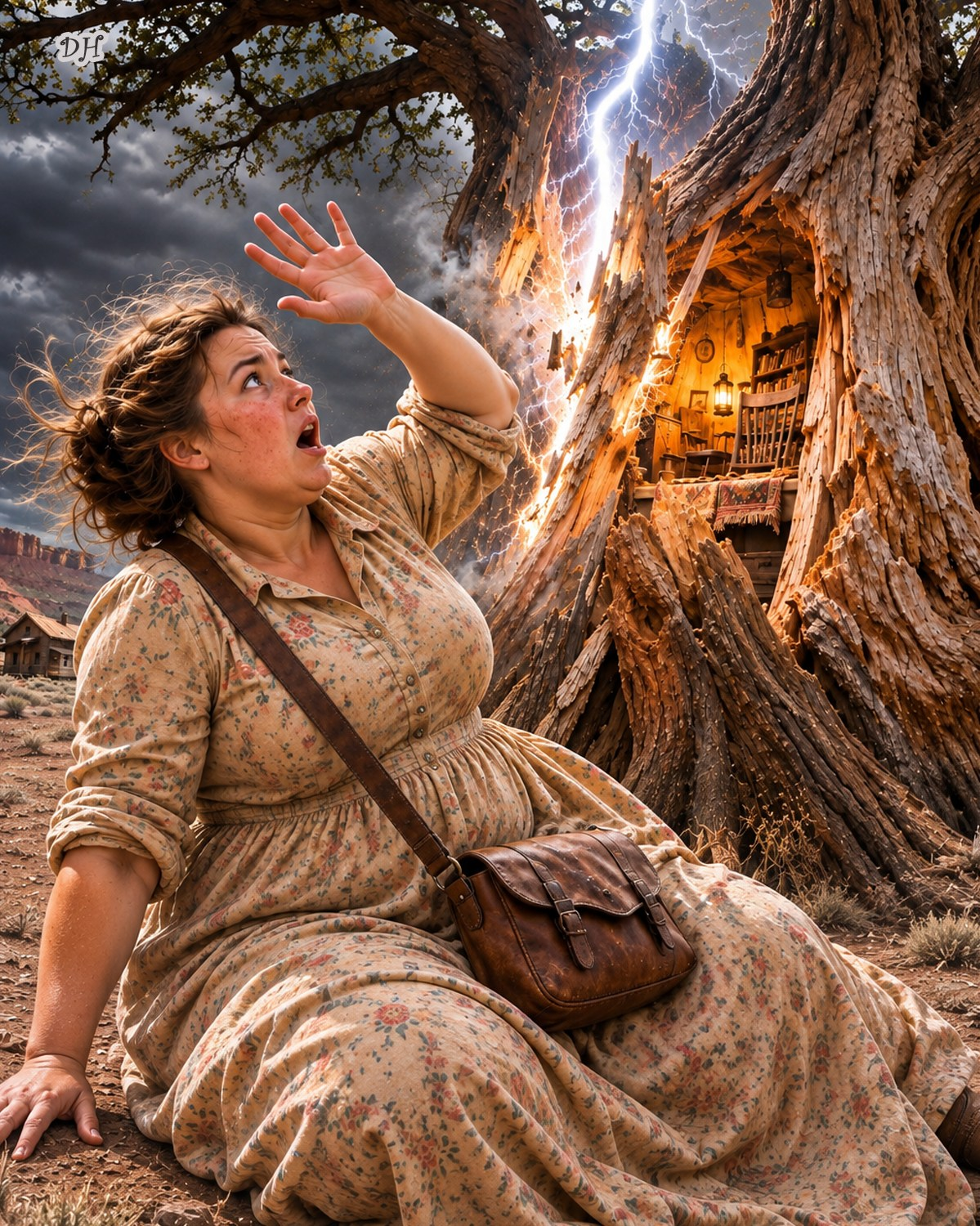
For several seconds, Mary stood perfectly still inside the hollow oak, listening to the wind move through its shattered branches.
She had expected to find an explanation for the strange chamber.
Perhaps the name of a forgotten trapper.
Perhaps the belongings of a man who had abandoned the frontier decades earlier.
She had not expected to find her stepfather's name.
Not here.
Not inside a tree that had stood behind Prudence Carver's cabin long before Mary was born.
And certainly not on a piece of parchment hidden inside a box that appeared to have been sealed nearly thirty years earlier.
Something was wrong.
Terribly wrong.
Mary lowered the lantern and examined the writing more carefully.
The letters resembled Edgar's familiar slanting script, but the ink was darker than the rest of the parchment. The words appeared to have been added later.
She remembered the legal waiver he had sent.
The elaborate capital letters.
The sharp downward strokes.
The peculiar way he formed the letter M.
The resemblance was unmistakable.
But why would Edgar know anything about a hidden chamber belonging to a man named Josiah Pike?
Mary looked toward the narrow opening in the tree.
Morning sunlight filtered through the broken wood.
Beyond it, the clearing lay silent.
She suddenly felt exposed.
If Edgar knew about this place, he might know how to find it.
And if he knew what was hidden inside, perhaps the six-dollar settlement had never been about her father's house at all.
Mary folded the parchment carefully.
Then she slipped it into the pocket of her dress.
She needed to get out.
The chamber had survived the lightning strike, but the standing half of the oak remained dangerously damaged.
She could hear occasional creaks from the broken trunk.
A heavy branch might fall at any moment.
Mary placed the black tin box beneath one arm, secured the lantern, and climbed toward the opening.
Her boot slipped against a splintered board.
She caught herself with her free hand.
Pain shot through her injured wrist.
She bit back a cry.
For a moment, she hung awkwardly between the chamber and the jagged exterior of the tree.
Then she found a foothold and pushed herself through.
The morning air struck her face.
She lowered the box onto the ground and climbed down.
Only when both boots touched the earth did she breathe freely.
Behind her, the Old Sentinel stood broken against the sky.
Mary looked at it for a long moment.
"You kept your secret well," she whispered.
Then she picked up the box and hurried toward the cabin.
Inside, Mary locked the door.
She had never bothered locking it during the day.
There was little worth stealing, and the nearest neighbor lived several miles away.
But now the familiar cabin felt different.
Every window seemed too large.
Every sound outside seemed suspicious.
She set the black box on the kitchen table.
Beside it stood the battered tin containing her savings.
Twenty dollars.
Fourteen she had earned.
Six Edgar had paid her.
Mary looked from one container to the other.
Then she opened the mysterious box completely.
The folded letter lay on top.
Beneath it rested a dark leather pouch, a small object wrapped in brown muslin, and a carved wooden horse.
Mary touched the horse first.
It was no longer than her palm.
One ear had been chipped.
Its legs were short and sturdy.
Someone had carved a saddle into its back with careful, patient strokes.
Mary turned it over.
Two letters were scratched beneath its belly.
D.P.
She felt an unexpected ache in her chest.
Her father had carved a horse for her when she was little.
She had carried it all the way from Hollowbrook when Edgar sent her away.
That horse still rested inside her wooden keepsake chest.
Mary placed the unfamiliar toy beside the letter.
Then she lifted the leather pouch.
It was tied with a narrow strip of rawhide.
The knot had stiffened with age.
She worked it loose.
A silver dollar slipped into her palm.
Then another.
Mary stared.
She tipped the pouch onto the table.
Coins spilled across the wood with a sound that made her heart pound.
She counted them slowly.
Ten.
Twenty.
Thirty.
Forty.
Forty-one.
Forty-two.
Forty-two silver dollars.
More than twice the money she had saved through months of sewing.
Mary sat down.
For a moment, she could do nothing but stare at the coins.
She imagined the flour she could buy.
The firewood.
The lamp oil.
A new pair of boots before winter.
Perhaps even enough supplies to survive until spring without depending on anyone.
She reached for one coin.
Then stopped.
The money was not hers.
At least, she did not yet know whether it was.
Someone had hidden it deliberately.
Someone had placed it inside a sealed box with a letter.
Mary drew her hand back.
She had spent too much of her life watching other people claim what did not belong to them.
She would not become one of them.
Not even because she was hungry.
She gathered the coins and returned them to the pouch.
Then she unfolded the letter.
The paper was fragile.
Mary smoothed it against the table with both hands.
The first page began simply.
To whoever opens this box,
My name is Josiah Pike.
If these words have reached you, then the great oak has finally surrendered the chamber I built within it.
I do not know who you are.
I do not know whether you are young or old, rich or poor, alone or surrounded by people who love you.
But I know that life can take everything from a person without warning.
Mary stopped reading.
Her throat tightened.
She looked toward Prudence's empty chair.
Then she continued.
I came west with my wife, Abigail, and our little boy, Daniel.
We believed this country would give us a fresh beginning.
I was a carpenter by trade. I had strong hands, a good set of tools, and a wife who believed I could build a home anywhere there was timber and water.
For a time, she was right.
We settled near North Fork Creek. I built a small cabin, planted a garden, and began making furniture for travelers and ranchers.
Daniel was five years old when we arrived.
He loved horses more than anything in the world.
Mary glanced at the carved toy.
She already knew what the next sentence would say.
I carved him a little wooden horse during our first winter.
He called it Captain.
Mary closed her eyes.
The chamber no longer felt like an abandoned storehouse.
It felt like a place where a man's grief had been carefully arranged on shelves.
She read on.
The following spring, fever came through the valley.
Abigail fell ill first.
Daniel followed three days later.
I tried everything I knew.
I rode for a doctor.
I boiled water.
I kept the fire burning.
I prayed until I had no words left.
My wife died on a Tuesday.
Our son died before sunrise on Friday.
Mary covered her mouth.
She knew the terrible silence that followed death.
She remembered sitting beside Thomas Brooks after his final breath.
She remembered the coldness of his hand.
She remembered the way the workshop seemed to lose its purpose when he was gone.
Josiah Pike had lost his wife and child within four days.
Mary could scarcely imagine what that had done to him.
She continued reading.
After I buried them, I remained in the cabin for several months.
I tried to work.
I tried to eat.
I tried to sleep.
But every corner reminded me of someone who would never return.
Daniel's little chair stood beside the hearth.
Abigail's sewing basket remained near the window.
I could not bear to move either one.
One evening, I carried my tools into the woods and sat beneath the great oak.
It was then I decided to build something.
Not a monument.
Not a grave.
Something useful.
Mary looked toward the window.
The shattered oak stood beyond the cabin.
She imagined a grieving carpenter sitting beneath its branches nearly thirty years earlier.
A man with tools.
A man with nothing left to protect.
A man searching for a reason to keep living.
I began hollowing the tree carefully, working only where old decay had already opened a cavity in its heart.
I strengthened the interior with cedar supports and fitted a floor above the roots.
The work took nearly two years.
Some days I labored from sunrise until darkness.
Other days I could manage only an hour.
But the work gave my hands a purpose.
And slowly, purpose gave me enough strength to survive another day.
Mary looked down at her own hands.
The calluses.
The tiny needle scars.
The brass thimble Prudence had given her.
She understood that kind of survival.
Sometimes grief could not be overcome.
It could only be carried into useful work.
The letter continued for several pages.
Josiah described the supplies he had gathered.
Food preserved against hunger.
Tools for repairing shelter.
Rope.
Canvas.
Lamp oil.
Matches.
Nails.
And silver coins saved from years of labor.
He had placed them inside the tree because he remembered what it felt like to have no one left to ask for help.
I cannot know who will find this chamber.
Perhaps it will be a traveler caught in a terrible winter.
Perhaps a widow with children.
Perhaps a young person who has been turned away from home.
Mary stopped.
She read that sentence again.
A young person who has been turned away from home.
Her eyes filled with tears.
Josiah Pike had written those words before Mary was born.
He had never known Thomas Brooks.
He had never seen Edgar Mallow.
He could not have imagined a fourteen-year-old girl standing beside a stagecoach with everything she owned packed into one canvas bag.
And yet the words seemed written for her.
She pressed the paper against the table.
For several minutes, she could not continue.
Then she wiped her eyes and read the next paragraph.
If you are hungry, eat the food.
If you are cold, use the supplies.
If you need money, take the silver.
I placed these things here to be used, not worshiped.
I ask only one thing in return.
Mary leaned closer.
When you are able, help someone who has less than you.
Do not wait until you are wealthy.
Do not wait until your own troubles have disappeared.
Kindness is not something we give only when it costs us nothing.
It is something we choose because we remember what suffering feels like.
Mary looked at the pouch.
Forty-two silver dollars.
The money was hers to use.
Not because she had inherited it.
Not because she had earned it.
But because a stranger who had lost everything wanted another stranger to survive.
She felt tears slip down her cheeks.
For the first time since Prudence's death, she did not feel entirely forgotten.
Near the bottom of the final page, Josiah's handwriting became less steady.
There is one thing I must ask you to remember.
My boy's name was Daniel.
He had brown eyes, a crooked front tooth, and a laugh that made his mother laugh even when she was angry.
He was afraid of thunder.
He loved apple preserves.
And he believed every horse in the world deserved a name.
Mary looked at the carved horse.
Captain.
She could almost imagine the little boy holding it.
I have no living family to remember him.
When I am gone, there may be no one left who speaks his name.
So I ask you to say it once.
Daniel Pike.
That is all.
Mary's lips trembled.
She lifted the wooden horse.
"Daniel Pike," she whispered.
The cabin remained silent.
She said it again.
"Daniel Pike."
Then she placed the toy carefully beside the letter.
Something inside her eased.
Not the grief of losing her father.
Not the anger toward Edgar.
But the terrible feeling that the dead disappeared completely when nobody remained to remember them.
Josiah had feared that his son would be forgotten.
Mary knew that fear.
She often wondered whether anyone in Hollowbrook still spoke Thomas Brooks's name.
Whether his workshop had been torn down.
Whether his tools had been sold.
Whether Edgar had erased every trace of the man who had raised her.
She touched the letter.
"I won't forget him," she whispered.
The final paragraph was different.
Josiah had written it beneath a thin horizontal line.
There is another place.
I built the oak chamber to preserve what might save a stranger's life.
But I could not place everything I owned inside it.
Some things belonged to Abigail and Daniel alone.
Those things remain where we first made our home.
If you find the second shelter, I ask that you treat what remains there with care.
There is no treasure worth more than the memory of those we love.
Mary reached for the parchment map.
North Fork Creek.
The oak.
The cabin marked with an X.
The drawing was crude, but the creek's bend was unmistakable.
She had crossed that part of the valley many times.
There were no buildings there now.
Only brush, fallen timber, and the remains of an old stone chimney.
Mary remembered seeing the chimney once while checking traps with Prudence.
She had asked what stood there.
Prudence had looked toward the ruins.
"An old place," she said.
"Whose?"
"Someone who left."
Mary had wanted to investigate.
But Prudence had told her to leave it alone.
At the time, Mary assumed the older woman simply did not want her wandering through unstable ruins.
Now she wondered whether Prudence had known more than she admitted.
Mary examined the parchment again.
The map had been drawn in brown ink.
But the words on the reverse were darker.
The final line had clearly been added later.
Edgar Mallow.
He knows where it is.
Mary's stomach tightened.
If Edgar knew about the second shelter, why had he never mentioned Josiah Pike?
Why had he claimed the land beneath Prudence's cabin?
And why had he suddenly demanded that Mary surrender every possible property claim?
She needed answers.
But she had to be careful.
Edgar was wealthy.
He knew lawyers.
He knew county officials.
He had already taken her father's property.
If she confronted him without evidence, he would simply deny everything.
Worse, he might come to Pine Ridge and take the cabin before she discovered what the map meant.
Mary folded the parchment.
Then she opened the drawer beneath the table.
Inside lay Thomas Brooks's turning gouge.
She picked it up.
The wooden handle fit her palm.
Her father had once told her that a person should never cut into timber without understanding its grain.
"You can ruin good wood by forcing it," he had said.
Mary looked at the map.
Perhaps the same was true of secrets.
She could not force the truth from Edgar.
She would have to follow the grain.
One clue at a time.
By midday, Mary had made a decision.
She would visit North Fork Creek.
But first, she needed to secure the contents of the oak chamber.
The broken tree was visible from the trail.
Anyone passing through the clearing might notice the opening.
If the supplies remained inside, they could be ruined by rain or stolen.
Mary carried the food tins into the cabin first.
Then the tools.
Then the canvas and rope.
She worked carefully, stopping whenever her injured wrist began aching.
The chamber held more than she initially realized.
Two axes.
Three augers.
A drawknife.
A hand plane.
A hammer.
Several boxes of nails.
A sharpening stone.
A heavy coil of rope.
A cast-iron skillet.
And enough preserved food to sustain one person for months if rationed carefully.
Mary arranged everything along the cabin wall.
She checked the tins for rust and damage.
Some were too old to trust.
Others appeared sealed.
She set them aside for careful inspection.
The tools, however, were extraordinary.
Their wooden handles were smooth.
Their iron blades had been protected with grease.
The drawknife was almost identical to one her father had owned.
Mary held it for a long moment.
Then she smiled faintly through her sadness.
"Papa would have loved this."
She placed it beside his turning gouge.
Near the rear wall of the chamber, she found the long bundle wrapped in oilskin.
She had noticed it earlier but left it untouched.
Now she carried it into the cabin.
It was nearly four feet long.
The wrapping was secured with three strips of old leather.
Mary untied them.
Inside lay a wooden case.
Its lid was carved with a simple pattern of leaves.
She opened it.
A beautifully made carpenter's level rested inside.
Beside it were a folding ruler and a small brass compass.
Mary lifted the level.
The workmanship was remarkable.
On its underside, a name had been burned into the wood.
Josiah Pike.
Mary ran her fingers over the letters.
A craftsman's tools were personal things.
Thomas had never allowed anyone to misuse his.
Josiah had preserved these with extraordinary care.
She returned the level to its case.
Then she noticed a narrow compartment beneath the folding ruler.
It was almost invisible.
Mary pressed the edge.
A thin wooden panel shifted.
Beneath it lay a folded scrap of paper.
Her pulse quickened.
She unfolded it.
There were only three lines.
The second shelter is not beneath the roof.
Look where the water once entered.
Trust the mark Daniel made.
Mary stared.
The second shelter.
The map.
The old stone chimney.
Now another clue.
She read the words again.
Trust the mark Daniel made.
What mark?
A child's drawing?
A carving?
Something hidden in the ruins?
Mary folded the paper and placed it beside Josiah's letter.
Then she looked toward the window.
The afternoon sun had moved west.
There were several hours of daylight remaining.
Enough time to reach North Fork Creek and return before dark.
She could wait until morning.
That would be sensible.
But she had spent too many years waiting for someone else to decide what happened to her life.
She would not wait now.
Mary packed a small canvas bag.
Bread.
A tin cup.
A coil of rope.
Her father's turning gouge.
The brass compass from Josiah's case.
And the parchment map.
She placed the forty-two silver dollars inside a cloth pouch and hid them beneath a loose floorboard near Prudence's old cot.
The letter went into her keepsake chest.
The wooden horse remained on the table.
Mary looked at it before leaving.
"Captain," she whispered.
Then she closed the cabin door.
The clearing smelled of wet bark.
The shattered oak stood behind the cabin like a wounded giant.
Mary approached it once more.
She examined the opening.
There was still enough space for a person to enter.
She considered covering it with canvas.
But that might draw attention.
Instead, she dragged several fallen branches across the exposed section.
The work took nearly an hour.
When she finished, the opening was difficult to see from the trail.
Mary stepped backward.
Satisfied, she turned toward the northern ridge.
North Fork Creek lay beyond the pines.
Half a mile.
Perhaps a little more if she followed the old trapping path.
She began walking.
The forest was quieter than usual.
Rainwater dripped from the branches.
The ground was soft beneath her boots.
Mary moved carefully, using the narrow paths Prudence had taught her.
As she walked, she remembered the older woman's warnings about abandoned homesteads.
"Old buildings are dangerous," Prudence used to say.
"Floors rot. Chimneys fall. Wells disappear beneath weeds."
Mary had listened.
But now she wondered whether Prudence's warnings had concealed something else.
Had her aunt known Josiah Pike?
Had she visited the cabin before it fell into ruin?
And why had she never mentioned the hollow oak?
Mary stopped beside a fallen pine.
A thought struck her.
Prudence had lived near the Old Sentinel for decades.
Surely she must have noticed Josiah working inside the tree.
A project that took nearly two years could not have gone entirely unseen.
Unless Prudence had arrived after he left.
Mary tried to remember what her aunt had said about the cabin's early years.
Very little.
Prudence rarely discussed the past.
She spoke of her deceased husband only when necessary.
She never explained the financial troubles Edgar later claimed had given him ownership of the land.
Mary frowned.
Perhaps Prudence had been protecting her from something.
Or perhaps she had been protecting someone else's secret.
The creek came into view shortly afterward.
Water moved swiftly between moss-covered stones.
Mary followed the bank northward.
The map showed a sharp bend where the creek turned east.
Beyond it stood a cluster of cottonwoods.
She recognized the place immediately.
The old chimney was nearby.
She crossed the creek at a shallow point, lifting her skirt above her knees.
The cold water soaked her boots.
She climbed the opposite bank.
Then she saw it.
A chimney.
Gray stones rose from a patch of weeds.
The surrounding cabin had long since collapsed.
Only fragments of timber remained.
Mary stopped.
She had passed this place before.
But she had never looked closely.
Now every fallen board seemed important.
She approached the ruins.
The chimney stood at the western end of a rectangular foundation.
A few blackened stones marked the old hearth.
The roof had disappeared.
Most of the walls had fallen inward.
Mary walked around the remains.
She saw no door.
No cellar entrance.
No obvious hiding place.
She took out the map.
The X marked the cabin.
But the second note had said the shelter was not beneath the roof.
Look where the water once entered.
Mary looked toward the creek.
A narrow depression ran from the bank toward the ruins.
Perhaps an old drainage channel.
She followed it.
The depression ended near a cluster of stones behind the chimney.
Mary knelt.
She brushed away leaves.
Beneath them lay a short length of rotted wooden trough.
Water had once been directed toward the cabin.
Possibly for washing.
Possibly for a small garden.
She followed the trough with her fingers.
It disappeared beneath the stones.
Mary's heart began beating faster.
She removed one loose rock.
Then another.
Beneath them was a flat piece of timber.
She scraped away the mud.
The wood was dark with age.
A small carving appeared near one corner.
Mary leaned closer.
It was a horse.
A child's horse.
Four short legs.
A crooked tail.
And beneath it, two letters.
D.P.
Mary stopped breathing.
Daniel Pike.
She had found the mark.
For several seconds, Mary simply stared.
The little carving was crude.
Nothing like the careful work on Josiah's tools.
It had been made by a child.
Perhaps Daniel had scratched it into the timber while his father worked nearby.
Perhaps Josiah had kept the board because it was one of the few things his son had touched.
Mary brushed away the remaining dirt.
A narrow seam ran along the edge.
She inserted the tip of her father's turning gouge.
The timber shifted slightly.
Mary paused.
Then she worked the blade farther beneath the edge.
The board lifted.
Underneath was darkness.
A narrow opening descended between stone walls.
Mary leaned closer.
Cool air rose from below.
The smell was different from the forest.
Dry earth.
Old wood.
Something metallic.
She had found another chamber.
But this one was beneath the ground.
Mary looked over her shoulder.
The forest was empty.
She listened.
Only the creek moved nearby.
She returned her attention to the opening.
A wooden ladder descended into darkness.
Its upper rungs were rotten.
She could not safely climb down without testing them.
Mary reached into her bag for the rope.
Then she heard something.
A faint metallic sound.
She froze.
It came from beneath the opening.
A small clink.
Then silence.
Mary held her breath.
Perhaps water had shifted something below.
Perhaps a loose stone had fallen.
She waited.
Nothing.
She leaned forward again.
The darkness seemed deeper than it should have.
She could not see the bottom.
Then another sound reached her.
Not metal.
Wood.
A slow scrape.
Mary's fingers tightened around the turning gouge.
Someone was moving beneath the ruins.
She backed away from the opening.
Her heel struck a loose stone.
It rolled across the ground.
The scraping stopped.
Mary stood perfectly still.
Then, from the darkness below, a man's voice spoke.
"Who's up there?"
Mary's heart slammed against her ribs.
She did not answer.
The voice came again.
Closer this time.
"Prudence?"
Mary went cold.
The man knew her aunt's name.
He waited.
Then she heard the unmistakable sound of a ladder creaking beneath someone's weight.
One rung.
Another.
Mary stepped backward.
A hand appeared at the edge of the opening.
Then a second hand.
The man was climbing out.
And before Mary could run, he spoke again.
"Prudence Carver, if that's you, there's something you need to know about Thomas Brooks."
Mary stopped breathing.
The name struck her harder than the lightning had struck the oak.
Her father.
The man beneath the ruins knew her father's name.
She took one trembling step toward the opening.
"Who are you?" she whispered.
The climbing stopped.
For a moment, the forest was silent.
Then the stranger answered.
"That depends."
Mary gripped her father's turning gouge.
"On what?"
The man's voice lowered.
"On whether Edgar Mallow sent you."
Mary stared into the darkness.
"No."
A long silence followed.
Then the stranger said something that made her blood turn cold.
"Then you need to get down here before he finds out what your father hid."
Mary looked at the narrow opening.
At the rotten ladder.
At the two hands gripping the edge.
She had come searching for Josiah Pike's forgotten belongings.
Instead, she had found a stranger who knew Thomas Brooks.
And he was waiting beneath a cabin that had supposedly been abandoned for nearly thirty years.
Mary opened her mouth to demand an explanation.
But the stranger suddenly looked past her.
His grip tightened.
His voice changed.
"Don't turn around."
Mary froze.
From somewhere beyond the cottonwoods came the unmistakable sound of approaching hoofbeats.
One horse.
Then another.
The stranger whispered urgently.
"Get down. Now."
Mary looked toward the trees.
A branch snapped.
A horse snorted.
Then a familiar voice called from the other side of the ruins.
"Mary Brooks! I know you're here."
It was Edgar Mallow.






Comments 0