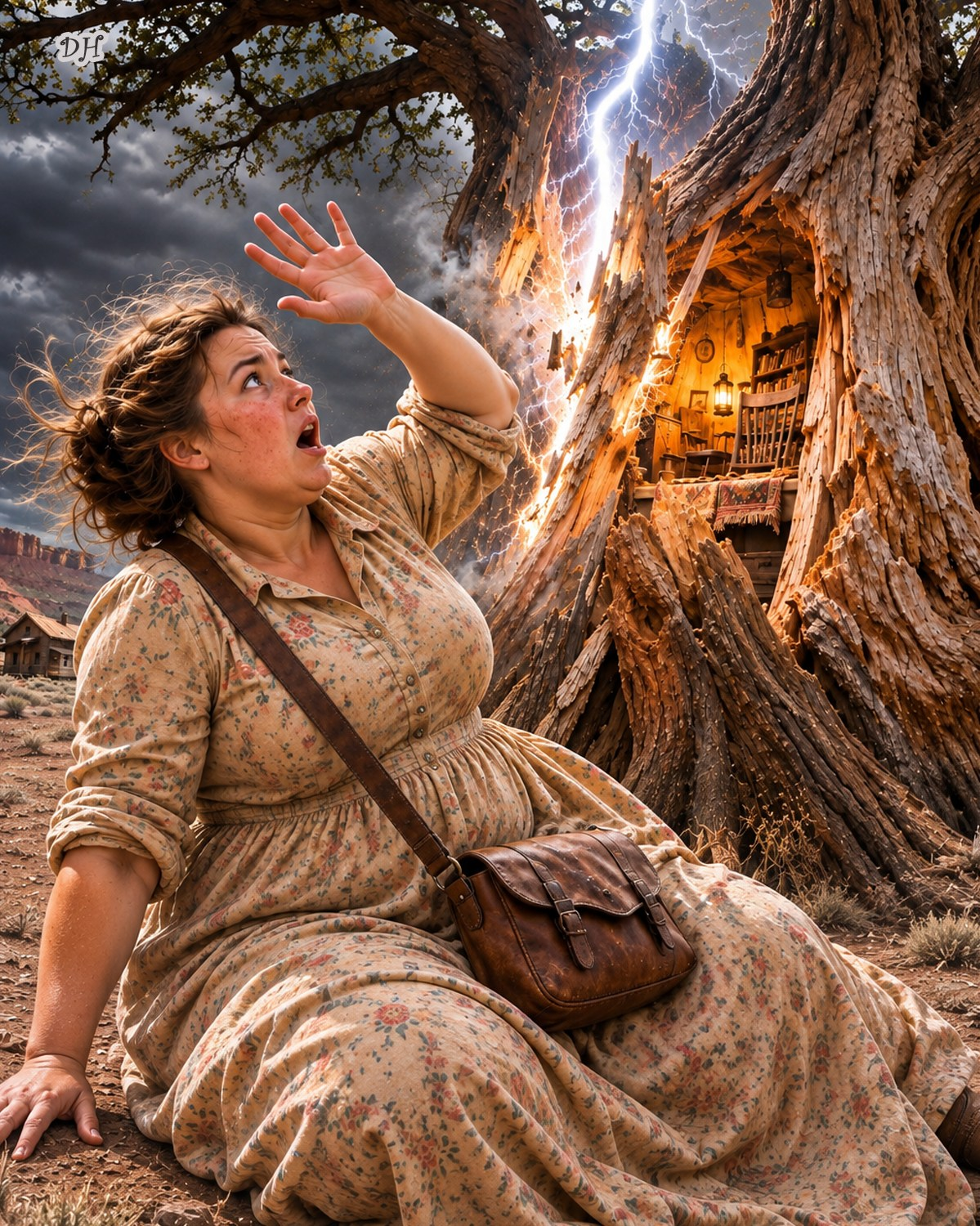
"Get away from that tree!" Mary Brooks shouted as a bolt of lightning tore through the sky.
Three days earlier, Edgar Mallow had sent a legal waiver and six silver dollars to the cabin.
At the bottom of the paper, beneath Mary's signature, was a small handwritten notation: All claims surrendered.
But Edgar had made one terrible mistake.
He believed Mary had nothing left worth fighting for.
Mary Brooks had learned that a person could lose almost everything without making a sound.
She had learned it at fourteen, when her father died.
She had learned it again when her mother sent her away.
And she learned it a third time on the afternoon a stranger rode up to her cabin and offered her six silver dollars in exchange for the last pieces of her childhood.
The stranger had arrived on a bay horse shortly after noon.
He wore a dark town coat, polished boots, and a stiff collar that seemed entirely inappropriate for the August heat.
Mary had been sitting on the porch, repairing a torn canvas shirt for a ranch hand named Samuel Reed.
She was twenty-two years old, with calloused fingers, tired eyes, and a quiet manner that often caused people to underestimate her.
She set aside her needle when the rider approached.
"Miss Mary Brooks?"
"That's me."
The man dismounted.
"I have business with you from Hollowbrook."
Mary felt something tighten beneath her ribs.
Nobody had brought her good news from Hollowbrook in eight years.
"From whom?"
"Mr. Edgar Mallow."
She looked at the leather document case beneath his arm.
"What does he want?"
The man removed a sealed envelope.
"I believe the letter explains everything."
Mary accepted it without inviting him inside.
She recognized the handwriting immediately.
Edgar had always written his capital letters with unnecessary flourishes, as though even his pen needed to remind people of his importance.
She broke the seal.
The first paragraph informed her that the house and workshop once belonging to her father, Thomas Brooks, had been sold.
Six hundred and forty dollars.
Mary read the number twice.
Her father had spent fifteen years building that property.
She remembered the workshop's broad doors, the smell of fresh pine, the iron hoops stacked against the wall, and the wooden bench where she had learned to carve her name.
Six hundred and forty dollars.
Not a fortune.
But more money than Mary had ever seen.
She continued reading.
According to Edgar, the proceeds belonged to her mother, Hannah, and had already been consumed by family expenses.
Mary would receive nothing.
Her jaw tightened.
Then she reached the second page.
Edgar claimed that an old financial arrangement involving Prudence Carver's deceased husband had given him ownership of the land beneath Mary's cabin.
The cabin itself, he wrote, might have belonged to Prudence.
But the ground beneath it did not.
He was prepared to allow Mary to remain temporarily.
In exchange, she must surrender any further claims involving the Brooks, Mallow, and Carver properties.
Her compensation would be six dollars.
Mary looked up.
"Did Mr. Mallow tell you what this says?"
The messenger shifted his weight.
"He instructed me to obtain your signature."
"That's not what I asked."
The man hesitated.
"I know it's a property settlement."
Mary held up the letter.
"He's offering me six dollars for my father's house and the land where my aunt lived."
"I don't know the particulars, miss."
"Did he tell you my aunt died four months ago?"
"No."
"Did he tell you I buried her myself?"
The messenger looked away.
Mary folded the letter.
For a moment, she considered refusing.
She imagined saddling Prudence's old mare, riding to Hollowbrook, and standing in Edgar's brick office until he explained every dollar.
But the mare had died the previous winter.
Mary had fourteen dollars in a tin box.
She owed the general store for flour.
Her lamp oil was running low.
And she had no lawyer.
The messenger cleared his throat.
"Mr. Mallow said the offer expires today."
Mary looked toward the cabin.
The porch steps had been repaired by Prudence.
The shutters had been painted by Prudence.
Even the little row of herbs beside the door had been planted by the older woman who took Mary in when nobody else wanted her.
"The cabin is mine," Mary said.
The messenger said nothing.
"My aunt told me so before she died."
"I'm sorry, miss."
Mary studied his face.
He wasn't cruel.
That almost made the situation worse.
He was simply a man carrying out another man's cruelty for a day's wages.
"Where do I sign?"
He handed her a pen.
Mary bent over the porch railing.
Her signature was steady.
Mary Brooks.
Her father had taught her to write those letters when she was seven.
She remembered his rough hand guiding hers across a scrap of pine.
"That's your name," Thomas had told her. "Don't ever let anyone make you ashamed of it."
She finished the final letter.
The messenger took the paper.
Then he counted six silver dollars onto the railing.
One.
Two.
Three.
Four.
Five.
Six.
Mary looked at the coins.
"Will that be all?" she asked.
"Yes, miss."
"Then you'd better get back before the weather changes."
The messenger glanced toward the western ridge.
Dark clouds had begun gathering beyond the pines.
He mounted his horse and rode away.
Mary watched him disappear down the narrow trail.
Only then did she collect the coins.
They felt heavier than they should have.
Eight years earlier, Mary had believed her father could repair anything.
Broken wagon wheels.
Cracked axles.
Splintered furniture.
A damaged door.
Once, when she was nine, she had dropped a small wooden horse he carved for her.
One of its legs snapped.
Mary had cried as though the world had ended.
Thomas had picked up the broken toy.
"Well," he said, "that's a difficult-looking injury."
"Can you fix him?"
"I expect so."
"But he'll never be the same."
Her father knelt beside her.
"No," he said gently. "He won't."
Mary cried harder.
Thomas waited until she looked at him.
"That doesn't mean he can't still be a fine horse."
He repaired the leg with a tiny wooden peg.
The horse stood again.
Mary kept it on the shelf beside her bed.
Years later, after Thomas died of lung fever, she would remember that conversation more often than she remembered his funeral.
Some things could be repaired.
Others could only be carried.
Thomas's death left a silence that spread through every corner of their home.
His workshop closed.
His tools gathered dust.
His chair remained empty.
Mary's mother, Hannah, became a different woman.
She stopped singing while cooking.
She stopped attending church.
Sometimes Mary found her standing in the workshop doorway, staring at the workbench without speaking.
Mary tried to comfort her.
She cleaned.
Cooked.
Sewed.
And waited for her mother to become herself again.
Then Edgar Mallow entered their lives.
He was a cattle broker with a prosperous business and a reputation for generosity.
He brought Hannah flowers.
He paid for repairs to the roof.
He spoke softly at dinner.
People in Hollowbrook called him a blessing.
Mary wanted to believe them.
Fourteen months after Thomas died, Hannah married Edgar.
Three weeks later, he announced that Mary would be sent away.
"Your great-aunt Prudence has agreed to take you," he said.
Mary stared at him.
"Why?"
"Because this arrangement is best for everyone."
"But this is my home."
Edgar folded his newspaper.
"Your mother and I are beginning a new life."
Mary turned toward Hannah.
"Mama?"
Her mother stood at the window.
"Please," Mary whispered. "I can stay out of the way."
Hannah's shoulders trembled.
But she did not turn around.
Edgar rose from his chair.
"The decision has been made."
Two days later, Mary boarded a stagecoach carrying a canvas bag.
Inside were three dresses, a small Bible, her father's turning gouge, and the wooden horse he had repaired.
She watched the road behind the stagecoach until Hollowbrook disappeared.
Her mother never came to say goodbye.
Prudence Carver was not an affectionate woman.
When Mary arrived at the cabin near Pine Ridge, the older woman stood on the porch with her arms folded.
She had iron-gray hair, sharp eyes, and the kind of hands that had never known an easy day's work.
She read Edgar's letter.
Then she looked at Mary.
"Can you sew?"
"A little."
"Can you cook?"
"Yes, ma'am."
"Can you work?"
Mary swallowed.
"Yes."
Prudence opened the door.
"Then we'll get along."
That first evening, she gave Mary a bowl of rabbit stew and a thick slice of bread.
She showed her a clean cot near the stove.
Then she placed an extra blanket at the foot of it.
Mary waited for questions about her mother.
None came.
She waited for Prudence to tell her everything would be all right.
The older woman said nothing of the kind.
But the next morning, Mary woke to find her shoes repaired.
And beside them lay a pair of wool stockings.
Over the following years, Mary discovered that Prudence's kindness rarely arrived in words.
It arrived in food.
In firewood.
In warm clothing.
In the careful way she left a lantern burning whenever Mary returned late from delivering sewing.
Prudence taught her to mend ranch shirts, repair leather, prepare traps, preserve vegetables, and recognize storms before they reached the valley.
"Watch the western ridge," she often said. "The sky gives warnings."
Mary learned.
She became useful.
Then capable.
Then strong.
By the time she turned twenty, she could manage almost every task required to keep the cabin standing.
But she never stopped missing her father.
Sometimes, while working with a piece of wood, she heard his voice.
"Be patient, Mary. Wood tells you what it needs."
Sometimes she found herself wondering whether he would recognize the woman she had become.
And sometimes, when loneliness grew unbearable, she sat beneath the enormous oak behind the cabin.
Prudence called it the Old Sentinel.
Its trunk was wider than three men could embrace.
Its branches spread over the clearing like the arms of something ancient and protective.
Mary loved that tree.
It had been standing long before she arrived.
It seemed impossible that anything could bring it down.
Prudence died in April.
The illness began with a cough.
Then came the fever.
Then the weakness that slowly stole her ability to walk.
Mary cared for her through the final weeks.
She brought broth.
Changed blankets.
Read aloud.
And pretended not to notice how little the older woman ate.
One morning, Prudence opened her eyes and reached for Mary's hand.
"The cabin's yours."
Mary leaned closer.
"Don't talk like that."
"Listen to me."
"I'm listening."
"The thimble's yours too."
Mary looked down at the worn brass thimble on her finger.
Prudence had given it to her years earlier.
Two small letters were engraved near the base.
P.C.
Mary shook her head.
"You're going to get better."
Prudence's mouth moved into the faintest smile.
"You've always been stubborn."
Mary tried to smile back.
She couldn't.
The older woman squeezed her fingers.
"And the rest," she whispered, "you'll find as you go."
Those were her final words.
Mary buried Prudence on the rise overlooking the clearing.
She carved her name into a cedar board.
Prudence Carver.
Beloved Aunt.
She worked until her fingers blistered.
Then she stood beside the grave and promised she would take care of the cabin.
For four months, she kept that promise.
She repaired clothing for ranch hands.
She saved every coin.
She planted vegetables.
She chopped firewood.
She endured the silence.
Then Edgar's letter arrived.
And suddenly, even the cabin seemed uncertain.
That evening, Mary sat at the kitchen table with the six silver dollars arranged before her.
Beside them stood her battered savings tin.
Fourteen dollars.
That was all she possessed.
Twenty dollars altogether.
Enough to buy flour, beans, lamp oil, and perhaps a little salt pork.
Not enough to fight Edgar Mallow.
She picked up one of the silver dollars.
Turned it between her fingers.
Then set it down.
"Six dollars, Papa," she whispered.
Her father's turning gouge lay in a wooden drawer nearby.
She took it out.
The handle had darkened with age.
Her fingers settled into the worn places where his hand had once rested.
For a moment, she imagined him sitting across from her.
He would have listened.
He would have considered the problem carefully.
Then he would have told her to measure twice before making a decision.
But Thomas Brooks was dead.
Prudence Carver was dead.
And Hannah Mallow had not written to her daughter in eight years.
Mary was alone.
She returned the gouge to the drawer.
Then she stood and looked through the window.
Beyond the woodshed, the Old Sentinel rose against the darkening sky.
Its branches moved in the wind.
Mary remembered Prudence's words.
"The sky gives warnings."
She opened the door.
The air smelled of rain.
A dark wall of clouds had gathered over the western ridge.
The pines swayed.
The first distant thunder rolled across the valley.
Mary knew that sound.
A powerful storm was approaching.
She moved quickly.
First, she secured the shutters.
Then she tied the woodshed door with a length of rope.
She carried two armloads of firewood inside.
She filled the water barrel.
Finally, she checked the roof for loose shingles.
By the time she finished, the wind had strengthened.
The oak's enormous branches groaned above the clearing.
Mary looked up.
"Hold together, old friend," she murmured.
Then she went inside.
The storm arrived shortly after dark.
Rain struck the roof.
Wind battered the shutters.
Thunder rolled so loudly that the iron stove rattled.
Mary sat beside the fire with Prudence's wool blanket around her shoulders.
She tried to sew.
But the light flickered too badly.
She set the shirt aside.
For a while, she listened to the storm.
Then came a sound she had never heard before.
A deep, strained groan.
It came from behind the cabin.
Mary turned toward the rear window.
The Old Sentinel.
Its branches were twisting violently.
She rose and moved closer.
A flash of lightning illuminated the clearing.
For one brief instant, she saw the enormous trunk bending beneath the wind.
Then darkness returned.
Mary stepped away from the window.
She remembered Prudence warning her that ancient trees could be dangerous during violent storms.
Even strong wood could split.
Even deep roots could fail.
Another gust struck the cabin.
Something slammed against the woodshed.
Mary grabbed the lantern.
The rope securing the shed door had come loose.
If the door broke free, it could tear the hinges from the frame.
She hesitated.
Going outside was foolish.
But losing the shed would mean losing the winter firewood.
She pulled on her boots.
Wrapped the shawl around her shoulders.
And opened the door.
The wind nearly tore it from her hand.
Rain struck her face.
She hurried across the porch and into the clearing.
The woodshed door banged against its frame.
Mary caught it with both hands.
The wind pushed against her.
She braced one boot against the threshold and dragged the rope into place.
Her fingers slipped.
She tried again.
This time, the knot held.
Mary stepped backward.
A brilliant flash illuminated the sky.
She looked toward the oak.
Something about its movement frightened her.
The highest branches were twisting in opposite directions.
The trunk gave a low cracking sound.
Mary knew she needed to get away.
She turned toward the cabin.
Then lightning struck.
The world became white.
The thunder came at the same instant.
Mary cried out.
A tremendous cracking sound tore through the clearing.
She threw up her left hand.
The enormous oak split open.
A shower of bark and splintered wood burst outward.
Mary stumbled backward.
Her heel caught a root.
She fell hard onto the wet ground.
For a moment, she could hear nothing but a high ringing sound.
The tree groaned.
Something massive moved above her.
Mary rolled away.
An enormous section of the trunk collapsed across the clearing.
The impact shook the ground.
Branches struck the earth.
Dust and rain rose together.
Then the terrible movement stopped.
Mary lay motionless.
Her heart hammered.
Her chest hurt.
She could taste dirt.
She slowly lifted her head.
The cabin was still standing.
The woodshed remained intact.
But the Old Sentinel was gone.
Or rather, half of it was.
The enormous tree had split from crown to root.
One side lay shattered across the clearing.
The remaining half stood upright, jagged and blackened.
Mary stared.
She had known that tree for eight years.
Prudence had known it for decades.
Now it looked like the broken remains of a wooden tower.
Mary tried to stand.
Pain shot through her left wrist.
She stopped and examined it.
Nothing appeared broken.
She could move her fingers.
She pressed her palm against the ground and pushed herself upright.
The rain began to weaken.
Smoke curled from the damaged trunk.
Mary remembered Prudence's warning about lightning fires.
Sometimes a tree could burn from the inside long after the strike.
She needed to make sure the cabin wasn't in danger.
She approached carefully.
Broken branches covered the ground.
Splinters lay everywhere.
The exposed heartwood glowed pale in the occasional lightning flash.
Mary moved closer.
Then she stopped.
There was something wrong with the inside of the tree.
At first, she thought the lightning had exposed a rotten cavity.
But the darkness behind the split looked unusually deep.
She leaned forward.
A faint current of air touched her face.
Dry air.
From inside the trunk.
Mary frowned.
She stepped closer.
Something straight caught her attention.
Not a branch.
Not a root.
A line.
A perfectly straight line running through the exposed wood.
She reached out.
Her fingertips brushed the surface.
It was smooth.
Far smoother than natural heartwood.
She moved her hand lower.
Another straight edge.
Then another.
Mary's pulse quickened.
She knew woodworking.
Her father had taught her how to recognize the difference between wood shaped by nature and wood shaped by human hands.
This was not natural.
Someone had cut these boards.
Someone had fitted them together.
Mary backed away.
She looked toward the cabin.
Then back at the enormous broken tree.
For the first time since the lightning strike, she forgot to be afraid of the storm.
She was afraid of what she might have discovered.
By dawn, the rain had stopped.
Mary had barely slept.
Every time she closed her eyes, she saw the lightning.
The splitting trunk.
The pale wood.
The straight lines.
At first light, she carried a lantern outside.
The clearing was a wreck.
Branches covered the ground.
The fallen section of the oak lay across a patch of grass where Prudence once dried laundry.
Mary walked around it carefully.
The standing half of the trunk was enormous.
Even shattered, it rose far above her head.
She examined the blackened bark.
Then she returned to the strange opening.
Daylight revealed what darkness had concealed.
There was a narrow gap between the jagged edges.
And behind it was a wall.
A real wooden wall.
Mary placed her lantern on the ground.
She pressed her hand against the exposed surface.
Cedar.
She recognized the grain immediately.
The boards had been fitted together with extraordinary care.
Their seams were sealed with old pitch.
Mary stepped backward.
"That isn't possible," she whispered.
She circled the trunk.
There was no visible door.
No window.
No opening large enough for a person.
Only the violent crack left by the lightning.
She returned to the cabin and fetched a length of rope.
Then she tied it around the lantern handle.
Back at the tree, she carefully lowered the lantern through the opening.
The light descended.
At first, it illuminated only rough wood.
Then the lantern swung sideways.
And Mary saw something that made her stop breathing.
A floor.
Smooth cedar planks.
Not roots.
Not earth.
A floor.
She lowered the lantern farther.
The light moved across a curved wall.
Then across three wooden shelves.
Mary stared.
On the shelves were metal tins.
Below them stood wooden crates.
A coil of rope hung from a peg.
Something that looked like a cast-iron skillet rested against the wall.
Mary's mouth fell open.
She had spent eight years living beside this tree.
She had sat beneath its branches.
She had sheltered from the summer sun.
She had listened to Prudence tell stories about it.
And all that time, something had been hidden inside.
Mary pulled the lantern upward.
She examined the crack.
The lightning had torn away enough wood to create a narrow opening.
She could squeeze through if she turned sideways.
But the chamber might be unstable.
The remaining trunk might collapse.
Mary looked toward the cabin.
She could walk away.
She could leave the secret untouched.
She could pretend she had never seen it.
But then she thought of Edgar Mallow.
The six silver dollars.
The paper she had signed.
The possibility of being driven from the only home she had left.
Mary tightened the rope around her waist.
She secured the other end to a sturdy root outside the opening.
Then she lifted the lantern.
"All right, Papa," she whispered. "Let's see what this wood has been keeping."
She stepped onto a broken section of the trunk.
Turned sideways.
And slowly squeezed through the jagged opening.
Her boot touched something solid.
She lowered her weight carefully.
The floor held.
Mary raised the lantern.
The chamber was roughly six feet across.
The walls curved with the shape of the tree.
The air smelled of cedar, old canvas, and metal.
Every shelf had been built to fit the narrow space.
Everything had been arranged with remarkable precision.
Canned peaches.
Condensed milk.
Coffee.
Salt pork.
Lamp oil.
Matches wrapped in waxed paper.
Axes.
Nails.
Augers.
A hand plane.
A drawknife.
Mary moved slowly around the chamber.
Whoever built this place had not been hiding a few valuables.
He had been preparing someone to survive.
A winter.
Perhaps several winters.
She examined one of the crates.
The wood was dry.
The iron fittings were old but carefully protected.
A folded canvas sheet rested on top.
Mary lifted it.
Beneath it lay a small wooden mallet and several neatly wrapped tools.
She thought of her father.
He would have admired the workmanship.
He would have understood the patience required to build a chamber inside a living tree.
Mary touched the curved cedar wall.
"Who did this?" she whispered.
No answer came.
Then she noticed something behind the lowest crate.
A black tin box.
It was small enough to carry beneath one arm.
A faded gold line ran around its lid.
A bent nail secured the clasp.
Mary knelt.
She reached for it.
The box was heavier than she expected.
Something shifted inside.
Metal against metal.
Mary held it closer to the lantern.
There were scratches along the lid.
A small dent near one corner.
And beneath the faded gold line, almost invisible in the weak light, were several shallow marks.
She tilted the box.
The marks formed letters.
Mary brushed away the dust.
Then she read them.
J. P.
Two initials.
Nothing more.
She stared at the box.
Somewhere outside, a loose branch fell from the shattered oak.
Mary flinched.
She looked toward the opening.
The chamber was silent again.
She should leave.
She knew that.
The tree was damaged.
The floor might not remain secure.
But her fingers had already moved toward the bent nail.
She pulled it free.
The clasp loosened.
Mary lifted the lid a fraction.
Inside, something pale rested on top of a dark leather pouch.
Paper.
A folded letter.
She opened the lid farther.
The paper was yellow with age.
Its edges had darkened.
Across the front, written in careful brown ink, were six words.
To whoever opens this box.
Mary's throat tightened.
She reached inside.
Her fingers touched the letter.
Then she noticed a second line written beneath the first.
The handwriting was smaller.
The ink had nearly faded away.
She moved the paper toward the lantern.
And suddenly she could read it.
If you found this, the Old Sentinel has finally fallen.
Mary froze.
Someone had known the tree would eventually break.
Someone had prepared for that moment.
Someone had left a message for whoever discovered the chamber.
Her hands began trembling.
She unfolded the first page.
At the top was a name.
Josiah Pike.
Beneath it was a date nearly thirty years old.
Mary brought the lantern closer.
The first sentence was written in the steady hand of a man who had taken great care with every word.
But before she could read further, a narrow piece of parchment slipped from between the folded pages.
It floated to the cedar floor.
Mary bent to retrieve it.
A rough drawing covered one side.
A creek.
A bend in the water.
An oak tree.
And a small cabin marked with an X.
Mary recognized the creek.
North Fork.
She had crossed it dozens of times while checking Prudence's traps.
The cabin marked on the drawing stood half a mile north of her home.
At least, that was where it should have stood.
Mary had never seen a cabin there.
She turned the parchment over.
Three lines had been written on the back.
The first two were faded.
The third had been pressed so deeply into the paper that she could feel the grooves beneath her thumb.
Mary held it toward the lantern.
She read the first line.
The first shelter holds what a man needs to survive.
Then the second.
The second holds what he could never bear to lose.
Mary swallowed.
Her eyes moved to the final line.
It was written in darker ink.
In a different hand.
And as she brought the parchment closer, she realized the handwriting looked disturbingly familiar.
She had seen those letters before.
On the paper that had taken away her father's property.
On the envelope delivered to her porch three days earlier.
Mary raised the lantern.
The final line began with a name.
Edgar Mallow.
And directly beneath it were four words that made her blood run cold.
He knows where it is.






Comments 0