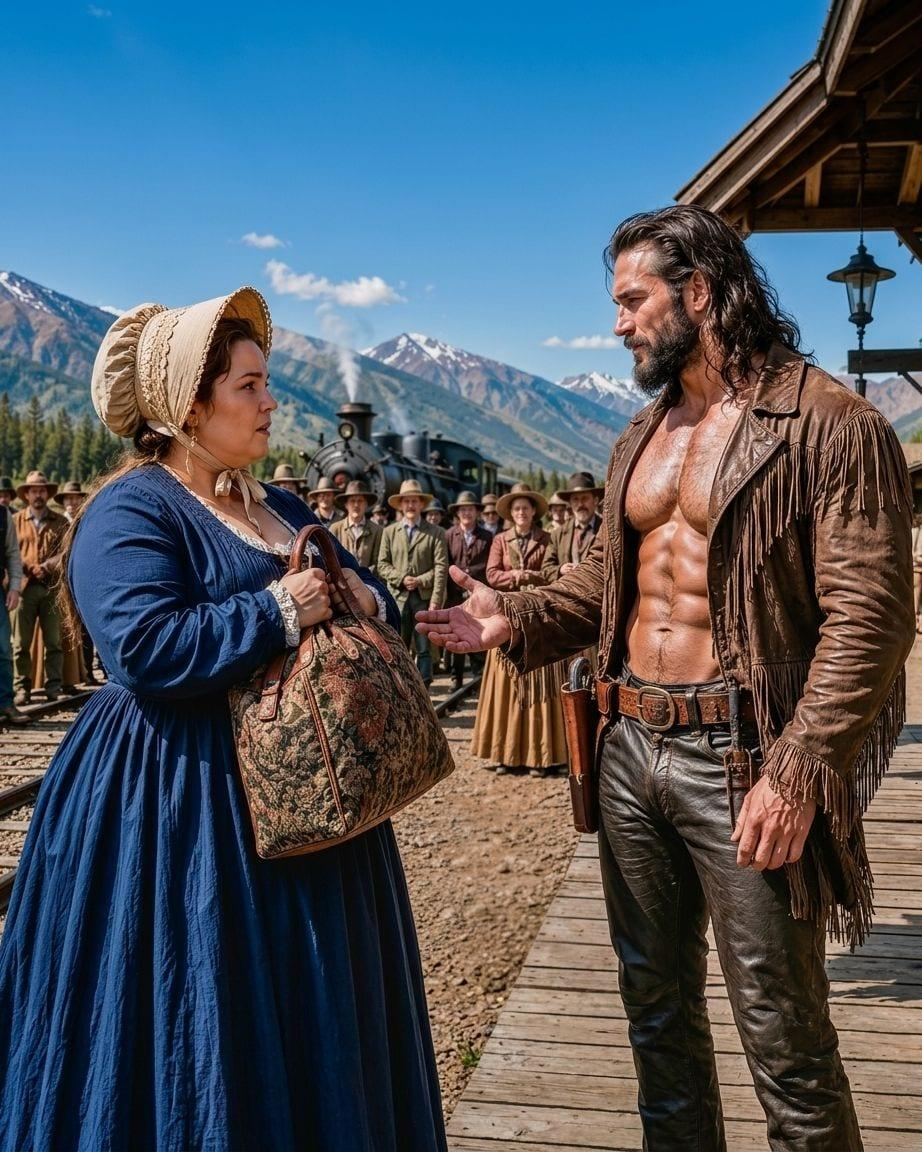
"I sent for a wife, not a draft horse!"
Amos Tully waved Kora's crumpled letter in front of the passengers at Red Bluff Station.
On the back, beneath her careful handwriting, someone had written three words in red pencil.
DO NOT RETURN.
Kora had never seen those words before.
And suddenly, her rejection was no longer the worst thing waiting for her in Montana.
The first laugh came from a ranch hand leaning against the ticket office.
It was short and ugly, the kind of laugh a man gave when he wanted everyone around him to know he had no intention of showing kindness.
The second came from somewhere behind the baggage cart.
Then a woman whispered something to her companion, and both covered their mouths.
Kora stood perfectly still.
Three days.
She had spent three days traveling from Boston to this lonely Montana town, sleeping upright on hard wooden benches, eating stale bread, and imagining what her new life might become.
She had imagined a modest home.
A kitchen with a proper stove.
Perhaps a garden.
She had imagined a husband who would appreciate a woman capable of working from sunrise until long after sunset.
She had not imagined standing on a railroad platform while a stranger compared her to livestock.
"Mr. Tully," she said quietly, "I believe we should discuss this somewhere private."
Amos looked offended by the suggestion.
"Private? What's there to discuss?"
He shook the letter.
"You told me you could cook, clean, sew, and keep accounts."
"I can."
"You neglected to mention you were built like a freight wagon."
Another laugh rose from the crowd.
Kora felt heat climb into her cheeks.
She was thirty years old. She had been large since childhood, and she knew every expression people wore when they decided her appearance made her less deserving of respect.
But knowing the cruelty of strangers did not make it hurt less.
She tightened her grip on her carpet bag.
"I answered every question you asked," she said.
Amos stepped closer.
"And I paid forty dollars for your railroad fare."
"I know."
"Forty dollars!"
His voice carried across the platform.
"Do you have any idea what forty dollars means to a respectable businessman?"
Kora glanced toward the locomotive.
A cloud of white steam drifted past the iron wheels.
"I intend to repay your kindness through honest work."
"Kindness?"
Amos laughed bitterly.
"Lady, you've mistaken me for a charity."
He held out his hand.
"I want my money back."
Kora looked at his open palm.
Then she looked into his face.
"I have three dollars."
"Three?"
"Yes."
"Then you've cheated me."
"I have done no such thing."
For the first time, her voice grew firm.
"I wrote you truthfully about my circumstances. I told you I had no family able to support me. I told you I was willing to work hard. I told you I wanted a respectable marriage."
"You should have told me what you looked like."
Kora swallowed.
"You never asked for a photograph."
"Because I assumed a woman looking for a husband would have enough sense to make herself presentable."
Something inside her went very quiet.
She had spent years trying to make herself smaller.
Smaller at dinner tables.
Smaller in crowded rooms.
Smaller in the presence of people who believed her body was an invitation to ridicule.
She had crossed half a continent because she wanted a place where she could stop apologizing for existing.
Now she realized she had traveled all that distance only to find the same cruelty waiting beneath a different sky.
"I cannot give you money I do not possess," she said.
Amos folded the letter.
"Then find employment."
"I intend to."
"Try the saloon. Perhaps they need someone to scrub floors."
He turned away.
"You're not coming to my house."
Kora watched him descend the station steps.
"Mr. Tully."
He stopped without turning.
"What?"
"Please return my letters."
He looked down at the papers in his hand.
For one brief moment, something uncertain crossed his face.
Then he shoved them into his coat pocket.
"Consider them payment toward what you owe me."
And he walked away.
The crowd began moving again.
People collected luggage.
Children ran between their mothers' skirts.
A railway porter shouted for passengers to stand clear.
Life continued with an indifference that felt almost deliberate.
Kora remained beside the train.
She had no husband.
No home.
No return ticket.
And three dollars would scarcely pay for a few nights in a boardinghouse.
She looked down at her carpet bag.
The faded floral fabric had belonged to her mother.
One leather handle had been repaired twice.
Inside were two dresses, a Bible, a sewing kit, a small tin containing her mother's wedding ring, and a carefully wrapped packet of family papers.
Everything she owned.
Everything she had managed to save.
She bent to adjust the bag's weight.
A sharp pain pulled across her lower back.
She closed her eyes.
Not here, she told herself.
Not in front of them.
She would not cry on that platform.
She would find work.
She would earn enough to rent a room.
She would build another life from whatever remained.
She had done it before.
She could do it again.
"Tully always was a weak-spined fool."
The voice came from her right.
Deep.
Rough.
Quiet enough that it seemed intended only for her.
Kora turned.
A man stood beneath the station roof.
He was the largest man she had ever seen.
His shoulders nearly filled the space between two wooden support posts.
Long dark hair brushed the collar of a weathered buckskin jacket. A thick beard covered his jaw, and his skin bore the marks of years spent beneath mountain sun and winter wind.
A leather holster rested at his hip.
But it was his eyes that held her attention.
Pale gray-blue.
Watchful.
Unusually gentle for such a formidable face.
He had not laughed.
Kora was certain of that.
"Excuse me?" she asked.
The stranger stepped into the sunlight.
His boots made a solid sound against the platform boards.
"I said Amos Tully is a fool."
Kora glanced toward the street where Amos had disappeared.
"I suppose you're acquainted with him."
"Unfortunately."
There was no humor in his answer.
He looked toward the townspeople, several of whom suddenly found reasons to examine their shoes.
Then his gaze returned to Kora.
"Name's Gideon Mercer."
"Kora Bennett."
He nodded.
"Miss Bennett."
She waited for the familiar question.
The familiar insult.
The inevitable suggestion that she ought to be grateful any man had approached her at all.
Instead, Gideon glanced at the carpet bag.
"That looks heavy."
"I can manage."
"I don't doubt it."
His answer surprised her.
He did not reach for the bag.
He simply stood there, allowing her to decide whether she wanted his assistance.
Kora studied him.
"What do you want, Mr. Mercer?"
He considered the question.
"To make you an offer."
Her stomach tightened.
"I've had quite enough offers from strange men."
"Fair enough."
He looked toward the departing train.
Its wheels began turning.
The locomotive gave a long, mournful whistle.
Gideon waited until the noise faded.
"I live about twelve miles north of here. Up in the mountains."
Kora said nothing.
"I have a cabin. Some livestock. Enough land to keep a man busy until his bones wear out."
"Congratulations."
One corner of his mouth moved.
It was not quite a smile.
"I also have two children."
That caught her attention.
"Children?"
"Twins."
"How old?"
"Six."
Kora glanced at his left hand.
There was no wedding ring.
"Where is their mother?"
Gideon's expression changed.
Not dramatically.
His jaw simply tightened, and something guarded entered his eyes.
"She's gone."
Kora lowered her gaze.
"I'm sorry."
He nodded once.
For a moment, neither spoke.
The last passenger car rolled past them.
A gust of warm air carried coal smoke across the platform.
Gideon cleared his throat.
"My children need someone who can keep a home."
Kora looked at him sharply.
"Mr. Mercer—"
"Someone who knows how to cook. Someone patient enough to teach them. Someone who won't run the first time winter closes the road."
She stared.
He continued.
"I heard what you told Tully."
"You were listening?"
"Hard not to. He made certain the whole town heard."
Her face warmed again.
Gideon's expression softened.
"Miss Bennett, I don't care what that man thinks a wife ought to look like."
Kora's throat tightened.
She looked away before he could see how deeply those words had reached her.
"You don't know anything about me."
"I know you traveled three days to keep your word."
"That proves very little."
"I know you stood there while a man insulted you in front of half the town, and you never insulted him back."
"He hardly deserved the courtesy."
"No," Gideon agreed. "He didn't."
For the first time that afternoon, Kora almost smiled.
Almost.
Then she remembered where she was.
A strange town.
No money.
A strange man offering her shelter in an isolated mountain cabin.
She had not survived thirty years by confusing desperation with trust.
"What exactly are you proposing?" she asked.
Gideon took a breath.
"Work, to begin with."
"What kind?"
"Cooking. Keeping house. Helping with the children. I'll pay wages, and you'll have a room of your own."
Kora studied him carefully.
"And afterward?"
His eyes met hers.
"If we come to respect one another, perhaps marriage."
She blinked.
The words seemed to hang between them.
"Marriage?"
"Eventually."
"You cannot possibly be serious."
"I don't make a habit of joking about marriage."
"Mr. Mercer, you met me less than five minutes ago."
"That's true."
"And you're asking me to come live in your home?"
"I'm asking whether you'd consider meeting my children."
She looked toward the mountains.
Their snow-covered peaks rose above the pine forests, beautiful and distant.
Twelve miles.
Twelve miles from the nearest town.
Twelve miles from anyone who might hear her call for help.
"Why me?" she whispered.
Gideon was silent for several seconds.
Then he answered.
"Because my little girl hasn't spoken above a whisper in eight months."
Kora looked back at him.
"My boy wakes screaming most nights. They need someone who can make a house feel safe again."
His voice grew quieter.
"I've tried. God knows I've tried."
There was no performance in his grief.
No attempt to impress her.
He looked like a man who had spent too many nights fighting battles he did not know how to win.
Kora thought of the children she had cared for in Boston.
Her younger cousins.
The neighbor's little boy whose mother worked in a laundry.
The orphaned sisters who used to come to her kitchen for bread.
Children had never cared about the size of her waist.
They cared whether she listened.
Whether she remembered their favorite stories.
Whether she kept her promises.
"What are their names?" she asked.
Gideon's face changed.
A little warmth returned.
"Samuel and Lily."
"Sam and Lily," Kora repeated.
He nodded.
"Sam's got more questions than a preacher at a confession. Lily likes drawing birds."
Kora felt an unexpected ache.
"And you believe they'd accept a stranger?"
"I don't know."
His honesty startled her.
"But I believe they deserve a chance."
A sudden shout interrupted them.
"Mercer!"
Gideon turned.
A railway porter approached carrying a small wooden crate.
"That package you were waiting on came in."
Gideon nodded.
"Set it by my wagon. I'll collect it."
The porter glanced at Kora.
His eyes flickered toward her carpet bag.
Then toward Gideon.
Something unreadable crossed his face.
"You're taking her up the mountain?"
Gideon's expression hardened.
"That's between Miss Bennett and me."
The porter looked uncomfortable.
"Just asking."
He hurried away.
Kora watched him go.
"People seem rather interested in your affairs."
"They've always been interested."
"Why?"
Gideon did not answer immediately.
Instead, he looked toward the mountains.
"Small towns have long memories."
Kora folded her hands around the bag handles.
"And what would they remember about you?"
A shadow passed across his face.
"Things I'd rather explain somewhere that doesn't have twenty people listening."
She should have walked away.
She knew that.
But something about his honesty made leaving harder than staying.
At last, she said, "I will meet your children. Nothing more is promised."
Gideon nodded.
"That's more than fair."
"And I expect wages."
"You'll have them."
"And a private room."
"With a door that locks from the inside."
She studied his face.
"You're not offended by my conditions?"
"No, ma'am."
"Why not?"
"Because a woman who's had her choices taken away deserves to make a few of her own."
Kora looked down.
For one dangerous moment, tears threatened.
She blinked them away.
Gideon extended his hand toward the carpet bag.
"May I?"
This time, she let him take it.
The weight seemed to surprise him.
"Good Lord. You carrying bricks?"
"My entire life."
His expression softened.
He did not joke again.
They started toward the station steps.
Then Kora stopped.
"Mr. Mercer?"
"Yes?"
"One more question."
He turned.
"How did your wife die?"
The change in his face was immediate.
The warmth vanished.
His hand tightened around the carpet bag.
For several seconds, he said nothing.
Then he answered.
"That's the trouble, Miss Bennett."
Kora felt a chill despite the afternoon heat.
Gideon glanced toward the railroad office, where the porter stood watching them through the window.
"We never found a body."
Before Kora could respond, a young boy came running from the station building.
He was pale and breathless.
In his hand was a folded piece of paper.
"Mr. Mercer!"
Gideon turned.
The boy held out the note.
"A man told me to give you this. Said it was important."
Gideon took it.
Kora watched his expression as he unfolded the paper.
His eyes moved across the first line.
Then stopped.
Every trace of color drained from his face.
Kora stepped closer.
"What is it?"
Gideon did not answer.
He slowly turned the paper so she could see the words.
The handwriting was delicate.
Feminine.
And the message began with a name.
Kora Bennett.
Beneath it were six words.
DO NOT LET HER NEAR THE TWINS.






Comments 0