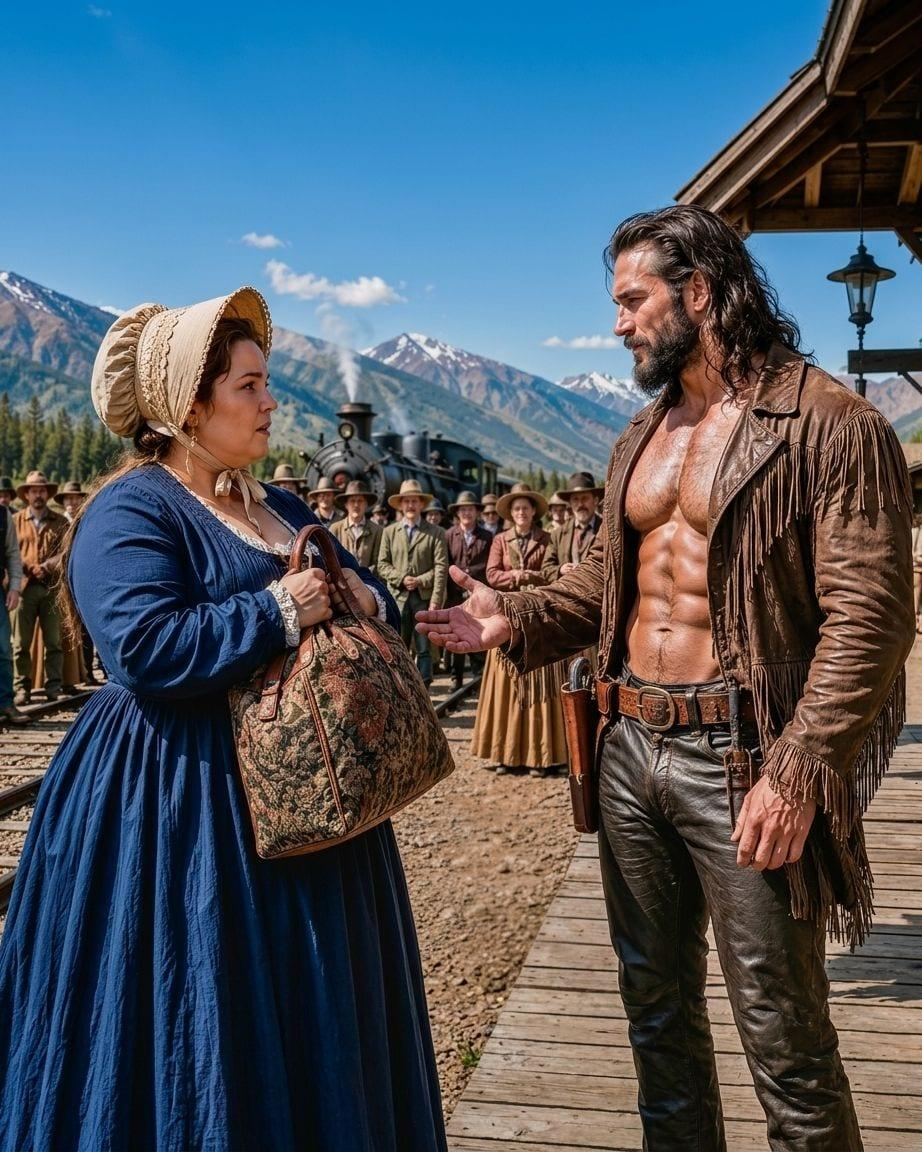
"Don't let her near the twins?"
Kora read the warning aloud, then looked straight into Gideon Mercer's pale eyes.
"Mr. Mercer, I have never met your children. I have never even heard their names until today."
Gideon stood motionless on the railroad platform, the folded note trembling almost imperceptibly between his thick fingers.
Behind them, the last passenger car disappeared around a bend, leaving a ribbon of smoke above the Montana foothills.
The station had grown quieter.
But Kora could still feel people watching.
"Who gave you this?" Gideon demanded.
The messenger boy took a nervous step backward.
"I don't know, sir."
"What did he look like?"
"Had a gray coat. Brown hat. Kept his face turned down."
"Was he from town?"
The boy shook his head.
"Never saw him before."
Gideon looked toward the street.
"Where did he go?"
"He was standing beside the freight office. Then he wasn't."
Kora studied the handwriting.
The letters were narrow and carefully formed, with a peculiar backward curve on the capital K.
Someone had written her full name.
Someone who knew she would be arriving that afternoon.
And someone who knew about Gideon's children.
"May I see it?" she asked.
Gideon hesitated.
Then he handed her the paper.
It was ordinary stationery, yellowed at the edges. No signature appeared beneath the warning.
Kora turned it over.
Blank.
She held it closer to the sunlight.
There was a faint impression in the paper, as though another sheet had rested above it while someone wrote.
She could not make out the words.
"Do you recognize the handwriting?" she asked.
Gideon stared at it.
"No."
But his answer came a fraction too late.
Kora noticed.
She had spent years keeping accounts for merchants who believed a woman could not recognize dishonesty. She knew the difference between uncertainty and concealment.
"Are you certain?"
His jaw tightened.
"I said I don't recognize it."
"Then whoever wrote this knows considerably more about us than we know about them."
Gideon glanced at her.
"Us?"
"Your name and mine appear to have become connected in someone's imagination."
She handed the note back.
"That seems rather unfortunate, considering we've only just met."
For the first time, a trace of amusement touched his expression.
"You're a practical woman, Miss Bennett."
"I've had to be."
The messenger boy remained beside them, twisting his cap.
Gideon reached into his pocket and gave him a coin.
"Thank you, Tommy. If you see that man again, tell Sheriff Bell."
The boy nodded eagerly and ran toward the station office.
Kora watched him disappear.
Then she turned back to Gideon.
"Does this change your offer?"
He looked surprised.
"Do you want it to?"
"That depends on whether you believe the warning."
"I don't know who wrote it."
"That wasn't my question."
For several seconds, they faced one another in silence.
Gideon was nearly a foot taller than she was. His broad shoulders and weathered face made him look capable of frightening most men without raising his voice.
Yet he did not use his size to intimidate her.
Instead, he lowered his gaze to the note.
"No," he said finally. "I don't believe a stranger's warning is reason enough to condemn a woman."
Kora felt something loosen inside her chest.
"Thank you."
"But I won't pretend it doesn't trouble me."
"It troubles me too."
He folded the paper and slipped it into his coat.
"Then perhaps we should both keep our eyes open."
"That," Kora said, "is the first sensible thing anyone has said to me since I arrived."
Gideon gave a quiet laugh.
It was brief, rough, and unexpectedly warm.
He lifted her carpet bag.
"My wagon's around back."
Kora followed him down the station steps.
The afternoon sun had begun sliding westward, throwing long shadows across Red Bluff's dusty main street.
Wooden storefronts lined the road. A blacksmith hammered iron beneath an open shed. Two horses stood outside a saloon, their tails flicking lazily at flies.
A sign above the general store read TULLY'S MERCANTILE.
Kora stopped.
Through the window, she saw Amos Tully speaking angrily to another man.
Amos noticed her.
Then he noticed Gideon.
His expression changed.
He hurried outside.
"Mercer!"
Gideon kept walking.
"Mercer, I'm talking to you!"
Gideon stopped beside a sturdy bay horse hitched to a wooden wagon.
"What is it, Amos?"
Amos looked from Gideon to Kora.
"What's she doing with you?"
"Walking."
"Don't get smart."
Gideon set the carpet bag carefully in the wagon bed.
Amos lowered his voice.
"That woman came here under an agreement with me."
Kora stepped forward.
"An agreement you publicly canceled."
"I paid your fare."
"And you made it abundantly clear you no longer wanted a wife."
Amos ignored her.
"Mercer, you can't just take another man's property."
The silence that followed was immediate.
Gideon turned slowly.
"Careful."
Amos swallowed.
"I'm speaking about the money."
"Then speak about money."
Gideon's voice remained quiet.
"Don't speak about Miss Bennett as though she's a horse you're selling."
A ranch hand across the street stopped sweeping.
Amos noticed.
His face reddened.
"You think you're some kind of hero?"
"No."
"Then mind your own business."
Gideon glanced at Kora.
"Miss Bennett is free to decide where she goes."
Amos sneered.
"You're taking her to that cabin?"
"That's the arrangement."
Something ugly entered Amos's eyes.
"After what happened to your wife?"
Gideon went still.
Kora saw his hand tighten around the wagon rail.
Amos smiled.
"Maybe the lady ought to know what happened to the last woman who lived up there."
"Enough," Gideon said.
"People don't just disappear, Mercer."
A cold uneasiness settled in Kora's stomach.
She looked at Gideon.
He did not deny the accusation.
Amos stepped closer.
"You want to know what folks say, Miss Bennett?"
Kora raised her chin.
"I've heard quite enough from you today."
"They say his wife went up that mountain and never came down."
Gideon's voice hardened.
"Walk away, Amos."
"And now he's bringing another woman up there."
Amos gave a humorless laugh.
"Seems mighty convenient."
Kora looked directly at him.
"Mr. Tully, you have spent the better part of an afternoon insulting me. If you believe that gives you authority over my decisions, you are mistaken."
Amos blinked.
She continued.
"You rejected me. You abandoned me. You made certain everyone in this town understood that you considered me worthless."
Her voice remained steady.
"So you will forgive me if I decline to accept your advice about my future."
A woman standing outside the bakery covered a smile.
Amos's face darkened.
"You'll regret this."
"Perhaps," Kora answered. "But at least the decision will be mine."
Gideon offered his hand to help her into the wagon.
She accepted.
His palm was rough and warm.
He supported her weight without hesitation or embarrassment.
When she settled onto the wooden seat, he climbed beside her.
Amos remained in the street.
"You hear me, Mercer?"
Gideon gathered the reins.
"I heard you."
He clicked his tongue.
The bay horse started forward.
As the wagon rolled away, Amos shouted one final warning.
"Don't say nobody told you!"
Kora did not look back.
But she could feel Gideon's tension beside her.
They traveled in silence until Red Bluff disappeared behind a rise.
The road narrowed.
Pine trees replaced storefronts.
The mountains grew larger, their dark slopes streaked with lingering snow.
Kora watched the landscape pass.
She had never seen country so vast.
Back in Boston, buildings crowded the streets until the sky seemed trapped between rooftops.
Here, the horizon stretched beyond anything she could measure.
It was beautiful.
And frightening.
"Was Amos telling the truth?" she asked.
Gideon kept his eyes on the road.
"About what?"
"Your wife."
He took a slow breath.
"Her name was Evelyn."
Kora waited.
"She disappeared eight months ago."
"From your home?"
"Yes."
"Did she leave a letter?"
"No."
"Take belongings?"
"Some clothes were missing."
"Money?"
"Not that I could tell."
Kora looked at him.
"And the children?"
His expression changed.
"They were asleep when I got home."
"Where had you been?"
"Helping a neighbor with a broken wagon axle."
"How long were you gone?"
"Most of the afternoon."
Kora considered that.
"When you returned, she was simply gone?"
Gideon nodded.
"I searched the woods until morning. Then I rode into town and brought the sheriff."
"Did they find anything?"
He hesitated.
"A shawl."
"Where?"
"Near the creek."
"Was it hers?"
"Yes."
Kora waited for him to continue.
He did not.
"Was there blood?"
"No."
"Footprints?"
"Too much rain."
"Did anyone see her leave?"
"Nobody admitted to it."
That choice of words caught Kora's attention.
"Admitted?"
Gideon's eyes remained fixed ahead.
"Evelyn wasn't happy on the mountain."
"Had she wanted to leave?"
"Sometimes."
"Did you try to stop her?"
He turned toward Kora.
There was pain in his face, but no anger.
"No."
She believed him.
Not because he was handsome or because he had defended her.
She believed him because he answered without trying to make himself appear innocent.
Still, she had learned that belief and certainty were different things.
"What did the sheriff conclude?"
"That she'd run away."
"And you?"
Gideon stared at the road.
"I don't know what happened."
The wagon creaked over a shallow rut.
Kora steadied herself against the seat.
"What do the children believe?"
Gideon's grip tightened on the reins.
"Sam thinks she abandoned them."
"And Lily?"
He swallowed.
"Lily thinks her mother is still somewhere in the woods."
Kora's heart sank.
"Why?"
"She says she heard someone calling her name the night Evelyn disappeared."
"Did she recognize the voice?"
Gideon shook his head.
"She won't talk about it."
For a while, only the horse's hooves and the wagon wheels broke the silence.
Kora looked toward the darkening trees.
She had imagined becoming a wife.
Perhaps, someday, a mother.
She had never imagined entering a household where two children were still waiting for a woman who might be dead.
"Mr. Mercer," she said, "I need you to understand something."
He glanced at her.
"I cannot replace their mother."
"I know."
"And I won't pretend I can."
"I wouldn't ask you to."
"If I come to your home, I will treat your children kindly. I will cook, clean, and help them however I can. But I will not demand their affection."
Gideon's expression softened.
"That's more than I hoped for."
Kora looked away.
The answer affected her more than she wanted him to know.
A mile farther along, Gideon stopped beside a narrow stream.
The horse lowered its head to drink.
Kora climbed down carefully and stretched her aching legs.
Gideon retrieved a wrapped parcel from beneath the wagon seat.
"Bread and cheese," he said.
She looked at him.
"You planned ahead."
"Two children taught me that hunger makes a person unreasonable."
He handed her half the bread.
They sat on a fallen log beside the stream.
For several minutes, they ate without speaking.
Then Kora asked, "What are they like?"
Gideon's face brightened.
"Sam likes taking things apart."
"Does he put them back together?"
"Rarely."
She laughed.
The sound surprised them both.
"And Lily?"
"She draws."
"You mentioned birds."
"Birds, flowers, trees. Sometimes people."
"Does she draw you?"
"Mostly my boots."
Kora smiled.
"Perhaps she finds them easier to capture."
"That's likely."
He looked down at his enormous boots.
"Certainly enough leather to keep her busy."
Kora laughed again.
It felt strange.
Only an hour earlier, she had believed her life was ruined.
Now she was sitting beside a mountain stream, sharing bread with a stranger who had made her laugh twice.
The realization frightened her.
Hope was dangerous when a person had so little left to lose.
"Why did you choose me?" she asked suddenly.
Gideon looked puzzled.
"I told you."
"No. You told me why you needed help."
She folded the remaining bread in its cloth.
"Why approach me specifically?"
He considered his answer.
"Because you reminded me of someone."
Kora's smile faded.
"Your wife?"
"No."
"Then who?"
"My mother."
She blinked.
Gideon looked toward the stream.
"She was a big woman. Strong hands. Loud laugh. Could carry two buckets of water and still scold my brothers for being lazy."
His voice softened.
"People made jokes about her too."
Kora said nothing.
"She never let them stop her."
He glanced at Kora.
"When my father died, she kept our farm running. Raised four boys. Fed half the valley when winter was bad."
"She sounds remarkable."
"She was."
"What happened to her?"
"Fever. Ten years ago."
"I'm sorry."
He nodded.
Then he said something that made Kora's throat tighten.
"She used to tell me that a person's worth wasn't measured by how little space they took up."
Kora stared at him.
For years, she had been made to feel that every inch of her body was an offense.
And here was a man who spoke of his mother's size as though it belonged among her strengths.
She looked down before he could see the tears gathering in her eyes.
Gideon did not mention them.
Instead, he stood.
"We should get moving. The children will be waiting."
They continued into the mountains.
The road became steeper.
The air cooled.
Pines crowded close, and sunlight filtered through their branches in narrow golden shafts.
At last, they emerged into a broad clearing.
A substantial log cabin stood near the edge of a meadow.
Smoke rose from its stone chimney.
A barn and fenced pasture occupied the far side of the property.
Beyond them, mountains climbed toward the evening sky.
Kora studied the house.
It was larger than she had expected.
Sturdy.
Well maintained.
A porch stretched across the front, and flower boxes hung beneath two windows.
Someone had once cared deeply about making the place beautiful.
"That's home," Gideon said.
Kora looked at him.
"You built it?"
"Most of it."
"It's lovely."
He seemed almost embarrassed.
"Evelyn planted the flowers."
Kora looked at the boxes.
Several blossoms had wilted.
Others were struggling through dry soil.
She made a quiet decision to water them.
The wagon stopped near the porch.
Gideon climbed down.
Before he could offer assistance, the cabin door opened.
A small boy appeared.
He had dark hair, serious gray eyes, and a wooden toy horse clutched in one hand.
"Daddy!"
He ran down the steps.
Gideon caught him and lifted him easily.
"There's my boy."
Sam wrapped his arms around his father's neck.
"Did you bring the nails?"
"Yes."
"And the sugar?"
"Yes."
"And the—"
"Sam."
The boy stopped.
Gideon nodded toward Kora.
"We have a guest."
Sam turned.
His gaze traveled over Kora's bonnet, blue dress, and carpet bag.
He did not laugh.
He did not stare at her figure.
Instead, he asked, "Can you make biscuits?"
Kora blinked.
Then she smiled.
"I believe I can."
"Good ones?"
"That depends. Do you like them with butter?"
Sam's eyes widened.
"And honey?"
"Especially honey."
The boy looked at his father.
"She can stay."
Gideon laughed.
Kora felt warmth spread through her chest.
Then she noticed the second child.
A little girl stood in the doorway.
She was smaller than her brother, with long dark hair and a faded yellow dress.
Her hands gripped the doorframe.
Her face was pale.
And her eyes were fixed on Kora with an expression that made the woman's smile disappear.
Fear.
Not shyness.
Not uncertainty.
Fear.
Gideon lowered Sam to the ground.
"Lily, sweetheart. Come meet Miss Bennett."
The little girl did not move.
Kora remained beside the wagon.
She understood frightened children.
They needed space.
Time.
The freedom to decide when they were ready.
"Hello, Lily," she said gently. "Your father tells me you like drawing birds."
Lily's fingers tightened around the doorframe.
Kora smiled softly.
"I once tried drawing a robin. It looked more like a potato with wings."
Sam giggled.
Lily did not.
Her eyes shifted toward the trees behind Kora.
Then toward her father's face.
Something passed across her expression.
Recognition.
Terror.
She took one step backward.
Gideon frowned.
"Lily?"
The girl shook her head.
"Sweetheart, what's wrong?"
Her lips moved.
No sound came.
Kora slowly lowered herself onto the wagon step so she would seem less imposing.
"It's all right," she said. "You don't have to come outside."
Lily stared at her.
Then, for the first time, she spoke loudly enough for everyone to hear.
"She can't sleep in Mama's room."
Gideon went rigid.
Sam stopped smiling.
Kora felt the air change.
"Of course not," she said gently. "Your father promised me a room of my own."
Lily shook her head harder.
"No."
Her voice trembled.
"She can't sleep in the house."
Gideon took a step toward her.
"Lily, nobody is going to hurt you."
The little girl backed into the doorway.
"That's what Mama said."
Kora's heart contracted.
Gideon stopped.
"What do you mean?"
Lily looked toward the dark woods.
Then she whispered something Kora barely heard.
"She said nobody would hurt us if we stayed quiet."
Gideon's face drained of color.
"Lily, when did Mama say that?"
The child began crying.
She turned and fled into the cabin.
Sam followed her.
Gideon stood motionless beside the porch.
Kora approached carefully.
"Mr. Mercer?"
He did not answer.
"Perhaps you should give her some time."
He rubbed a hand over his face.
"She hasn't said that much about Evelyn in months."
Kora looked toward the open door.
"Then something about my arrival frightened her."
Gideon nodded slowly.
"Maybe."
But his voice held no conviction.
He carried Kora's bag into the house and showed her a small room beside the kitchen.
It contained a narrow bed, a washstand, a wooden wardrobe, and a window overlooking the meadow.
The room was simple.
Clean.
Private.
Kora placed her bonnet on the bed.
From somewhere upstairs came the faint sound of a child crying.
She turned toward Gideon.
"I'd like to help with supper."
"You've had a long day."
"So have your children."
He studied her.
Then nodded.
"The kitchen's yours."
Kora rolled up her sleeves.
Within an hour, the cabin smelled of fresh biscuits, fried potatoes, and warming stew.
Sam appeared first.
He hovered beside the kitchen doorway, watching her work.
"Are those biscuits?"
"They are."
"Can I have one?"
"When they're ready."
He considered this.
"How long?"
"Long enough for you to wash your hands."
He disappeared immediately.
Kora smiled.
Then she noticed a folded piece of paper on the kitchen table.
A child's drawing.
Two small figures stood beside a tall man.
A woman appeared near the edge of the page.
Her face had been scratched out with heavy black pencil marks.
Kora picked up the drawing.
At the bottom, in uneven childish letters, someone had written:
THE LADY IN THE TREES.
A cold sensation traveled down her spine.
She turned the paper over.
Another drawing covered the back.
It showed the cabin at night.
A window.
Two children standing behind it.
And outside, beneath the trees, a woman holding something long and narrow.
Kora leaned closer.
It looked like a key.
Behind her, the kitchen floor creaked.
She turned.
Lily stood in the doorway.
Her eyes were fixed on the drawing.
"Where did you get this?" Kora asked gently.
Lily's face went white.
She stepped forward and snatched the paper from Kora's hand.
"You weren't supposed to see."
Kora crouched.
"Lily, sweetheart, who is the lady in the trees?"
The little girl's lower lip trembled.
She glanced toward the window.
Then toward the hallway.
"She comes when Daddy's asleep."
Kora felt her pulse quicken.
"Who does?"
Lily's eyes filled with tears.
"The lady who took Mama."
A floorboard creaked upstairs.
Lily seized Kora's wrist.
Her tiny fingers were ice-cold.
"Don't tell Daddy," she whispered.
"Why not?"
The child leaned closer.
"Because she said she'd take Sam next."
Kora looked toward the darkening window.
Beyond the glass, the pine trees stood motionless.
Then she noticed something hanging from the outside latch.
A narrow strip of yellow fabric.
Freshly tied.
It had not been there when they arrived.
Lily saw it too.
Her grip tightened painfully.
"She's here," the little girl whispered.
At that moment, three slow knocks sounded against the back door.
Kora turned.
The handle began to move.
Someone was opening it from the outside.






Comments 0