Hattie Mercer grabbed the edge of the wooden counter as a man's hand tightened around her wrist.
"You're going to marry me whether you like it or not."
Mr. Albright stood beside her, holding a folded marriage agreement.
Three words had been written across its bottom.
Property. Work. Obedience.
Hattie suddenly understood what kind of wedding he had planned.
She was not going to be his wife.
She was going to belong to him.
And she had already decided to run.
Three days earlier, Hattie Mercer had stepped off a train in Redemption Creek, Ohio, carrying a small leather suitcase and wearing a blue silk dress that had cost more than anything she had owned in years.
She was twenty-seven years old.
Her copper-red hair had been carefully braided before the journey, although the long hours aboard the train had loosened several strands around her face. Her hazel-green eyes were tired, but there was still a quiet determination in them.
She had spent most of her adult life trying to survive.
Her mother had died when Hattie was young. Her father had raised her alone, teaching her to ride horses, mend broken tack, recognize an injured animal, and understand the difference between fear and aggression.
He had never been a wealthy man.
But he had given her something more valuable than money.
He had taught her that a person's worth could never be measured by what someone else was willing to pay for them.
Unfortunately, her father had not survived long enough to see the woman she eventually became.
Whiskey had taken him slowly.
First his work.
Then his savings.
Finally, his health.
When he died, Hattie had been left with unpaid bills, a deteriorating rented room, and almost nobody willing to help her.
For months, she had worked wherever someone would hire her.
She cleaned kitchens, washed clothes, and helped at a small stable outside town.
But the money was never enough.
Then a letter arrived.
It came from a man named Mr. Albright, a respectable businessman living in Redemption Creek.
He described himself as financially secure, well established, and interested in marriage.
He promised a comfortable home.
He promised financial protection.
He promised that Hattie would never have to worry about rent or food again.
The letter had been polite and carefully written.
It even included money for her train ticket.
For a woman who had spent months wondering where she would sleep next, the offer seemed like an unexpected answer to a desperate prayer.
Hattie had written back.
She accepted.
She believed she was traveling toward a new beginning.
She had no idea she was traveling toward a cage.
When Hattie first arrived in Redemption Creek, Mr. Albright was waiting on the wooden platform.
He was in his early fifties, thin-faced, neatly dressed, and considerably less charming than his letters had suggested.
His dark hair was combed straight back.
His expensive coat looked almost too clean for a town covered in dust.
He greeted her with a brief nod.
"Miss Mercer?"
"Yes. Mr. Albright?"
"You're late."
Hattie glanced toward the station clock.
The train had arrived only seven minutes behind schedule.
"I'm sorry. There was a delay."
He did not answer.
Instead, he reached for her suitcase.
For a moment, she thought he was being considerate.
Then she noticed that he did not ask whether she wanted help.
He simply took it.
"Come along. My sister is waiting."
His voice made the instruction sound like an order.
Hattie followed him through town.
Redemption Creek was larger than she had expected. There was a mercantile store, a blacksmith's workshop, a church, a hotel, and several wooden buildings surrounding a broad dirt street.
Men stood outside the saloon.
A woman carried a basket of laundry.
Two children chased one another past the hitching posts.
It should have felt welcoming.
Instead, Hattie noticed that people seemed to look at Mr. Albright before looking at her.
Several men nodded respectfully.
One even removed his hat.
Albright appeared to enjoy the attention.
"This town knows me," he said. "I've invested in several businesses here."
"That's wonderful," Hattie replied politely.
He glanced at her.
"You'll learn that respect matters in a place like this."
Hattie did not answer.
They stopped outside a mercantile store.
Behind the counter stood a narrow-faced woman in her late forties.
She wore a dark gray dress with a stiff collar and had her silver-streaked hair pinned tightly against her head.
"This is my sister, Eleanor," Albright said.
Eleanor looked Hattie over.
Her gaze moved from the blue silk dress to the worn leather shoes beneath its hem.
Then to the small suitcase.
"Well," she said. "You've arrived."
"Good afternoon," Hattie replied.
Eleanor did not return the greeting.
"That dress is rather impractical for this town."
Hattie looked down.
"It was a gift."
"From my brother?"
"Yes."
Eleanor exchanged a brief glance with him.
It was the first moment Hattie noticed that the two siblings communicated without needing to speak.
Albright placed his hand against Hattie's elbow.
"She'll be useful."
The words were quiet.
But Hattie heard them.
Useful.
Not beautiful.
Not intelligent.
Not even welcome.
Useful.
She looked at him, waiting for him to explain.
He did not.
Instead, he began discussing the wedding arrangements with Eleanor.
The date.
The church.
The guests.
The food.
Everything seemed to have already been decided.
Nobody asked Hattie what she wanted.
By late afternoon, Hattie had been taken to Albright's house.
It stood several blocks away from the mercantile, a large gray building with a narrow porch and carefully trimmed bushes.
Inside, everything was clean.
The furniture was expensive.
The floors were polished.
Yet the house felt strangely lifeless.
There were no family photographs on the walls.
No flowers.
No personal belongings scattered around.
Every object seemed to have been placed precisely where it belonged.
Eleanor showed Hattie the kitchen, the dining room, and the upstairs bedrooms.
"This is where you'll sleep until the wedding," she said.
The room was small.
A narrow bed stood against one wall.
There was a wooden dresser, a washbasin, and a single window overlooking the backyard.
Hattie placed her suitcase beside the bed.
"Thank you."
Eleanor remained in the doorway.
"You'll need to learn how things are done here."
"Of course."
"My brother likes his meals served at six. His shirts are to be pressed before breakfast. The floors must be cleaned every morning."
Hattie turned toward her.
"I thought we were discussing marriage."
Eleanor's expression tightened.
"We are."
"Then perhaps we should discuss what Mr. Albright expects from me."
For the first time, Eleanor seemed genuinely surprised.
She folded her arms.
"My brother expects a wife who understands her responsibilities."
"And what does he offer in return?"
Silence.
Eleanor stared at her.
Then she gave a thin smile.
"You'll understand soon enough."
She closed the door.
Hattie stood motionless.
The sound of the latch sliding into place seemed unusually loud.
Dinner was served at six.
Albright sat at the head of the table.
Eleanor sat opposite him.
Hattie was given a place near the kitchen door.
The meal was simple.
Roasted meat, potatoes, bread, and vegetables.
Nobody asked about her journey.
Nobody asked about her father.
Instead, Albright discussed business.
He spoke about property, cattle prices, and the people who owed him money.
Hattie listened quietly.
Eventually, he placed his fork down.
"We should discuss the wedding."
Hattie straightened.
"Yes."
"I've arranged for the ceremony next week."
"Next week?"
"There's no reason to delay."
She had expected a longer engagement.
Perhaps a few weeks.
Perhaps enough time to understand the man she was supposed to marry.
But Albright seemed impatient.
"I thought we would have time to get to know each other."
He looked at her as though she had asked an unreasonable question.
"There's no need for that. We corresponded for months."
"Letters aren't quite the same as living together."
Eleanor stopped cutting her food.
Albright leaned back.
"You're an unmarried woman with no family and no financial security, Miss Mercer. I would think you understand how fortunate this arrangement is."
Hattie felt the blood drain from her face.
He continued.
"I am providing a home. Food. Protection. You will not need to worry about money again."
"And what would you expect me to do?"
He answered immediately.
"Run my household."
"Anything else?"
"Be a proper wife."
Hattie waited.
Albright's eyes narrowed.
"That should be enough."
For several seconds, nobody spoke.
Then Eleanor returned to her meal.
Hattie looked down at her plate.
She suddenly remembered her father's voice.
Never mistake a man who offers you shelter for a man who has earned your trust.
At the time, she had thought he was talking about strangers on the road.
Now she understood.
That night, Hattie sat on the narrow bed and removed the blue silk dress.
She folded it carefully.
The fabric was beautiful.
Its deep blue color caught the light from the small oil lamp.
But now it reminded her of something she could not quite explain.
A promise that had never been real.
She reached into her suitcase and removed a worn brown blouse and a dark charcoal riding skirt.
They were practical clothes.
Her father had helped her choose them years earlier.
She touched the leather belt hanging beside them.
The memory came back so clearly that she almost heard his voice.
"Your hands are stronger than you think, Hattie. Don't let anyone convince you otherwise."
She smiled faintly at the memory.
Then the smile disappeared.
There was something else in her suitcase.
A small envelope.
Inside were the remaining coins she had saved before leaving Ohio, a few hairpins, and the train-ticket debt she still owed Mr. Albright.
She had no intention of taking money that did not belong to her.
She had agreed to the journey.
She had accepted his offer.
But she had never agreed to surrender her freedom.
Hattie looked toward the bedroom door.
The hallway was silent.
She waited.
Then she heard footsteps.
Slow.
Heavy.
Coming toward her room.
She quickly put the envelope beneath her folded clothes.
A knock followed.
"Miss Mercer."
Albright.
She stood.
"Yes?"
"Open the door."
Hattie hesitated.
Then she unlocked it.
Albright entered without waiting for an invitation.
He carried several papers.
"I've prepared the final arrangements."
He placed them on the dresser.
Hattie glanced down.
A marriage agreement.
Several pages of legal language.
And a document with a signature line already marked.
"Read it," he ordered.
She picked up the paper.
At first, the words seemed ordinary.
Household responsibilities.
Financial provisions.
Living arrangements.
Then she reached the final section.
Her eyes stopped.
The agreement stated that any property, income, or earnings acquired by her after marriage would be managed entirely by her husband.
It also granted him authority over her place of residence and household employment.
Hattie read the paragraph twice.
"Why does this say my earnings would belong to you?"
Albright's expression did not change.
"Because I will be responsible for your financial security."
"But these are my earnings."
"After marriage, there is no such distinction."
Hattie put the paper down.
"I don't agree with that."
His jaw tightened.
"You're making this unnecessarily difficult."
"I thought we were entering a marriage."
"We are."
"Then why does this agreement sound like an employment contract?"
For a moment, his eyes became cold.
He picked up the document and tapped the final paragraph.
"Because I have no intention of supporting a woman who refuses to understand her responsibilities."
Hattie stared at him.
The truth was becoming impossible to ignore.
He had not invited her west because he wanted a companion.
He had chosen her because he believed she had nowhere else to go.
He thought her poverty made her obedient.
He thought her loneliness made her grateful.
He thought she would accept anything in exchange for a roof over her head.
Albright moved toward the door.
"Sign it tomorrow."
Then he stopped.
"And don't make plans to leave. The train fare was an investment."
The door closed.
Hattie remained standing beside the dresser.
She looked at the paper.
Then at the blue dress.
Finally, she looked toward the window.
Outside, the moon had risen over the dark outline of the hills.
Somewhere beyond those hills lay a road leading away from Redemption Creek.
She had no money to buy another ticket.
No family waiting for her.
No promise of safety.
But she still had her hands.
She still had her knowledge of horses.
And she still had the freedom to make one decision for herself.
Hattie sat down and removed the hairpins from her copper-red braid.
One by one, she placed them beside the washbasin.
Then she opened her suitcase.
She took out her riding clothes.
She folded the blue silk dress neatly and placed it on the bed.
Beside it, she left the train-ticket debt and the unsigned marriage agreement.
She would not steal.
She would not beg.
And she would not marry a man who considered her his property.
A little after midnight, Hattie opened the back door.
The house was quiet.
She carried no suitcase.
Only her hairpins, her practical clothing, and the courage she had nearly forgotten she possessed.
She stepped into the backyard.
The grass was damp beneath her boots.
A wooden fence separated the property from a narrow path leading toward the bluffs.
She stopped once and looked back at the house.
One upstairs window was illuminated.
Albright's room.
She wondered whether he was awake.
Then she turned away.
The fence was easy to climb.
Beyond it, the path disappeared into a cluster of juniper trees.
Hattie followed it without looking back.
For the first time in months, she felt that her life belonged to her.
She walked through the darkness until the town's lights became distant points behind her.
The road was uneven.
Several times, loose stones slipped beneath her boots.
She continued.
She did not know where she would sleep.
She did not know how she would find work.
She did not even know whether Redemption Creek was the right place to begin again.
But she knew one thing.
She would never return to that bedroom.
By the time dawn approached, Hattie had reached the edge of the bluffs.
She found shelter beside a cluster of junipers and sat down to rest.
Her feet hurt.
Her throat was dry.
She had eaten almost nothing since dinner.
She leaned against a rock and closed her eyes.
Then a sound interrupted her.
A distant shout.
Followed by another.
Then the unmistakable thunder of dozens of hooves.
Hattie immediately stood.
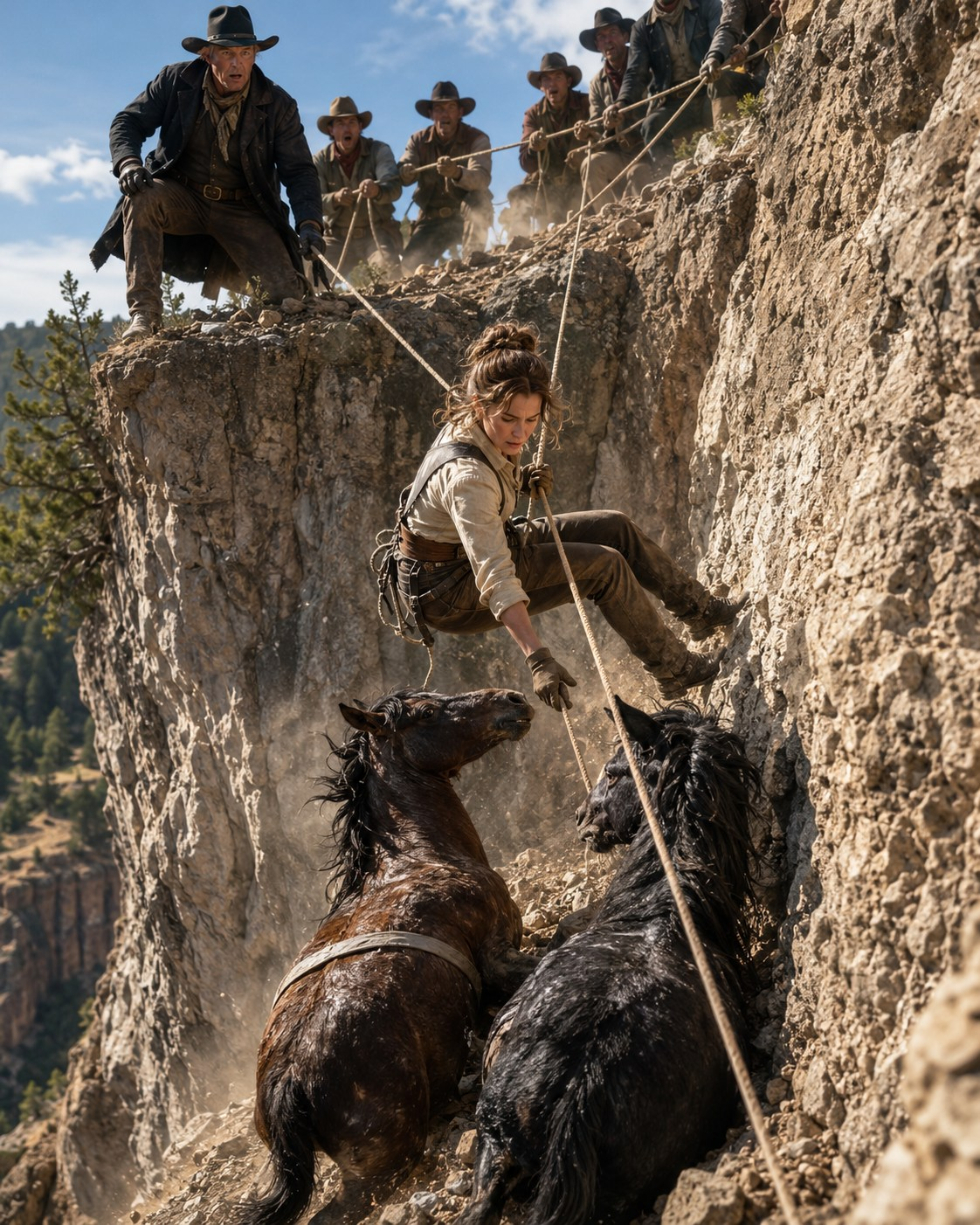
She moved between the junipers and looked down into the valley.
A massive horse drive was moving through the open country.
The animals crowded together as cowboys attempted to guide them toward a narrow pass.
Dust rose in thick clouds.
Several horses broke sideways.
One animal reared.
Another collided with it.
The movement spread through the herd like a wave.
Then Hattie heard a terrible cracking sound.
Two geldings disappeared over the edge of a rocky shelf.
She rushed closer.
Her heart began pounding.
Nearly forty feet below, the animals stood on a narrow ledge.
One was dark chestnut.
The other was charcoal-black.
Both were trembling.
Above them, six cowboys hurried toward the edge.
A tall man wearing a dark brown hat dismounted from a black stallion.
He was broad-shouldered, with short sandy-blond hair and pale gray eyes.
His burgundy shirt was covered in dust.
He grabbed a rope from one of his men.
"Get the lines ready!"
The cowboys moved quickly.
But the rock beneath the edge was unstable.
One of them looked down and stepped backward.
"There's no safe way down."
The man in the burgundy shirt turned toward him.
"Then find one!"
Nobody answered.
Hattie watched the trapped horses.
The chestnut gelding was pawing at the ledge.
The black one pressed itself against the rock wall, its eyes rolling with terror.
She recognized the danger immediately.
If they continued struggling, they could lose their footing.
If someone pulled the ropes too aggressively, the horses might panic.
And if the cowboys tried to drag them upward without properly distributing their weight, the animals could suffer serious injuries.
Hattie took one step forward.
Then another.
She looked at the six men.
At the ropes.
At the narrow ledge.
She knew what had to be done.
The tall cowboy turned toward his crew.
"Who's going down?"
Silence.
Hattie stepped out from behind the junipers.
"I can."
Every man turned.
The cowboy stared at her.
For several seconds, he seemed unable to decide whether she was serious.
Then he slowly walked toward her.
His pale gray eyes moved over her dusty clothes and tangled copper-red hair.
"Who are you?"
Hattie looked past him toward the horses.
"My name is Hattie Mercer."
He glanced at the cliff.
"Do you understand what you're volunteering for?"
"Yes."
"That's a forty-foot drop."
"I can see that."
One of the younger cowboys gave a short laugh.
Thatcher did not.
He stepped closer.
"This isn't a place for a lady."
Hattie met his gaze.
"Then it's a good thing I'm not asking permission to be one."
The laughter stopped.
Thatcher studied her for a moment.
Then his eyes shifted toward the trapped geldings.
"Miss Mercer," he said slowly, "those horses may not survive another hour."
Hattie nodded.
"Then we'd better stop wasting time."
She reached for the nearest rope.
And behind Thatcher, one of the cowboys suddenly shouted.
"Boss! Look at the ledge!"
Everyone turned.
The chestnut gelding had just slipped.
And the black horse was beginning to move toward the edge.






Comments 0