Hattie stared at the photograph.
The wind moved through the juniper bushes, but she barely noticed it.
In the picture, a dark chestnut horse stood beside an old wooden stable. Its mane was thick, its ears pointed forward, and a small white mark crossed the center of its forehead.
Hattie knew that horse.
She had seen it before.
Not in Redemption Creek.
Not in Ohio.
But in the faded photographs her father had kept inside a small wooden box beneath his bed.
Its name had been Copper.
And according to everything her father had ever told her, Copper had died more than ten years ago.
"Where did you get this?" she asked.
The rider lowered the photograph.
"Mr. Albright gave it to me."
"That's not what I asked."
The man shifted in his saddle.
"He told me to deliver it."
Hattie stepped closer.
"Where was it taken?"
"I don't know."
"Who is standing beside the horse?"
The rider looked at the photograph.
"I couldn't tell you."
Hattie reached for it.
He hesitated before finally handing it over.
Her fingers trembled slightly.
She hated that.
She had spent the entire morning controlling her fear, her exhaustion, and the pain in her shoulder. Yet a small photograph had unsettled her more than the dangerous descent.
She turned it over.
There was another message on the back.
Some debts are inherited.
Below it was a date.
October 14, 1878.
Hattie's eyes narrowed.
Her father had died four years earlier.
But the date on the photograph was almost twenty years old.
She looked at the rider.
"Why does Mr. Albright have this?"
The man shrugged.
"He said you'd understand."
"Understand what?"
"That's all he told me."
Hattie stared at him.
"Then you haven't been very useful."
The rider's expression hardened.
"Watch your tone, young lady."
Thatcher stepped forward.
"She's had enough of your instructions for one morning."
The rider looked at him.
"This doesn't concern you."
Thatcher moved closer.
"She's standing on my ground."
The man glanced toward the rescued horses.
Then toward the six cowboys.
He appeared to reconsider his position.
"I've delivered the message," he said. "My business is finished."
He turned his horse toward the trail.
"Tell Mr. Albright I won't be returning," Hattie called.
The rider did not look back.
"Tell him yourself."
Then he disappeared beyond the rocky rise.
Hattie continued holding the photograph.
Thatcher watched her.
"Do you know that horse?"
She nodded.
"His name was Copper."
"Was?"
"My father told me he died."
Thatcher looked at the photograph again.
"How long ago?"
"More than ten years."
"Could this be an old picture?"
"Possibly."
She turned it over again.
"But why would Albright have it?"
Thatcher did not answer.
He looked toward the trail where the rider had disappeared.
Then he looked at Hattie.
"Maybe it's time you told me a little more about your father."
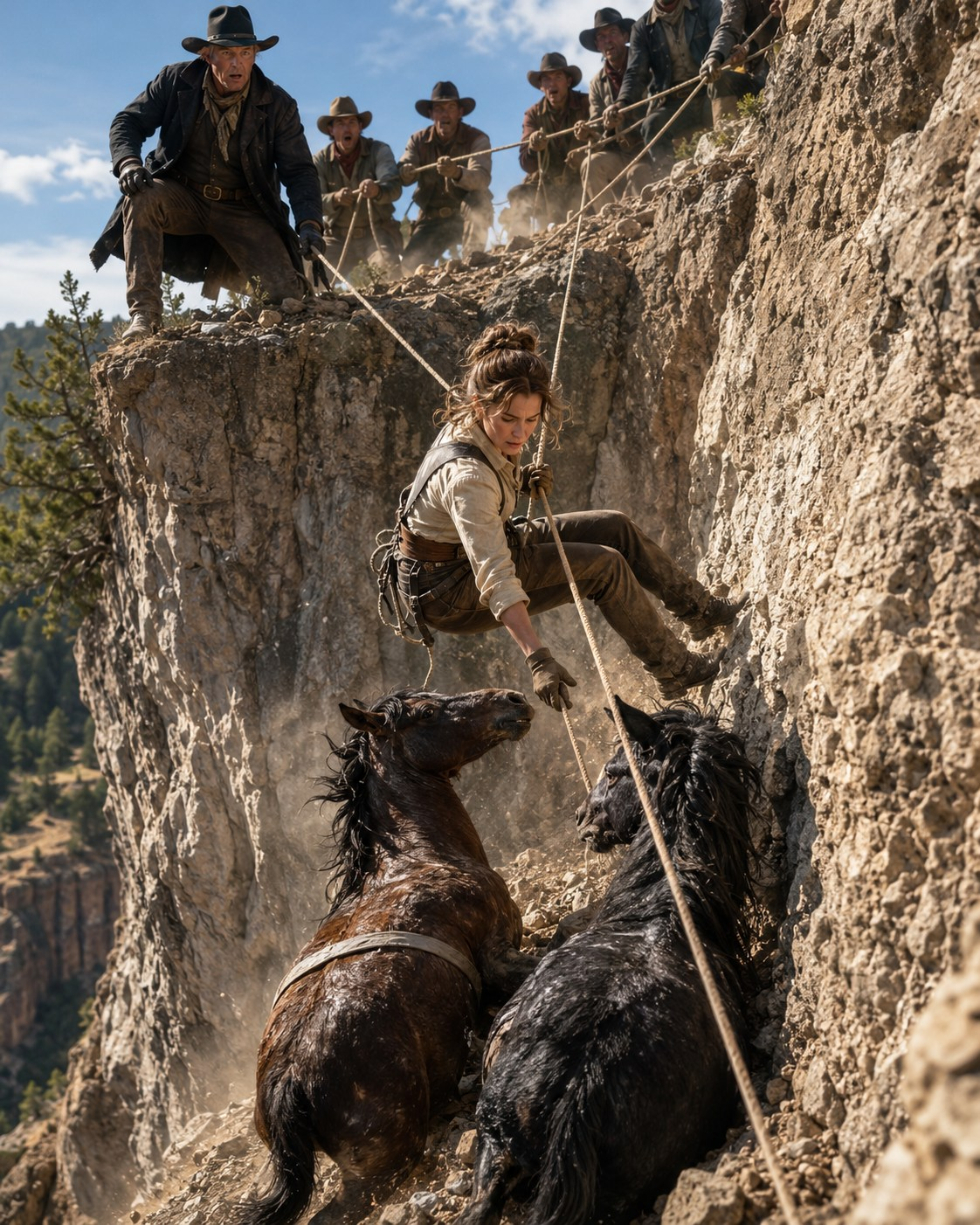
The rescued horses were moved away from the cliff.
Caleb led the black gelding toward a patch of level ground beside the junipers. Silas followed with the chestnut.
Both animals were exhausted.
The chestnut's injured leg needed attention, so one of the older cowboys prepared a temporary shelter using a canvas blanket and two saddle frames.
Hattie insisted on checking the bandage herself.
Thatcher initially objected.
"You've already done enough."
"That horse still needs care."
"So do you."
"I can sit down after I finish."
He looked at her injured shoulder.
Then at the horse.
Finally, he stepped aside.
"Five minutes."
"Ten."
"Seven."
Hattie gave him a brief look.
Thatcher shook his head.
"You're negotiating like you've been working cattle all your life."
"My father taught me that a fair bargain requires both sides to give something."
"Did he?"
"Yes."
She knelt beside the chestnut gelding.
The horse recognized her voice.
Its ears moved forward.
"Hello again, boy."
She examined the temporary bandage.
There was a little blood, but the bleeding had slowed.
She carefully loosened the cloth and inspected the wound.
The gelding shifted.
Hattie placed a hand against its neck.
"Easy."
She cleaned the area as best she could with the supplies available.
Then she applied a fresh cloth.
The horse lowered its head.
Hattie noticed the black gelding standing nearby.
It had not moved far from its companion.
She looked toward Caleb.
"Could you bring him closer?"
Caleb nodded.
He led the animal forward.
The two geldings touched noses.
The chestnut seemed to relax.
Hattie watched them for a moment.
Then she looked at the photograph again.
Copper.
Her father's old horse.
The one he had supposedly buried after a terrible accident.
Something about the image bothered her.
The horse looked healthy.
Strong.
And very much alive.
Thatcher found her sitting on a flat rock a few minutes later.
He carried two tin cups.
"Coffee."
Hattie accepted one.
"Thank you."
He sat several feet away.
For a while, neither spoke.
The cowboys continued working around the horses.
A gentle wind moved through the trees.
Thatcher looked at the photograph in her hand.
"Your father was named Mercer?"
"Daniel Mercer."
"Did he work around here?"
"Not that I know of."
"Where did you grow up?"
"Mostly in Ohio."
"Mostly?"
Hattie looked into her coffee.
"We moved around when I was young."
Thatcher nodded.
"Your father worked with horses?"
"Yes. He trained them, repaired tack, and sometimes helped ranchers with difficult animals."
"Sounds like a useful man."
"He was."
Her voice softened.
"He could recognize a frightened horse from across a field. He always said that most people only noticed an animal when it became difficult. He paid attention before that happened."
Thatcher smiled faintly.
"That explains a few things."
Hattie looked at him.
"What?"
"The way you approached those geldings."
She lowered her eyes.
"My father taught me to listen before touching."
Thatcher took a drink.
"Did he teach you the rope work too?"
"Yes."
"Where?"
"At a ranch outside Dayton. We stayed there for almost two years."
"Was that where Copper lived?"
Hattie looked at the photograph.
"I think so."
She paused.
"When I was about nine, my father brought Copper home. He was a beautiful animal. Dark chestnut, white mark on his forehead. He was the first horse I ever learned to ride."
Thatcher listened.
"He was gentle with me. My father trusted him more than any other horse."
"What happened?"
Hattie's fingers tightened around the cup.
"One winter, my father came home without him."
"Did he explain?"
"He said Copper had been injured badly. He said the horse didn't survive."
"Did you see the body?"
She shook her head.
"No."
Thatcher looked at her.
"That's strange."
"I know."
"Did your father bury him?"
"He said he did."
"Where?"
"Near the old ranch."
She looked at the photograph again.
"But he never took me there."
Thatcher leaned back.
"Maybe he didn't want you to see it."
"Maybe."
She seemed unconvinced.
Thatcher noticed.
"What's bothering you?"
Hattie turned the photograph over.
The message stared back at her.
Some debts are inherited.
"I don't think this is about the horse."
"What do you think it's about?"
"I don't know."
She looked toward the canyon.
"But I think Mr. Albright knows something my father never told me."
By midday, the cowboys had settled the horses.
The black gelding was drinking from a shallow wooden trough.
The chestnut stood beneath a canvas shade.
Thatcher had instructed Silas to find a veterinarian in the nearest settlement.
Silas prepared to leave.
"Anything else?"
"Tell the doctor we've got two injured animals."
Silas nodded.
Then he glanced toward Hattie.
"Tell him the woman who pulled them off that cliff wants him to hurry."
Hattie looked up.
"I didn't pull them off the cliff."
Silas grinned.
"Close enough."
He mounted his horse and rode away.
Caleb approached Thatcher.
"Boss, what about the herd?"
"Send the men ahead. We'll catch up when the horses are ready."
Caleb nodded.
He looked toward Hattie.
"You're welcome to ride with us."
Hattie seemed surprised.
"Where are you going?"
"Redemption Creek."
Her expression changed.
Thatcher noticed.
"Something wrong?"
She hesitated.
"That's where Mr. Albright lives."
"I know."
"I don't want to go back there."
Thatcher nodded.
"Then you won't."
The answer came so simply that Hattie looked at him for several seconds.
He continued.
"We have a ranch about twelve miles east of town. There's a bunkhouse, a stable, and a spare room in the main house. You can stay there until you decide what comes next."
Hattie looked down at her hands.
"I can't pay you."
"I didn't ask for money."
"I don't want charity."
"Neither do I."
He leaned forward.
"You saved two of our horses. One of them would almost certainly have died without you. You earned a place to rest."
Hattie looked toward the chestnut.
"I haven't finished helping them."
"Then come with us and finish."
She remained quiet.
Thatcher waited.
Finally, she nodded.
"All right."
He stood.
"Good. We'll get you a horse."
Before leaving the canyon, Hattie examined Copper's photograph again.
The paper was old.
Its edges were worn.
But the image itself was unusually clear.
She studied the background.
Behind the horse stood a wooden stable.
A narrow sign hung above the entrance.
Most of the letters were difficult to read.
She moved the photograph closer to the sunlight.
There.
The final letters were visible.
...CREEK STABLES.
Hattie frowned.
She had never heard of a stable with that name.
But something about the building seemed familiar.
A large wooden beam crossed the entrance.
A small bell hung beside the door.
And near the lower corner of the photograph was a strange mark.
Three small circles arranged in a triangle.
Her father had drawn that symbol many times.
She remembered seeing it on his old saddle.
On the underside of his toolbox.
Even on the back of the wooden box where he kept his photographs.
Hattie turned the picture over.
The date.
The message.
The symbol.
Her heart began beating faster.
"Thatcher."
He turned.
"What is it?"
"Do you recognize this mark?"
She showed him the photograph.
Thatcher examined it.
His expression changed.
"Where did you see that?"
"My father used to draw it."
Thatcher looked at the symbol again.
Then he glanced toward the canyon trail.
"I've seen it before."
Hattie stared at him.
"Where?"
He hesitated.
"On an old ranch ledger."
"What ledger?"
"One that belonged to my grandfather."
Hattie felt a chill move through her.
"Where is it now?"
"At my ranch."
She looked at the photograph.
Then at Thatcher.
"Can we go there?"
He nodded.
"Yes."
But his expression had become more serious.
"There's something else you should know."
Hattie waited.
"That mark belonged to a group of ranchers who operated in this territory before Redemption Creek became a town."
"What kind of group?"
Thatcher looked toward the horses.
"Men who shared land, horses, and money. They kept their records private."
"Why?"
"Because not everybody trusted the banks."
Hattie looked at the symbol.
"Was my father involved?"
Thatcher did not answer immediately.
"I don't know."
Then he added something that made her grip the photograph tighter.
"But if your father used that mark, he may have known my family."
The ride toward the ranch began shortly after noon.
Thatcher offered Hattie a dark bay mare.
She was calm, sturdy, and accustomed to long journeys.
Hattie checked the saddle before mounting.
Thatcher watched her.
"You've ridden before."
She glanced at him.
"Is that another question?"
"No. Just an observation."
She swung into the saddle.
The movement was effortless.
Thatcher mounted his black stallion.
The five cowboys gathered around them.
Silas rode at the front.
Caleb remained near the rescued geldings, which were being led carefully behind the group.
The ride was slow.
The animals needed time to recover.
Hattie kept the photograph inside her blouse, close to her chest.
She could not stop thinking about it.
Copper.
The stable.
The symbol.
Her father had kept so many secrets.
Why had he never told her?
She remembered the final winter of his life.
He had been ill for weeks.
His hands had trembled.
Sometimes he forgot where he had placed things.
But one evening, when Hattie was sitting beside his bed, he had reached for her wrist.
"Promise me something."
She had leaned closer.
"Anything."
"If you ever meet a man who tells you that you owe him your future, ask what he has hidden from your past."
At the time, she had thought he was speaking about marriage.
Now she wondered whether he had been warning her about something much older.
They stopped beside a creek to let the horses drink.
Thatcher dismounted and walked toward the water.
Hattie followed.
She removed her hat and wiped dust from her forehead.
The water was cold.
She cupped some in her hands and drank.
Thatcher stood nearby.
"How long did you know Albright before accepting his offer?"
"About four months."
"Did you meet him in person?"
"No."
"Only letters?"
"Yes."
"Did he ever mention your father?"
Hattie thought for a moment.
"Once."
Thatcher turned.
"What did he say?"
"He asked whether my father had ever worked in the western territories."
"And what did you tell him?"
"That I wasn't sure."
Thatcher frowned.
"Why didn't you know?"
"My father rarely spoke about his earlier years."
She sat on a nearby rock.
"He told stories about horses, ranches, and people he had worked for. But whenever I asked about certain places, he changed the subject."
"Did he ever mention Redemption Creek?"
Hattie shook her head.
"Not once."
Thatcher looked toward the creek.
"Albright may have known more about your family than you realize."
"That's what I'm beginning to think."
He crouched and picked up a small stone.
"Do you remember anything else from those letters?"
Hattie nodded.
"He said he had heard about my father's death."
Thatcher looked at her.
"How?"
"I never told him the exact date."
"Did you mention the town?"
"No."
Thatcher became still.
"Then how did he know?"
Hattie looked at him.
"I don't know."
A silence settled between them.
The creek continued flowing over the rocks.
Then Hattie remembered something.
"There was one more thing."
"What?"
"His first letter mentioned a photograph."
Thatcher waited.
"He said he had seen a picture of me when I was younger."
"Where?"
"He didn't say."
"Did you send him one?"
"No."
Thatcher slowly stood.
"Then someone else must have."
Hattie looked toward the riders.
For the first time, she felt certain that her arrival in Redemption Creek had not been an accident.
The ranch appeared on the horizon late that afternoon.
It was larger than Hattie expected.
Several wooden buildings stood around a broad open yard. A long barn occupied the western side, while the main house stood slightly elevated above the surrounding pasture.
Horses grazed beyond the fences.
Men worked near the stable.
Smoke rose from a kitchen chimney.
It was a working ranch.
Not a showpiece.
Hattie felt something loosen inside her chest.
For the first time since leaving Ohio, she was somewhere that reminded her of the life her father had described.
Thatcher rode ahead.
A young ranch hand approached.
"Boss!"
"How are the cattle?"
"All settled."
"And the far pasture?"
"Fence needs repairing."
Thatcher nodded.
"We'll deal with it tomorrow."
The ranch hand looked at Hattie.
Then at the two rescued geldings.
"Those the horses from the canyon?"
"Yes."
"Both made it?"
"Both."
The young man whistled.
"That's something."
Thatcher glanced toward Hattie.
"She brought them up."
The ranch hand looked surprised.
"She did?"
Hattie dismounted.
"With help."
Thatcher shook his head.
"Don't start giving away credit."
For a moment, the ranch seemed almost welcoming.
Then Thatcher's expression changed.
He looked toward the main house.
A woman stood on the porch.
She was in her early fifties, wearing a cream-colored dress and a dark shawl.
Her silver hair was pinned neatly behind her head.
She held a folded letter.
When Thatcher approached, she stepped forward.
"You're late."
"Had trouble with the horses."
Her eyes moved toward Hattie.
"Who's this?"
"Hattie Mercer."
The woman studied her.
Then her gaze dropped toward the photograph Hattie had just taken from her blouse.
She stopped moving.
Thatcher noticed.
"What is it, Margaret?"
The woman did not answer.
She stared at the picture.
Her lips parted.
Then she looked directly at Hattie.
"Where did you get that?"
Hattie held the photograph more tightly.
"It was given to me today."
Margaret stepped down from the porch.
"Who gave it to you?"
"Mr. Albright."
The woman's face lost its color.
Thatcher moved closer.
"Margaret?"
She ignored him.
Instead, she reached toward the photograph.
"May I?"
Hattie handed it over.
Margaret examined the front.
Then the back.
Her fingers began trembling.
"Good Lord."
Thatcher looked at her.
"What?"
Margaret raised her eyes.
"Where did you say this girl was from?"
"Ohio," Thatcher answered.
Margaret shook her head.
"No."
She looked at Hattie.
"Where did your father live before Ohio?"
Hattie hesitated.
"I don't know."
Margaret closed her eyes.
For several seconds, she seemed unable to speak.
Then she turned toward Thatcher.
"You need to bring out your grandfather's ledger."
Thatcher frowned.
"Why?"
"Because this photograph belongs to something that should have been buried years ago."
Hattie stepped forward.
"What does that mean?"
Margaret looked at her.
"Your father wasn't just a horse trainer, child."
Hattie's heart began pounding.
"What was he?"
Margaret looked toward the old barn.
Then toward the house.
Finally, she spoke.
"Daniel Mercer was the last man who knew where the missing ranch money went."
Thatcher went completely still.
He looked at Hattie.
Then at the photograph.
And suddenly, the symbol on its back made sense.
But before he could ask another question, Margaret reached inside her shawl and removed a second photograph.
It showed a much younger Daniel Mercer.
Standing beside Thatcher's grandfather.
And between the two men was a third person.
A man wearing Mr. Albright's unmistakable silver pocket watch.
Margaret placed the photograph in Hattie's hand.
Then she whispered:
"Your father didn't disappear from this country, Hattie. He was driven out."
She turned toward the main house.
"Thatcher, lock the front gate."
"Why?"
Margaret looked toward the road.
Because a cloud of dust was rising beyond the pasture.
A rider was approaching the ranch.
And this time, he wasn't carrying a letter.
He was leading a second horse.
A horse with a familiar white mark across its forehead.
Copper was alive.






Comments 0