I stared at the handwritten instruction.
It was dated three days before my mother called me.
The paper contained a short note addressed to Evelyn.
Remove the old receipts from the filing cabinet. We don't need unnecessary questions during the restructuring.
At the bottom was Caleb's signature.
I recognized it immediately.
He had always signed his name with an exaggerated capital C, followed by a long underline.
I looked at Evelyn.
"Did you destroy them?"
"No."
"Where are they?"
She glanced toward the other customers.
"Some are still in my possession. Others are in the original accounting files."
"Why didn't you tell my father?"
"I tried."
She lowered her eyes.
"Your father told me to follow Caleb's instructions. He said your brother was responsible for the financial side of the business and that I shouldn't interfere."
I leaned back.
For a moment, I couldn't find the right words.
My father had built the company from almost nothing. He had spent decades working with his hands, serving customers, and earning the trust of local contractors.
I remembered him coming home with sawdust on his clothes.
I remembered him teaching us how to identify solid oak and explaining why cheap materials could ruin an otherwise beautiful cabinet.
I had always believed he was proud of what he created.
Now I was beginning to wonder whether he understood what was happening inside it.
"How much money are we talking about?" I asked.
Evelyn opened a small notebook.
"I haven't calculated everything. I don't have access to all the accounts anymore."
"Why not?"
"Caleb changed the permissions."
"When?"
"About six months ago."
I looked at the notebook.
She had written down dates, amounts, and transaction descriptions.
The entries were organized by month.
There were payments for restaurants, hotel stays, vehicle expenses, and purchases that didn't appear to be related to the cabinet business.
"Did you question these transactions?"
"Several times."
"What did Caleb say?"
"He said they were client development expenses."
"Did you see any client names?"
"No."
"Receipts?"
"Not for most of them."
I took a breath.
"Did you speak to the accountant?"
She shook her head.
"Your father dismissed the previous accountant last year. Caleb brought in someone else."
"Who?"
"An outside bookkeeping service. I've never met the person who actually reviews the accounts."
I looked at the notebook again.
There was a payment for $1,275 at a restaurant.
Another for $2,430 at a hotel.
A vehicle payment for $1,860.
I wasn't qualified to determine whether any of these expenses were improper merely from their descriptions.
A restaurant bill could be legitimate.
A hotel stay could be related to a business trip.
A vehicle payment could be connected to a company vehicle.
But there was a pattern of missing documentation.
That was enough to justify asking questions.
"Why are you telling me?" I asked.
Evelyn's expression softened.
"Because I remember you."
I frowned.
"What do you mean?"
"You used to come into the office when you were little. Your grandfather would give you little jobs to do. You always wanted to know where everything belonged."
I smiled faintly.
"I remember."
"Your brother would run around the workshop. Your father would tell him to slow down. You would sit with the invoices and sort them."
She paused.
"Your grandfather used to say you were the one who would notice when something was missing."
I looked down at my coffee.
It was strange how a sentence from someone who had known me as a child could affect me more than anything my parents had said in years.
"Did my grandfather ever discuss the company finances with you?"
"Not in detail. But he trusted records. He wanted every payment documented."
She tapped the notebook.
"That's why I kept asking for the receipts."
I nodded.
"Do you have copies of everything?"
"Not everything. But enough to establish a timeline."
I took out my phone.
"Can you send me the documents you are legally permitted to share?"
"Yes."
"Don't remove anything from the company's records without permission. Don't alter anything. And don't confront Caleb."
She looked relieved.
"I was hoping you'd say that."
I hesitated.
"Have you spoken to anyone else?"
"One supplier contacted me last week. He said the company had missed several payments."
"Which supplier?"
"Oak Ridge Lumber."
I knew the name.
They had supplied materials to my father for years.
"How far behind?"
"I don't know the exact balance. But I heard the owner was considering legal action."
I looked out the window.
The street was busy.
People were walking into shops, carrying coffee, and going about their ordinary lives.
Meanwhile, the business my grandfather had helped build was apparently facing a crisis nobody wanted to discuss openly.
"Does my father know about the overdue invoices?"
"I believe he knows some of them. I don't think he knows the full amount."
"And Caleb?"
Evelyn looked directly at me.
"Caleb knows."
I sat quietly.
That was the first thing I couldn't explain away as poor organization.
If Caleb knew about overdue supplier invoices, missing receipts, and unusual company expenses, why was he asking me for money without showing me the records?
I had no answer.
When we finished breakfast, Evelyn handed me a business card.
It belonged to a local attorney named Nora Whitfield.
"She helped a friend of mine with a business dispute," Evelyn explained. "She understands financial records and company agreements."
I turned the card over.
"Have you already spoken to her?"
"No. I didn't want to do anything without knowing whether you were willing to look into this."
I put the card in my wallet.
"Thank you."
Evelyn reached across the table.
"Claire, I need you to understand something. I don't want your father to lose his business."
"Neither do I."
"I've worked there for twenty-three years. It's more than a job to me."
I understood.
The company had supported several families in the community. People depended on it.
I didn't want to see it collapse.
But I also wasn't going to let anyone use my savings to hide problems that needed to be addressed.
I returned to the hotel and called Nora Whitfield.
Her receptionist offered an appointment for the following afternoon.
I accepted.
Then I spent several hours reviewing the documents Evelyn had sent.
I created a simple spreadsheet.
Date.
Vendor.
Amount.
Description.
Available documentation.
Unresolved questions.
I didn't draw conclusions.
I simply organized what we knew.
By the time I finished, I had identified seventeen transactions that required additional documentation.
The total was not a measure of wrongdoing.
It was simply the amount of money represented by expenses that Evelyn had been unable to verify.
I saved the spreadsheet.
Then I received a message from my mother.
Your father wants you to come home for dinner tonight. Please don't make things worse.
I read it twice.
I typed a response.
I'll come, but I'm not promising any money.
She replied almost immediately.
We are family, Claire.
I put the phone down.
That sentence had followed me throughout my life.
Family meant attending Caleb's celebrations.
Family meant understanding when Dad was angry.
Family meant forgiving Mom for forgetting.
Family meant being flexible when I was the one who had been overlooked.
But somehow, family never seemed to mean giving me the same consideration.
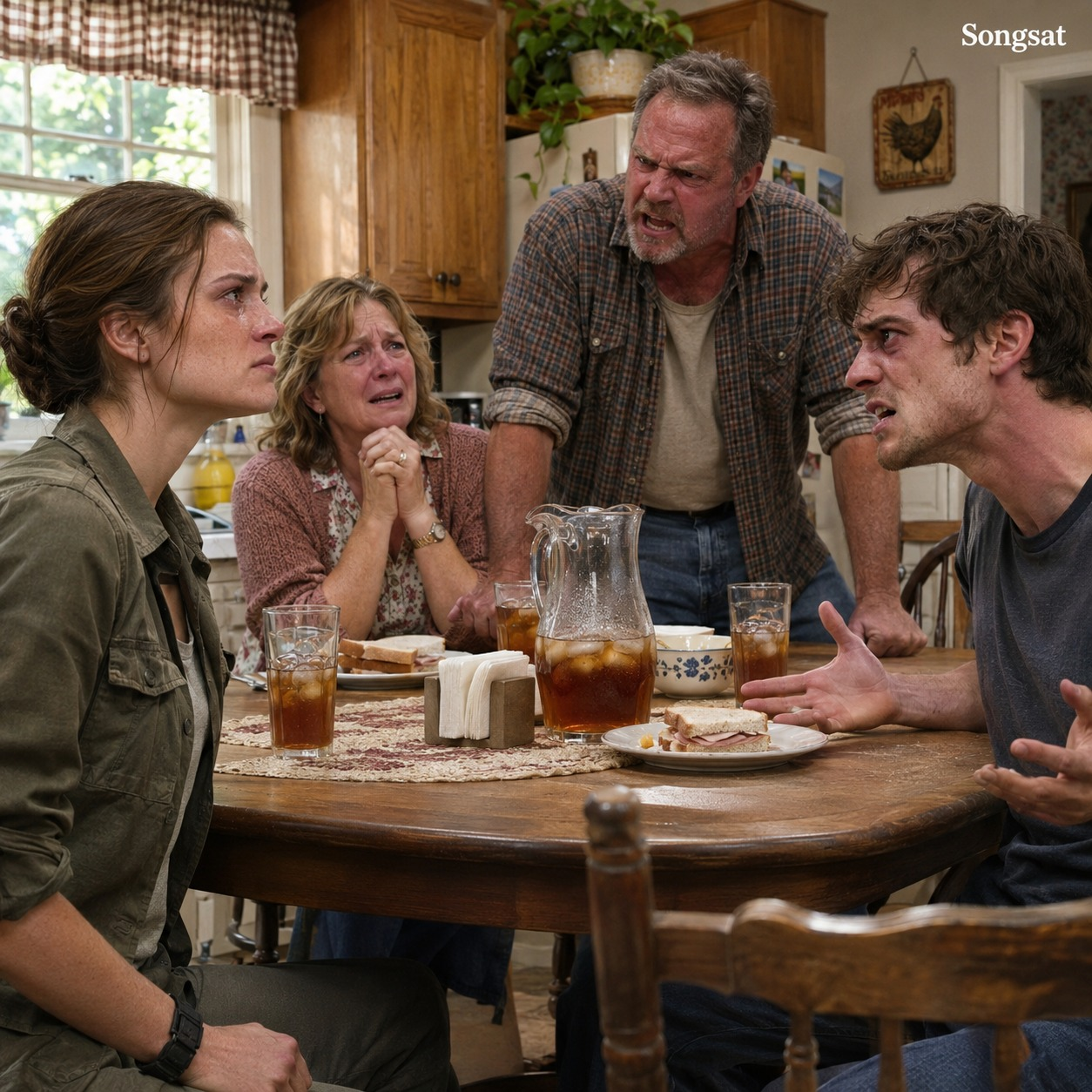
I drove to my parents' house at six.
Caleb's truck was parked outside.
The lights were on in the kitchen.
When I entered, my mother was carrying plates to the dining table.
Dad sat near the window.
Caleb stood beside the counter, holding his phone.
"You're late," he said.
"It's six."
"We've been waiting."
I looked at the table.
There were four plates.
No documents.
No financial statements.
Just dinner.
My mother gave me a nervous smile.
"I made your favorite."
I sat down.
For a few minutes, we talked about ordinary things.
My unit.
The drive home.
The hotel.
My father's recent back pain.
Caleb asked whether I was planning to stay long.
"I don't know yet."
"Your leave isn't unlimited."
"No."
He nodded.
Then he looked at Dad.
The exchange was brief.
But I noticed it.
My father cleared his throat.
"Your brother and I have been discussing the financing."
I put down my fork.
"Okay."
"We believe thirty-five thousand would give us enough room to catch up on some payments."
"How much are the overdue supplier invoices?"
Caleb sighed.
"Can we not do this again?"
"How much?"
"About eighty thousand."
My father looked at him.
I turned toward Caleb.
"Is that included in the $280,000?"
"Obviously."
"Then what does the rest consist of?"
"Operating expenses."
"Which ones?"
He put down his fork.
"Why does everything have to become an interrogation?"
"Because you're asking me to contribute money."
Dad leaned forward.
"Claire, the business is in trouble. We need solutions, not criticism."
"An accurate financial picture is the beginning of a solution."
Caleb shook his head.
"You're treating this like some military inspection."
I looked at him.
"It's a financial decision. The principles are the same. Records should match reality."
He laughed.
"You really think you're going to come in here and tell us how to run the company?"
"No."
"Then what do you want?"
"To know where my money would go."
My mother placed her napkin on the table.
"Please. I don't want another argument."
I looked at her.
"Then nobody should ask me for money they can't explain."
Dad pushed his chair back slightly.
"We've done everything for this family."
I looked at the photographs on the refrigerator.
There were pictures of Caleb receiving his scholarship.
Caleb at his first job.
Caleb standing beside Dad at the workshop.
There was one photograph of both of us as children.
It was small.
I wondered when it had been taken.
"Did you ever tell Caleb about the graduation mistake?" I asked.
My mother looked confused.
"What?"
"At Hickory High. When the assistant principal called his name again when I crossed the stage."
Caleb frowned.
"Seriously? We're talking about that now?"
"I asked a question."
Mom looked uncomfortable.
"That was ten years ago."
"Yes."
"It was an honest mistake."
"I know."
She glanced toward Dad.
"Why are you bringing this up?"
I looked around the table.
"Because I want to understand why everyone expects me to keep accepting things that would never be acceptable if they happened to Caleb."
Dad's expression hardened.
"Your brother is trying to save the company."
"And I'm trying to understand what he's asking me to save."
Caleb stood.
"Forget it."
He walked toward the kitchen.
My father followed him with his eyes.
Then he turned back to me.
"You're making your mother miserable."
I took a slow breath.
"I didn't create the debt."
Nobody answered.
I finished dinner without another argument.
When I stood to leave, my mother followed me to the front door.
"Claire, please don't give up on us."
I looked at her.
"I'm not giving up on anyone. But I won't agree to something I don't understand."
She nodded, though I wasn't sure she believed me.
I drove back to the hotel.
At 9:17 p.m., Nora Whitfield called.
"Claire, I received the documents you forwarded."
I sat down.
"What do you think?"
"I think you need to be very careful."
"Why?"
"Because one of the documents Evelyn provided contains a reference to a financing arrangement that may involve your name."
I looked at my phone.
"What kind of arrangement?"
"An expected family contribution."
My stomach tightened.
"I never agreed to that."
"I understand. But there's something else."
She paused.
"Do you recognize the date on the proposal?"
I opened the photograph.
The document showed a date from the previous week.
"Yes."
"Claire, that proposal was submitted before you even arrived home."
I stared at the screen.
"Who submitted it?"
Nora's voice became more serious.
"Your brother."
Then she said something that made me reach for the folder on the hotel desk.
"He didn't just list your name as a possible source of funds. He represented your contribution as part of the financing plan."
I looked at the document again.
The amount was there.
My name was there.
And beside it was a date showing when the money was expected to arrive.
June 1.
Nora continued.
"Claire, I need you to check whether there is a second page attached to that proposal, because the document I received references an additional authorization..."






Comments 0