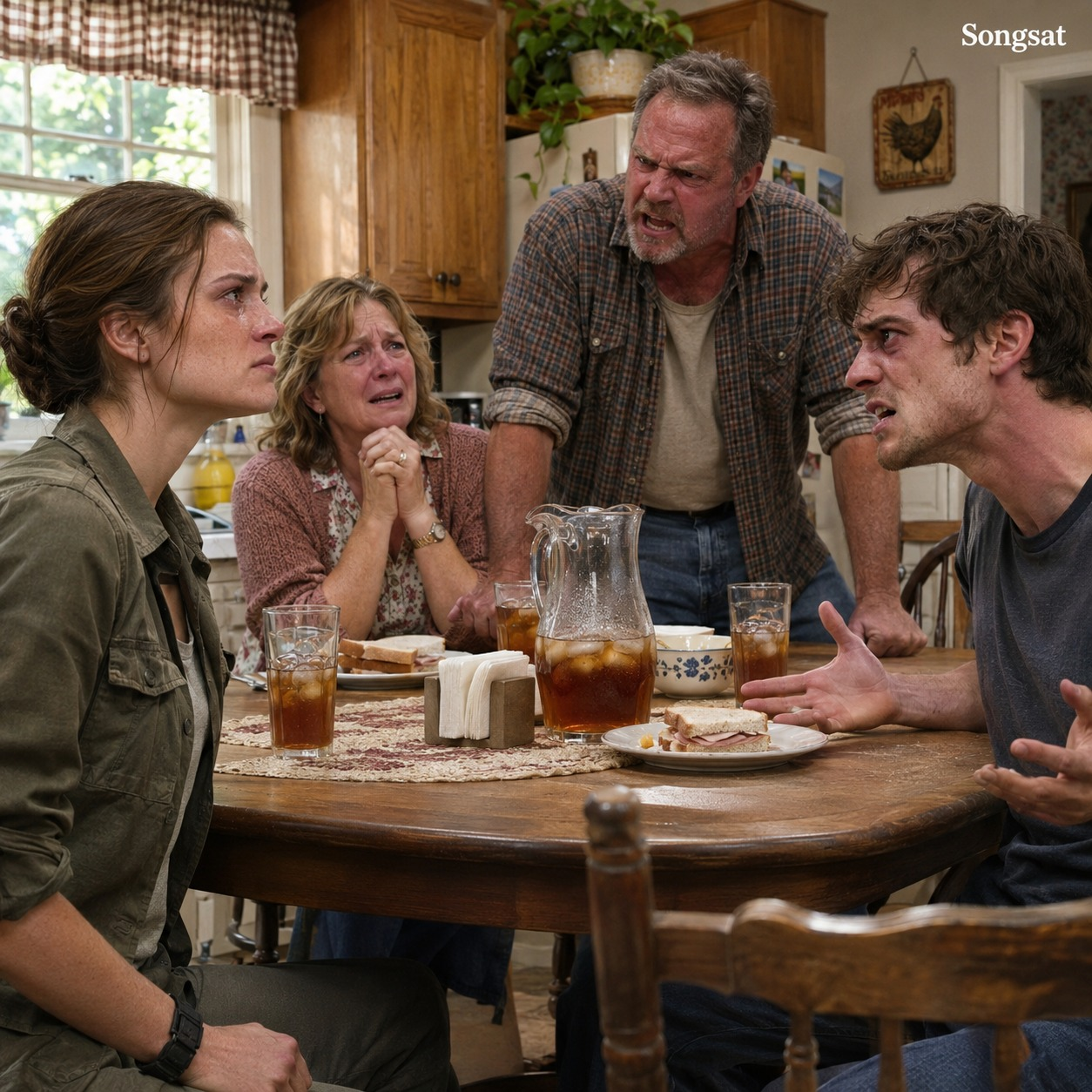
Caleb slammed the financing proposal onto the dining table.
"You're going to help us, Claire, whether you like it or not."
My father stood behind him, gripping the back of a wooden chair.
My mother stopped moving.
I looked down at the document.
My name was printed beside a promise I had never made.
Claire Bennett — Expected Family Capital Contribution: $35,000.
I slowly turned the page.
And for the first time since I had returned home, I realized this wasn't simply a family asking for help.
They had already started spending my money.
I was twenty-eight years old, and I had spent almost ten years learning that a person's signature could be worth more than their promises.
As a Staff Sergeant in the United States Army, I managed equipment inventories, supply records, purchase requests, and accountability reports. My job required me to notice discrepancies before they became expensive problems.
A missing serial number mattered.
An unexplained expense mattered.
A signature without authorization mattered even more.
Apparently, those lessons were about to become useful at my parents' dining table.
"Where did you get this?" I asked.
Caleb leaned back.
"It's part of the restructuring proposal."
"That wasn't my question."
My father exhaled sharply.
"Claire, don't start."
I looked at him.
"Someone put my name on a financial document. I'm asking who."
My twin brother rolled his eyes.
"You're acting like we're criminals."
"I'm asking a simple question."
"You're always asking questions."
He said it as if that were a character flaw.
I had heard that tone before.
Ten years earlier, when we were eighteen, my questions had been ignored because Caleb's achievements were considered more important. His decisions were celebrated. His mistakes were explained away. My accomplishments were acknowledged only when there was nothing else happening.
Apparently, nothing had changed.
My mother sat between us, her hands clasped tightly.
"Can we please have one peaceful conversation?"
I glanced at the document again.
"Mom, this isn't a conversation about what we're having for dinner. It's a financing proposal."
"Your brother is under tremendous pressure."
"I understand that."
"Then help him."
I looked at Caleb.
"What's the repayment schedule?"
He laughed.
"Here we go."
"What's the interest rate?"
"Claire."
"What's the company's current monthly revenue?"
My father slapped his palm against the table.
"Enough!"
The glass pitcher of iced tea rattled.
My mother flinched.
Caleb gave Dad a grateful glance, as if someone had finally stepped in to silence an unreasonable employee.
I didn't move.
I had spent years in situations where people became louder when they didn't have answers. Raising their voices never changed the numbers.
I picked up the proposal.
There were twelve pages.
The first contained a summary of the cabinet business's financial position. The second listed expected family contributions. The third described a proposed restructuring arrangement.
I turned back to the second page.
My name appeared again.
This time, beneath it, someone had written an anticipated availability date.
June 1.
I had never discussed June 1 with anyone.
I hadn't promised money.
I hadn't agreed to a loan.
I hadn't authorized anyone to use my name.
"Who submitted this?" I asked.
Caleb shrugged.
"The lender wanted to see where the family stood."
"Did you tell them I was contributing thirty-five thousand dollars?"
"We're still working out the details."
"That's not an answer."
"You're making this into something it isn't."
I placed the paper flat on the table.
"Did you tell them I agreed?"
His expression tightened.
My father stepped closer.
"Your brother has been keeping this business alive. You have no idea what he's dealing with."
I almost laughed.
Not because anything was funny.
Because the irony was becoming difficult to ignore.
I had spent almost a decade maintaining accountability records for equipment worth far more than this business. I knew how to trace an order, verify a receipt, reconcile a missing item, and determine who had approved a transaction.
But according to my father, I had no idea how business worked.
"Then show me the current financial statements," I said.
Caleb shook his head.
"We've already gone over this."
"No, you haven't."
"Claire, I don't have time to sit here and explain every little thing to you."
"Then we can have the accountant explain it."
He pushed his chair backward.
"You're impossible."
I looked at him.
"Thirty-five thousand dollars is not a little thing."
My mother reached for her glass.
Her fingers trembled slightly.
"Sweetheart, your father has worked his whole life for that business."
"I know."
"And Caleb has sacrificed so much to keep it going."
"I know that, too."
"Then why can't you just help?"
I looked at her for a long moment.
Because there was something she still didn't understand.
I hadn't come home intending to fight.
When she called me three days earlier, her voice had sounded frightened. She said Dad was under terrible stress. She said the business was struggling. She said the family needed me.
I had imagined a medical emergency.
I had imagined hospital rooms, difficult conversations, and the possibility that my father might not have much time left.
I had requested leave from my unit, packed a small bag, and driven home.
Instead, I had found a financial crisis waiting at the dining table.
And apparently, my family had already decided what my role would be.
I would provide the money.
Caleb would retain control.
My parents would call it family.
Nobody would ask whether I wanted any part of it.
"What's the business worth?" I asked.
Caleb stared at me.
"What?"
"The company. What's its current valuation?"
"We're not selling."
"I didn't ask whether you were selling."
Dad rubbed his forehead.
"Claire, you don't need to understand every detail."
I looked at him.
"Then why do you need my money?"
Nobody answered.
For several seconds, the only sound was the refrigerator humming behind us.
I returned to the first page.
The business name was printed in bold letters: Bennett Custom Cabinetry.
It had been my grandfather's workshop before Dad expanded it into a proper commercial operation.
I remembered visiting as a child.
The smell of cut wood.
The sound of machinery.
My grandfather teaching Caleb and me how to identify different types of timber.
He had never treated us differently.
When I broke a small wooden handle, he showed me how to repair it.
When Caleb damaged a cabinet door, Grandpa showed him the same thing.
He used to say that a good piece of furniture depended on accurate measurements.
"Measure twice," he would tell us. "Cut once."
I wondered what he would have thought about the way the business was being managed now.
"Are the suppliers being paid?" I asked.
Dad looked away.
Caleb answered.
"We're handling it."
"How far behind are you?"
"That's private."
I stared at him.
"You're asking me to contribute thirty-five thousand dollars. It's no longer private."
He leaned forward.
"Do you know what the problem is with you?"
I waited.
"You've been gone so long that you think you're better than everyone here."
I lowered the document.
"That's not true."
"You come home wearing that uniform, talking about paperwork and procedures, acting like you're some kind of expert."
"I never said I was."
"Then stop pretending you know how to run a business."
My father nodded.
"Caleb has been here every day. He's the one doing the work."
I looked at my brother.
He was wearing a burgundy shirt with the sleeves rolled up. His hair was slightly messy, and his face looked tired.
For a moment, I felt sorry for him.
He had inherited something that mattered to our family, and now he was struggling to keep it alive.
But sympathy wasn't the same as financial consent.
I closed the proposal.
"I'm not giving you thirty-five thousand dollars today."
Caleb's face changed.
"You're serious?"
"Yes."
"You'd rather watch the business collapse?"
"I'd rather understand what I'm being asked to finance."
Dad stepped away from the chair.
"Your grandfather would be ashamed of you."
That one hurt.
I hadn't expected it to.
My grandfather had been the only person in the family who seemed genuinely interested in what I wanted to become.
He had attended my school events when my parents were busy with Caleb.
He had called me after I enlisted.
He had told me that leaving home didn't mean I had abandoned my family.
I looked at Dad.
"Don't use Grandpa to make me feel guilty."
His face reddened.
"Get out."
My mother immediately looked up.
"Robert!"
"She heard me."
I stood.
I gathered my folder, placed the financing proposal back on the table, and picked up my bag.
Caleb shook his head.
"I knew you would do this."
I didn't respond.
My father followed me toward the kitchen doorway.
"You think that military paycheck makes you independent?"
I stopped.
"No. I think working for ten years and saving my own money makes me independent."
Then I walked out.
Nobody followed.
Not my mother.
Not my father.
Not Caleb.
The same silence.
The same empty space behind me.
Ten years earlier, I had walked away from my high school graduation while my family celebrated my twin brother.
Now I was walking away from the dining table while they celebrated the idea that I would eventually surrender.
I reached my car and sat behind the steering wheel.
For several minutes, I didn't start the engine.
My phone vibrated.
A message from an unfamiliar number appeared.
I almost ignored it.
Then I noticed the name attached to the contact information.
Evelyn Brooks.
She had worked at my father's cabinet shop for more than twenty years. I remembered her from childhood. She had been the person who kept the office organized and knew where every invoice was filed.
Her message was short.
Claire, I heard you were home. We need to talk about the business.
I typed a response.
Is something wrong?
The reply arrived almost immediately.
There are things happening in the accounts that your parents don't know about.
I stared at the screen.
Then another message appeared.
And Caleb absolutely does not want you looking into them.
I read it twice.
My hands remained still on the steering wheel.
I had come home believing my family needed financial help.
Now someone who had worked alongside my father for two decades was telling me that the real problem might be something entirely different.
I started the engine.
Before I could pull away, Evelyn sent one final message.
Please meet me tomorrow morning. Bring someone you trust. I think you need to see what I found.
And beneath it was a photograph of a company expense report with one transaction circled in red...






Comments 0