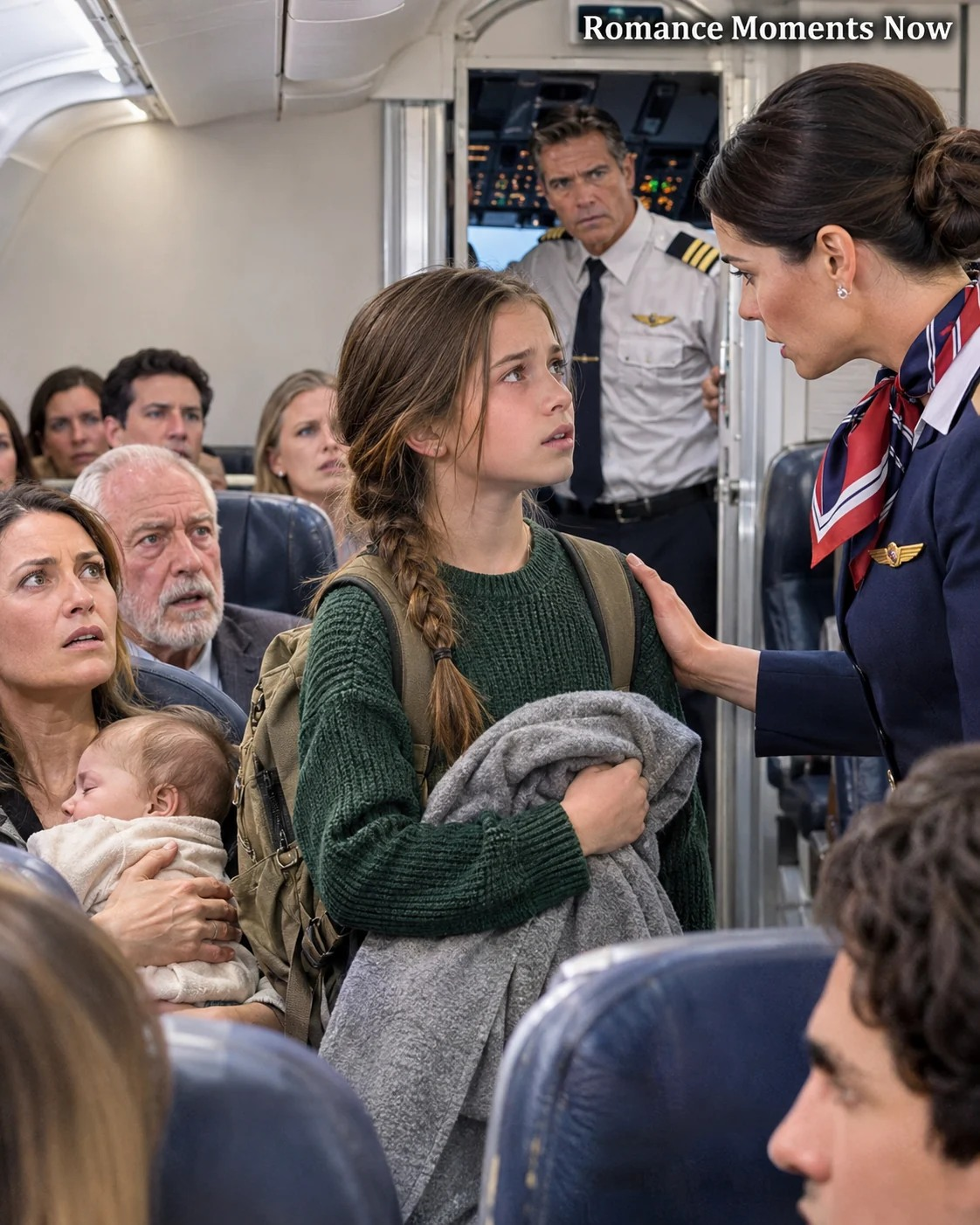
A twelve-year-old girl stood frozen in the aisle of a passenger airplane, clutching a gray blanket.
"Please tell me there's a fighter pilot on this plane!"
The captain's desperate announcement had just sent nearly three hundred passengers into panic.
But the little girl in seat 8A knew something nobody else did.
Her father had taught her to recognize the warning that was now flashing inside the cockpit.
And she had just heard the voice that was supposed to be dead.
My name is Brooke Hartley, and I was twelve years old when Flight 728 disappeared from the ordinary world and became the reason I would never look at an airplane the same way again.
I remember the seat number because I repeated it to myself several times before boarding.
Eight A.
Window seat.
A little space to myself.
A long flight from New York to Madrid.
And, most importantly, nobody sitting beside me who might ask why a twelve-year-old girl was traveling across the Atlantic without her parents.
My mother had arranged everything.
She had spoken to the airline, completed the paperwork, attached the identification documents, and made sure a flight attendant knew I was an unaccompanied minor.
She had also called me four times before I boarded.
The last call had come while I was standing near the gate.
"Remember what we discussed, Brooke."
"I know, Mom."
"Keep your phone charged. Don't leave your backpack unattended. And if you need anything, tell the flight attendant."
"I know."
There had been a pause.
Then she said something that made me look away from the crowded terminal.
"And please, sweetheart, don't let yourself get upset if somebody mentions your father."
I tightened my grip on my phone.
"I won't."
It was a promise I wasn't sure I could keep.
My father had been dead for three years.
At least, that was what I had been told.
His name was Captain Nathan Hartley, United States Air Force.
He had flown F-16 fighter jets and spent most of his adult life training for situations that ordinary people never wanted to imagine.
He had been the kind of man who checked the weather before taking a family road trip, explained the difference between turbulence and an actual emergency, and could identify aircraft by their silhouettes.
He had also been the kind of father who never allowed me to believe that being afraid meant being helpless.
When I was younger, he used to sit me on his lap in front of a flight simulator.
He would place his hands over mine and show me how the controls worked.
"Never panic because an alarm makes noise," he used to say. "First, understand what the alarm is telling you."
I had loved those evenings.
The simulator was set up in a small room at the back of our house. There were aviation manuals stacked beside the desk, photographs of aircraft on the walls, and a battered coffee mug that said THE SKY IS NOT THE LIMIT.
My father had bought it at an air show.
He claimed it made him a better pilot.
I thought it was funny.
Then, one afternoon, everything changed.
An official came to our front door.
My mother answered it.
I remembered standing halfway down the stairs, holding a stuffed rabbit, while she listened to a man in a dark uniform.
I remembered her hand covering her mouth.
I remembered the rabbit falling.
And I remembered the words.
"Your husband was lost during a classified training operation."
There had been no funeral with an open casket.
No final goodbye.
Only a folded flag, a photograph, and an explanation that left more questions than answers.
After that, my mother stopped entering the simulator room.
Eventually, she locked it.
I stopped asking about my father because every question seemed to hurt her.
But I never stopped remembering what he taught me.
Three years later, those memories were all I had left.
And that was why I had chosen the window seat.
I wanted to look outside.
I wanted the ocean beneath me.
I wanted to feel close to something my father had loved.
For the first two hours, the flight was ordinary.
The cabin lights were dimmed.
Passengers watched movies or slept.
A baby cried briefly near the front before settling against its mother's chest.
A flight attendant pushed a beverage cart down the aisle.
I declined dinner, asked for water, and opened the book my mother had packed.
I didn't read a single page.
Instead, I watched the darkness outside the window.
The wing light blinked at regular intervals.
White.
Darkness.
White.
I counted the flashes without realizing I was doing it.
Then I leaned my head against the window and closed my eyes.
I must have slept for twenty minutes.
Perhaps thirty.
I woke when the aircraft speakers clicked.
At first, I thought the captain was making an ordinary announcement.
Then I heard his voice.
"Ladies and gentlemen, may I have your attention, please?"
It sounded different from the cheerful voice that had welcomed us aboard.
There was a strain beneath the words.
A tightness that made me open my eyes.
"We are currently experiencing a serious technical issue. Our flight crew is working through the appropriate procedures."
The cabin became quieter.
I sat upright.
The captain continued.
"If anyone aboard has experience as a military fighter pilot, we ask that you identify yourself to a member of the cabin crew immediately."
For several seconds, nobody moved.
Then a man near the middle of the cabin laughed nervously.
"Did he just say fighter pilot?"
His wife grabbed his arm.
The woman across the aisle stopped adjusting her baby's blanket.
An elderly man in a brown jacket looked toward the cockpit.
I stared at the seat in front of me.
A commercial airplane had almost three hundred people aboard.
A trained flight crew.
Modern navigation equipment.
Multiple systems designed to handle emergencies.
Why would the captain need a fighter pilot?
My stomach tightened.
I remembered my father's voice.
First, understand what the alarm is telling you.
A flight attendant hurried down the aisle.
She was in her late thirties, with dark blonde hair pinned neatly behind her head. Her charcoal-blue uniform looked immaculate, but her face did not.
She was frightened.
Not dramatically frightened.
Not the kind of fear people showed in movies.
It was something smaller.
The tightness around her mouth.
The way her eyes moved quickly from one passenger to another.
The way she kept one hand against the seatbacks as she walked.
"Does anyone have military aviation experience?" she asked.
A man raised his hand.
"I work in airport operations."
She shook her head politely.
"Thank you, sir. We specifically need military fighter-pilot experience."
Another passenger spoke.
"My brother flies helicopters."
"Thank you."
She moved farther down the aisle.
Nobody answered.
Then she reached my row.
I was still holding the gray blanket.
I looked at her.
She looked at me.
And before I could stop myself, I spoke.
"My dad flew fighter jets."
She leaned closer.
"I'm sorry, sweetheart?"
"My father was an F-16 pilot."
The woman stopped.
For a moment, she seemed unsure whether she had heard me correctly.
"Your father?"
I nodded.
"He was in the Air Force."
The elderly man beside the aisle turned toward me.
"How old are you, young lady?"
"Twelve."
He gave the flight attendant a look.
It wasn't cruel.
But it was dismissive.
The expression adults sometimes wore when a child said something they considered impossible.
The flight attendant crouched slightly.
"What's your name?"
"Brooke."
"Brooke, do you know whether your father is currently serving?"
I lowered my eyes.
"No. He died three years ago."
Her expression softened.
"I'm sorry."
I nodded.
For a moment, I thought the conversation was over.
Then I remembered the simulator.
The warning lights.
The lessons.
The emergency checklists.
I looked up again.
"But he taught me about aircraft systems."
The elderly man made a quiet sound.
"She's just a child."
I felt my cheeks grow warm.
The flight attendant didn't respond to him.
Instead, she asked me another question.
"What exactly did he teach you?"
I hesitated.
"I know some of the warning systems. I know how to recognize certain flight-control problems."
"Did he teach you how to fly an aircraft?"
"No."
I answered immediately.
"I can't fly this plane. I'm not a pilot."
That seemed to surprise her.
I continued.
"But I know how he explained the emergency procedures. He used to make me memorize the difference between certain warning sequences."
She studied my face.
"Can you give me an example?"
I looked toward the front of the aircraft.
"Was there a warning about the flight controls?"
Her expression changed.
It was subtle.
But I saw it.
She glanced toward the cockpit.
Then she looked back at me.
"Why would you ask that?"
"Because of what the captain said."
I lowered my voice.
"My father once explained what happens when an aircraft's flight-control computers disagree about the position of the control surfaces."
The flight attendant became very still.
I swallowed.
"He said that if certain warnings appeared together, you shouldn't assume the first warning was the actual problem."
She stared at me.
"What warnings?"
I tried to remember the exact wording.
My father had explained it using a diagram.
He had drawn three boxes on a piece of paper and connected them with arrows.
I remembered the red markings.
I remembered him tapping the page.
"Look for the disagreement first," he had said. "Don't chase the alarm that makes the most noise."
I looked at the flight attendant.
"He said the important thing was identifying which systems were disagreeing, not just reacting to the warning."
Her face lost some of its color.
"Stay here."
She stood up.
Then she walked quickly toward the front.
The elderly man beside me shook his head.
"Unbelievable."
I looked down.
I wanted to disappear.
I wished I had never spoken.
I wished I could pull the blanket over my head and return to the ordinary world where the biggest problem was whether I would finish my book before landing.
Then the cabin speakers clicked again.
The captain's voice returned.
But this time, he sounded different.
"Would the young passenger in seat 8A please come forward with a crew member immediately?"
My heart stopped.
Every face turned toward me.
The woman holding her baby stared.
The elderly man slowly lowered his newspaper.
A passenger behind me leaned into the aisle to get a better look.
I looked toward the cockpit.
The flight attendant was standing near the front.
She motioned for me to come.
My hands had started trembling.
I placed the gray blanket on my lap and reached for my seat belt.
The buckle seemed impossible to open.
I pressed it once.
Nothing.
I pressed again.
It released.
I stood up.
The flight attendant returned and gently placed one hand on my shoulder.
"Brooke, I need you to come with me."
"Why?"
She glanced toward the cockpit.
"The captain wants to speak with you."
"Did I do something wrong?"
"No, sweetheart."
Her voice softened.
"You haven't done anything wrong."
I picked up my blanket.
My backpack remained beside the window seat.
I hesitated.
She noticed.
"Do you want to bring it?"
I shook my head.
"No."
Then I began walking.
The aisle seemed much longer than it had when I boarded.
People watched me as I passed.
Some looked curious.
Others looked frightened.
A little boy sitting beside his mother asked why I was going to the front.
His mother gently pulled him closer.
I kept my eyes on the cockpit door.
My father had once told me that an airplane cockpit was not a place to enter without a reason.
He had shown me photographs of the instruments, explained the responsibility carried by the people sitting behind them, and reminded me that even experienced pilots had to follow procedures.
I had promised him I would never enter a cockpit unless there was a genuine emergency.
I had made that promise when I was nine.
Now I was twelve.
And I was about to break it.
The flight attendant stopped outside the cockpit.
She knocked.
A voice answered immediately.
"Come in."
The door opened.
I saw the captain first.
He was a tall man with short silver-gray hair, wearing a white shirt with four gold-striped epaulets.
His face looked exhausted.
Behind him, the cockpit was filled with glowing instruments.
There were warning indicators on several displays.
A second pilot sat at the controls, leaning forward.
He did not turn around.
The captain looked at me.
"You're Brooke Hartley?"
I nodded.
"Yes, sir."
He studied my face for a moment.
Then he asked something unexpected.
"Your father's full name was Nathan Hartley?"
My fingers tightened around the blanket.
"Yes."
The captain looked toward the other pilot.
Something passed between them.
A silent exchange.
Then the captain stepped closer.
"How long has it been since you last heard your father's voice?"
I couldn't understand the question.
"Three years."
He looked down.
For the first time, I noticed something in his expression that wasn't fear.
It was recognition.
"Brooke, I need you to listen carefully."
My mouth had gone dry.
"What is happening?"
He didn't answer immediately.
Instead, he reached toward the small desk behind him and opened a black leather folder.
There was a photograph inside.
A photograph of a military aircraft.
An F-16.
I recognized the tail markings immediately.
My father had shown me hundreds of pictures like it.
But this one was different.
Someone had written a date on the back.
A date from three years earlier.
The day my father supposedly died.
I stared at it.
"Where did you get that?"
The captain didn't answer.
He looked toward the second pilot.
The man in the other seat slowly turned his head.
I saw his profile first.
Then his eyes.
My blanket slipped slightly through my fingers.
The man looked directly at me.
And I heard a voice.
A voice I had spent three years trying not to forget.
"Brooke?"
My knees nearly gave way.
I knew that voice.
I knew the slight roughness at the end of his words.
I knew the way he pronounced my name.
I knew the tiny pause he always made before speaking when he was trying not to frighten me.
It was impossible.
My father was dead.
I had seen the folded flag.
I had watched my mother cry.
I had spent three years living with his empty chair.
But the man inside that cockpit was looking at me as if he had been waiting for this moment.
His lips moved again.
"Sweetheart..."
I took one step forward.
And then the captain quietly closed the cockpit door behind us.
"Brooke, before you say anything, there's something you need to know about the day your father disappeared."






Comments 0