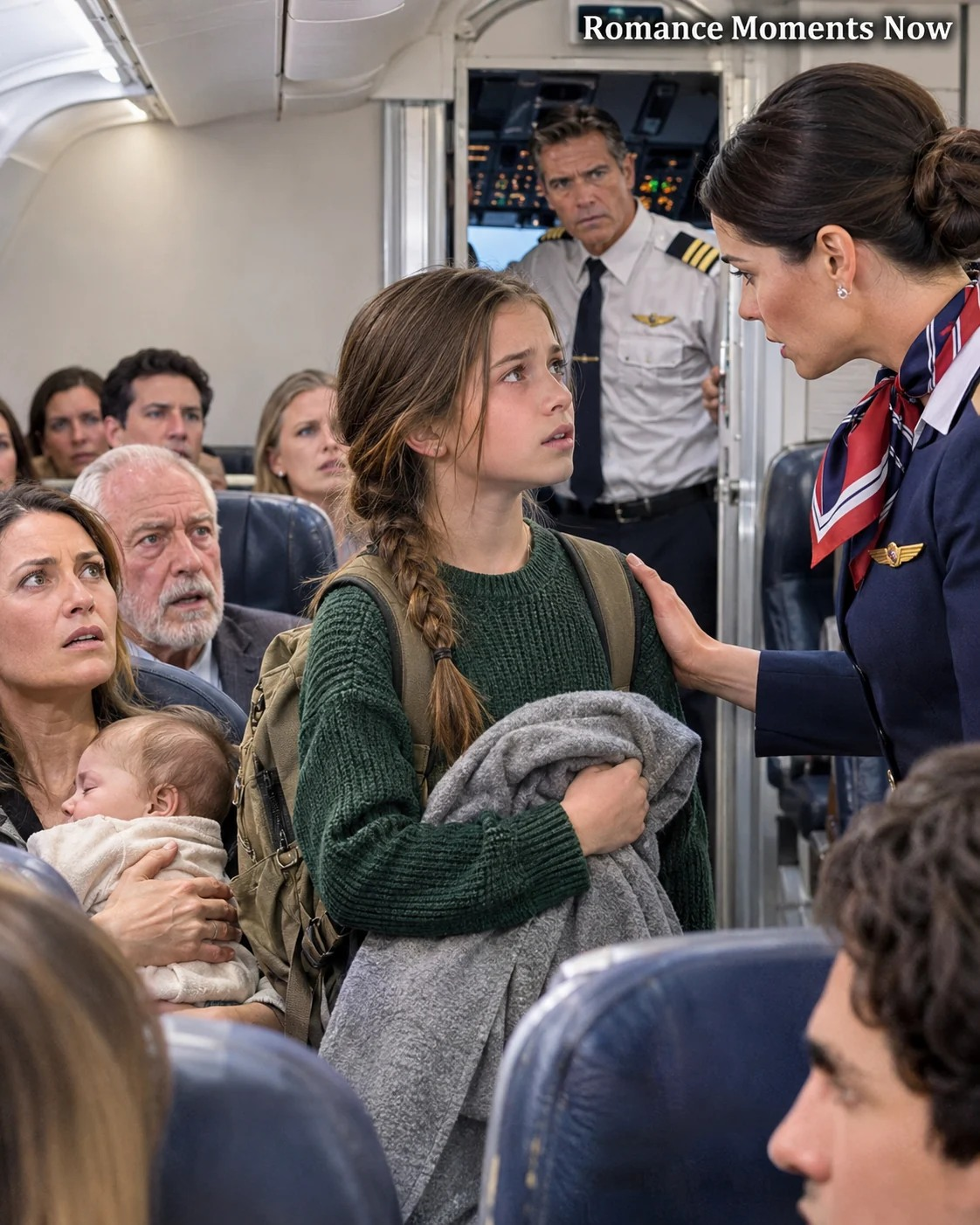
"If you want to know why your daughter was sent aboard Flight 728, ask her mother what happened on October 17."
The voice disappeared.
For several seconds, nobody inside the cockpit moved.
My father stood with one hand resting against the console, staring at the radio.
The captain slowly reached for the communication controls.
"Identify yourself."
Nothing.
"Repeat your identification."
Only static answered.
I looked at the photograph in my father's hand.
My mother stood outside a military building, wearing the same blue coat I remembered from the day two officers came to our house.
The man behind her was almost impossible to recognize.
But there was something familiar about his posture.
He stood with his left shoulder slightly lower than his right, as though carrying an old injury.
I had seen someone stand like that before.
I just couldn't remember where.
"Give me the photograph," I whispered.
My father looked at me.
"Brooke, not now."
"That's my mother."
"I know."
"Then let me see it."
He hesitated before handing it over.
I examined the picture carefully.
The building behind my mother had several large windows. A security camera was mounted above the entrance. A military vehicle was parked near the curb.
My mother wasn't smiling.
She wasn't crying either.
She looked angry.
That surprised me.
I had spent three years remembering her as the woman who cried whenever someone mentioned my father.
But in this photograph, she looked like someone preparing to confront another person.
"Where was this taken?" I asked.
My father studied the image.
"At Falcon Ridge."
The captain turned toward him.
"Your evaluation facility?"
"Yes."
"Was your wife ever there?"
My father didn't answer.
I looked at him.
"Dad?"
He rubbed his forehead.
"Your mother visited the facility once."
"When?"
"October 17."
I stared at him.
"That day?"
He nodded.
"She came to see me before the final evaluation."
I felt something tighten in my chest.
"Why didn't you tell me?"
"Because I didn't know she had been photographed."
"That's not what I asked."
He looked at me.
I continued.
"Why didn't you tell me Mom knew about your mission?"
He lowered his eyes.
"Because I didn't know how much she knew."
The captain placed the photograph on the table.
"We need to separate the family questions from the security problem. We have an unidentified transmission, a possible compromise involving a passenger's belongings, and an aircraft emergency."
My father nodded.
"Agreed."
He turned toward the first officer.
"What's the latest status?"
The first officer gave him an update.
The aircraft was still operating under the flight crew's established emergency procedures. The pilots were comparing indications, communicating with the appropriate ground personnel, and evaluating the safest course of action.
My father listened without interrupting.
Then he asked the captain to verify one particular indication.
The captain checked.
His expression changed.
"You're right. That's different from the previous report."
"Don't make assumptions yet," my father replied. "Verify it against the independent indications."
The captain nodded.
I watched them.
It was strange seeing my father work.
He wasn't trying to impress anyone.
He wasn't pretending to be the hero.
He simply focused on the problem in front of him.
The same way he had focused on my homework when I was little.
The same way he had patiently explained the simulator when I accidentally selected the wrong training scenario.
He had always believed that panic wasted time.
And time mattered.
The captain looked at me.
"Brooke, I need you to stay seated and let us work."
I nodded.
But my eyes kept returning to the photograph.
My mother.
October 17.
The same date my father had disappeared.
I reached into my pocket and took out my phone.
There were several messages from Mom.
The last one had arrived before takeoff.
Have you eaten? Remember to drink water. I love you.
I stared at it.
My mother had sounded normal.
She had reminded me to pack my headphones, told me to keep my passport safe, and asked me to send her a message after landing.
She had even joked that I would probably sleep through the entire flight.
But now I wondered whether every small instruction had been part of something larger.
I opened her contact.
My thumb hovered over the call button.
My father noticed.
"Brooke."
I looked up.
"I need to call Mom."
He stepped closer.
"Not yet."
"Why?"
"We don't know who is monitoring this communication."
"She's my mother."
"I know."
"Then why can't I call her?"
He looked at the photograph.
"Because whoever sent that message may be waiting for you to do exactly that."
I lowered my phone.
I hated that he might be right.
The captain turned toward the radio.
"Atlantic Control, Flight 728 requesting confirmation of the previous transmission and the identity of the individual who contacted us."
The response came after several seconds.
"Flight 728, stand by."
My father looked toward the communication panel.
"Captain, ask them to confirm through an independent channel."
The captain did.
There was another pause.
Then the radio crackled.
"Flight 728, we have no record of the previous message being transmitted by our authorized controller."
The captain exchanged a look with the first officer.
My father moved closer.
"Can you verify whether the transmission originated from a known aviation frequency?"
The captain relayed the question.
The answer was not reassuring.
"We cannot confirm the source at this time."
I looked between them.
"Does that mean someone pretended to be air traffic control?"
The captain answered carefully.
"It means we received a communication that has not been authenticated."
My father looked at me.
"That's why we verify before acting."
I nodded.
Then I looked at the photograph again.
The man standing behind my mother.
The strange posture.
The partially hidden face.
Something about him bothered me.
I turned the photograph sideways.
There was a small reflection in one of the building's windows.
At first, I thought it was just a light.
Then I noticed a second figure.
Someone standing inside the building.
The person appeared to be watching my mother from behind the glass.
I moved closer to the light.
"Dad?"
He looked at me.
"What's wrong?"
I pointed.
"Who is that?"
He took the photograph.
His eyes narrowed.
For a long moment, he didn't speak.
Then he turned it over and examined the date again.
"That's not possible."
The captain approached.
"What?"
My father pointed at the reflection.
"That person shouldn't have been there."
"Who is it?"
My father shook his head.
"I can't tell from this photograph."
I looked at him.
"But you recognize the person?"
He didn't answer.
The captain's expression became serious.
"Nathan, we need the truth."
My father slowly placed the photograph on the table.
"Three years ago, there were four people who knew about the final evaluation."
He counted them on his fingers.
"Myself. Daniel Mercer. Elias Ward. And the program director."
"Who was the director?" I asked.
He looked at me.
"General Richard Vance."
The name meant nothing to me.
But it meant something to the captain.
His expression changed immediately.
"Vance?"
My father nodded.
"You know him?"
The captain looked toward the photograph.
"I served under him during my military career."
"Then you understand why I didn't trust the official report."
The captain remained silent.
I looked at my father.
"Was he the person who told Mom you were dead?"
"I don't know."
"Did he know you were alive?"
"I don't know that either."
"Why does everyone keep saying they don't know?"
My voice had become louder.
Nobody answered.
I felt embarrassed, but I couldn't stop.
"You're all talking about my family like it's some secret mission. I'm the person who had to live without my father. Mom had to explain why he wasn't coming home. I had to listen to people say how brave we were."
My father looked at me.
I continued.
"And now you're telling me that people knew something was wrong, but nobody told us?"
His eyes became wet.
"You're right."
I shook my head.
"No, I'm not right. I don't even know what's true anymore."
He lowered his head.
For the first time, I saw him struggle to find words.
Then he said something I wasn't expecting.
"Your mother tried to find me."
I stopped.
"What?"
"After I disappeared, she contacted several people. She wrote letters. She asked questions. She even went to the base."
"How do you know?"
"Because I received copies of her messages."
I stared at him.
"From whom?"
"An anonymous source."
"What did the messages say?"
He looked toward the document case.
"She wanted to know why the Air Force had given her a death notification without returning your father's personal belongings."
I swallowed.
"She asked for your belongings?"
He nodded.
"She asked for my identification tag, my flight jacket, and the personal effects I supposedly left behind."
I looked down at the silver tag in my hand.
"Then why didn't she get them?"
My father hesitated.
"Because the official records stated that those items had been destroyed during the operation."
I looked at the tag.
It was real.
It had his name.
It had his identification information.
It had been in his possession.
"So they lied."
My father looked at me.
"Someone did."
The captain opened the document case again.
"There may be another explanation."
He removed a second sheet of paper.
It was a copy of an official notification.
The heading contained the seal of the United States Air Force.
Below it was my father's name.
Nathan Hartley.
The document stated that his remains had not been recovered.
I read the sentence twice.
"Not recovered?"
My father nodded.
"That's what the report said."
"But Mom told me you were dead."
"She was told that I had been killed."
The captain looked at the document.
"That's an important distinction."
I felt sick.
For three years, I had imagined my father dying alone somewhere far away.
I had imagined him thinking about us.
I had imagined that he might have wanted to come home but couldn't.
Now I was beginning to understand that the people responsible for the official story might have deliberately left my mother with no way to know what had happened.
I looked at the captain.
"Why are you carrying these documents?"
He closed the folder.
"Because I was asked to deliver them to a person in Madrid."
"Who?"
He glanced at my father.
"Someone connected to the original investigation."
My father frowned.
"You didn't tell me that."
"I wasn't given the full information."
"Who arranged the delivery?"
The captain took a breath.
"Elias Ward."
My father stepped closer.
"Why didn't you tell me before we departed?"
"Because I didn't know you were aboard."
My father stared at him.
The captain continued.
"I received instructions to deliver the folder after landing. I was told that a member of the original evaluation team would meet me."
"Who?"
The captain opened the document case and removed a small card.
There was a name printed on it.
MARTIN ELLIS.
Below it was an address in Madrid.
My father looked at the card.
Then he shook his head.
"I don't know that name."
"Neither do I."
"Then why are you carrying this?"
"Because the instructions came through an official contact."
My father examined the card.
"Captain, do you have any idea what is inside that folder?"
The captain looked at him.
"No."
My father opened the folder.
There were several pages, most of them marked confidential.
He turned through them carefully.
Then he stopped at the final page.
His face changed.
I stepped closer.
"What?"
He didn't answer.
He read the page again.
Then he placed it on the table.
There was a list of passengers aboard Flight 728.
My name appeared near the top.
BROOKE HARTLEY.
Beside it was a handwritten notation.
PRIMARY CONTACT — DO NOT ALLOW TO LEAVE THE AIRCRAFT WITHOUT ESCORT.
I felt my skin go cold.
"Why is my name there?"
The captain took the page.
He examined it.
"That wasn't in the original manifest I received."
My father looked at him.
"Who added it?"
"I don't know."
I stared at the words.
Primary contact.
Do not allow to leave.
It sounded as if somebody had planned for me to be on this flight.
I looked at my father.
"Did you know about this?"
He shook his head.
"No."
"Did Mom?"
He didn't answer.
I reached for my phone again.
This time, my father didn't stop me.
I pressed her contact.
The call began.
One ring.
Two rings.
Three.
Then the screen changed.
CALL FAILED.
I tried again.
The same result.
I looked at the captain.
"Is there something wrong with the phone system?"
He shook his head.
"Not necessarily. We may have limited connectivity at this altitude."
I stared at the screen.
Then a message appeared.
Unknown number.
STOP ASKING YOUR FATHER ABOUT OCTOBER 17.
I stopped breathing.
My father noticed my expression.
"What is it?"
I handed him the phone.
He read the message.
His jaw tightened.
"Don't respond."
Another message arrived.
HE DOESN'T KNOW WHAT YOUR MOTHER DID TO KEEP YOU ALIVE.
I felt my hands begin to shake.
My father read it again.
Then he looked at me.
"Brooke, listen to me. Whatever this person says, don't believe it without evidence."
I nodded, but my eyes had filled with tears.
A third message appeared.
This time, there was an attachment.
A photograph.
I opened it.
It showed a hospital room.
A little girl lay in a bed.
She had a bandage around her head.
A woman sat beside her, holding her hand.
The woman was my mother.
The girl was me.
I recognized the room immediately.
It was the hospital where I had spent two days after a car accident three years earlier.
The accident had happened shortly before my father's official death notification.
My mother had always told me that I had hit my head during the crash and lost consciousness.
She had said that my father had been away on a military assignment and that she had been unable to reach him.
I had never questioned the story.
But now I noticed something in the photograph.
My mother was holding a document.
A document with a military seal.
And the date printed in the corner was October 17.
I looked at my father.
He had gone completely pale.
"Do you remember that accident?" he asked.
I nodded slowly.
"I remember waking up in the hospital."
"Do you remember what happened before you lost consciousness?"
I tried.
A road.
Rain against the windshield.
My mother shouting my name.
A sudden impact.
Then darkness.
I looked at the photograph again.
"Why was Mom holding that document?"
My father took the phone.
He enlarged the image.
His eyes moved toward the lower corner.
Then he stopped.
There was a second person standing outside the hospital room.
Only part of his face was visible through the glass.
My father recognized him.
I could tell from the way his fingers tightened around the phone.
"Who is that?" I whispered.
He didn't answer.
Instead, he turned toward the radio.
"Elias!"
Static.
"Elias, answer me!"
Nothing.
The captain looked at the communication panel.
Then the radio suddenly came alive.
A different voice spoke.
"Flight 728, this is Atlantic Control. We have received an urgent security notification concerning a passenger aboard your aircraft."
The captain reached for the microphone.
"Please identify the passenger."
There was a pause.
Then the voice answered.
"Passenger Brooke Hartley."
My father stepped toward the radio.
"Who authorized this notification?"
The response came immediately.
"Captain, you are instructed to keep the passenger in a secure location until authorities arrive."
The captain looked at my father.
My father looked at me.
I couldn't move.
Then the radio delivered one final instruction.
"Do not allow her mother to contact the aircraft. She has just been identified as a suspect in the disappearance of Major Nathan Hartley."






Comments 0