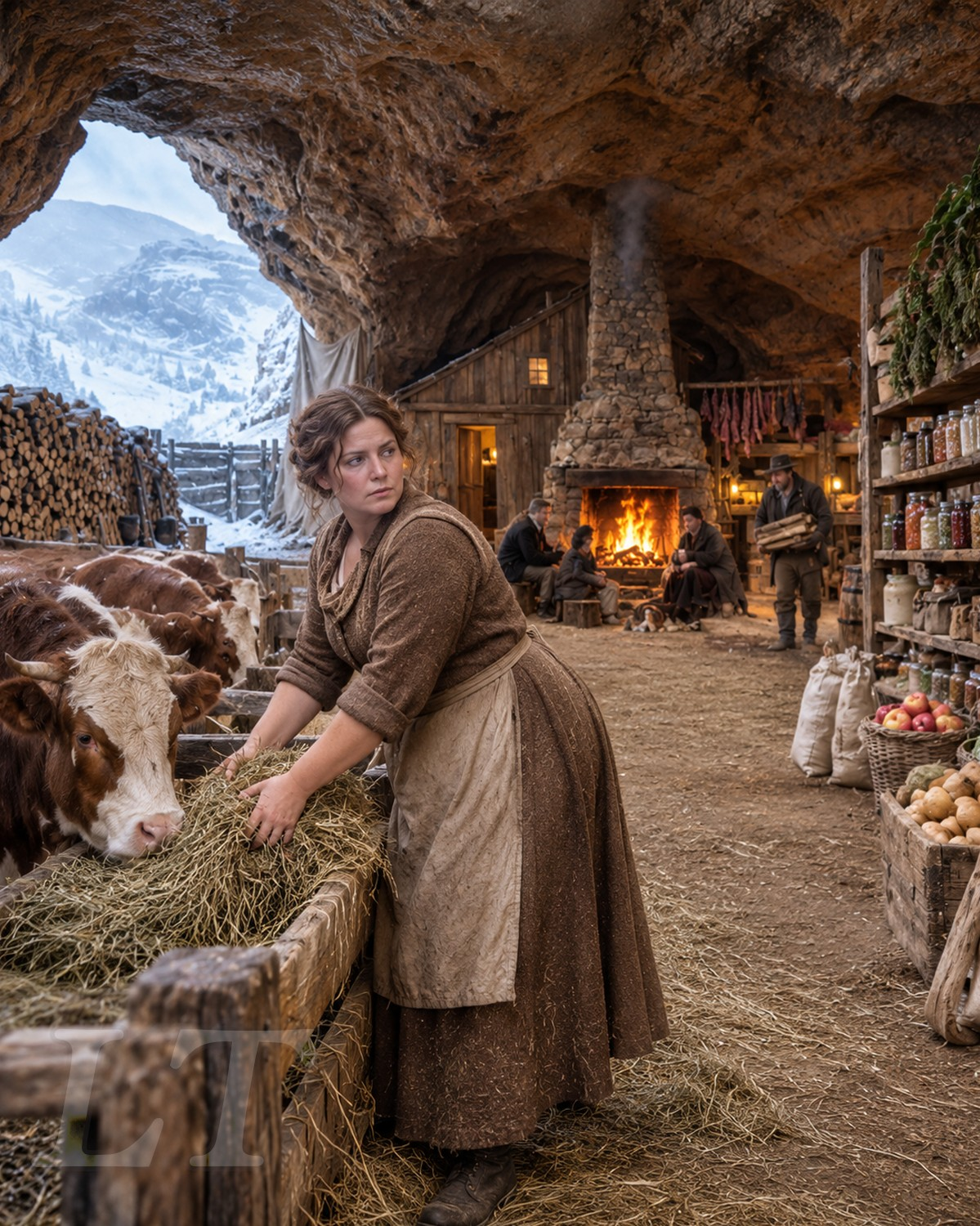
I froze beside the abandoned sheep shed.
The footprints were unmistakably human.
They crossed the thin layer of snow from the direction of the valley, passed through a gap in the broken fence, and stopped directly in front of the shed's wooden door.
I looked over my shoulder.
The sandstone cliffs stood behind me.
Beyond them, the valley stretched toward the cabin I had been forced to leave that morning.
There was no movement.
No horses.
No people.
Only the wind pushing loose snow across the frozen ground.
I crouched and examined the tracks.
The boots were large, probably belonging to a man. The right heel had left a deeper impression than the left. Whoever had made them was carrying considerable weight.
I touched the edge of one footprint.
The snow inside was still loose.
Fresh.
My stomach tightened.
Walter had known I was heading west. He had watched me leave the property. Perhaps he had sent someone to make certain I did not return.
I stood slowly.
For several seconds, I considered turning back toward the cliffs.
But there was nowhere else to go.
If someone was watching me, running would accomplish nothing. I had no weapon powerful enough to defend myself against a determined man, and I could not afford to waste daylight.
I reached beneath my shawl and touched the handle of my hunting knife.
Then I approached the shed.
The wooden door hung crookedly from one rusted hinge. A narrow opening remained between the door and its frame.
I pushed it gently.
The wood groaned.
Inside, the air smelled of old straw, damp earth, and rotting timber.
I waited.
Nothing moved.
I stepped through the doorway.
The interior was smaller than I remembered. One section of the roof had collapsed, leaving a wide opening through which the gray sky was visible. Broken branches lay across the floor. An old feeding trough had fallen onto its side.
Near the back wall, six wooden boards remained attached to the original frame.
I recognized them immediately.
They were thick cottonwood planks, weathered but still solid.
If I could remove them, they might be enough to construct a barrier inside the cave.
I turned toward the doorway again.
The footprints remained visible.
I could not shake the feeling that someone had been standing there recently, looking inside.
"There's nothing here worth taking," I whispered.
My voice sounded strangely small.
I waited another moment.
Then I found a loose stone and placed it against the bottom of the door.
If anyone approached, the stone would move.
It was a poor warning system.
But it was better than nothing.
I returned to the wooden frame and examined the nails.
They were old and heavily rusted.
I had no hammer.
No saw.
No proper tools.
Only my hands, a hunting knife, and the iron poker Daniel had made.
I removed the poker from my bag.
Its heavy end was slightly flattened from years of use.
I positioned it beneath the first board and pushed.
Nothing happened.
I adjusted my grip and tried again.
The wood creaked.
A small piece of rotten frame broke away.
I continued working.
For nearly twenty minutes, I rocked the board back and forth, using the poker as a lever.
My shoulders began to ache.
My fingers grew numb.
Finally, one nail loosened.
Then another.
With a sudden crack, the board came free.
I nearly fell backward.
I caught myself against the wall and lowered the plank carefully.
It was heavier than I expected.
I examined its length.
Almost seven feet.
Long enough to cover part of the cave entrance.
I placed it beside the doorway and returned for the second board.
The work became increasingly difficult.
The nails were positioned at awkward angles, and several had bent into the wood. I had to use the edge of my knife to clear away splinters before I could get the poker underneath them.
By the time the second board came loose, my right hand was trembling.
I looked down.
A thin line of blood had appeared near the base of my thumb.
The nail of my glove had torn.
I removed the glove.
A small cut crossed the skin.
It was not deep, but the cold made it sting.
I wrapped the wound with a strip of cloth torn from the inside of my old apron.
Then I put the glove back on.
I had learned something during the six years Daniel and I had worked the claim.
A person could survive an extraordinary amount of discomfort.
But a person could not survive everything.
Every injury had a cost.
Every wasted movement consumed energy.
And every hour spent without food or shelter brought winter closer.
I could not afford mistakes.
I continued.
By early afternoon, six boards lay beside the shed.
I also collected several shorter pieces of timber from the collapsed roof.
They were not particularly straight, but they would be useful for supporting the larger planks.
I found a length of old rope beneath a pile of straw.
It was stiff and dirty, but most of its fibers remained intact.
I shook away the dust and tested its strength.
It held.
I tied the boards together into a rough bundle.
Then I placed the canvas strap across my shoulder and began dragging the load toward the cliffs.
The first few yards were manageable.
The snow was relatively shallow, and the ground sloped gently upward.
But once I reached the lower hillside, the boards began catching against rocks and frozen grass.
I stopped repeatedly to rearrange them.
My boots slipped.
My shoulder burned.
The canvas strap cut into my skin.
At one point, the entire bundle slid backward.
I fell onto my knees.
The impact sent a sharp pain through my left leg.
For several seconds, I remained where I was.
The sky above me had become darker.
The wind was increasing.
I looked toward the valley.
The cabin was no longer clearly visible.
Snow had begun covering the distant fence lines.
I could still turn around.
I could walk back to the road.
Perhaps someone in town would give me shelter for one night.
But what would happen tomorrow?
I had no money.
No property.
No family willing to protect me.
And Walter had already made it clear that he considered me a burden.
I thought about Daniel.
He had once told me that the worst thing a person could do was surrender before discovering what was possible.
I pressed my hands against the frozen ground.
Then I stood.
The boards were still there.
So was the cave.
I lifted the rope again.
And I kept climbing.
By the time I reached the sandstone opening, my breathing had become shallow.
My knee throbbed.
My fingers felt swollen inside my gloves.
But I had brought the lumber.
I dragged the bundle inside and leaned it against the wall.
For a moment, I simply stood there.
The silence was extraordinary.
Outside, the wind pushed snow across the cliffs.
Inside, the air remained almost perfectly still.
I removed my gloves and rubbed my hands together.
Then I examined the chamber again.
It was roughly twelve feet across at its widest point. The ceiling was uneven, with several natural ridges running through the sandstone.
The floor was mostly dry.
There were patches of loose sand near the entrance, but farther inside, the ground felt firm.
I walked slowly along the walls.
My first task would be to construct a wind barrier.
I could not simply cover the entrance completely. I had seen what happened when smoke became trapped in an enclosed space, and I knew that fresh air would be necessary.
But perhaps I could build a second protected area inside the chamber.
A wall that stopped the direct wind while leaving enough room for air to move.
I measured the available space using my steps.
Then I selected two of the longer boards.
I positioned them against the sandstone walls and considered how to secure them.
There were no convenient nails.
I would have to use the shorter pieces as supports.
I dragged a fallen branch inside and placed it upright.
It leaned badly.
I adjusted the base with several flat stones.
Then I tied the first board against it using the old rope.
The structure moved.
I added another support.
This time, it held.
I worked for nearly an hour before the first section of the barrier stood upright.
It was uneven and ugly.
But it blocked the direct view of the entrance.
That mattered.
A shelter did not have to be beautiful.
It had to work.
I gathered dry grass from a small sheltered patch beneath the cliffs. Most of it was brittle, but the center remained relatively dry.
I carried several armfuls inside and packed the grass into the gaps between the boards.
Then I pressed loose sand into the larger openings.
The wind began making a faint whistling sound through one corner.
I found another piece of timber and wedged it into the gap.
The sound stopped.
I stepped backward.
The barrier was still incomplete, but the protected space behind it already felt different.
I placed my canvas bag near the far wall.
Then I laid out the few supplies I possessed.
The tin cup.
The cornmeal.
The dried venison.
The matches.
The hunting knife.
Daniel's iron poker.
I counted the food twice.
Three strips of venison.
A small quantity of cornmeal.
It was not enough.
Even if I rationed everything carefully, I would need another food source within days.
There might be edible roots beneath the snow, but digging through frozen ground would consume too much energy.
There might be rabbits in the lower valley.
Perhaps I could set simple snares once the worst weather passed.
But for now, I had to concentrate on surviving the first night.
I looked toward the entrance.
The snow was coming faster.
The light outside had changed from gray to a dull, heavy blue.
I needed warmth.
I collected several small branches and arranged them between flat stones near the entrance.
The fire pit was shallow.
I had no proper chimney.
But I thought I could make a small fire long enough to warm the chamber.
I placed the driest grass beneath the branches.
Then I removed a match.
My fingers were stiff.
I struck it.
The first attempt failed.
The second produced a small flame.
I held it carefully beneath the dry grass.
A thin line of smoke rose.
Then the branches caught.
For a few seconds, I felt something close to relief.
The flames illuminated the sandstone walls.
The chamber became warmer.
I sat beside the fire and extended my hands toward it.
I could almost imagine Daniel sitting across from me.
He would have complained about the poor quality of the wood.
Then he would have found a way to improve the arrangement.
I smiled faintly at the memory.
It disappeared when the smoke began collecting overhead.
At first, I thought it was normal.
Then a thin gray layer spread beneath the ceiling.
The smoke stopped rising.
It drifted sideways.
Then it began rolling back toward me.
I stood immediately.
My eyes started burning.
I moved the fire poker, trying to separate the branches.
The flames grew larger.
So did the smoke.
I coughed.
A second wave struck my throat.
I bent forward and reached for the nearest branch, attempting to pull it away from the fire.
But the smoke became too thick.
My lungs tightened.
I stumbled toward the entrance.
Behind me, the flames continued burning.
I turned once.
The chamber was filling with smoke.
I grabbed a handful of snow and threw it onto the fire.
The flames hissed.
Then another handful.
Finally, the fire collapsed into a smoking pile of blackened wood.
I dropped to my knees and crawled toward the entrance.
Cold air struck my face.
I coughed until my chest hurt.
For several minutes, I could do nothing except breathe.
When the smoke finally cleared, I sat against the sandstone and stared at the remains of the fire.
I had made a terrible mistake.
The chamber had no proper ventilation.
Without a reliable way to remove smoke, I could not safely burn wood inside.
And without a fire, the coming nights would be dangerous.
I looked at my hands.
The bandage around my thumb had become damp.
My shoulders trembled.
I was exhausted.
But the worst part was the realization that I had almost destroyed the only shelter I had.
I looked toward the entrance.
The sky had darkened further.
The storm was approaching faster than I had expected.
A gust of wind drove loose snow through the opening.
I pulled my shawl tightly around my shoulders.
Then I moved deeper into the chamber.
The sandstone wall behind me felt cold against my back.
I pressed my palm against it.
The rock was cool, but it did not have the biting cold of the exposed entrance.
I moved closer to the inner wall.
The difference became more noticeable.
Near the entrance, the air moved constantly.
Farther inside, it was almost still.
I looked at the wooden barrier.
Then at the chamber beyond it.
An idea began forming.
Perhaps I had been thinking about the shelter incorrectly.
I had been trying to make the entire cave warm.
That would be difficult.
But I did not need to warm the entire cave.
I needed to protect a smaller space.
A place where I could sleep, store food, and preserve whatever heat I managed to produce.
I stood and walked toward the boards.
If I moved the barrier farther inside, I could create a separate chamber behind it.
The natural rock walls would protect three sides.
The wooden structure would protect the fourth.
I could leave a small opening near the top for airflow.
It would not solve the problem of the fire.
But it would stop the wind from reaching my sleeping place.
I began moving the boards.
One at a time.
The work was slow.
My injured thumb throbbed whenever I pulled the rope tight.
Several times, I had to stop and rest.
But I continued until the barrier stood nearly shoulder-high.
I packed dry grass into the largest gaps.
Then I used the clay-like earth near the entrance to seal several openings.
The wall was not perfectly straight.
One corner leaned inward.
Another section had a gap large enough for a hand.
But when I sat behind it, I noticed something important.
The wind no longer struck my face.
I could still hear it.
I could still feel the pressure of the storm beyond the entrance.
But the air behind the barrier was quieter.
I closed my eyes.
For the first time since leaving the cabin, I felt that I might have a chance.
I placed the canvas bag against the inner wall.
Then I arranged the wool stockings and spare dress nearby.
The fire poker rested beside my hunting knife.
I checked the matches.
Only a few remained.
I needed to preserve them.
I also needed to solve the ventilation problem before attempting another fire.
Outside, the storm continued building.
The sound of the wind changed as darkness approached.
It no longer moved in ordinary gusts.
It roared continuously across the cliffs.
Fine sand slipped from a crack in the ceiling.
I looked up.
A small amount of dust drifted downward.
The sandstone was solid, but the vibrations reminded me that even a mountain could be affected by a violent storm.
I pulled my shawl closer and settled against the inner wall.
My stomach ached.
I ate one small piece of dried venison and drank a little water from my canteen.
Then I wrapped my hands inside the shawl.
I could not sleep properly.
Every sound made me alert.
The creaking boards.
The distant movement of loose stones.
The occasional rush of snow across the entrance.
At one point, I heard something scrape against the outer rock.
I sat upright.
I listened.
Nothing.
Then it happened again.
A slow scraping sound.
Like wood dragging across stone.
I reached for the hunting knife.
My heart began beating faster.
I remained behind the barrier, trying not to move.
The sound came from the entrance.
Then stopped.
I waited.
One minute.
Two.
Five.
Finally, I gathered enough courage to move toward the narrow gap between the boards.
I leaned forward and looked outside.
The opening was almost completely white.
Snow was blowing across the hillside.
I could barely see the lower slope.
Then a shadow moved beyond the entrance.
I stopped breathing.
It was tall.
Human-shaped.
And it was standing directly outside my shelter.
I tightened my grip on the hunting knife.
The shadow moved closer.
Then a man's voice came through the storm.
"Ruth Calder?"
I knew that voice.
I had heard it before.
But the man standing outside was not supposed to know where I had gone.
Meet the requested 2,000-word length Strengthen the cave’s ventilation logic






Comments 0