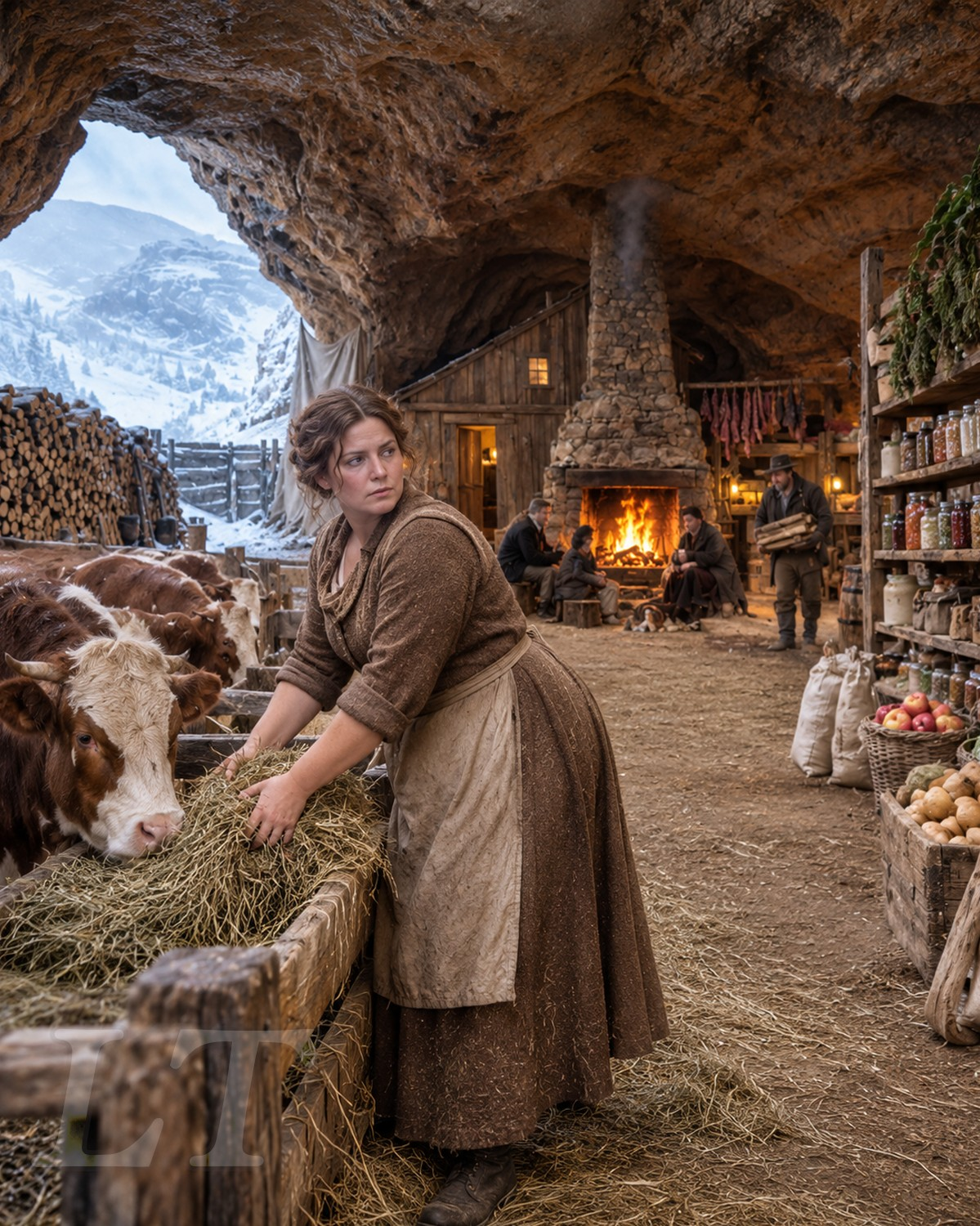
I dragged my canvas bag across the cabin floor and whispered, "You cannot throw me out of the home I helped build."
Walter Calder stepped between me and the door.
He held the signed property deed in his right hand.
On the bottom corner, I noticed a small handwritten note:
"All improvements included."
I suddenly understood that this had never been about a family disagreement.
It had been planned.
For several seconds, nobody spoke.
The dying fire inside the iron stove made a faint clicking sound.
I could smell coffee.
I could smell the last piece of bread Agnes had taken from the wooden table.
And I could smell the smoke from the fireplace that my husband, Daniel, had built with his own hands.
That smell almost broke me.
Not because I was cold.
Not because I was hungry.
But because I suddenly understood that I was standing inside a home that no longer belonged to me.
Six years.
I had spent six years helping Daniel turn that small piece of Montana wilderness into something worth protecting.
I had carried stones until my shoulders bruised.
I had planted vegetables in stubborn soil.
I had repaired fences during thunderstorms.
I had helped raise cattle, cut firewood, and preserve enough food to survive winters that seemed determined to bury the entire valley.
When Daniel became sick, I had continued working.
When his hands became too weak to hold a hammer, I had finished repairing the barn roof.
When he could no longer walk to the creek, I had carried water to him.
And when he died, I had stayed.
I had stayed because that cabin was not simply a building.
It was the last place where I could still feel close to him.
Now Walter stood beside the stove, drinking coffee as if nothing extraordinary were happening.
He was Daniel's older brother.
He had always been a large man, with broad shoulders, a heavy jaw, and a habit of speaking as though everyone else owed him an explanation.
Daniel had been different.
He listened before answering.
He rarely raised his voice.
And when he promised something, he meant it.
I looked at Walter.
"Where am I supposed to go?"
He lowered his coffee cup.
"That's not my concern."
His wife, Agnes, stood near the kitchen shelves.
She wore a dark blue dress and a knitted shawl.
Her expression was calm.
Too calm.
"The paperwork has already been completed," she said. "You need to accept that."
I turned toward her.
"What paperwork?"
Agnes glanced at Walter.
He reached into his coat and pulled out a folded document.
"The land transfer."
I stared at the paper.
The handwriting was familiar.
Daniel's name appeared near the bottom.
For a moment, my heart stopped.
"That isn't possible."
Walter unfolded the document and placed it on the table.
"Your husband signed it before he died."
I approached slowly.
I recognized the shape of Daniel's signature.
But something about the document felt wrong.
The date was several weeks after Daniel had become too weak to leave his bed.
I remembered those weeks clearly.
He had barely been able to hold a spoon.
He had certainly not been able to travel into town to sign legal documents.
"Who witnessed this?"
Walter folded his arms.
"That's none of your business."
"It is my business. Daniel was my husband."
Agnes sighed.
"Ruth, please don't make this harder than it needs to be."
I looked at her.
"Harder for whom?"
She did not answer.
Walter stepped toward me.
"The claim belongs to me now. I've given you enough time."
I stared at him.
"Enough time?"
"You've been living here without paying anything."
I almost laughed.
Not because anything was funny.
Because the accusation was so absurd that my mind struggled to understand it.
I had spent six years building that place.
I had worked beside Daniel until my hands became rough and my back ached every morning.
I had helped repair the barn after Walter's own livestock damaged the fence.
I had even sent food to his family during the previous winter.
And now he was telling me that I had been living there for free.
I looked at the document again.
There was another signature.
Agnes's.
My stomach tightened.
"Did Daniel know about this?"
Walter's expression hardened.
"He's dead, Ruth."
The words struck harder than I expected.
I lowered my eyes.
For one brief moment, I saw Daniel standing near the stove, smiling at me while holding a wooden spoon.
I remembered the last evening we had spent together.
He had been weak, but he had squeezed my hand.
He had told me that the cabin would always be my home.
I had believed him.
I still wanted to believe him.
"His last wish was that I should remain here," I said.
Walter shook his head.
"His last wish doesn't change the law."
I looked toward the bedroom.
The door was open.
Daniel's old coat still hung behind it.
His boots remained beneath the bench.
I had not moved them.
I could not bring myself to do it.
"At least let me take his things."
Agnes looked toward the canvas bag.
"Everything you are allowed to take is already packed."
I stared at her.
"Everything?"
She nodded.
I walked to the bag and opened it.
Inside were two wool stockings, a spare dress, a tin cup, a hunting knife, a small quantity of cornmeal, three strips of dried venison, and an old iron fire poker.
I recognized the poker immediately.
Daniel had made it during our second winter together.
He had spent two evenings shaping the iron, heating it until it glowed, then hammering it into the shape he wanted.
He had laughed when I told him it was too heavy.
"Good tools should feel like tools," he had said.
I picked it up.
The handle was worn smooth where his fingers had held it.
For the first time that morning, I felt my eyes burning.
I turned away before either of them could see.
"Where are my winter blankets?"
Walter shrugged.
"Those belong to the property."
I looked at him.
"Daniel bought those blankets for us."
"And Daniel's property belongs to me now."
Agnes walked to the table and began collecting the remaining dishes.
Her movements were deliberate.
She was already behaving as though I had disappeared.
I looked around the cabin one last time.
The wooden shelves.
The stone fireplace.
The narrow window above the sink.
The small scratch on the doorframe where Daniel had measured my height during our first year.
Every corner carried a memory.
I remembered the night we finished the roof.
We had stood outside in the rain, laughing because the final board had slipped from my hands.
I remembered Daniel carrying me across the threshold when we first moved in.
I remembered the morning he planted the apple tree beside the fence.
That tree was still there.
I had watered it through two dry summers.
I had protected it from frost.
I had watched it produce its first small harvest.
Now Walter would own that tree too.
I tightened the canvas strap.
"Is this really what you want?"
Walter finally looked directly at me.
"It is what the papers require."
I searched his face for even the smallest sign of regret.
I found none.
Agnes moved toward the door and opened it.
A violent gust of cold air entered the cabin.
The temperature outside had dropped overnight.
I looked beyond the threshold.
The sky above the Musselshell country was gray.
Not the soft gray of an ordinary winter morning.
It was darker.
Heavier.
The clouds seemed to press down over the mountains.
I knew that sky.
Every rancher in the region knew it.
A northern storm was approaching.
I had seen storms like that before.
They could bury fences in hours.
They could turn familiar trails into deadly white fields.
And they could kill a person who underestimated them.
I looked back at Walter.
"You know there's a storm coming."
He lifted his coffee cup.
"Then you'd better get moving."
For a moment, I thought he might be joking.
But his face did not change.
I stepped outside.
The cold struck my cheeks immediately.
My eyes watered.
The wind pushed at the canvas bag, forcing me to hold it close to my body.
Behind me, Agnes began closing the door.
I turned around.
"Walter."
He stood in the doorway.
"What?"
"If Daniel had known you were going to do this, he would have been ashamed of you."
His jaw tightened.
"Don't speak about my brother."
I looked at him.
"He was my husband."
Walter said nothing.
The door closed.
I heard the heavy wooden latch fall into place.
That sound followed me as I walked away.
I did not look back.
Not because I no longer cared.
But because I knew that if I looked at the cabin again, I might not have the strength to keep walking.
The wind grew stronger as I crossed the frozen yard.
The cattle stood close together near the fence.
One of them lifted its head as I passed.
I stopped briefly.
The brown-and-white cow had been born during the second spring Daniel and I spent on the claim.
I had helped deliver her.
I had named her Daisy.
She watched me with dark, quiet eyes.
I wanted to touch her.
Instead, I continued walking.
Beyond the pasture stood the woodpile.
Walter had already begun stacking the logs differently.
He was preparing the property for himself.
The thought made my stomach turn.
I had cut most of that wood.
I had dragged it through snow.
I had split it until my arms trembled.
Now even the firewood belonged to him.
I reached the old fence and stopped.
From there, I could see the entire valley.
The little creek.
The distant ridge.
The low wooden barn.
And the cabin where Daniel and I had once believed we would grow old together.
I pressed my gloved hand against the canvas bag.
The iron poker inside made a faint metallic sound.
I took one breath.
Then another.
I had no money.
No horse.
No proper winter coat.
Only a small amount of food, a hunting knife, and the clothes I was wearing.
But I had something Walter did not understand.
I knew this land.
I knew where the snow accumulated.
I knew which slopes became dangerous after freezing rain.
I knew where the creek ran beneath the ice.
And I remembered something I had discovered several weeks earlier.
A narrow opening in the sandstone cliffs west of the cabin.
At the time, it had seemed like nothing more than a place to escape a cold autumn rain.
But I remembered how still the air had been inside.
I remembered how the stone felt warmer than the wind outside.
I remembered standing there and wondering whether someone could survive a winter inside that mountain.
Now that question mattered more than anything else.
I adjusted the strap over my shoulder.
Then I began walking west.
The trail was difficult.
Frozen grass snapped beneath my boots.
The wind pushed against my back.
Snowflakes began drifting through the air.
I passed a low wooden fence and followed the shallow rise toward the sandstone country.
My fingers were already stiff.
I tried flexing them inside my gloves.
The canvas bag felt heavier with every step.
At one point, I stopped beside a cottonwood tree and looked back.
The cabin was still visible.
A thin line of smoke rose from its chimney.
Someone was already using my fire.
I watched until the wind broke the smoke apart.
Then I turned away.
I had no intention of returning.
Not to beg.
Not to apologize.
And not to ask Walter Calder for permission to survive.
The cliffs appeared shortly before midday.
They were low and uneven, rising from the frozen grassland in long bands of reddish sandstone.
I remembered the opening.
It was narrow and difficult to see from below.
A dark gap between two sections of rock.
I climbed carefully.
Twice, my boots slipped.
The second time, I caught myself against the stone and scraped my palm through the glove.
I continued upward.
Finally, I reached the opening.
It looked smaller than I remembered.
The entrance was barely wide enough for two people to stand side by side.
A thin layer of snow had collected along the lower edge.
I stepped closer.
Then I stopped.
The wind was roaring across the exposed hillside.
But inside the opening, the air appeared strangely still.
I reached into my bag and found a match.
My fingers trembled as I struck it against the box.
A tiny flame appeared.
I held it near the entrance.
The flame moved slightly.
Then it steadied.
I stared at it.
For the first time that morning, something inside me shifted.
It was not happiness.
It was not even confidence.
It was a possibility.
I stepped inside.
The narrow passage extended farther than I remembered.
After several yards, the sandstone walls widened.
I continued carefully until the passage opened into a larger chamber.
I stood still.
The ceiling rose above me.
The floor was relatively level.
The walls were dry.
I walked to the far side and pressed my bare fingertips against the sandstone.
It was cool.
But not freezing.
I moved my hand closer to the entrance.
The difference was unmistakable.
The outside wind had almost disappeared.
I looked around.
There was enough space for a sleeping platform.
Enough space to store food.
Enough room for a small fire, if I could find a way to vent the smoke.
I imagined the wooden barrier I might construct.
The stones I could gather.
The supplies I would need.
Then I remembered the abandoned sheep shed below the cliffs.
Its roof had collapsed months earlier.
But some of its boards might still be usable.
I looked toward the entrance.
The sky had darkened considerably.
The first serious snow was approaching.
I had perhaps a few hours of daylight.
I placed my canvas bag against the sandstone wall.
Then I pulled out Daniel's iron poker and set it beside me.
I ran my fingers over the worn handle.
"I found somewhere to go," I whispered.
For a moment, I imagined him standing beside me.
I could almost hear his familiar voice telling me to keep my hands warm.
I swallowed the lump in my throat.
Then I stood up.
There was no time to mourn.
Not yet.
I walked back toward the entrance and looked down at the frozen valley.
A small structure stood near the lower slope.
The abandoned sheep shed.
Its remaining wooden boards were dark against the snow.
If I could recover enough of them, I might be able to build a wind barrier.
I tightened my gloves.
Then I began climbing down.
I had just reached the bottom of the slope when I noticed something.
A second set of footprints crossed the frozen ground near the shed.
They were fresh.
Much fresher than mine.
I stopped.
The tracks came from the direction of the valley.
They ended beside the broken wooden door.
I looked toward the cabin in the distance.
Then toward the empty shed.
Someone had been here.
Someone who knew I had left the property.
And judging by the size of the bootprints, that person was not Agnes.






Comments 0