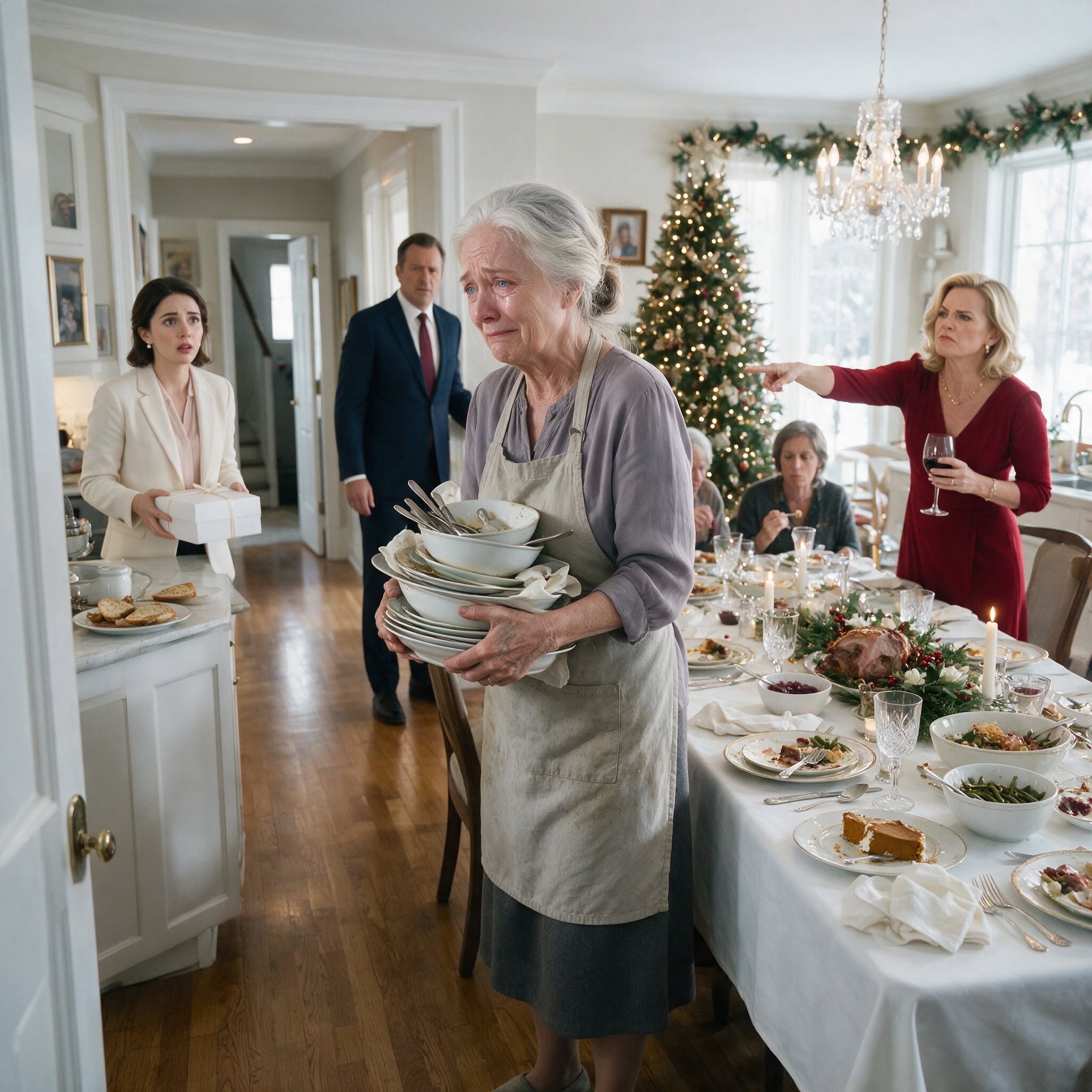
"Grandma, put those plates down!" I shouted.
My mother stood beside the Christmas table, gripping a crystal wineglass.
On the kitchen counter sat a small white gift box with a gold ribbon.
Underneath it was a handwritten card.
For Grandma. Because you deserve something beautiful.
That was when I realized the woman who had raised me wasn't even allowed to sit at her own family's Christmas dinner.
And the worst part was that nobody else seemed surprised.
My name is Audrey Bennett. I was twenty-eight years old that Christmas Eve, and until that moment, I had believed there were certain things my family would never do.
I knew my mother could be difficult.
I knew my stepfather, Patrick, had a way of making people feel small without ever raising his voice.
But I had never imagined they would treat my grandmother like someone who had to earn the right to eat.
I had driven down from Columbus that afternoon with a box of pastries from Grandma's favorite bakery and a carefully wrapped Christmas present in the passenger seat.
The present was a soft wool cardigan.
Grandma Rosalyn had always complained about being cold, even in July.
When I was little, she used to wrap me in blankets and tell me that a warm house wasn't about the thermostat.
"It's about the people inside it, sweetheart."
I remembered that sentence as I stood in my mother's dining room.
Because the house was warm.
The people were not.
There were twelve of us gathered for Christmas Eve.
My mother had arranged the table with expensive china, polished silverware, crystal glasses, and an elaborate centerpiece made of evergreen branches and red berries.
A chandelier sparkled overhead.
The Christmas tree beside the windows looked like something from a magazine.
Everything was beautiful.
Except Grandma.
She was standing between the dining room and kitchen, holding a stack of dirty plates so high that I could barely see her hands.
Her silver hair was pulled back.
Her faded apron had a dark stain near the pocket.
Her shoulders were hunched.
And she was limping.
Not the slight stiffness I remembered from last Christmas.
A real limp.
The kind that made every step look painful.
"Grandma?"
She turned toward me.
For one brief second, her face brightened.
"Audrey, honey. You're here."
Then her eyes moved toward my mother.
The smile disappeared.
"I didn't hear you come in."
I stepped forward.
"Why are you carrying all that?"
"Oh, it's nothing."
She adjusted the plates.
One bowl shifted dangerously.
I reached out to steady it.
"Here. Let me help."
"No, sweetheart. I've got it."
She said it quickly.
Too quickly.
Before I could insist, my mother called from the table.
"Rosalyn, those glasses need to be washed separately. Don't put them in the dishwasher."
Grandma immediately turned toward the kitchen.
"All right, Diane."
I stared at my mother.
She was wearing a beautiful evening dress and a necklace I recognized from a photograph taken at a family wedding.
She looked perfectly relaxed.
"Mom?"
She glanced at me.
"Oh, Audrey. You're finally here."
She came over, kissed the air near my cheek, and looked at the pastry box.
"That's sweet, but we've already had dessert."
I barely heard her.
"Why is Grandma cleaning while everyone else is sitting down?"
My mother blinked.
"Because dinner is over."
"That wasn't my question."
Her expression changed.
Only slightly.
But I knew that look.
It was the same look she used when I was a teenager and asked questions she didn't want to answer.
"Audrey, please don't start."
"Start what?"
"An argument."
I looked toward Grandma.
She had reached the kitchen counter and was carefully lowering the plates.
Her hands were trembling.
"She's seventy-four, Mom."
"And?"
"And she's carrying everyone's dishes while we're sitting around drinking wine."
My mother sighed.
"Your grandmother lives here, Audrey."
"I know."
"Without paying rent."
I waited.
My mother adjusted her necklace.
"Helping around the house is how she contributes."
I looked at her for several seconds.
"Contributes?"
"Yes."
"She's your mother."
"And I'm the person paying the bills."
That sentence landed between us like something heavy.
I glanced around the table.
My aunt Linda was staring into her glass.
My cousin Rachel was checking her phone.
Patrick's brother was cutting another slice of pie.
Nobody looked particularly shocked.
That disturbed me more than anything.
Because it meant this wasn't new.
It meant they had seen it before.
And somehow, they had decided it was normal.
I walked into the kitchen.
Grandma was standing at the sink, rinsing plates under hot water.
"Grandma."
"I'm fine, honey."
"You haven't even asked me how my drive was."
She smiled weakly.
"How was your drive?"
"Grandma."
Her smile faded.
I lowered my voice.
"Have you eaten?"
She looked toward the dining room.
"Not yet."
My stomach tightened.
"Not yet?"
"There was a lot to do."
"Everyone else has finished."
"I know."
"Why didn't you sit with them?"
She dried her hands on her apron.
For a moment, she seemed to be searching for an answer that wouldn't upset anyone.
"Your mother wanted everything served properly."
"That's not an answer."
She looked down.
"Sometimes it's easier not to make trouble."
I felt something cold move through my chest.
I had heard Grandma say those words before.
When my grandfather died and she refused to complain about the hospital bills.
When her arthritis first became painful and she insisted she didn't need help.
When she sold her old car because driving had become difficult.
But this was different.
This wasn't Grandma being independent.
This was Grandma being afraid.
I turned off the faucet.
"Come sit down."
"Audrey—"
"Please."
She hesitated.
Then she looked toward the dining room again.
"Your mother won't like it."
I took a breath.
"Mom doesn't have to like everything."
Grandma's face changed.
Not with relief.
With alarm.
"Sweetheart, please."
Before I could ask what she meant, my mother's voice came from behind us.
"Rosalyn, why isn't the kitchen finished?"
I turned.
My mother stood in the doorway.
Her wineglass was nearly empty.
"Because she's going to sit down and eat," I said.
My mother looked at Grandma.
"Did you tell Audrey to interfere?"
Grandma's face went pale.
"No, Diane. I didn't."
"Then why is she making a scene?"
I stepped between them.
"She's not making a scene. I am."
My mother gave a short, humorless laugh.
"Clearly."
I pulled out a chair at the dining table.
"Grandma, sit here."
Grandma took one uncertain step.
Then Patrick spoke.
"Don't turn this into a big family argument."
He had been sitting near the end of the table, leaning back with one arm resting across his chair.
Patrick was sixty-one, broad-shouldered, and always dressed as though he expected someone important to walk into the room.
He didn't raise his voice.
He rarely needed to.
"Audrey," he said, "your grandmother knows how things work in this house."
I looked at him.
"Apparently, I don't."
He smiled.
It wasn't a friendly smile.
"We provide her with a roof over her head. Food. Medicine. Electricity. That's not free."
I stared at him.
He continued.
"Everybody contributes. Nobody eats for free in this house."
Grandma lowered her eyes.
That was the moment I understood something terrible.
She wasn't surprised.
Not even a little.
She had heard those words before.
Probably many times.
I looked around the table.
"Did everyone hear that?"
My aunt Linda shifted uncomfortably.
"Audrey, honey, maybe we should all just calm down."
"Calm down about what?"
"Christmas isn't the time for this."
I laughed once.
I couldn't help it.
"Christmas isn't the time to make sure Grandma gets dinner?"
Patrick's expression hardened.
"Watch your tone."
I looked directly at him.
"Then watch how you treat her."
The room went silent.
My mother set down her glass.
"That is enough."
I turned toward her.
"You're right. It is."
For a second, I thought she understood.
Then she pointed toward the kitchen.
"Rosalyn, finish those dishes before you eat."
Grandma flinched.
Actually flinched.
As though the words had struck her.
And suddenly, I wasn't twenty-eight anymore.
I was eight years old, sitting at Grandma's kitchen table after my parents' divorce.
I remembered her making pancakes shaped like hearts.
I remembered her staying awake when I had the flu.
I remembered her sewing a button onto my winter coat because Mom had forgotten.
I remembered how she had never once made me feel like a burden.
Not when I spilled juice.
Not when I failed a math test.
Not when I cried because my father missed another birthday.
Grandma had always made room for me.
And now, in a house full of people she had spent her life loving, nobody could make room for her.
I walked to the kitchen counter.
There was a small plate near the microwave.
Cold turkey.
A spoonful of mashed potatoes.
A few green beans.
Two pieces of bread.
I looked at Grandma.
"Is this yours?"
She nodded.
"That's plenty."
I picked up the plate.
The turkey was dry.
The potatoes had formed a thin skin.
I couldn't believe it.
The dining table was still covered with food.
There were serving bowls half full of vegetables.
An entire tray of rolls.
Slices of pie.
Enough leftovers to feed another family.
But Grandma had been given a small plate of scraps.
I carried it into the dining room.
"Who made this?"
Nobody answered.
I looked at my mother.
"Did you give Grandma this?"
"It's perfectly good food."
"It's cold."
"She can heat it."
"After she washes everyone's dishes?"
My mother folded her arms.
"Audrey, you don't understand what it's like having an elderly parent living with you."
"No," I said quietly. "I don't understand what it's like making my mother afraid to sit at Christmas dinner."
Her face tightened.
"How dare you."
Patrick pushed back his chair.
"That's enough."
I looked at him.
"Then stop."
He stood.
For the first time, I noticed Grandma watching him with unmistakable fear.
She wasn't looking at my mother anymore.
She was looking at Patrick.
And that frightened me.
Because Grandma had always been gentle, but she had never been timid.
She had raised three children.
Worked two jobs when my grandfather was sick.
Managed her own household for decades.
She had once marched into my elementary school and demanded to know why a teacher had humiliated me in front of my classmates.
That woman had not been afraid of anyone.
But now she was standing beside the kitchen counter, trembling because my stepfather had stood up.
Something was very wrong.
Patrick walked toward me.
"You're a guest here, Audrey."
I didn't move.
"Grandma isn't a guest."
"Exactly."
He stopped.
I waited.
He continued.
"She lives here. And living here comes with responsibilities."
"She's seventy-four."
"She's not helpless."
"She's limping."
"She's always complaining about her knees."
I felt my hands curl into fists.
Then I remembered Grandma.
I forced them open.
"Grandma," I said, "come sit with me."
She looked between us.
"Audrey, please don't fight."
"I'm not fighting."
But I was.
Just not the way Patrick expected.
I pulled out the chair again.
This time, Grandma slowly sat down.
Her movements were stiff.
She gripped the edge of the table to lower herself.
When she finally settled into the chair, she exhaled as though she'd been holding her breath for hours.
I brought her a fresh plate.
Warm turkey.
Mashed potatoes.
Vegetables.
A roll.
I placed it in front of her.
"Eat."
She looked at the food.
Then at me.
Her eyes filled.
"Oh, sweetheart."
I sat beside her.
For one beautiful moment, I thought that might be enough.
Then my mother spoke.
"You're making her dependent."
I looked up.
"What?"
"You're encouraging her to think she doesn't have to do anything for herself."
Grandma's fork stopped halfway to her mouth.
My mother continued.
"Patrick and I have worked very hard to keep this household running. You come here once or twice a year and suddenly think you know everything."
I didn't answer immediately.
Because part of what she said was true.
I hadn't been there.
I had called Grandma.
Sent birthday cards.
Visited when work allowed.
But I hadn't been there every day.
And now I was beginning to wonder how much I had missed.
My mother mistook my silence for agreement.
"Exactly," she said.
I looked at Grandma.
She had put down her fork.
"Why did you stop eating?"
She whispered, "I'm not very hungry."
I knew she was lying.
I could see it.
She wanted the food.
But she wanted the argument to stop more.
I leaned closer.
"Grandma, look at me."
She did.
"You don't have to earn dinner."
Her chin trembled.
I took her hand.
"You never did."
For a moment, she looked as though she might cry.
Then she squeezed my fingers.
It was a tiny gesture.
But I felt something in it that I hadn't felt all evening.
Trust.
After that, I stopped arguing.
Not because I agreed.
Because I needed to understand what was happening.
I watched.
I listened.
I paid attention to things I might otherwise have missed.
When Grandma asked for another glass of water, my mother told her the pitcher was in the kitchen.
When Patrick wanted coffee, he called her name without looking up.
When Grandma tried to sit again after clearing dessert plates, my mother reminded her that the serving dishes still needed washing.
Each time, Grandma obeyed.
And each time, I felt my understanding of my family shift.
The people around that table weren't monsters in the way movies showed monsters.
They were ordinary people.
They discussed football.
Complained about grocery prices.
Shared photographs of vacations.
Laughed about old family stories.
And somehow, in the middle of all that ordinary conversation, they had accepted the humiliation of an elderly woman as part of the evening.
That was what made it unbearable.
Around nine-thirty, relatives began leaving.
My aunt Linda hugged me at the door.
"Your mother has a lot on her plate," she whispered.
I looked at her.
"So does Grandma."
Linda sighed.
"Families are complicated."
"No," I said. "This is pretty simple."
She didn't answer.
As the front door closed behind her, I noticed Grandma carrying another basket of laundry toward the hallway.
"Grandma, what are you doing?"
"Just putting these away."
"Tonight?"
"Your mother likes everything finished before bed."
I reached for the basket.
"I'll take it."
She pulled it closer.
"Please, Audrey."
That word stopped me.
Please.
Not because she needed help.
Because she was begging me not to cause trouble.
I lowered my voice.
"Where do you sleep?"
Grandma looked toward the hallway.
"Downstairs."
"In the guest room?"
She didn't answer.
I had stayed in that house before.
There were three bedrooms upstairs.
A guest room beside the study.
A finished sitting room near the back.
I couldn't imagine why Grandma would be sleeping downstairs.
"Show me."
"Sweetheart, it's late."
"Please."
She hesitated.
Then Patrick appeared at the top of the basement stairs.
"What's going on?"
I turned toward him.
"I asked Grandma where she sleeps."
He looked at her.
The expression on his face changed so quickly I almost missed it.
A warning.
Then he smiled at me.
"Downstairs. It's quieter."
"Why?"
"She gets confused sometimes at night."
Grandma stared at the floor.
I looked at Patrick.
"Confused how?"
"She wanders."
"Grandma?"
"Older people do that, Audrey."
I glanced at her.
She had always been sharp.
She remembered birthdays, anniversaries, and phone numbers better than I did.
Only last month, she had reminded me about a dentist appointment I'd mentioned once during a phone call.
"Grandma, do you get confused at night?"
She opened her mouth.
Patrick answered first.
"She doesn't always remember."
I looked back at him.
"I asked her."
The silence stretched.
Finally, Grandma whispered, "Sometimes I'm tired."
Patrick gave a small shrug.
"There. You see?"
But I didn't.
Not at all.
I followed them downstairs.
The basement smelled faintly of detergent and damp cardboard.
A washing machine hummed near the far wall.
There were shelves of holiday decorations, storage bins, and old furniture.
Beyond the laundry area was a narrow hallway.
At the end stood a plain wooden door.
Patrick opened it.
Inside was a small room.
A narrow cot.
A thin blanket.
A battered suitcase.
Several cardboard boxes.
And a small window with duct tape around one corner.
There was no Christmas decoration.
No bedside lamp.
No comfortable chair.
Nothing that made the space feel like a bedroom.
I stood in the doorway.
"Grandma sleeps here?"
Patrick crossed his arms.
"It's perfectly adequate."
I stepped inside.
The room was cold.
Not just cooler than upstairs.
Cold enough that I could feel it through my sweater.
I looked at the cot.
The blanket was so thin I could see the shape of the mattress beneath it.
"Where's the heat?"
Patrick sighed.
"The basement stays cooler."
"She's always cold."
"Then she can wear another sweater."
I turned toward Grandma.
She stood just outside the doorway.
Her hands were folded in front of her.
She looked ashamed.
And that broke something inside me.
Because she hadn't done anything wrong.
She was the one being mistreated.
Yet she was the one who looked embarrassed.
My mother came downstairs a moment later.
"What is taking everyone so long?"
I looked at her.
"Why is Grandma sleeping in here?"
She barely glanced at the room.
"Because that's where she sleeps."
"There are empty bedrooms upstairs."
"Those rooms are for guests."
I stared at her.
"She's your mother."
My mother exhaled sharply.
"Audrey, I am not doing this again."
Then she turned to Grandma.
"You need to get up early tomorrow. Patrick still has shirts that need to be finished."
I looked at the laundry basket beside the cot.
Several men's dress shirts were folded over the edge.
"You're making her iron tomorrow?"
My mother frowned.
"She's perfectly capable of ironing."
"On Christmas morning?"
"Don't be dramatic."
Grandma quietly stepped into the room.
"I'll do them, Diane."
I watched her sit on the edge of the cot.
She moved carefully, holding one hand against her knee.
Patrick reached for the door.
Something about the movement caught my attention.
He wasn't simply closing it.
He was holding a key.
A small brass key attached to a dark leather ring.
I looked at his hand.
"What's that for?"
He paused.
"The door."
"Why does her bedroom need a key?"
He looked at me.
For the first time that evening, his expression lost its practiced politeness.
"Because I said so."
Then he closed the door.
I heard the lock turn.
One clean metallic click.
I stared at the wood.
Behind it was my seventy-four-year-old grandmother.
Alone.
In a cold basement room.
On Christmas Eve.
And Patrick had just locked her inside.
I turned toward him.
"Open it."
He slipped the key into his pocket.
"Good night, Audrey."
"Open the door."
My mother grabbed my arm.
"Stop embarrassing us."
I pulled away.
"You're locking Grandma in a basement."
Patrick stepped closer.
"Lower your voice."
I looked at him.
Then at my mother.
Then at the locked door.
I wanted to scream.
I wanted to call the police immediately.
I wanted to tear the door off its hinges.
But something stopped me.
Grandma's face.
The fear in her eyes.
If I made a scene and failed to get her out, she would be the one left behind to deal with the consequences.
So I forced myself to breathe.
"Fine," I said.
Patrick studied me.
"What?"
I nodded once.
"You're right. It's late."
My mother looked relieved.
"Finally."
I walked past them.
Up the basement stairs.
Through the hallway.
Into the guest room.
I closed the door behind me.
Then I took out my phone.
I checked the time.
10:46 p.m.
I had no intention of sleeping.
I sat on the edge of the bed and listened to the house settle.
At eleven-fifteen, I heard my mother laughing downstairs.
At eleven-forty, the television went off.
At midnight, Patrick walked past my room.
His footsteps were heavy and deliberate.
At twelve-thirty, the upstairs bedroom door closed.
I waited.
I thought about Grandma.
About the cold leftovers.
The trembling hands.
The thin blanket.
The key.
I remembered something else.
Earlier that evening, Patrick had mentioned needing to finish paperwork in his study.
He had gone inside carrying a leather folder.
When he came out, he had locked the study door.
And I had seen him place a spare key ring in the top drawer of the hallway cabinet.
I looked at the clock.
1:58 a.m.
I stood.
Put on my shoes.
Opened the guest room door.
The hallway was dark.
I moved carefully past the family photographs.
There was one of my mother and Patrick on a cruise.
One of my cousin's wedding.
One of my grandfather standing beside his old car.
But there wasn't a single recent photograph of Grandma.
Not one.
I reached the hallway cabinet.
Opened the drawer.
Inside were batteries, receipts, a flashlight, and a small ring of keys.
I picked it up.
Three brass keys.
One silver key.
I closed the drawer.
Then I heard something upstairs.
A floorboard creaked.
I froze.
For several seconds, nothing moved.
Then came the unmistakable sound of a bedroom door opening.
Patrick.
I slipped behind the wall beside the kitchen entrance.
His footsteps approached the staircase.
I held my breath.
If he found me holding those keys, I knew exactly what would happen.
He would take them.
He would send me upstairs.
And Grandma would still be locked in that room.
The footsteps stopped.
A light clicked on.
I heard Patrick mutter something under his breath.
Then he started walking toward the hallway cabinet.
Toward the drawer I had just opened.
Toward me.
I pressed myself against the wall.
His shadow stretched across the kitchen floor.
He was only a few steps away.
Then his phone rang.
Patrick stopped.
He answered in a low voice.
"Hello?"
A pause.
Then he said something that made my blood run cold.
"No. She hasn't found anything."
I stopped breathing.
Patrick listened.
Then he continued.
"The old woman doesn't remember what she signed. And Audrey is leaving tomorrow."
My hand tightened around the keys.
He was talking about Grandma.
And me.
I leaned closer to hear.
Patrick's voice dropped even lower.
"Everything is still in the study. I'll deal with it after Christmas."
He ended the call.
For a moment, he stood completely still.
Then he turned toward the cabinet.
I couldn't move.
He opened the drawer.
I heard him shifting objects around.
Then silence.
He had noticed the missing keys.
"Audrey?"
His voice was barely above a whisper.
I stared at the dark hallway.
He called my name again.
Closer this time.
"Audrey, I know you're awake."
I looked toward the basement stairs.
The spare keys were still in my hand.
And somewhere behind that locked door, Grandma was waiting.
Then Patrick took another step toward my hiding place.
His hand reached around the corner.
And the light came on.






Comments 0