The sound of breaking glass was followed by my mother's scream.
Then the call went dead.
For three seconds, I couldn't move.
I sat behind the steering wheel, staring at my phone while the last words I'd heard repeated inside my head.
Patrick has just found it.
It says who must receive the house.
Grandma gripped my arm.
"Audrey."
I turned toward her.
Her face was pale, but her eyes were steady.
"Call the police."
I nodded.
My fingers shook as I dialed.
I gave the dispatcher Walter Harlan's office address, explained the threats, the photographs of Patrick holding a lighter near important documents, and the sound of breaking glass before the call disconnected.
The dispatcher told us officers were being sent and instructed us not to go to the building.
I promised we wouldn't.
Then I called Rebecca.
She answered immediately.
"Audrey?"
"Mom called. Patrick was threatening to burn the envelope. Elaine Bennett was there. Then something broke, and the call ended."
Rebecca went silent.
"Elaine?"
"Yes. Grandma recognized her voice."
"Where are you?"
"Still in the parking lot."
"Good. Stay somewhere safe. I'm coordinating with the police and Walter's family."
I swallowed.
"Rebecca, what if Patrick destroys the document?"
She took a breath.
"Audrey, listen to me. Walter has copies of the trust records, and we've already preserved substantial evidence. The original is important, but your grandmother's rights do not depend on one envelope surviving."
I closed my eyes.
For days, every discovery had seemed to depend on a single missing paper.
A box.
A signature.
A recording.
A key.
I had started to believe that if Patrick destroyed one last document, he could erase everything Grandpa had done.
Rebecca's words gave me something to hold on to.
"Okay," I whispered.
Then Grandma reached across the console.
"Audrey, look at me."
I turned.
She squeezed my hand.
"Frank didn't spend his whole life protecting us so that one frightened man could burn it all away."
My throat tightened.
"Grandma—"
"We've told the truth. We've given the records to Rebecca. We don't have to chase Patrick anymore."
I nodded.
And for once, I believed her.
Forty minutes later, Rebecca called back.
"Walter is safe."
I nearly dropped the phone.
"Thank God."
Grandma covered her mouth.
"Is Elaine okay?" I asked.
"Yes. Diane too."
"And Patrick?"
Rebecca paused.
"Officers detained him at the office. They're investigating the threats and what happened there."
I closed my eyes.
"What broke?"
"A glass cabinet. According to the initial account, Patrick knocked it over during an argument."
I exhaled.
"Was anyone hurt?"
"Walter has a small cut on his hand. He declined emergency transport but agreed to have it examined."
Grandma whispered, "Oh, Walter."
Rebecca continued.
"The envelope was recovered before it was burned."
My eyes filled.
"He didn't destroy it?"
"No."
I looked at Grandma.
She was crying.
But this time, there was relief in her face.
Rebecca's voice softened.
"Audrey, I also want you to know that Diane remained at the office and spoke with the officers."
I swallowed.
"About what?"
"She's begun explaining her involvement in the disputed documents."
I stared through the windshield.
For years, Mom had protected Patrick.
She had protected him when Grandma was frightened.
When money disappeared.
When the house changed hands.
When my signature appeared on a document I'd never seen.
Now, at last, she was talking.
"Does that mean she'll tell the truth?"
Rebecca hesitated.
"It means she's started. We'll see whether her account is supported by the records."
I nodded.
That was enough for tonight.
The next morning, Grandma and I met Rebecca at her office.
Walter was there.
A small bandage covered his left hand.
When Grandma saw it, she hurried toward him.
"Walter!"
He smiled.
"It's nothing, Rosie."
She took his hand carefully.
"Don't you dare tell me it's nothing."
He laughed softly.
"You sound exactly like you did forty years ago."
Grandma shook her head.
"And you're still stubborn."
For a moment, they were simply two old friends.
Then Walter turned toward me.
"Audrey, your grandfather would have been very proud of how you've handled this."
My throat tightened.
"I've been terrified most of the time."
He smiled.
"Courage usually feels that way."
Rebecca invited us to sit.
On the table was the recovered envelope.
It had a dark scorch mark along one corner.
But it was intact.
My name was written across the front.
Original Ownership Declaration — Audrey Elizabeth Bennett.
I stared at Grandpa's handwriting.
Walter carefully removed the contents.
There were several pages.
A signed declaration.
A schedule identifying ownership interests.
And a letter addressed to Grandma and me.
Rebecca explained the legal significance before we read it.
The documents, together with records Walter had retained independently, supported that Grandpa had arranged for a substantial ownership interest in Bennett Heritage Properties to pass to me.
Grandma's rights to her home and financial security were addressed separately through the family trust.
The papers didn't magically settle every disputed transaction.
But they provided strong evidence of Grandpa's intentions and the arrangements he'd made.
I looked at Rebecca.
"So Patrick couldn't simply transfer everything into his company?"
"Not lawfully without the required authority and valid documents," she answered. "That's what we'll be asking the court to determine."
I swallowed.
"And my signature?"
"The available evidence strongly supports your account that you never signed the birthday authorization."
I looked down.
For seven years, someone had used my name to move property I didn't even know existed.
The thought still made me sick.
Walter unfolded Grandpa's letter.
"Would you like to read this, Audrey?"
I nodded.
My hands trembled as I accepted it.
My dear Rosie and Audrey,
If these papers are needed, then I hope the people I trusted have done their best to protect you.
Rosie, the house is your home. No daughter, son-in-law, business partner, or creditor of someone else's making has the right to turn you into a guest there.
I stopped.
Grandma was already crying.
I continued.
Audrey, the business interest I arranged for you is not a reward and not a responsibility you must carry for the rest of your life. It is a choice. You may keep it, sell it, or use it to build something that makes you happy.
My throat tightened.
I have spent too many years watching people confuse money with power. Money is useful when it gives someone freedom. It becomes dangerous when one person uses it to control another.
I wiped my eyes.
Then I reached the final paragraph.
Whatever happens, remember that the most valuable thing I ever owned was the life I built with Rosalyn. If you protect anything, protect her right to live that life on her own terms.
I couldn't finish aloud.
Grandma reached for the letter.
She read the last sentence herself.
Then pressed the page against her chest.
"Oh, Frank," she whispered.
Nobody spoke for a long time.
Elaine Bennett came to Rebecca's office later that afternoon.
She was in her early sixties, with dark hair streaked silver and a face that looked so much like my mother's that I understood why Grandma had kept the photograph hidden.
But Elaine's expression was gentler.
And when she saw Grandma, she began crying.
"Rosie."
Grandma stood.
"Elaine."
They embraced.
I watched two women who had spent years separated by suspicion and lies hold each other as though neither wanted to waste another minute.
Then Elaine turned toward me.
"Audrey."
I nodded.
"Hello."
She smiled sadly.
"You were so little the last time I saw you."
I studied her.
"Why did you disappear?"
She looked down.
"Because Patrick accused me of stealing records. He threatened legal action, and I was afraid the family would believe him."
"Did Grandpa?"
"No."
Her eyes filled.
"Frank believed me. But he was already ill, and I didn't want to make things harder for him."
I swallowed.
"Then why didn't you come back after he died?"
Elaine glanced at Grandma.
"Diane told me Rosalyn wanted no contact."
Grandma shook her head.
"I never said that."
"I know now."
Elaine looked at me.
"And Diane told Rosalyn that I was trying to take the family money."
I felt anger rise.
"She kept everyone apart."
Elaine nodded.
"Patrick benefited from that."
Rebecca asked Elaine to explain her role in the business.
Elaine had helped Grandpa review rental-property accounts.
She'd discovered transfers that didn't match approved expenses.
Some money had gone to Patrick's company through transactions described as loans or management payments.
Others lacked adequate documentation.
She had warned Grandpa.
Then Patrick had accused her of misconduct.
"Did you ever help prepare the forged documents?" I asked.
Elaine shook her head immediately.
"No."
"Then why were you at Walter's office last night?"
"Walter called me after Harold's disappearance. He wanted someone who understood the original business records to help identify the papers."
I frowned.
"Did you know Patrick would be there?"
"No."
She took a breath.
"I arrived after Diane. Patrick was already searching the cabinets."
"What happened?"
"Patrick found the envelope. Walter told him to leave it alone. Patrick threatened to burn it."
I swallowed.
"And Mom?"
Elaine looked at me.
"Your mother tried to stop him."
I stared at her.
"She did?"
Elaine nodded.
"She told him she wasn't going to help him hide anything else."
I looked down.
For a moment, I didn't know what to feel.
Elaine continued.
"Patrick became furious. He knocked over the glass cabinet. Walter reached for the envelope, and the glass cut his hand."
I closed my eyes.
"Then the police arrived?"
"Yes."
I looked at Elaine.
"And the person who helped change the documents?"
She sighed.
"Harold supplied historical records. Patrick arranged for altered paperwork to be prepared. Diane delivered documents and signed as a witness when she hadn't witnessed the signatures."
I swallowed.
"Did Harold know?"
Elaine looked at Rebecca.
"That's something he needs to answer himself."
Rebecca nodded.
"We'll rely on the evidence and formal statements."
I looked at Grandma.
She was holding Elaine's hand.
Then Grandma spoke.
"I don't want anyone else deciding what I know."
Elaine squeezed her fingers.
"Then nobody should."
The following months were not easy.
There were interviews.
Statements.
Financial reviews.
Court filings.
Meetings with attorneys.
Days when I was so tired of hearing the words trust, transfer, and authorization that I wanted to throw my phone into the Ohio River.
But the difference was that we were no longer fighting in the dark.
Edward Marsh cooperated through his attorney.
He explained that after his father's death, old commission information and document templates had remained in the business archives. The disputed acknowledgment had been prepared using information that should never have been used for a new notarization.
He supplied correspondence showing Patrick's company had requested the paperwork.
He also provided the recording that had first revealed Grandpa confronting Patrick.
Harold Ellis eventually contacted his own attorney and gave a formal statement.
He admitted supplying records and concealing questionable transfers.
He also admitted he'd failed to tell Grandpa the full extent of Patrick's financial problems until Frank discovered discrepancies himself.
Harold said he had been afraid of losing money he'd invested alongside Patrick.
That fear had led him to make decisions that harmed the people who trusted him.
Margaret moved out of their home for several weeks while she decided what she wanted their marriage to become.
She apologized to Grandma again.
This time, Grandma didn't immediately comfort her.
She simply said, "I hope you make better choices from now on."
Margaret nodded.
"I intend to."
Patrick faced criminal charges related to financial misconduct, falsified documents, and his treatment of Grandma. He was no longer permitted to contact her while the proceedings were underway.
He denied some allegations, but eventually entered a negotiated guilty plea to several offenses.
The court imposed a sentence that included incarceration, restitution obligations, and restrictions intended to protect Grandma.
The financial recovery took longer.
But it came.
A court approved setting aside the disputed transfer of Grandma's house into Whitmore Residential Holdings.
The trust's ownership was restored in the property records, and Grandma's right to occupy and control her home under the trust was confirmed.
The forged birthday authorization was invalidated.
The disputed business interest was returned to the proper ownership structure.
Some money had already been spent and couldn't be recovered immediately.
But other assets were traced.
Accounts were secured.
Restitution and civil recovery arrangements were established.
Grandma received control over her pension and Social Security payments again.
Her debit card belonged to her.
Her bank statements came directly to her.
Her decisions were hers.
And one afternoon, Rebecca called to tell us the final order restoring the house had been recorded.
Grandma was sitting at my kitchen table.
I put the phone on speaker.
Rebecca said, "Rosalyn, the house is yours to come home to."
Grandma covered her mouth.
Then she began crying.
I hugged her.
She whispered, "Frank, we did it."
Mom's consequences were different.
Her cooperation mattered.
But it didn't erase what she'd done.
She admitted witnessing signatures she hadn't actually seen.
She admitted knowing Patrick had moved Grandma's money.
She admitted helping pressure Grandma into signing papers after her surgery.
And she admitted knowing about the locked basement door.
She faced legal consequences of her own, including court-supervised obligations and restrictions on handling Grandma's finances.
She also entered counseling.
For months, she sent letters.
Grandma read some of them.
Others she put away.
She never let me decide which ones she should open.
One spring afternoon, Mom asked to meet us at Rebecca's office.
Grandma agreed.
I went with her.
Mom looked older.
Her hair was shorter.
She wasn't wearing her wedding ring.
She sat across from us with a tissue in her hands.
For a long moment, nobody spoke.
Then Mom looked at Grandma.
"I don't know how to ask you to forgive me."
Grandma was quiet.
Mom began crying.
"I kept telling myself Patrick was right. That we were helping you. That you needed us."
She swallowed.
"But I knew you were unhappy."
Grandma looked at her.
"Yes."
Mom wiped her cheeks.
"And I knew about the lock."
Grandma nodded.
"Yes."
Mom's voice broke.
"I should have stopped him."
Grandma's expression changed.
"You should never have helped him."
Mom closed her eyes.
"You're right."
I watched her.
For once, she didn't argue.
She didn't blame stress.
She didn't say Grandma was confused.
She didn't tell me I was being dramatic.
She simply sat there and accepted the truth.
Then she turned toward me.
"Audrey, I used your name."
I felt my throat tighten.
"Yes."
"I knew you hadn't signed those papers."
I stared at her.
She began crying harder.
"I told myself it was just paperwork. Patrick said nobody would lose anything."
I shook my head.
"You knew better."
She nodded.
"I did."
I took a breath.
"Mom, I don't know if I can trust you again."
She lowered her eyes.
"I understand."
Grandma reached for my hand.
Then she looked at her daughter.
"Diane, I love you."
Mom began sobbing.
"But loving you doesn't mean I'm going to let you hurt me again."
Mom nodded.
"I know."
Grandma continued.
"You may write to me. You may call when I'm ready. But you will not control my money, my home, or my decisions."
"I understand."
"And if you ever speak to me the way Patrick did, the conversation ends."
Mom wiped her cheeks.
"All right."
Grandma sat back.
For a moment, I thought she'd say something else.
Instead, she looked at Rebecca.
"I'm ready to go."
And we left.
There was no dramatic embrace.
No instant forgiveness.
No pretending that years of cruelty had vanished because someone finally said sorry.
But Mom had begun taking responsibility.
And Grandma had stopped carrying it for her.
That was enough.
By summer, Grandma moved back into her house.
The first thing she did was replace the locks.
The second was order a new porch swing.
The third was buy rosebushes.
I offered to plant them.
She insisted on supervising.
"You put that one too close to the steps," she told me.
I laughed.
"Grandma, you've said that about every rosebush."
"Because you've planted every rosebush too close to something."
Megan arrived with lemonade.
Elaine brought sandwiches.
Walter came with a folding chair and announced that he was too old to dig holes but young enough to criticize our technique.
Grandma laughed so hard she had to sit down.
I stood in the garden and watched her.
Her blue cardigan was draped over the porch railing.
Her cane rested beside her chair.
She had dirt on her hands.
And she was smiling.
Not the polite smile she'd worn when Mom told her to be grateful.
A real smile.
The kind I remembered from childhood.
I walked over.
"Happy?"
She looked around.
At the roses.
The porch.
The people who had come because they wanted to.
Then she nodded.
"Very."
I sat beside her.
"Do you miss living with me?"
She smiled.
"Of course."
I laughed.
"That sounded suspicious."
She squeezed my hand.
"I miss seeing you every morning. I don't miss your tiny kitchen."
I laughed harder.
"Fair."
Then she looked at the house.
"But I needed to come home."
I nodded.
"I know."
She leaned against my shoulder.
"And I needed to know I could."
My own life changed too.
The recovered business interest was worth more than I had ever imagined.
Not enough to turn me into some overnight millionaire.
But enough to give me choices.
Rebecca helped me understand the ownership arrangements and find independent financial advice.
I chose to sell part of my interest while retaining a smaller investment.
I paid off my student loans.
I put money aside for the future.
And I took the first real vacation I'd had in years.
Grandma came with me.
We spent five days in Charleston.
She insisted on visiting every historic garden she could find.
I insisted on taking photographs.
She complained about how many I took.
Then asked me to send every single one.
One evening, we sat near the water watching the sunset.
Grandma turned toward me.
"Audrey?"
"Yes?"
"Do you remember what Patrick said at Christmas?"
I felt my stomach tighten.
"Which part?"
She looked down.
"That nobody eats for free in his house."
I nodded.
"Yes."
She was quiet for a moment.
Then she said, "I believed him."
My throat tightened.
"I know."
She looked at me.
"I thought maybe I really had become a burden."
I took her hand.
"You never were."
She smiled.
"I know that now."
Then she looked out at the water.
"And I wish Frank could see me."
I swallowed.
"Me too."
She squeezed my fingers.
"But I think he'd like this."
I smiled.
"Grandpa would complain about the hotel prices."
She laughed.
"He absolutely would."
Then she added, "And he'd secretly pay for the nicest room."
I laughed.
"That sounds right."
We sat together until the sky turned purple.
And for once, neither of us had anything we needed to investigate.
The following Christmas, Grandma hosted dinner.
At her house.
Her table.
Her decision.
She invited me, Megan, Elaine, Walter, Rebecca, and a few old friends from the neighborhood.
Margaret came too.
She and Harold were living separately while he worked through the consequences of his actions.
She had spent the year rebuilding relationships honestly, without asking anyone to pretend the past hadn't happened.
Grandma welcomed her.
Not because everything had been forgotten.
Because Grandma wanted her there.
Mom wasn't invited to dinner.
She had written a thoughtful letter and respected Grandma's decision to keep their contact limited.
Grandma sent her a Christmas card.
It said she hoped the coming year would bring healing and better choices.
Nothing more.
Nothing less.
I watched Grandma address the envelope herself.
Then place it beside the front door.
No one told her what to write.
No one told her whether to send it.
That mattered.
By four o'clock, the house smelled like roasted turkey, cinnamon, butter, and fresh bread.
I found Grandma in the kitchen wearing a red apron.
She was stirring gravy.
"Grandma, sit down. I'll finish."
She looked at me.
"Audrey Elizabeth Bennett."
I froze.
She only used my full name when she meant business.
"Yes, ma'am?"
"I have spent an entire year getting my independence back."
I smiled.
"Okay."
"And if I want to stir my own gravy, I will stir my own gravy."
I laughed.
"Understood."
She handed me a spoon.
"But you can taste it."
I did.
"Perfect."
She smiled.
"Of course it is."
When dinner was ready, everyone gathered around the table.
Walter carried the bread.
Elaine brought the vegetables.
Megan poured the drinks.
Rebecca helped Grandma bring out the final dish.
I reached for the serving platter.
Grandma stopped me.
"Audrey?"
"Yes?"
"Would you get the photograph?"
I knew which one she meant.
I went to the living room.
On the mantel was a framed picture of Grandpa.
He was standing beside Grandma in the rose garden.
Both of them were laughing.
I carried it into the dining room.
Grandma pointed toward the sideboard.
"Right there."
I set it down where everyone could see.
Then Grandma looked around the table.
Every chair was occupied.
Every plate was full.
Nobody was waiting in the kitchen.
Nobody was standing in a cold basement.
Nobody was being told to earn their dinner.
Grandma took her seat at the head of the table.
The place Grandpa used to sit was beside her.
She had chosen to leave it empty.
Not because she was waiting for him to return.
But because she wanted to remember him.
She looked at the photograph.
Then smiled.
"Well, Frank," she said softly, "I think we finally got Christmas right."
Walter wiped his eyes.
Elaine reached for Margaret's hand.
Megan smiled at me.
And I looked at Grandma.
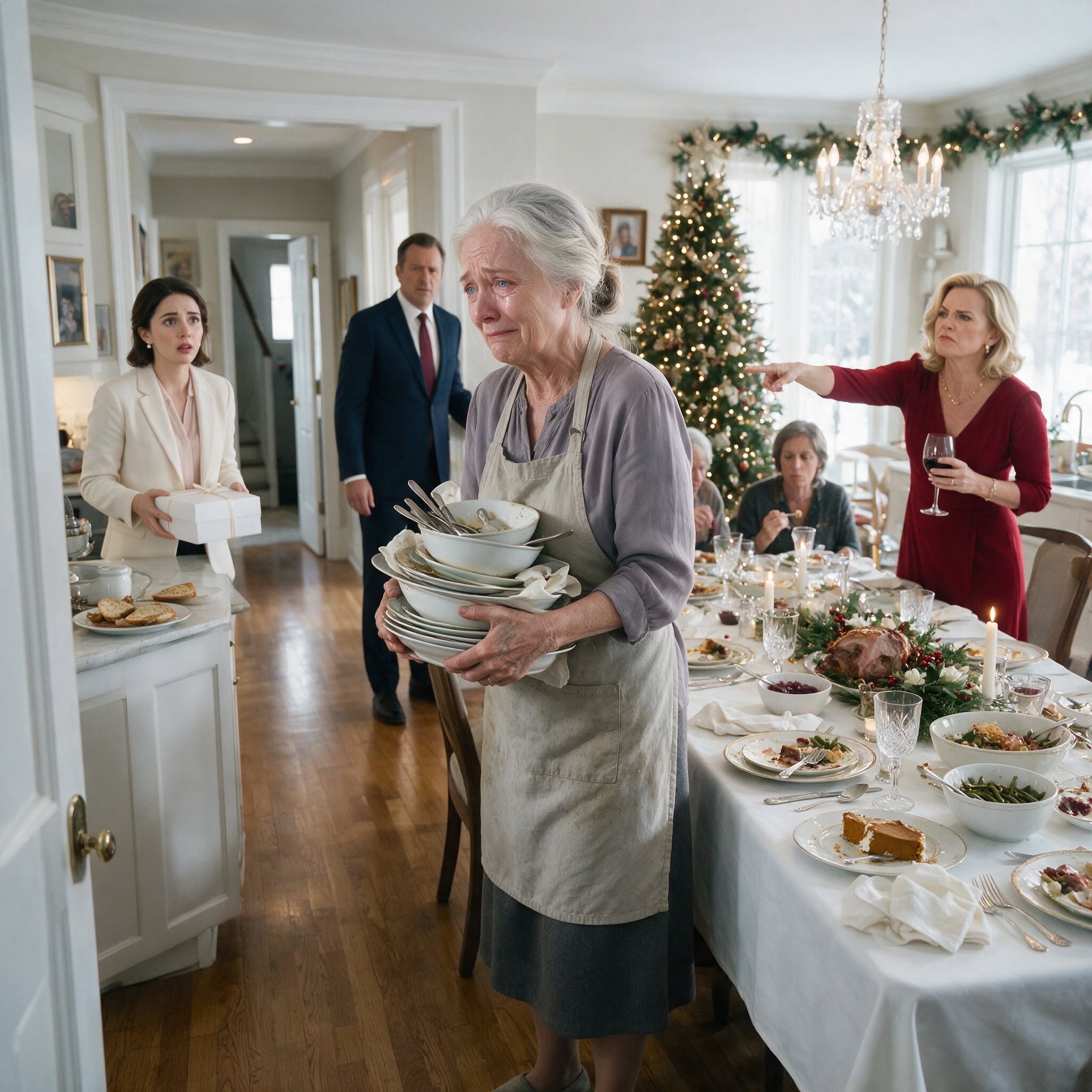
My seventy-four-year-old grandmother, who had once stood in a kitchen waiting for permission to eat, was sitting at the head of her own table.
She owned her home.
She controlled her money.
She had friends who respected her.
She had a granddaughter who loved her.
And she had something Patrick had never understood.
Freedom.
Grandma lifted her glass.
"I'd like to say something."
Everyone became quiet.
She looked around.
"Last Christmas was very difficult for me."
Her voice trembled slightly.
"But I learned something important."
I smiled through my tears.
She continued.
"I learned that getting older doesn't mean becoming invisible."
Walter nodded.
"And needing help doesn't mean giving up your dignity."
Elaine wiped her eyes.
Grandma looked at me.
"And I learned that sometimes the person who saves you is the one who finally asks whether you're happy."
My throat tightened.
She smiled.
"Audrey asked."
I shook my head.
"Grandma—"
She lifted a hand.
"Let me finish, sweetheart."
Everyone laughed softly.
She continued.
"She didn't tell me what I should want. She listened when I told her."
I wiped my cheeks.
Grandma looked around the table.
"So tonight, I want to thank all of you for being here."
She raised her glass a little higher.
"And I want to make one rule."
Megan smiled.
"What's the rule?"
Grandma looked directly at me.
"Nobody leaves this table hungry."
Everyone laughed.
Then she added, "And nobody has to earn their place here."
The room grew quiet.
I looked at Grandpa's photograph.
Then at Grandma.
For years, I'd thought a happy ending meant everything going back to the way it used to be.
The same family.
The same house.
The same Christmas traditions.
But things hadn't gone back.
Mom was learning to live with the consequences of her choices.
Patrick could no longer control Grandma.
Harold had admitted what he'd done.
Margaret and Elaine were rebuilding the trust that had been damaged.
Grandpa was still gone.
And some things could never be made exactly as they were before.
But Grandma had her home again.
She had her voice.
She had the right to decide who entered her life.
And she had people who loved her without asking for anything in return.
Grandma reached for my hand beneath the table.
"Audrey?"
I turned.
"Yes?"
She smiled.
"Would you pass me the potatoes?"
I laughed through my tears.
"Of course."
I passed her the bowl.
She helped herself.
Then handed it to Walter.
Outside, snow began falling over the rose garden.
Inside, the house was warm.
Grandma was laughing.
Dinner was ready.
And every person at that table had a place because they were welcome.
Not because they had earned it.
Not because they owed anyone.
Simply because they were loved.
I looked once more at Grandpa's photograph.
Then I looked at Grandma.
And for the first time since that terrible Christmas Eve, I didn't wish I could change the past.
I was grateful we'd finally changed the future.






Comments 0