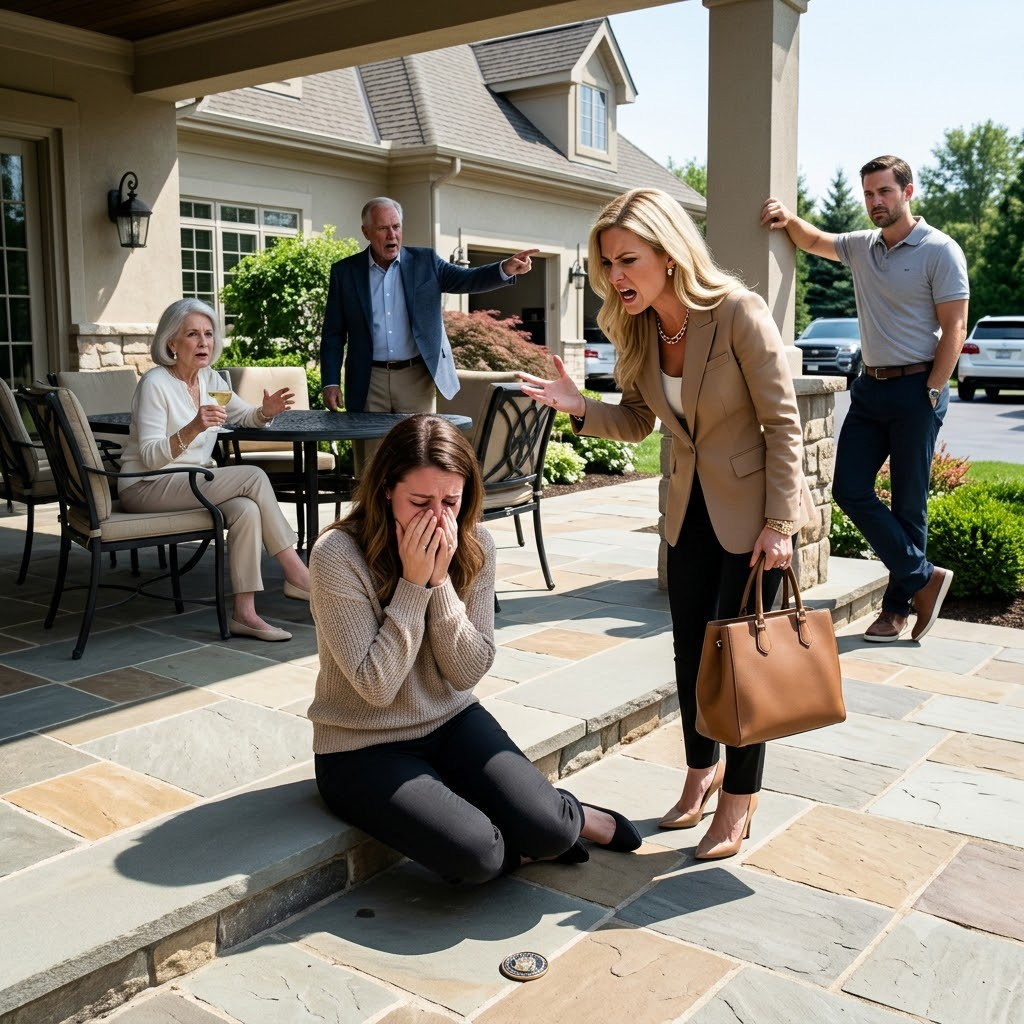
"IF VESPER SURVIVES THE PATIO INCIDENT, ACTIVATE PHASE TWO."
I read those words three times before I understood what they meant.
Someone had known I would be attacked.
Someone had expected me to survive.
And someone had already prepared whatever came next.
The medical vehicle continued down my parents' private driveway while my husband stared at the message on his secure phone.
For three years, I had prayed for Thorne to come home.
Now he was sitting beside me, holding my bloodstained hand, and I had never been more frightened.
"Thorne," I whispered. "What is Phase Two?"
He didn't answer immediately.
That frightened me more than the message.
My husband was not a man who panicked. Even before his classified deployment, he had possessed a kind of stillness that made people listen when he spoke.
But I knew him.
I knew the difference between his ordinary silence and the silence he used when something was seriously wrong.
His thumb moved across the phone screen.
He read the message again.
Then he pressed a button on his headset.
"Lieutenant Mercer."
A woman's voice answered.
"Sir."
"Preserve the entire recovered communication. I want the original encrypted file, the transmission metadata, and the chain of custody documented. No assumptions about the sender."
"Understood."
"Has the local police department been informed about the suspected threat?"
"Detective coordination is underway."
"Good. Request immediate protective assessment of my wife's residence. Nobody enters without proper authorization."
"Yes, sir."
He ended the call.
I watched him.
"You think they're going to my apartment."
"I think someone wants us to believe they are."
"That's not an answer."
He looked at me.
"No," he said quietly. "It isn't."
Sergeant Hale adjusted the blanket around my shoulders.
"Mrs. Vesper, I need you to keep your head still. We're almost at the hospital."
I nodded.
My face felt as though someone had poured hot cement beneath my skin.
Every heartbeat sent a pulse of pain through my left cheek.
But the pain seemed distant compared with the words on that screen.
If Vesper survives.
Not if the plan succeeds.
Not if the package is delivered.
If I survived.
I looked at Thorne again.
"Someone wanted me hurt."
His expression tightened.
"We don't know who wrote that message or whether it's authentic."
"But you believe it's connected."
"I believe we have enough reason to take it seriously."
I swallowed.
"Do you think Cresa knew?"
He didn't answer immediately.
I hated that hesitation.
Because I knew what it meant.
He was considering a possibility I desperately wanted him to dismiss.
The medical vehicle reached the main road.
Through the small rear window, I could see one of the black SUVs following at a respectful distance.
Another remained at the estate.
I watched the road disappear behind us.
Somewhere back there, my parents were probably telling the police I had caused everything.
Cresa would be crying by now.
Not because she regretted hitting me.
Because she had realized people might believe me.
My mother would be explaining that our family was respectable.
My father would be demanding someone's supervisor.
And Balthazar—
I couldn't stop thinking about Balthazar.
The man who had spent years laughing at my husband suddenly looked terrified when the military vehicles arrived.
Not surprised.
Terrified.
I turned toward Thorne.
"Can I ask you something?"
"Anything."
"Did you know Balthazar was trying to get defense contracts?"
His expression remained neutral.
"I knew he had expressed interest."
"How?"
"He talked about it when we met."
"That was three years ago."
"Yes."
I stared at him.
"You remembered?"
"I remember people who ask unusually specific questions about my work."
A chill moved through me.
"What did he ask?"
Thorne glanced toward Sergeant Hale, then back at me.
"Nothing classified. But he seemed very interested in whether I could introduce him to people responsible for government transportation contracts."
I remembered that dinner.
It had been six weeks after our wedding.
My parents invited us to celebrate my father's birthday.
Balthazar spent most of the evening drinking expensive whiskey and bragging about a freight company he had recently acquired.
At the time, he claimed he was expanding into international logistics.
He had asked Thorne what kind of military work he did.
Thorne said he couldn't discuss his assignments.
Balthazar laughed and called him a glorified security guard.
Later, Cresa told me that a real man would have a job he could explain to his family.
I had gone home furious.
Thorne had made us tea.
Then he told me not to worry about it.
I thought he was being kind.
Now I wondered whether he had been watching them all along.
"Did you investigate him?" I asked.
Thorne shook his head.
"Not personally. That would have been inappropriate. But when a person with potential conflicts appears around sensitive work, there are procedures for reporting concerns."
I studied his face.
"Was Balthazar a concern?"
"He was someone I preferred to keep away from my professional life."
That was a careful answer.
I knew better than to push him about classified matters.
But this was no longer only about his work.
It was about my broken face.
And a message suggesting someone had planned the attack.
"Thorne," I said, "if my family is involved in something dangerous, I need to know."
He leaned closer.
"And you will know everything I'm legally allowed to tell you. I promise."
I looked away.
Three years of marriage.
Three years of secrets.
I trusted my husband.
But I was beginning to understand that trust and information were not the same thing.
At the hospital, everything happened quickly.
A nurse asked my name.
A physician examined my face.
I was taken for imaging.
Thorne stayed with me whenever the staff allowed it.
When he couldn't, I saw him waiting outside the treatment area, standing perfectly still with his hands clasped in front of him.
I had imagined our reunion so many times.
I had pictured him in jeans.
Maybe a dark sweater.
I had pictured myself running into his arms.
Instead, I lay on a hospital bed while a doctor explained that I had sustained a fracture of my left cheekbone and damage near the orbital rim.
The good news was that my eye itself appeared intact.
The bad news was that I would need specialist evaluation and close follow-up.
The doctor also wanted to monitor me for concussion symptoms.
"Will my face look normal again?" I asked.
The question escaped before I could stop it.
The physician's expression softened.
"We expect a good recovery, but swelling and healing take time. The specialist will discuss whether any procedure is necessary."
I nodded.
Thorne stood beside my bed.
He reached for my hand.
I couldn't look at him.
It was ridiculous.
My sister had hit me with a handbag, and somehow I was embarrassed that my face was damaged.
"I'm sorry," I whispered.
Thorne frowned.
"For what?"
I looked toward the hospital window.
"This isn't how you were supposed to see me."
He was silent for a moment.
Then he moved closer.
"Vesper."
I shook my head.
"Don't."
"Look at me."
"I look terrible."
His voice became very gentle.
"Look at me anyway."
I turned.
He studied my face.
Not with pity.
Not with disgust.
With the same tenderness he had shown me when I was twenty-six and sick with the flu, lying on our couch with a fever and refusing to let him see me without makeup.
"You are the woman I married," he said.
My eyes filled.
"Even like this?"
"Especially when you need me."
I started crying.
He kissed my forehead.
Carefully.
Far away from the injury.
And for one brief moment, I forgot about my family.
I forgot about the coin.
I forgot about the threatening message.
I was simply a woman whose husband had finally come home.
Then someone knocked on the hospital room door.
Three sharp knocks.
Thorne turned.
"Come in."
A woman entered carrying a dark folder.
She was tall, perhaps forty, with short black hair and a charcoal suit.
Her expression was serious.
"Commander."
Thorne straightened.
"Mercer."
She looked at me.
"Mrs. Vesper. I'm Lieutenant Elena Mercer. I'm sorry we're meeting under these circumstances."
I nodded.
"Thank you."
She glanced toward Thorne.
"We have preliminary information."
He looked at the door.
"Is the room secure for a private conversation?"
"Hospital staff have cleared the space for the moment. I'll keep this limited to information she can receive."
Thorne nodded.
"Go ahead."
Mercer opened the folder.
And that was when I learned the coin had not simply been stolen by a curious child.
"The device in your possession was genuine," Mercer said.
I frowned.
"What does that mean?"
"It means the emergency communications component was authentic. But the packaging and delivery were not authorized."
Thorne's jaw tightened.
Mercer continued.
"The courier who was supposed to deliver the package never reached your apartment."
I stared at her.
"What happened to him?"
"He's alive. He reported a vehicle collision earlier that morning. His delivery route was interrupted."
"A collision?"
"Yes."
"Was he hurt?"
"Minor injuries. He was treated and released."
I looked at Thorne.
"That can't be a coincidence."
"We don't know yet," he said.
Mercer turned a page.
"The original package was accounted for after the incident. But someone had access to a second presentation case and a genuine device that should not have been outside controlled custody."
I felt cold.
"So the coin was stolen?"
"That is one possibility. We're still establishing how it left its authorized location."
I remembered opening the envelope.
The black case.
The note.
Thorne's handwriting.
I looked at him.
"The note was yours."
He hesitated.
"The message was based on something I wrote."
"What does that mean?"
"I prepared a personal note for the authorized delivery."
Mercer answered carefully.
"The note you received appears to be a reproduction."
My stomach dropped.
"Someone copied my husband's handwriting?"
"Yes."
I stared at the blanket.
That morning, I had sat on my kitchen floor crying because I thought Thorne had sent me a promise.
I had held that note against my chest.
I had believed every word.
Now I learned someone had used my husband's handwriting to manipulate me.
I felt sick.
"Why?" I whispered.
Neither answered immediately.
Then Mercer placed a photograph on the bed.
It showed the gold coin.
Enlarged.
Under bright forensic lighting.
Along the outer rim was the scratch Thorne had noticed.
But it wasn't random.
There were tiny marks arranged in a deliberate sequence.
I leaned forward.
"What is that?"
Mercer looked at Thorne.
He nodded.
She answered.
"A marking that appears to have been added after the device left authorized custody."
"By whom?"
"We don't know."
I studied the photograph.
The scratches looked like numbers.
Small.
Almost invisible.
Draven had noticed them.
An eight-year-old boy had spotted something that I had completely missed.
"What do they mean?" I asked.
Mercer hesitated.
"We're still analyzing them."
I looked at Thorne.
He was staring at the photograph.
Something in his expression frightened me.
"Thorne?"
He didn't answer.
"Do you recognize them?"
He looked at Mercer.
"Has the sequence been compared with the incident records?"
"Not yet. The team is working on it."
I felt my heart begin pounding.
"What incident records?"
Thorne turned toward me.
"Vesper, there are details of my assignment I can't discuss."
I stared at him.
"Someone put a threatening message in a package delivered to my apartment. Someone may have planned my assault. And now you're telling me there are more secrets?"
His face tightened.
"I know."
"Do you?"
My voice rose.
I immediately regretted it.
Not because he was angry.
Because he looked hurt.
I swallowed.
"I'm sorry."
He shook his head.
"Don't apologize."
I looked down.
"I just want to understand what's happening."
He took my hand.
"So do I."
That surprised me.
I looked up.
He continued.
"I know enough to recognize that something is wrong. I don't yet know who is responsible or what they want."
For the first time since the convoy arrived, I saw uncertainty in my husband.
Not weakness.
Not fear.
Uncertainty.
And somehow that frightened me more than anything else.
Mercer closed the folder.
"There's another matter."
Thorne looked at her.
"What?"
"The security-camera image from Mrs. Vesper's apartment building."
I felt my stomach tighten.
"The woman with the green handbag."
Mercer nodded.
"We obtained a clearer image from a second camera."
She placed a tablet on the bed.
The screen showed the hallway outside my apartment.
The figure in the dark coat stood near my door.
A baseball cap concealed most of the face.
But the handbag was unmistakable.
Dark emerald leather.
Heavy brass corners.
I leaned closer.
"That's Cresa's bag."
Mercer studied me.
"Are you certain?"
"Yes."
"How certain?"
"My sister has carried it everywhere for months. She tells anyone who will listen how much it cost."
Mercer nodded.
"Do you recognize the person carrying it?"
I stared at the screen.
The figure's shoulders were slightly hunched.
The hair was tucked beneath the cap.
The shoes were plain black sneakers.
Cresa never wore sneakers unless she was exercising.
And even then, she preferred expensive white ones.
"I don't know," I admitted.
Mercer tapped the screen.
The video advanced.
The figure bent down.
Placed an envelope beneath my door.
Then stood.
For half a second, the person turned toward the camera.
My breath caught.
Not because I recognized the face.
Because I recognized something else.
The person was wearing a silver bracelet.
A narrow chain with three small charms.
One round.
One heart-shaped.
One shaped like a tiny key.
I had seen that bracelet before.
I knew exactly where.
My mother's jewelry box.
It had belonged to my grandmother.
Morwena wore it every Christmas.
She had once told me it was the only thing she would never give away.
I pointed at the screen.
"That bracelet."
Mercer leaned closer.
"What about it?"
"It belongs to my mother."
Thorne looked at me.
"Are you sure?"
I nodded.
"Grandma gave it to her. I've known it my whole life."
Mercer enlarged the image.
The bracelet was blurry.
But the three charms were visible.
She made a note.
"Could your sister have borrowed it?"
"Maybe."
"Could someone else have access?"
"I don't know."
I stared at the figure.
The handbag.
The bracelet.
The dark coat.
Two objects belonging to two different women in my family.
And someone had used them to deliver a package that should never have reached me.
I looked at Thorne.
"Do you think my mother and Cresa were working together?"
He shook his head.
"I think we need evidence before deciding that."
I knew he was right.
But I also knew my family.
They borrowed each other's jewelry.
They shared handbags.
They lied for one another.
And when they wanted to hurt me, they rarely acted alone.
Mercer left to coordinate with the investigators.
Thorne stayed beside my bed.
For a while, neither of us spoke.
The hospital room was quiet except for the steady hum of equipment.
I watched the afternoon light move across the wall.
Finally, I said, "I should have told you more."
He looked at me.
"About what?"
"My family."
He didn't interrupt.
I stared at my hands.
"I made it sound like they were just difficult."
"Vesper—"
"No. Let me finish."
He nodded.
I took a breath.
"When you left, Mom started calling every week. At first, she asked whether I'd heard from you. Then she started asking about money."
Thorne's expression changed.
"What kind of questions?"
"Whether you had savings. Whether you owned property. Whether you'd left me anything."
He became very still.
I continued.
"She said she was worried I might be responsible for your debts."
"Did you tell her anything?"
"No."
"Good."
I looked at him.
"Then Balthazar started asking about your military benefits."
Thorne's eyes sharpened.
"When?"
"About a year after you left."
"What did he ask?"
"Whether I received payments. Whether I had access to any special accounts. Whether your service came with insurance."
Thorne leaned back slightly.
"Did he mention a trust?"
I hesitated.
"Yes."
His expression changed.
"He did?"
I nodded.
"He called it a military family trust. He said he'd heard some specialized units had unusual financial arrangements."
Thorne stared at me.
"Vesper, why didn't you tell me?"
I looked away.
"Because I thought he was fishing for money."
"He was."
"But I didn't know it mattered beyond that."
Thorne stood and walked toward the window.
He remained there for several seconds.
Then he turned back.
"Did Balthazar ever ask you to sign anything?"
I frowned.
"Sign what?"
"Financial documents. Authorization forms. Beneficiary paperwork."
I thought.
My mother had sent me papers over the years.
Birthday cards.
Holiday invitations.
Requests for money.
Then I remembered something.
A document.
A thick envelope.
My stomach tightened.
"Last Christmas."
Thorne moved closer.
"What happened?"
"Mom sent me a packet. She said it was estate planning paperwork."
"What kind?"
"She wanted me to sign something acknowledging that Cresa would inherit the house."
Thorne waited.
"I didn't sign it."
"Why not?"
"Because I couldn't afford a lawyer to review it, and the language was strange."
"What language?"
I closed my eyes, trying to remember.
"There was something about releasing claims against future family assets. And something about spousal interests."
Thorne's face changed.
"Spousal interests?"
I nodded.
"Yes."
"Do you still have the documents?"
"I think so. They're in a file box at my apartment."
He reached for his phone.
I caught his wrist.
"Thorne."
He looked at me.
"Is that important?"
He hesitated.
Then said, "It might be."
I felt a cold knot forming in my stomach.
My mother had insisted those papers were harmless.
She'd called me ungrateful when I refused to sign.
Cresa had sent me six angry messages.
My father had threatened to cut me out of his will.
I had assumed they were angry because I wouldn't surrender a hypothetical inheritance.
Now I wondered whether the papers had anything to do with Thorne's trust.
An hour later, a detective arrived.
Her name was Rebecca Sloan.
She was in her late forties, with tired blue eyes and a practical manner.
She introduced herself as a detective working with the county police department.
She asked whether I felt well enough to give a statement.
I said yes.
Thorne offered to step outside.
I asked him to stay.
Detective Sloan pulled a chair beside the bed.
"Mrs. Vesper, I'm going to ask you some questions about what happened at your parents' estate. Take your time."
I nodded.
She began with the afternoon.
The steaks.
The party.
Draven taking my jacket.
The coin.
The accusation.
Cresa's handbag.
I told her everything.
When I reached the moment of impact, my voice began shaking.
Sloan waited.
She didn't rush me.
She didn't tell me to calm down.
She simply gave me time.
Then she asked, "Did your sister threaten you before she struck you?"
"She called me a parasite."
"Anything else?"
"She said not to touch her son."
"Did you strike the child?"
"No."
"Did you intentionally hurt him?"
"No."
"Did anyone witness the entire incident?"
"I don't know. Draven was there. Cresa arrived after he screamed."
Sloan wrote something down.
"Did your parents see the impact?"
"My mother was sitting nearby. My father came over afterward."
"Did anyone offer medical assistance?"
I looked down.
"No."
"Did anyone call an ambulance?"
"No."
"Who contacted medical personnel?"
I looked at Thorne.
"His team."
Sloan nodded.
She asked about the handbag.
I described the brass corners.
She asked whether I would be willing to provide photographs of my injuries and medical records relevant to the investigation.
I agreed.
Then she closed her notebook.
"There's something else I want to clarify."
I waited.
"Your sister claims you assaulted her son because he found something valuable in your jacket."
I nodded.
"That's not true."
"She says the object was a gold coin."
"Yes."
"She also claims you threatened to have her family arrested if anyone touched it."
I stared at her.
"What?"
Sloan watched my face.
"Did you make that statement?"
"No."
"Did you threaten anyone?"
"No."
She nodded.
"All right."
I looked at Thorne.
He was standing beside the window again.
His expression was unreadable.
Sloan continued.
"Your father has also provided a statement."
I felt my stomach tighten.
"What did he say?"
"He claims you arrived at the party visibly upset and behaved aggressively toward several family members."
I laughed.
It hurt my face.
I winced.
Sloan waited.
"I'm sorry," I whispered. "It's just..."
I shook my head.
"I spent six hundred dollars buying steaks for their anniversary. I cooked for them. I served their guests. I cleaned their patio. And now they're saying I came there looking for a fight?"
Sloan's expression softened slightly.
"We'll compare the statements with the available evidence."
I looked at her.
"Do you believe me?"
She didn't give me the comforting answer I wanted.
Instead, she said, "I believe your injuries are serious. I believe they require investigation. And I believe the evidence matters more than anyone's family reputation."
I nodded.
For some reason, that helped.
Because she wasn't promising to take my side.
She was promising to look at what happened.
My family had never done that.
After Detective Sloan left, Thorne received another call.
He stepped into the hallway.
I watched through the glass as he spoke quietly.
His posture changed halfway through the conversation.
He straightened.
Then looked toward my room.
A moment later, Mercer appeared beside him.
They spoke for several minutes.
I couldn't hear them.
But I saw Mercer hand him a tablet.
Thorne studied it.
Then closed his eyes.
Just for a second.
When he returned, I knew something had happened.
"What is it?" I asked.
He pulled a chair beside my bed.
"Vesper, I need to ask you something about your apartment."
I felt my stomach tighten.
"Okay."
"Has anyone in your family had a key?"
I shook my head.
"Not anymore."
"Not anymore?"
"Mom used to have one. I changed the locks last year."
"Why?"
I hesitated.
He waited.
"Because things kept disappearing."
His expression hardened.
"What things?"
"Nothing huge. A necklace. Some cash. A folder of old tax documents."
"Did you report it?"
"No."
"Why not?"
I looked away.
"Because I couldn't prove who took them."
He was silent.
Then he asked, "Did anyone ever admit entering your apartment?"
I thought about it.
My mother had once mentioned the color of a new blanket I'd bought.
I hadn't shown it to her.
Cresa had made a joke about my cheap kitchen appliances.
She hadn't visited in months.
At the time, I had convinced myself they were guessing.
Now those memories felt different.
"Thorne," I whispered, "what happened?"
He turned the tablet toward me.
It showed a photograph of my apartment door.
The lock was damaged.
The frame was splintered.
My stomach dropped.
"Someone broke in?"
He nodded.
"When?"
"Less than an hour ago."
I stared at the screen.
My books.
My clothes.
Our wedding photographs.
Everything I owned was inside that apartment.
"Did they take anything?"
"We don't know yet. Police are securing the scene."
I pressed a hand against my chest.
"Was anyone hurt?"
"No one was home."
I exhaled.
Then I remembered.
The file box.
The estate papers.
The documents my mother wanted me to sign.
"Thorne."
He looked at me.
"The Christmas packet."
His expression sharpened.
"What about it?"
"It's in the apartment."
He nodded.
"I know."
"No, you don't understand."
I sat forward too quickly.
Pain shot through my face.
I gasped.
Thorne steadied me.
"Easy."
"The file box is in my bedroom closet."
He waited.
"Behind the winter blankets."
He looked at Mercer, who had just entered.
"Lieutenant, relay that location to the detective handling the burglary. Ask them to preserve any paperwork found there."
Mercer nodded.
Then her phone vibrated.
She read the message.
Her expression changed.
"Commander."
Thorne turned.
"What?"
"The responding officers have confirmed forced entry."
"And?"
Mercer hesitated.
"The apartment appears to have been searched."
I felt my heart pounding.
"Was the file box there?"
Mercer looked at me.
"I'm sorry, ma'am."
I stared at her.
"What does that mean?"
"The closet was open. Several storage containers were emptied."
My throat tightened.
"Did they find the papers?"
She shook her head.
"Not yet."
I closed my eyes.
Someone had delivered a counterfeit package.
Someone had planned an incident at my parents' anniversary party.
Someone had broken into my apartment while I was in the hospital.
And now the one set of documents I had refused to sign might be gone.
I looked at Thorne.
"Those papers weren't about the house, were they?"
He didn't answer.
I felt sick.
"They were about your trust."
He reached for my hand.
"We don't know that yet."
But I could see it in his face.
He was afraid I might be right.
By early evening, the swelling around my eye had worsened.
The medical team adjusted my pain medication.
A specialist explained the treatment plan and told me I would need follow-up examinations.
I tried to listen.
I really did.
But my mind kept returning to the same question.
Why would my family want access to Thorne's trust?
They already had money.
My parents owned a multimillion-dollar estate.
Cresa wore jewelry that cost more than my annual rent.
Balthazar drove expensive cars and bragged about business deals.
What could they possibly need from us?
Then I remembered something my father had said at the anniversary party.
Balthazar's business partners will be here any minute.
He had been furious that I was bleeding on the patio.
Not because I was injured.
Because he thought my appearance would embarrass him.
He had been expecting important guests.
Guests connected to Balthazar's defense contracting ambitions.
And Thorne's convoy had arrived before them.
I turned toward my husband.
"Did Balthazar's guests ever arrive?"
Thorne looked up from his phone.
"Not that I know of."
"Could they have been involved?"
"Possibly. But we need facts."
I nodded.
Then asked, "What kind of business was he trying to get?"
Thorne studied me.
"Specialized freight transportation."
"That's what he told me."
"Yes."
"Would a company like his need a lot of money to qualify?"
"Depending on the contract, yes. Financial capacity, insurance, performance history, equipment, and other requirements can matter."
I thought about the rented luxury cars.
The expensive parties.
The way Balthazar always seemed to be waiting for his next big deal.
"What if he doesn't have the money?"
Thorne's expression changed.
"What do you mean?"
"What if the cars are rented? What if the business isn't doing as well as he says?"
Thorne leaned forward.
"Vesper, has he ever asked you for a loan?"
I shook my head.
"Not directly."
"Has your father?"
"No."
"Your mother?"
I hesitated.
"She asked me to co-sign something last year."
Thorne went still.
"What?"
"A business line of credit."
"Did you?"
"No."
"Why not?"
I almost laughed.
"Because I had forty-three dollars in my checking account this morning."
He didn't smile.
"What did she say when you refused?"
I looked down.
"She said I was selfish."
Thorne's expression hardened.
I continued.
"She told me Balthazar was building something important for the family. She said I should be grateful they were even including me."
"Did she mention collateral?"
I thought.
"She said there were family assets that could support the loan."
Thorne stared at me.
"Did she specify which assets?"
"No."
He stood.
Walked toward the window.
Then turned back.
"Vesper, I need you to tell me everything you remember about that conversation."
I swallowed.
And I did.
Every word.
Every insult.
Every strange question about my marriage.
By the time I finished, Thorne looked as though he had aged five years.
He sat beside me.
Then said something that made my blood run cold.
"Your family may have been trying to establish a claim against assets they had no right to touch."
I stared at him.
"How?"
"Through documents. Misrepresentations. Possibly fraud."
"Can they do that?"
"Not legally."
I looked toward the door.
"Then why would they try?"
Thorne didn't answer.
Because neither of us knew how far they had gone.
At 7:18 that evening, Lieutenant Mercer returned.
She carried a sealed evidence envelope.
Thorne stood.
"What have you got?"
Mercer glanced at me.
"Mrs. Vesper, the police recovered something from your apartment."
My heart jumped.
"The papers?"
"Not exactly."
She placed a photograph on the bed.
It showed the inside of my bedroom closet.
The blankets had been thrown onto the floor.
The file box was open.
Papers were scattered everywhere.
But on the back wall of the closet, someone had written a message.
Three words.
In black marker.
SHE KNOWS TOO MUCH.
I stared at the photograph.
My hands began shaking.
"Who wrote that?"
Mercer shook her head.
"We don't know."
Thorne looked at the image.
His face became unreadable.
I felt the room closing around me.
Someone had entered my home.
Someone had searched through my private papers.
Someone had left a threat.
And whoever it was believed I knew something worth killing for.
But I didn't know anything.
At least, I didn't think I did.
I was a freelance academic indexer.
I organized information for publishers.
I spent my days building indexes for history books, biographies, and academic manuscripts.
I didn't work in defense.
I didn't handle classified documents.
I didn't have access to Thorne's operations.
I was nobody important.
Then I remembered something.
A project.
Six months earlier.
A manuscript I'd been hired to index.
It was supposed to be a dry academic study of federal procurement practices.
The author had used public records, court filings, and government reports.
I had spent weeks organizing names, companies, dates, and contract references.
At the time, I thought it was boring.
But one name had appeared repeatedly.
A freight company.
A company connected to a series of disputed transportation bids.
I hadn't recognized it then.
Because Balthazar rarely used his company's formal legal name.
He preferred calling it his logistics group.
I looked at Thorne.
"Oh, God."
He turned.
"What?"
I gripped the blanket.
"I indexed something."
He frowned.
"What?"
"A manuscript. Six months ago."
"What was it about?"
"Federal procurement. Defense logistics. Contracting irregularities."
Thorne became very still.
I continued.
"There was a company mentioned in it. A freight contractor."
"What company?"
I tried to remember the exact name.
The manuscript had been nearly seven hundred pages.
Hundreds of companies.
Thousands of index entries.
But I remembered one particular section.
A series of contracts.
A disputed shipment.
A contractor accused of falsifying financial qualifications.
And a name.
A name I had seen on Balthazar's business card.
I looked at Thorne.
"Blackthorn Freight Holdings."
His expression changed.
I felt my stomach drop.
"That's Balthazar's company, isn't it?"
Thorne didn't answer.
Mercer looked toward him.
The silence lasted too long.
Finally, Thorne said, "Vesper, do you still have a copy of that manuscript?"
I shook my head.
"The publisher retained the final files."
"Any notes?"
"Maybe."
"Where?"
I swallowed.
"My laptop."
Mercer looked at the photograph of my apartment.
"Was the laptop recovered?"
She checked her phone.
Then shook her head.
"No."
I stared at her.
"Someone took it?"
"It wasn't found during the initial search."
My heart began pounding.
The manuscript.
The missing laptop.
The stolen estate documents.
The coin.
The threat.
For the first time, the pieces seemed to be moving toward one another.
But they still didn't fit.
Why would anyone care about an indexer who had worked on a manuscript using public records?
Why would they stage an assault at my parents' anniversary party?
And why would they risk exposing themselves by tampering with a protected military device?
Thorne looked toward Mercer.
"Contact the publisher through the proper investigative channels. We need to establish what manuscript she worked on and whether the missing laptop contained relevant evidence."
Mercer nodded.
Then her phone rang.
She stepped into the hallway.
Thorne sat beside me.
He took my hand.
"Vesper, I need you to think carefully."
I nodded.
"Did anyone in your family know about that project?"
I opened my mouth.
Then stopped.
Because I remembered a conversation.
Three months earlier.
My mother had called while I was working.
She asked what I was doing.
I told her I was finishing an index for a book about government contracting.
She laughed.
Then asked whether the book mentioned any companies she might recognize.
I thought she was making conversation.
So I mentioned a few names.
One of them was Blackthorn Freight Holdings.
My mother had gone silent.
Then she'd asked me to repeat it.
I had.
And the next day, Balthazar called me for the first time in nearly a year.
He asked whether I could recommend a publisher.
I thought he wanted to write a business memoir.
Now I understood why he had called.
I looked at Thorne.
"My mother knew."
His face tightened.
"What?"
"She knew about the manuscript."
"Did she know Balthazar's company was mentioned?"
I nodded slowly.
"I think I told her."
Thorne closed his eyes.
Then opened them.
"All right."
I stared at him.
"That's why they wanted my laptop."
"Possibly."
"And the estate documents?"
"We still need to examine them."
I felt sick.
"They weren't just trying to humiliate me."
Thorne squeezed my hand.
"No."
I looked toward the hospital window.
The city lights had begun appearing in the distance.
For years, I had believed my family treated me badly because they thought I was poor.
Now I was beginning to wonder whether they had kept me close because they were afraid of what I might discover.
Mercer returned several minutes later.
Her expression was tense.
"Commander, we have a development."
Thorne stood.
"What is it?"
"The police have located Mrs. Vesper's laptop."
My heart jumped.
"Where?"
Mercer hesitated.
"Inside a vehicle."
"What vehicle?"
She looked at Thorne.
"A black luxury sedan registered to a company associated with Balthazar's freight business."
I stared at her.
"Where was the car?"
"Parked outside a private office building approximately twenty minutes from your apartment."
Thorne's expression hardened.
"Was anyone inside?"
"No. The vehicle was unattended."
I exhaled.
"Then they have my laptop."
Mercer nodded.
"The laptop was visible on the rear seat. Officers have secured the vehicle pending the appropriate legal process."
I looked at Thorne.
"Can they get it back?"
"They'll handle it through the investigation."
Mercer continued.
"There's something else."
Thorne waited.
"The vehicle's security camera captured someone approaching it shortly before officers arrived."
"Who?"
"We're still confirming identity."
She turned the tablet toward us.
The screen showed a parking garage.
A black sedan.
A person in a dark coat.
The figure approached the rear passenger door.
Opened it.
Placed something inside.
Then turned toward the camera.
I leaned forward.
The image was clearer than the hallway footage.
The person was wearing a baseball cap.
But this time, the face was visible.
I stared.
My mind refused to accept what I was seeing.
Because the person standing beside that car was someone I had known my entire life.
Someone who had sat beside me at birthday dinners.
Someone who had watched me grow up.
Someone who had told me, only hours earlier, that I was making too much of my injuries.
I covered my mouth.
Thorne looked at me.
"Vesper?"
I couldn't answer.
Mercer enlarged the image.
The face filled the screen.
My husband went completely still.
Then he looked at Mercer.
"Are you certain this footage is authentic?"
"Yes, sir. We've verified the source."
I stared at the photograph.
The person had one hand resting on the open car door.
And in that hand was a small black presentation case.
The same kind that had held Thorne's gold coin.
My heart hammered.
"Thorne," I whispered.
He looked at me.
I pointed at the screen.
"That's my mother."
Before he could answer, Mercer's secure phone vibrated again.
She read the message.
Her expression changed.
Then she looked directly at Thorne.
"Commander, we just received confirmation from the technical team."
He straightened.
"About the coin?"
"Yes."
"What did they find?"
Mercer swallowed.
"The markings weren't random. They correspond to an internal reference associated with a restricted investigation."
Thorne's face went pale.
I had never seen that happen.
Not once.
Not even when he first saw my injuries.
He looked at Mercer.
"Which investigation?"
She hesitated.
Then turned the tablet toward him.
A document appeared on the screen.
Most of the page was blacked out.
But one line remained visible.
SUBJECT: BLACKTHORN FREIGHT HOLDINGS — OPERATION NIGHTFALL
Thorne stared at it.
His hand slowly tightened around the edge of the hospital bed.
I looked between them.
"What is Operation Nightfall?"
Neither answered.
Then Mercer received another message.
She read it.
Her eyes widened.
"Commander..."
Thorne turned sharply.
"What?"
Her voice dropped.
"The lead investigator has just identified the person who authorized the original package transfer."
Thorne went completely still.
"Who?"
Mercer looked at me.
Then back at him.
"The authorization came from inside your own command structure."
The room fell silent.
Thorne reached for the tablet.
Mercer opened the attached personnel record.
A photograph began loading.
I watched the screen.
A man's face appeared.
Thorne stopped breathing.
Then, very quietly, he said—
"That man was supposed to be dead."






Comments 0