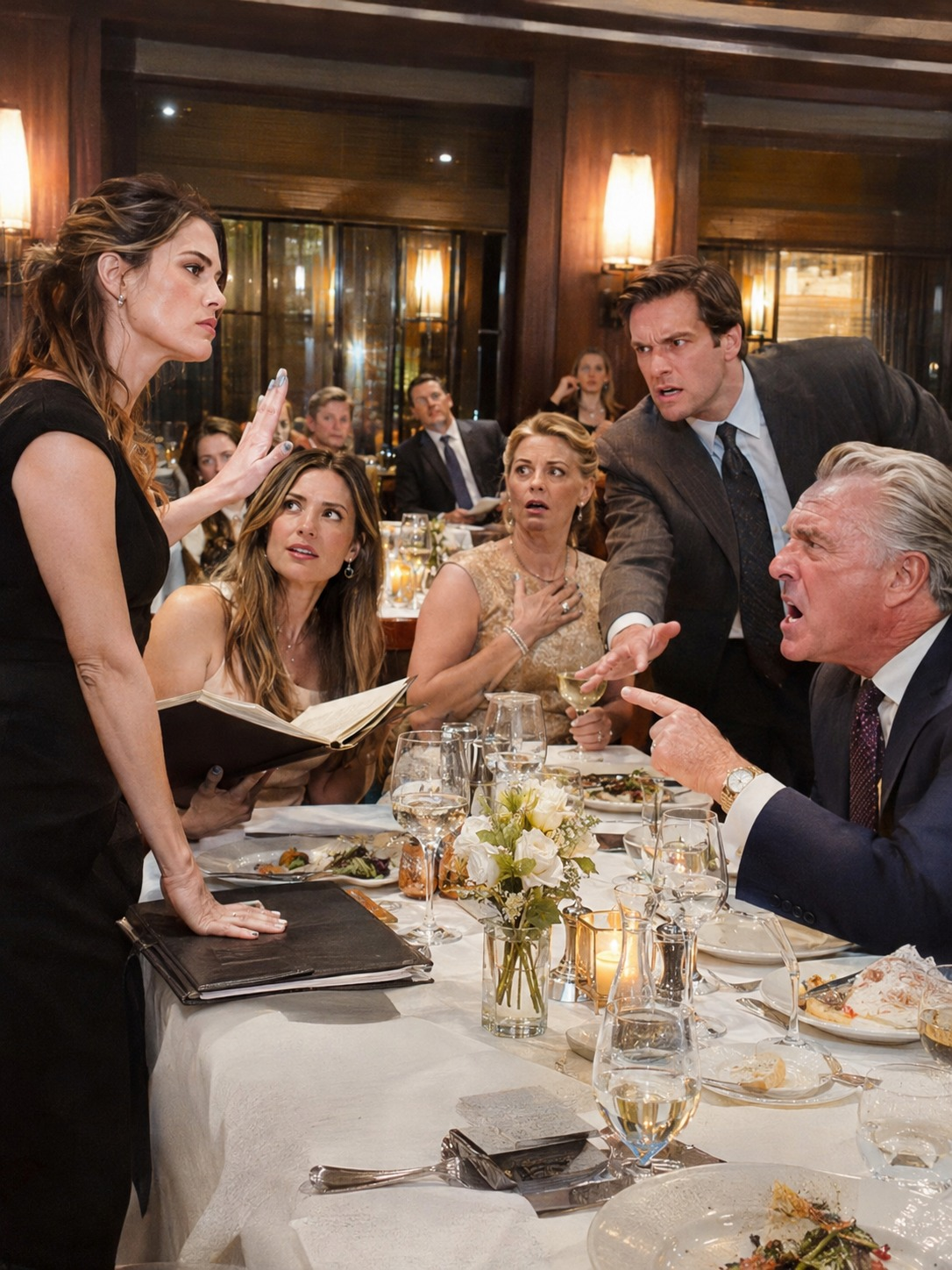
"That's not my name," I whispered, turning the place card over.
My father, Dr. Russell Whitfield, approached the table holding a crystal wineglass and glanced at the little ivory card in my hand.
Three words were printed beneath the gold border:
"Miss A. Witford."
He laughed.
"Close enough, sweetheart."
That was when I realized the mistake wasn't the name.
It was believing anyone in my family would care enough to correct it.
I stood beside my chair for another moment, holding the card between two fingers.
My legal name was Vivian Ailen Whitfield.
Everyone had called me Ailen since childhood. I had never particularly liked Vivian, mostly because my mother used it when she was disappointed in me, but it was the name on my birth certificate, my college transcripts, and every legal document I had signed as an adult.
Whitfield, however, had never been optional.
It was the name engraved on the brass plaque outside my father's medical office. The name printed on my mother's law firm stationery. The name my brother wore on his hospital identification badge like a medal.
Yet at my father's sixty-eighth birthday celebration, somebody had managed to turn me into Miss Witford.
And apparently, that was close enough.
"Don't stand there looking wounded," Dad said, adjusting his cuff links. "It's a place card, not a legal document."
"I know."
"Then enjoy yourself. Tonight's important."
He touched my shoulder briefly before walking toward a group of physicians gathered near the bar.
I watched him go.
There were certain things my father could identify without hesitation.
An abnormal heartbeat.
A dangerous complication during surgery.
A former patient he hadn't seen in fifteen years.
But he couldn't recognize what was wrong with his own daughter's name.
I slipped the card into my clutch instead of leaving it on the table.
I couldn't have explained why.
At the time, it felt like the sort of small, embarrassing thing I might want to complain about later to my friend and business partner, Olivia.
I didn't yet understand how important that little piece of cardboard would become.
"You're blocking the photographer."
My mother's voice appeared behind me.
Darlene Whitfield stood in an elegant royal-blue evening gown, her platinum-blonde hair arranged perfectly around her face. A diamond bracelet rested against her wrist, and she carried the expression she always wore at charity dinners: warm enough to impress strangers, sharp enough to control everyone related to her.
"Sorry, Mom."
"Move a little to the left. Russell and Lyall need a picture together."
I stepped aside.
My brother Lyall joined Dad beneath a large birthday banner.
HAPPY 68TH, DR. RUSSELL WHITFIELD.
Below it, in smaller gold letters, were the words:
HOSTED BY DARLENE AND LYALL WHITFIELD.
I studied the banner while the photographer adjusted his camera.
There was nothing unusual about my mother and brother organizing Dad's birthday.
What bothered me was that I had helped organize it, too.
Three weeks earlier, Mom had called because the restaurant's reservation system had duplicated several guest names. I spent an entire evening fixing the spreadsheet, correcting dietary restrictions, and coordinating with the event manager.
Two days later, Lyall asked whether I could troubleshoot the presentation equipment.
The night before the dinner, Mom sent me twelve frantic messages because the slideshow wouldn't load properly.
I fixed that as well.
But the banner belonged to Darlene and Lyall.
And the daughter who had done the technical work was standing outside the photograph.
"Perfect!" the photographer announced.
Dad put his arm around Lyall.
They smiled.
The flash went off.
I turned toward the dining table.
Eleven people were seated in our immediate section, with other relatives and colleagues occupying tables throughout the private room.
The restaurant was called Blue Ridge, an expensive establishment where the waiters seemed trained to move without making noise.
Dark walnut panels covered the walls. Crystal glasses reflected the golden candlelight. White flowers sat in small arrangements between polished silverware and carefully folded linen napkins.
My mother had selected every detail.
Even the color of the flowers matched the invitations.
I wondered whether anyone had proofread those as carefully as the place cards.
"Ailen!"
I turned.
My brother approached with his fiancée, Janelle.
Lyall was thirty-eight, handsome in the polished, expensive way that made strangers trust him before he said anything. His sandy-blonde hair was neatly styled, his midnight-blue suit perfectly tailored.
He had inherited Dad's height, Mom's confidence, and an extraordinary ability to make other people's accomplishments sound like his own.
"Hey, little sister," he said.
"I'm forty-one, Lyall."
He grinned.
"You'll always be little to me."
Janelle smiled politely.
She was younger than both of us, with copper-red hair and an elegant champagne-colored dress. She worked in healthcare investment strategy, though my family usually described her as someone who was "good with business."
I suspected she was considerably better than that.
"Happy birthday to your dad," she said.
"Thank you. You look beautiful."
"So do you."
Lyall glanced at my emerald-green dress.
"Big night for the computer department, huh?"
I looked at him.
"What does that mean?"
"Nothing. Just nice to see you away from a keyboard."
He laughed.
Janelle didn't.
Instead, she studied me for a moment.
"Actually, Ailen, I've been meaning to ask what kind of systems you work on."
"Mostly healthcare information platforms."
"Really? Which ones?"
I opened my mouth.
Lyall answered for me.
"She does the backend stuff. Very technical. You'd fall asleep."
Janelle looked at him.
"I work in healthcare technology, Lyall."
"Exactly. You know how boring the engineering side gets."
I could have corrected him.
I could have explained that my company developed systems used by hospitals to transfer patient information securely between departments.
I could have mentioned the years Olivia and I spent developing Medysync.
I could have explained that the software Lyall called boring had recently attracted serious acquisition interest.
Instead, I said, "It's more interesting than he makes it sound."
Janelle gave me a small smile.
"I'd like to hear about it sometime."
"Of course."
Lyall checked his watch.
"Come on, babe. Dad wants us at the main table."
He guided her away.
I watched them go and felt something familiar settle beneath my ribs.
Not anger exactly.
More like exhaustion.
There is a particular kind of loneliness that comes from being surrounded by people who believe they know you.
They know your childhood nickname.
They remember the time you fell off your bicycle.
They can tell embarrassing stories about your first boyfriend.
But they have no idea what you do every morning when you leave your apartment.
And worse, they don't seem curious.
I had spent years convincing myself that my family simply didn't understand my work.
Medicine was their language.
Law was my mother's language.
Software engineering was mine.
Different worlds, I told myself.
Different interests.
Different ways of measuring success.
But standing beside that dining table, I began wondering whether the problem was really a lack of understanding.
Perhaps understanding had never been the goal.
"Ailen, honey."
Mom appeared again.
"Can you check the projector before everyone sits down?"
I glanced toward the ceiling-mounted equipment.
"Is something wrong?"
"The slideshow was flickering earlier."
"Did you tell the restaurant?"
"They said it's fine, but you know how these people are."
She handed me a small remote.
"Just make sure it works."
I looked at the remote, then at her.
"Mom, I'm a guest."
She blinked.
"Of course you are."
"Then why am I checking the equipment?"
Her smile tightened.
"Because you're good at these things."
"That's not the same as being responsible for them."
"Ailen."
There it was.
That particular tone.
The one that meant I was approaching the invisible boundary between being helpful and being difficult.
"Your father has worked incredibly hard," she continued. "Tonight is about celebrating him. Please don't make everything complicated."
I took the remote.
"Okay."
Her smile returned immediately.
"Thank you, sweetheart."
She kissed the air beside my cheek and walked away.
I stood there holding a projector remote at my father's birthday dinner.
Somewhere behind me, someone laughed.
I didn't turn around.
The projector was fine.
Of course it was.
I checked the connection, tested the opening slide, and returned the remote to the event coordinator.
Then I went back to my seat.
The incorrect place card was still in my clutch.
I kept thinking about the first time my father had asked me what I wanted to become.
I was seventeen.
We were sitting in his study, surrounded by medical journals and framed certificates.
I told him I wanted to design technology that helped hospitals communicate better.
He listened for perhaps thirty seconds.
Then he said, "Why not become a doctor instead?"
"Because I like building systems."
"Systems don't save lives, Ailen. Doctors do."
I remember wanting to argue.
I remember thinking about medication errors, missing records, delayed test results, and all the ways a broken communication system could hurt patients.
But I was seventeen, and my father had spent his life saving people in operating rooms.
So I nodded.
Years later, I would learn that the difference between saving a life directly and building something that helped others save lives mattered far less than he believed.
But I never managed to convince him.
Dinner began shortly after seven.
The first course was served.
Dad entertained the table with a story about a difficult surgical case.
Everyone listened.
Lyall contributed an observation about hospital leadership.
Dad nodded approvingly.
My mother smiled at the guests as though each compliment paid to her husband and son reflected on her personally.
I ate quietly.
Across the table, Janelle occasionally glanced in my direction.
I couldn't tell whether she was curious or simply uncomfortable with the way Lyall kept interrupting me.
Halfway through the main course, Dad mentioned a new hospital technology initiative.
"Communication is the future of modern medicine," he announced.
I looked up.
"Absolutely," I said.
Dad continued.
"We've been studying some remarkable systems that improve coordination between departments."
Lyall leaned forward.
"Especially platforms that reduce information delays between clinical teams."
I stopped cutting my food.
That phrasing was familiar.
Very familiar.
It came from an early Medysync presentation Olivia and I had developed in college.
Not word for word.
But close enough.
Dad nodded toward Lyall.
"This is why I'm so proud of what my son is doing."
Several guests murmured their approval.
Lyall accepted the attention with practiced modesty.
"There's still a lot of work ahead," he said.
I set down my fork.
"Actually, the recent Medysync integrations—"
Dad raised one hand.
"Let's not turn dinner into a TED Talk, honey."
A few people laughed.
The words weren't shouted.
That almost made them worse.
He delivered them with the easy confidence of a man who had never considered that interrupting his daughter might be rude.
I looked down at my plate.
Janelle's fork stopped moving.
My mother leaned toward me.
"Just let your father enjoy his evening," she whispered.
I nodded.
It was easier.
It had always been easier.
For years, I had mistaken avoiding conflict for maintaining dignity.
I believed that if I stayed patient, worked hard, and allowed my accomplishments to speak for themselves, eventually my family would notice.
I had no idea how much silence could cost a person.
After the main course, I excused myself.
The restroom was empty.
I stood at the sink and studied my reflection.
My dark hair was smooth. My makeup was intact. My emerald dress looked exactly as it had when I left home.
Nothing about my appearance suggested that I was struggling to keep my composure.
I turned on the cold water.
Then I remembered something Olivia had said the previous week.
"You're allowed to be proud of what we've built, Viv."
She was the only person who regularly called me Vivian.
Not because she disliked Ailen.
Because Vivian Whitfield was the name on our incorporation documents, patent filings, and original development records.
She had spent so many years signing contracts beside that name that it had become natural to her.
I dried my hands.
My phone vibrated inside my clutch.
A message from Olivia.
"How's the family celebration?"
I stared at the screen.
Then I typed:
"Apparently I'm still the printer girl."
Her reply arrived almost immediately.
"Did they at least spell your name correctly this time?"
I laughed.
A real laugh.
It startled me.
I took a photograph of the place card and sent it.
Three dots appeared.
Disappeared.
Appeared again.
Finally, Olivia wrote:
"Viv. That's not funny anymore."
I read the message twice.
Then I typed:
"I know."
I was about to put the phone away when another notification appeared.
An email.
The sender was someone I recognized from Horizon Health Tech, the investment group currently reviewing Medysync for a potential acquisition.
I opened it.
The subject line read:
"Medysync Acquisition Review — Original Authorship Documentation."
My heartbeat quickened.
The message was short and professional.
Horizon wanted additional records establishing the platform's earliest technical development.
They were particularly interested in the original architecture sketches, prototype documentation, and names of the individuals who had contributed to the first working version.
I knew exactly where those documents were.
Some were stored in our company's secure archives.
Others existed in Olivia's timestamped development repository.
And the earliest designs were inside a worn leather notebook I had kept since college.
A notebook my father had once dismissed after barely looking through it.
A notebook I later found in a box of discarded household items.
I reread the email.
There was nothing threatening about it.
Nothing unusual for a company conducting acquisition due diligence.
Yet something about the timing unsettled me.
For years, my family had treated my work as a hobby.
Now an outside organization was asking questions that required exact names, dates, and documented contributions.
Facts.
Not family opinions.
Not dinner speeches.
Not jokes.
I forwarded the message to Olivia with a brief note.
"We should review the original archive tomorrow."
Then I returned to the dining room.
Dessert was being served.
Dad stood at the head of the table, preparing to make his birthday toast.
Lyall sat beside him.
Mom raised her glass.
I took my seat quietly.
Nobody noticed that I had been gone.
Dad began speaking about medicine, family, sacrifice, and legacy.
He thanked my mother.
He praised Lyall.
He spoke about the importance of carrying the Whitfield name into the next generation.
I listened without interrupting.
Then he looked toward my brother.
"One day, everything we've built will be in good hands."
Lyall smiled.
The guests applauded.
I placed my hands beneath the table.
My phone vibrated again.
I assumed Olivia had responded.
But when I glanced down, I saw a new email notification from Horizon.
This one had been marked urgent.
The subject line was different.
"Confidential: Third-Party Ownership Representation."
I stared at those words.
Then I opened the message.
The first sentence made me sit perfectly still.
Horizon had received information suggesting that another organization was claiming ownership rights over technology associated with Medysync.
I scrolled down.
There was an attachment.
A formal document.
The filename contained a word I recognized immediately.
Whitfield.
Not my name.
Not my company.
My family's name.
I touched the attachment.
It opened slowly.
The first page displayed an official letterhead.
Below it was a statement identifying the person who had allegedly authorized the ownership claim.
I leaned closer to the screen.
And there, beneath the signature line, was a name I knew better than my own...






Comments 0