The screaming came from the hallway.
For one terrible second, I thought someone had been killed.
Deputy Miller was already moving toward the door.
"Stay here," she ordered.
Thomas stood beside my bed, his face pale.
I heard hurried footsteps.
A woman crying.
Then a man's voice.
"Please! Somebody help me!"
Daniel.
My son.
I knew that voice.
I had heard it when he was six years old and broke his arm falling from a tree.
I had heard it when he was seventeen and wrecked his first car.
I had heard it when Robert died.
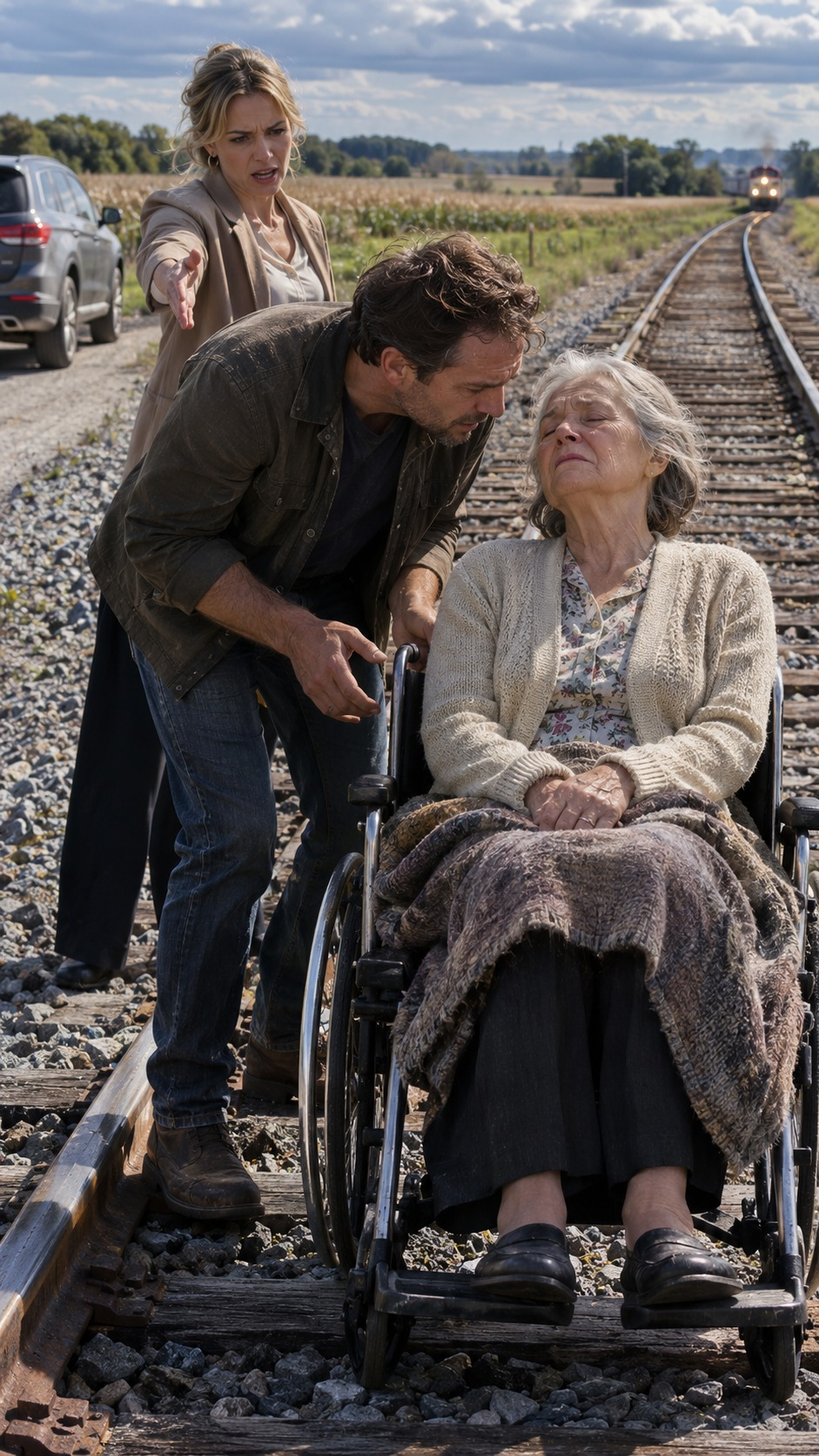
And I had heard it at the railroad crossing, just before he left me to die.
"Mom, please!"
I gripped the blanket.
Thomas looked at me.
"Eleanor, don't try to get up."
"I won't."
But I wanted to.
Every part of me wanted to see what had happened.
Miller returned a moment later.
"Mrs. Whitmore, your son is downstairs with officers."
"Is he hurt?"
"He's being examined."
"The blood?"
She hesitated.
"We don't know whose it is yet."
I closed my eyes.
Then I heard Daniel shouting again.
"Tell her I'm sorry!"
My heart twisted.
Sorry.
He had said that before.
I'm sorry, Mom. Please let this free both of us.
I opened my eyes.
"Deputy, is he under arrest?"
"He's being detained while investigators assess the situation."
I nodded.
"Good."
The word surprised even me.
For seventy-six years, I had been a mother.
For most of those years, I believed my first responsibility was to protect my son.
Now I understood something Robert had tried to tell me.
Protecting Daniel from consequences had never protected him from becoming the man he was.
It had only allowed him to keep making worse choices.
I looked at Miller.
"I want to know what happened."
"You will. But first we need to establish that everyone is safe."
I nodded.
She left again.
Thomas sat beside me.
Neither of us spoke for a while.
Then I looked at him.
"Victor said there was an old police report."
Thomas lowered his eyes.
"I know."
"Do you know what he meant?"
He took a slow breath.
"I think I do."
My stomach tightened.
"Thomas."
He looked at me.
"Years ago, Robert asked me to hold a sealed packet of documents. He told me they were connected to Daniel's business dispute. I was not involved in the original investigation, and I didn't review the packet at the time."
I stared at him.
"Where is it?"
"In my office safe."
"Did you open it?"
"After Victor mentioned the police report, I contacted my office and asked my associate to locate the packet. I received a scan of its inventory page a few minutes ago."
I gripped the blanket.
"And?"
"One item is described as a copy of a supplemental witness statement."
"Whose statement?"
Thomas swallowed.
"Marianne Hale's."
I closed my eyes.
The woman whose call had ended with a scream.
The woman Victor had apparently found.
The woman who knew what happened to Laura Bennett.
"Why didn't Robert give it to the police?"
Thomas looked troubled.
"We don't know that he didn't. The packet may contain a copy of something already submitted."
I nodded.
I was tired of discovering that every terrible possibility had another question attached.
"Then find out."
"I will."
He reached for my hand.
"Eleanor, there's something else I need to say."
I looked at him.
"Go ahead."
"I should have examined Robert's sealed materials sooner, once the threats began."
I studied his face.
He looked exhausted.
Older.
Ashamed.
"Thomas, you made mistakes."
He nodded.
"So did Robert."
His eyes filled.
"So did I."
I squeezed his hand.
"But you're here now. And we're going to tell the truth."
He nodded.
"Yes."
At seven-thirty that morning, Detective Carter came into my room.
He carried a folder.
His expression was serious, but he no longer looked as though he had been awake for three days.
"Mrs. Whitmore, we have information about Daniel."
I sat straighter.
"Is he alive?"
"Yes. His injuries are minor."
I exhaled.
I hadn't realized how tightly I had been holding my breath.
"And the blood?"
"Most of it appears to belong to another person."
My stomach tightened.
"Who?"
"Victor Hale."
I stared at him.
"Is Victor dead?"
"No. He's in custody and receiving medical treatment."
I closed my eyes.
Alive.
Victor was alive.
For reasons I couldn't explain, I was relieved.
I wanted him held accountable.
I wanted him to answer every question.
I didn't want another death.
Carter continued.
"Daniel arrived at the hospital after an altercation at a property outside town. He called emergency services while driving here."
"Did he hurt Victor?"
"According to Daniel, Victor attacked him after a disagreement. Daniel says he struck Victor with a metal object while defending himself. We're investigating that account."
I nodded.
"And Claire?"
Carter hesitated.
"She's alive."
My heart pounded.
"Where?"
"She's with investigators."
I stared at him.
"Did Daniel tell you what happened at the railroad?"
"He's begun giving a statement."
I looked down.
The railroad.
The tracks.
The train.
The cold metal beneath my wheelchair.
For a moment, I could hear the horn again.
I could feel the wind.
I could see Daniel turning away.
I gripped the blanket.
"Did he admit it?"
Carter looked at me.
"Yes."
I stopped breathing.
"He admitted leaving me on the tracks?"
"Yes."
My eyes filled with tears.
I had recorded what happened.
I had survived.
I had told the police.
But hearing that Daniel had finally admitted it felt different.
For days, I had been fighting people who wanted to make me doubt my own memory.
Now my son had confirmed the truth.
I wasn't confused.
I wasn't imagining things.
He had tried to kill me.
I looked at Carter.
"Did he say why?"
"He's described financial pressure, threats from Victor, and his own fear of losing access to your property."
I stared at the wall.
"My house."
"Yes."
"My money."
"Those were among the things he mentioned."
I swallowed.
"And Claire?"
Carter paused.
"Daniel says Claire helped plan the trip to the railroad crossing and prepared documents intended to support a false account of your condition and disappearance."
I closed my eyes.
There it was.
Not a misunderstanding.
Not a terrible accident.
A plan.
My son and his wife had decided that my death would solve their problems.
I began crying.
Quietly at first.
Then harder.
Thomas moved closer.
I shook my head.
"Don't."
He stopped.
"I need to feel this."
He nodded.
I cried for the mother I had been.
For the son I had raised.
For the family I had believed we still were.
And for the woman I nearly lost at that railroad crossing.
When I finally wiped my face, Carter was waiting.
I looked at him.
"Keep going."
He nodded.
"Daniel says Victor was pressuring them to obtain Robert's old records. He believed those records could expose his involvement in financial misconduct twenty years ago."
"Was Daniel stealing money?"
"Investigators have identified evidence of diverted business funds. Daniel has acknowledged participating in some of those transactions."
I looked down.
Robert had paid debts.
Signed settlements.
Tried to keep Daniel out of prison.
And Daniel had learned that someone else would clean up his mistakes.
Until there was no one left.
"Did Victor order them to kill me?"
Carter considered.
"Daniel says Victor threatened him and demanded access to your property and Robert's records. Daniel also says the decision to leave you at the crossing was made by him and Claire."
I nodded.
I didn't want Daniel to escape responsibility by blaming Victor.
He had been the one who pushed my wheelchair onto the tracks.
He had looked into my eyes.
He had walked away.
Nothing Victor said could erase that.
I looked at Carter.
"What about Dr. Keller?"
"We've confirmed that the medical assessment attributed to Dr. Martin Keller was fabricated. The real physician did not examine you or authorize the report. Investigators traced the false contact information to a service connected with Claire."
My stomach tightened.
"And the power of attorney?"
"The signature appears inconsistent with your verified signatures, and investigators have obtained evidence suggesting it was copied from another document."
I remembered April seventeenth.
Robert's birthday.
Yellow roses.
The cemetery.
The café.
Claire asking me to sign a card.
I looked at Carter.
"The birthday card."
He nodded.
"That is one of the documents being examined."
I closed my eyes.
Claire had taken me to Robert's grave.
She had watched me place flowers beside his headstone.
Then she had used my trust to obtain a signature.
It was almost too cruel to understand.
"What about the death notification?"
Carter opened his folder.
"Investigators found a matching draft on a computer used by Claire. It was prepared before the railroad incident."
I stared at him.
"So they expected me to die."
"That is consistent with the evidence."
I nodded slowly.
I had known it.
But knowing and hearing it confirmed were different things.
The draft.
The false medical report.
The forged authorization.
The missing-person story.
The railroad.
All pieces of the same plan.
I looked at Carter.
"And Margaret?"
"She's recovering. Investigators have interviewed her."
"Did she help them?"
He hesitated.
"She admits that she passed information about your property and routines to Claire and Victor. She says Victor threatened to expose financial irregularities involving her late husband's business."
I swallowed.
"So she betrayed me."
"She acknowledges doing things she knew were wrong. We're still determining the full extent of her involvement."
I looked down.
Margaret had been my friend for twenty-seven years.
She had held my hand at Robert's funeral.
She had brought banana bread.
She had listened when I was lonely.
And she had told people about my private life.
I felt anger.
But I also felt sadness.
"Did she know about the railroad?"
"She says she did not know Daniel and Claire intended to leave you there. The evidence we've reviewed so far does not establish that she participated in that decision."
I nodded.
"Then why was she at Robert's grave?"
"Daniel asked her to help recover a container he had buried after the funeral. Margaret says she believed it contained documents Victor was threatening to use."
I closed my eyes.
"Did she know Daniel had written a confession?"
"She says no."
I believed that might be true.
But I didn't know whether I could ever trust her again.
Carter continued.
"After the cemetery visit, Victor intercepted Margaret and held her at his property. Officers recovered evidence supporting her account of being restrained."
I swallowed.
"Will she be all right?"
"Her doctors expect her to recover."
I nodded.
"Good."
I meant it.
Even after everything.
At nine that morning, Deputy Miller returned with news about Marianne Hale.
She was alive.
Victor had reached her during the telephone call, but she had managed to escape through a rear exit while he was distracted.
She had contacted authorities from a nearby business.
By the time Miller told me, Marianne was under police protection.
I closed my eyes.
"Thank God."
Miller sat beside me.
"She's agreed to provide a formal statement."
My heart pounded.
"About Laura?"
"Yes."
I looked at her.
"Do you know what happened?"
Miller nodded slowly.
"We have her account, and we're comparing it with the old investigative records."
I gripped the blanket.
"Please tell me."
She took a breath.
"According to Marianne, Laura discovered that Victor had been diverting funds from the business. Daniel had helped conceal some transactions, though he later claimed he didn't understand the full extent of the scheme."
I nodded.
"Laura threatened to report them."
"Yes."
"And there was an argument."
"Yes."
Miller paused.
"Marianne says Victor grabbed Laura near the staircase. Daniel tried to pull Victor away. During the struggle, Laura lost her balance and fell."
I stared at her.
"So Victor caused her death."
"Marianne's account places Victor's actions at the center of the fall. Investigators are reviewing whether the evidence supports criminal charges."
I closed my eyes.
Twenty years.
A woman dead.
A child without her mother.
A family destroyed.
All because people had valued money and secrecy more than truth.
I looked at Miller.
"Then why did Victor say someone pushed her?"
"Marianne says Victor repeatedly described the incident as a deliberate push when threatening Daniel. But her account is that he grabbed Laura and she fell during the struggle."
I swallowed.
"And Daniel?"
"He was there. He concealed information afterward. His letter appears to reflect both guilt and fear."
I nodded.
I didn't excuse him.
But I understood the difference between causing a death and hiding the truth about one.
"Did Robert know?"
Miller looked at me carefully.
"He learned much of what happened from Marianne. We found evidence that he provided information to the original investigators."
I stared at her.
"Then why wasn't Victor charged?"
"The original case was closed without charges after investigators concluded they lacked sufficient evidence to establish criminal responsibility. Marianne had left the area before they could complete a follow-up interview."
I looked down.
"And Robert?"
"He kept copies of the documents and continued trying to locate her."
Tears filled my eyes.
Robert had made mistakes.
He had protected Daniel financially.
He had kept secrets from me.
But he had also tried to uncover what happened.
He had not simply buried the truth.
I looked at Miller.
"What was the police report Victor mentioned?"
"A supplemental statement describing Marianne's account and identifying Victor as the person who grabbed Laura. It was never enough by itself to establish what happened beyond reasonable doubt."
I nodded.
"Thomas didn't destroy it?"
"No. The copy in Robert's files matches the archived report."
I closed my eyes.
I was relieved.
Thomas had been my friend for decades.
I didn't want to discover that he had helped conceal a woman's death.
Miller continued.
"Marianne also explained the photographs."
I looked up.
"The one at Fairview?"
"Yes."
"The woman beside Robert and Victor?"
"Marianne."
I nodded.
"Not Claire."
"Correct."
I felt a strange relief.
At last, one question had a clear answer.
"And the little girl?"
"Emily Hale. Laura Bennett's daughter."
I swallowed.
"Claire."
Miller nodded.
"Claire was born Emily Hale. Victor was her father. Laura was her mother."
I stared at the wall.
The little girl in the birthday photograph.
The child who lost her mother.
The woman who became my daughter-in-law.
I looked at Miller.
"Why did she change her name?"
"Marianne says Emily was raised by relatives in Ohio after Laura's death. As an adult, she began using the name Claire Bennett. She also misrepresented her age in some personal accounts."
I nodded.
"And Victor?"
"He reestablished contact with her years later."
My stomach tightened.
"Did he tell her Daniel killed Laura?"
"According to Marianne, Victor blamed Daniel for Laura's death and encouraged Emily to seek information from the Whitmore family."
I closed my eyes.
Victor had turned his own daughter against Daniel.
Against Robert.
Against me.
He had used her grief.
Just as Robert had feared.
I looked at Miller.
"Did Claire know Victor caused Laura's fall?"
"Marianne says she tried to tell Emily years ago, but Victor prevented further contact. We don't yet know exactly what Claire believed at each point."
I nodded.
I wanted to understand Claire.
But I didn't want understanding to become an excuse.
She had suffered.
Then she had chosen to make me suffer.
Those were two different truths.
At eleven that morning, Daniel asked to speak with me.
Miller told me the request.
I sat quietly for a long time.
Then I said, "No."
She nodded.
"You don't have to."
I looked at her.
"Not today."
"That's your choice."
I swallowed.
"Tell him I'll speak through the investigators and my lawyer."
"I will."
After she left, Thomas sat beside me.
"Are you sure?"
I looked at him.
"Yes."
He nodded.
I stared toward the window.
"Part of me wants to see him."
"Of course."
"I want to ask how he could do it."
Thomas waited.
"But I don't think any answer would be enough."
He squeezed my hand.
"No answer has to be enough."
I nodded.
Then I whispered, "I still love him."
Thomas's eyes filled.
"I know."
"I wish I didn't."
He shook his head.
"You don't have to stop loving someone to protect yourself from them."
I closed my eyes.
That was the hardest truth of all.
Daniel was my son.
He always would be.
But he would never again have the power to decide whether I lived or died.
Over the following weeks, the investigation moved forward.
The railroad recording was preserved.
The photographs were examined.
The forged documents were traced.
Financial records from Fairview Storage revealed the old business scheme and helped investigators establish how Victor had continued using the dispute to threaten Daniel.
The metal case recovered from the storage unit contained copies of bank transfers, correspondence, and a list of payments Robert had made to settle legitimate debts.
It also contained a note in Robert's handwriting.
I paid what was owed. I will not pay for silence.
When Thomas read those words to me, I cried.
Robert had tried to draw a line.
He had simply drawn it too late.
Daniel and Claire were charged in connection with the attempted killing at the railroad crossing and the fraudulent documents.
Victor faced charges connected to his threats, the restraint of Margaret, and financial offenses. Investigators also reopened Laura Bennett's death, using Marianne's testimony and the recovered records.
I followed the proceedings carefully.
But I stopped watching every television report.
I stopped reading every rumor.
I learned that knowing the truth did not mean I had to let it consume every hour of my life.
Three months after the railroad incident, I returned to my house.
Not as a guest.
Not as a patient.
Not as a woman whose son and daughter-in-law had decided she couldn't live alone.
As the owner.
Thomas had arranged the necessary legal steps.
Daniel and Claire no longer had permission to occupy the property.
Their belongings had been removed under supervised arrangements.
The locks had been changed.
My financial accounts were secured.
My medical records were corrected.
The forged power of attorney had no authority over my care.
And my house was still mine.
When the car stopped in the driveway, I stared at the front porch.
The white railing needed paint.
The roses were overgrown.
A shutter hung slightly crooked.
But it was home.
Rebecca had come with me.
So had Thomas.
And Deputy Miller, who insisted she was only there to make sure the return went smoothly.
I smiled.
"You're all treating me like a queen."
Thomas laughed.
"Only because you're difficult to argue with."
I looked at him.
"That hasn't stopped you before."
He grinned.
Rebecca opened the car door.
My wheelchair waited beside the driveway.
I transferred carefully.
My knees ached.
But the pain was familiar now.
Manageable.
My physical therapist had helped me rebuild strength.
I could stand for short periods.
Walk a few steps with support.
And sit when I needed to.
I no longer treated the wheelchair as a prison.
It was a tool.
A way to move safely when my legs needed rest.
What mattered was that I decided when and how to use it.
Thomas pushed the chair toward the porch.
I stopped him.
"Wait."
He looked at me.
"What?"
I stared at the front steps.
Then at the temporary ramp that had been installed.
I smiled.
"Robert always said I was stubborn."
Thomas nodded.
"He was right."
I placed my hands on the armrests.
Rebecca moved beside me.
"Take your time."
I nodded.
I stood.
Slowly.
Carefully.
My knees trembled.
Rebecca offered her arm.
I took it.
Then I took one step.
Another.
And another.
I walked the short distance to the front door.
Thomas stood behind me.
I heard him sniff.
I turned.
"Are you crying?"
He shook his head.
"Allergies."
I laughed.
"Of course."
I reached into my handbag.
Took out my new house key.
And unlocked the door.
For a moment, I simply stood there.
The hallway smelled faintly of lemon polish.
Sunlight fell across the wooden floor.
Robert's photograph hung beside the staircase.
The grandfather clock ticked in the living room.
Everything was familiar.
And yet everything felt different.
I stepped inside.
My house.
My life.
My choice.
I began crying.
Rebecca put her arm around me.
I let her.
Then I looked at Robert's photograph.
"I'm home," I whispered.
For the first time in months, I believed I truly was.
The months that followed were not easy.
I attended medical appointments.
I worked with a physical therapist.
I met with counselors who helped me understand the fear that sometimes returned without warning.
I had nightmares about the railroad.
Sometimes I woke hearing a train horn that wasn't there.
Sometimes I dreamed Daniel was standing beside my bed.
But the nightmares became less frequent.
The house became peaceful again.
I hired a gardener to restore the roses.
I had the kitchen painted a soft yellow.
I replaced the curtains Claire had chosen without asking me.
And I moved Robert's favorite chair back beside the window.
One afternoon, Margaret wrote me a letter.
It was six pages long.
She apologized for passing information to Claire and Victor.
She admitted that fear had made her dishonest.
She said she had convinced herself that small betrayals didn't matter.
Then she wrote something I read three times.
I thought I was protecting my own life by giving away pieces of yours.
I sat at the kitchen table for a long time.
I remembered the banana bread.
The funerals.
The birthdays.
The twenty-seven years.
I didn't answer immediately.
A week later, I wrote back.
I told her I was glad she was recovering.
I told her I understood she had been frightened.
But I also told her that our friendship could not return to what it had been simply because she was sorry.
Trust would take time.
Perhaps it would never fully return.
I wished her well.
Then I mailed the letter.
I didn't feel cruel.
I felt honest.
Six months after the railroad incident, the criminal cases reached important resolutions.
Daniel pleaded guilty to charges arising from the attempted killing and the false statements made afterward.
Claire also pleaded guilty to charges connected with the plan and the fraudulent documents.
Victor was convicted of offenses related to his threats, unlawful restraint, and financial conduct. The renewed investigation into Laura's death established a much clearer account of the fatal struggle, though the passage of time limited what could be proved in court.
Marianne testified.
So did Margaret.
And so did I.
I sat in the courtroom in my wheelchair.
My hands rested on the armrests.
I looked at the judge.
Then at the lawyers.
Then at Daniel.
He looked older.
His hair had gone gray at the temples.
His shoulders were hunched.
For a moment, I saw the little boy who used to fall asleep on Robert's chest.
Then I remembered the railroad tracks.
I took a breath.
And told the truth.
I described the drive.
The crossing.
The wheelchair.
Daniel's words.
The train.
My escape.
The recording.
I did not exaggerate.
I did not soften anything.
When I finished, the courtroom was silent.
Daniel was crying.
I looked at him.
For a moment, I wanted to comfort him.
Then I looked away.
He had people who could help him face what he had done.
That was no longer my responsibility.
After the hearing, Thomas met me outside.
"You were extraordinary," he said.
I smiled faintly.
"I was terrified."
"I know."
"I thought my voice would shake."
"It did."
I laughed.
"Thank you."
"But you kept speaking."
I looked toward the courthouse steps.
"Yes."
I had.
And that was enough.
Later, I received a letter from Claire.
She wrote under both names.
Claire Whitmore.
Emily Hale.
She told me she had grown up believing Daniel was responsible for her mother's death.
She said Victor had encouraged that belief.
She admitted that when she met Daniel as an adult, she concealed her identity and began looking for Robert's records.
But she also wrote something that mattered.
I could have stopped. I had chances to tell the truth. Instead, I chose to hurt you. Whatever happened to my mother does not excuse that.
I read the letter twice.
Then placed it in a drawer.
I didn't write back.
I hoped Claire would someday understand what she had done.
I hoped she would find a way to live honestly.
But I no longer believed I had to be part of that journey.
One year after the railroad incident, I visited Robert's grave.
The damaged ground had been restored.
Fresh grass grew beside the headstone.
The old oak tree cast a broad shadow across the path.
I brought yellow roses.
His favorite.
Thomas drove me.
But when we reached the cemetery, I asked him to wait by the car.
I wanted a few minutes alone.
I moved my wheelchair along the path.
Stopped beside the grave.
Then looked at Robert's name.
"Hello, sweetheart."
The wind moved through the leaves.
I smiled.
"You wouldn't believe the year I've had."
I told him about the house.
The garden.
The new curtains.
The physical therapy.
The court proceedings.
I told him Daniel was alive and facing the consequences of what he had done.
I told him Claire's real name.
I told him Marianne had survived.
And I told him that Laura Bennett's daughter finally knew more of the truth about her mother.
Then I sat quietly.
For a long time.
At last, I looked at the headstone.
"Robert, I wish you'd told me everything."
My voice trembled.
"I know you were trying to protect me. But I needed to know."
I wiped my eyes.
"I think you knew that by the end."
The wind stirred the roses.
I smiled through my tears.
"I forgive you for being afraid."
I took a slow breath.
"But I'm not going to live afraid anymore."
I placed the flowers beside the stone.
Then I looked toward the path.
Thomas stood by the car, pretending not to watch.
I laughed softly.
"He's still bossy, you know."
I could almost hear Robert laughing with me.
I reached for the wheelchair brakes.
Locked them.
Then placed my hands on the armrests.
Slowly, I stood.
My knees trembled.
I held the headstone for support.
Then took one careful step.
And another.
I stood beside Robert's grave.
Not because I had to prove anything.
Not because walking made me stronger than sitting.
But because I wanted to.
Because my body still belonged to me.
Because my life still belonged to me.
And because I had survived.
I looked down at the headstone.
"Thank you for loving me," I whispered.
Then I smiled.
"And thank you for reminding me to love myself."
I returned carefully to the wheelchair.
Unlocked the brakes.
And made my way back to the car.
Thomas opened the door.
"Ready?"
I looked at the cemetery one last time.
Then nodded.
"Yes."
We drove home beneath a clear blue sky.
The roses were blooming when we arrived.
The porch railing had been painted.
The shutters were straight.
And sunlight filled the kitchen.
I made tea.
Thomas sat at the table.
We talked about ordinary things.
The weather.
The garden.
A book I was reading.
A neighbor's new puppy.
For the first time in a long while, ordinary things felt wonderful.
That evening, after Thomas left, I sat beside the living room window.
Robert's photograph rested on the table.
The grandfather clock ticked softly.
I looked around my house.
There were no whispered conversations upstairs.
No hidden documents.
No one answering questions for me.
No one telling me what I remembered.
No one deciding what I was allowed to do.
There was only the quiet sound of my own home.
I thought about the woman I had been at the railroad crossing.
Frightened.
Abandoned.
Certain she had reached the end of her life.
Then I thought about the woman sitting beside the window.
Still frightened sometimes.
Still grieving.
Still learning.
But alive.
And free.
I smiled.
The next morning, I had plans.
I was meeting Rebecca for lunch.
I was going to the garden center to buy new rosebushes.
And I was finally going to take the painting class I had talked about for years.
I had spent so much of my life caring for other people.
Now I was going to care for Eleanor too.
I reached for the lamp.
Turned it off.
And looked once more at Robert's photograph.
"Good night, sweetheart."
Then I went to bed in my own house.
With my own keys on the bedside table.
My own decisions waiting for morning.
And a future that belonged to no one but me.






Comments 0