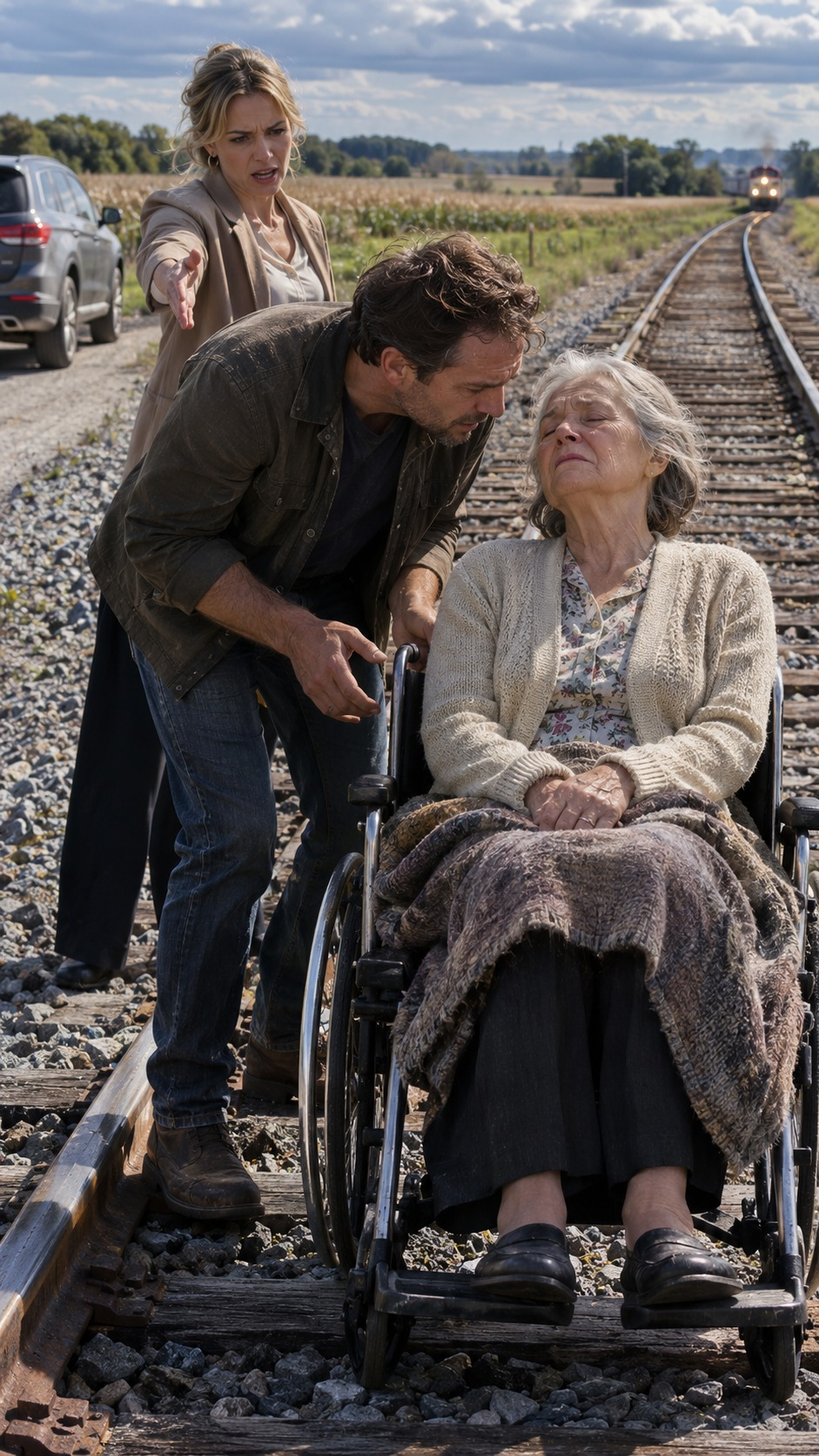
"Your daughter-in-law told the police you've been suffering from severe memory loss."
Thomas spoke the words slowly.
I stared at him from my hospital bed.
For a moment, I thought I had misunderstood.
"Memory loss?"
He nodded.
"According to Claire, you've been experiencing episodes of confusion, paranoia, and what she called dangerous delusions."
I looked at the phone in his hand.
"She said that?"
"Yes."
"To the police?"
"Yes, Eleanor."
I felt something cold settle in my stomach.
Claire hadn't simply lied about where Daniel had left me.
She had given the police a reason to question everything I said.
I reached for Thomas's phone.
"Let me see."
He hesitated.
"Are you sure?"
"Thomas, my son pushed me onto railroad tracks this afternoon. I think I can survive reading a message."
He handed me the phone.
The screen displayed a summary of the information Deputy Miller had shared with him.
Claire Whitmore had reportedly told investigators that I had become increasingly forgetful over the previous year.
She claimed I sometimes accused family members of stealing things.
She said I had trouble distinguishing dreams from reality.
And then came the sentence that made my hands begin to shake.
Mrs. Whitmore has repeatedly expressed the irrational belief that her son and daughter-in-law intend to kill her for her money.
I read it again.
And again.
My mouth went dry.
Claire had taken the very thing I feared most and turned it into evidence that I was losing my mind.
"She knew," I whispered.
Thomas leaned closer.
"What?"
"She knew I was suspicious. She knew I was afraid of them."
"Yes."
"But instead of asking why, she decided to make me sound crazy."
Thomas said nothing.
I looked toward the hospital window.
Outside, headlights moved through the parking lot.
People were arriving to visit loved ones.
Husbands carrying flowers.
Parents holding children's hands.
Families coming together because someone they loved needed help.
And somewhere in the same town, my son and his wife were telling police officers that I couldn't be trusted to describe my own attempted murder.
I handed the phone back.
"There's something else, isn't there?"
Thomas didn't answer immediately.
I knew him too well.
Thirty years of friendship had taught me to recognize the expression he wore when he was deciding how much bad news a person could bear at once.
"Thomas."
He sighed.
"Claire says she has medical documentation supporting her concerns."
I stared at him.
"What documentation?"
"She claims a doctor evaluated you several months ago."
"That's impossible."
"She says the evaluation indicated significant cognitive decline."
I shook my head.
"No."
"Eleanor—"
"No, Thomas. I never had that evaluation."
He watched me carefully.
"I believe you."
"The only doctors I've seen recently are Dr. Patel for my knees and my regular physician, Dr. Reynolds."
"Did either discuss cognitive testing with you?"
"Dr. Reynolds asked me a few routine questions during my annual examination. That's all."
"Did he diagnose you with anything?"
"Of course not."
My voice rose before I could stop it.
I lowered it immediately.
I didn't want anyone in the hallway hearing an elderly woman shouting about false medical records.
That was exactly the sort of behavior Claire would use against me.
Thomas seemed to understand.
"Listen carefully," he said. "A claim isn't proof. If she has a document, we'll find out where it came from."
I looked down at the blanket covering my legs.
"How long do you think they've been planning this?"
He didn't answer.
That frightened me more than any answer he could have given.
Because the truth was that I already knew.
It hadn't started at the railroad crossing.
It hadn't started when Daniel took my car keys.
It hadn't even started when I found the folder containing my financial records.
It had started when I became someone they could describe as helpless.
And I had helped them.
Not intentionally.
But I had.
After my fall eighteen months earlier, I had been frightened.
I had slipped on water near the kitchen sink and landed so hard that I couldn't stand.
For several terrifying minutes, I lay on the floor wondering whether anyone would find me.
Daniel had arrived after I called him.
He had knelt beside me.
"Mom, why didn't you tell me you were having trouble?"
I remembered crying.
Not because of the pain.
Because I was embarrassed.
I had always been independent.
I had raised Daniel while working part-time at the library.
I had managed our household finances after Robert's death.
I had repaired leaking faucets, negotiated insurance claims, and learned to use a computer long after most of my friends had given up trying.
Then one fall had made me feel like a burden.
Daniel had taken my hand.
"You're not doing this alone anymore."
I had believed him.
Three days later, he and Claire moved into my house.
At first, it felt like a blessing.
Claire organized my medications.
Daniel drove me to physical therapy.
They cooked dinner.
They cleaned.
They told me to rest.
And because I was grateful, I didn't notice when their help began turning into permission.
Permission to open my mail.
Permission to answer my phone.
Permission to decide who could visit.
Permission to tell other people what I could and couldn't remember.
The first time Claire corrected me in front of a neighbor, I laughed it off.
We were sitting in the kitchen with my friend Margaret Ellis.
Margaret had brought homemade banana bread.
I mentioned that Robert and I had purchased the house in 1989.
Claire smiled.
"Actually, Eleanor, I think it was 1991."
I frowned.
"No, dear. It was 1989."
Claire touched my shoulder.
"That's okay. Dates get confusing."
Margaret looked uncomfortable.
I remembered feeling embarrassed.
After she left, I went upstairs and found the original property documents.
1989.
I had been right.
When I showed Claire, she laughed.
"Oh, Eleanor. I was only trying to help."
I accepted that explanation.
Why wouldn't I?
She was my daughter-in-law.
Family.
I wanted us to get along.
But now, lying in that hospital bed, I remembered Margaret's expression.
She hadn't known which one of us to believe.
And Claire had noticed.
That was what frightened me.
Claire was observant.
She understood how people reacted.
She knew that a gentle smile and a concerned tone could make an accusation sound like kindness.
I looked at Thomas.
"Margaret."
He frowned.
"What about her?"
"Claire started correcting me in front of Margaret more than a year ago."
"Correcting you about what?"
"Everything. Dates. Appointments. Things I said. Things I supposedly forgot."
Thomas listened.
"Did Margaret ever mention being concerned?"
I nodded slowly.
"She called me last Christmas."
"What did she say?"
"She asked whether I was feeling all right. She said Claire had mentioned I was having trouble remembering conversations."
Thomas took out a small notebook.
"Do you think Margaret would speak with investigators?"
"Yes. But she may believe Claire."
"Then we'll let her describe what she actually witnessed."
I watched him write.
Something about seeing my memories placed into an orderly list made me feel stronger.
For months, every incident had existed alone.
A missing set of keys.
An opened envelope.
A corrected date.
A canceled appointment.
Each one seemed too small to justify a confrontation.
But together, they formed something I could no longer ignore.
A pattern.
And patterns could be examined.
Thomas closed his notebook.
"I'd like to contact Dr. Reynolds tomorrow."
"Why?"
"With your authorization, I'd like to obtain your actual medical records. We need to establish what evaluations you received and what your doctors documented."
I nodded.
"Do it."
He hesitated.
"There's another possibility we need to consider."
"What?"
"If Claire presents a document that doesn't match your records, we'll need to determine whether it's inaccurate, altered, or something else."
I stared at him.
"Are you saying she might have forged a medical report?"
"I'm saying we shouldn't assume anything until we see it."
That was Thomas.
Careful.
Measured.
Never willing to make an accusation he couldn't support.
I used to find that quality irritating.
That night, it felt like the only solid ground beneath my feet.
A soft knock came at the door.
Nurse Rebecca entered.
"Mrs. Whitmore? How are you feeling?"
"Tired."
"Any dizziness?"
"No."
"Pain?"
"My knees."
She checked the monitor beside my bed.
"Your blood pressure is improving. The doctor would like you to stay overnight for observation."
I looked at Thomas.
He nodded.
"That's probably wise."
Rebecca adjusted my blanket.
Then she glanced at the chair beside my bed.
"Would you like us to bring your wheelchair closer?"
"Yes, please."
She moved it within reach.
I looked at the black metal frame.
The worn hand rims.
The navy-blue blanket folded across the seat.
That wheelchair had nearly become my coffin.
Yet it had also helped save my life.
I had leaned against it when my legs threatened to collapse.
I had pushed it off the rails.
And hidden inside it was the phone Daniel hadn't known existed.
I reached toward the cushion.
Rebecca noticed.
"Do you need something?"
"No, thank you."
I withdrew my hand.
The hidden pocket was empty now.
Thomas had the phone.
And the recorder was being preserved as evidence.
For the first time in months, I had no secret device to protect.
No hidden plan to maintain.
Everything had begun moving into the open.
That should have made me feel safer.
Instead, I felt exposed.
After Rebecca left, Thomas pulled his chair closer.
"Eleanor, there's something I want to ask."
"Go ahead."
"Why did you agree to take that drive?"
I looked at him.
He already knew the answer.
We had argued about it the night before.
He had told me not to go.
He had said that if I feared Daniel and Claire might harm me, I should leave the house immediately.
He had offered to arrange transportation.
A safe place to stay.
Whatever I needed.
But I had refused.
I had told him I needed to know.
I needed to see whether my own son would actually do what I feared.
Now I understood how reckless that decision had been.
"I thought I could still be wrong," I said.
Thomas waited.
"I thought maybe Claire was cruel and Daniel was weak. Maybe they wanted my money but wouldn't actually hurt me."
My throat tightened.
"I wanted to believe there was a line he wouldn't cross."
Thomas's expression softened.
"You wanted to believe in your son."
"Yes."
I looked at my hands.
"And I almost died because of it."
He leaned forward.
"Eleanor, what Daniel and Claire chose to do is their responsibility. But I need you to promise me something."
"What?"
"No more testing them. No more putting yourself in danger to find out what they're capable of."
I nodded.
"I promise."
He studied me for a moment.
Then he reached into his briefcase.
"I brought something else."
He handed me a small envelope.
My name was written across the front in Robert's handwriting.
I stared at it.
For a moment, I couldn't breathe.
"Where did you get this?"
Thomas looked almost apologetic.
"From the estate file."
"Robert's?"
"Yes."
I ran my fingers across the familiar letters.
Eleanor.
My husband had always written the capital E with a little extra curve.
I hadn't seen his handwriting in years.
"Why do you have this?"
"Robert left several personal letters with his estate documents. Most were given to you after his death. This one remained in a sealed file because it related to instructions he wanted me to discuss with you if questions ever arose about the house."
I looked up.
"What questions?"
Thomas paused.
"About Daniel's inheritance."
My heart gave a painful thud.
"Robert never told me there was a problem."
"There wasn't a problem at the time."
"Then why write a letter?"
"Your husband believed in preparing for circumstances he hoped would never happen."
I almost smiled.
That sounded exactly like Robert.
He kept spare batteries in every drawer.
He carried jumper cables in the trunk.
He once bought three fire extinguishers because a neighbor's kitchen had caught fire.
He had always believed that being prepared was another way of loving someone.
I turned the envelope over.
The seal was intact.
"Should I open it?"
"That's your decision."
I held it for several seconds.
Then I placed it on the bedside table.
"Not tonight."
Thomas nodded.
He didn't push.
I was grateful.
I had already lost too much of my past in one day.
I wasn't ready to open another piece of it.
A few minutes later, Thomas's phone rang again.
He stepped into the hallway.
Through the partially closed door, I heard his low voice.
"Yes, Deputy."
A pause.
"No, she hasn't been discharged."
Another pause.
"I understand."
His tone changed.
"What exactly did she provide?"
I sat straighter.
Thomas listened for nearly a minute.
Then he said, "Please send me whatever you're authorized to share."
When he returned, I could tell something had happened.
"Claire?" I asked.
He nodded.
"Deputy Miller says Claire has produced a document."
My stomach tightened.
"The medical report?"
"Apparently."
"What does it say?"
"They're still reviewing it. But the document is dated six months ago."
I shook my head.
"Six months ago, I was seeing Dr. Patel about my knee."
"Do you remember the date?"
"Not exactly."
"That's all right. We'll check."
I looked at him.
"Does it have a doctor's name?"
"Yes."
"Who?"
Thomas hesitated.
"Dr. Martin Keller."
I frowned.
"I don't know anyone by that name."
"Neither do I."
"Where does he practice?"
"According to the document, at a private geriatric assessment clinic outside town."
I stared at him.
"I've never been there."
Thomas nodded.
"We'll verify that."
I felt anger rising.
For months, Claire had treated me like a confused child.
Now she was apparently presenting a medical report from a doctor I had never met.
I wanted to call her.
I wanted to demand an explanation.
I wanted to hear her stumble over her lies.
But then I remembered the railroad tracks.
And I remembered Daniel's message.
Mom's missing.
They were already constructing their story.
Anything I said to them now could become part of it.
I forced myself to remain quiet.
"Thomas?"
"Yes?"
"Please don't let them near me."
His expression became firm.
"I'll make sure the hospital knows your wishes, and we'll speak with the deputy about appropriate protections."
I nodded.
Then I asked the question that had been growing inside me since the afternoon.
"Do they know I'm alive?"
Thomas looked at his phone.
"Not from me. The investigators are handling contact with them."
"But eventually they'll find out."
"Yes."
I stared at the ceiling.
I tried to imagine Daniel receiving that news.
Would he be relieved?
Would he cry?
Would he rush to the hospital?
Or would he panic because the woman he had left to die was still breathing?
I didn't know which possibility frightened me more.
Thomas remained until nearly nine.
Before leaving, he spoke with the hospital staff about my safety concerns.
He made sure my belongings were accounted for.
He reminded me that the sheriff's office had my statement.
And he promised to return first thing in the morning.
At the door, he turned back.
"Eleanor."
"Yes?"
"You're not alone."
I looked at him.
The words were familiar.
Daniel had said them eighteen months earlier.
But coming from Thomas, they felt different.
He wasn't asking me to surrender control.
He was offering help while leaving the decisions in my hands.
"Thank you," I whispered.
After he left, the room became quiet.
I watched the television without absorbing a word.
At ten, Rebecca brought my evening medication.
At eleven, she checked my blood pressure.
By midnight, the hallway had grown still.
I tried to sleep.
Every time I closed my eyes, I heard Daniel's voice.
I'm sorry, Mom.
Then Claire's.
Stop hesitating.
I opened my eyes.
The hospital room was dim.
A small light glowed above the sink.
I reached for the glass of water beside my bed.
My hand brushed Robert's envelope.
I picked it up.
Turned it over.
For a moment, I considered opening it.
Then I remembered something my husband had once told me.
"People show you who they are when they think you have nothing left to give them."
At the time, we had been talking about a former business partner.
Robert had trusted the man.
Lent him money.
Helped him find work.
And when Robert needed a favor in return, the man disappeared.
I had asked whether Robert regretted helping him.
"No," he had said. "I regret confusing gratitude with character."
I looked at the envelope.
Then at the wheelchair.
My son had confused my love with weakness.
And Claire had confused my silence with surrender.
I placed the letter back on the table.
Tomorrow, I would open it.
Tonight, I needed rest.
I had just begun drifting to sleep when I heard voices outside my room.
A man's voice.
Low.
Insistent.
Then a woman's voice.
Firm.
"I'm sorry, sir. You can't go in there."
My eyes opened.
I recognized Rebecca.
The man answered.
"I don't understand. I'm her son."
My entire body went cold.
Daniel.
I gripped the blanket.
He was here.
Somehow, he had found me.
Rebecca spoke again.
"Mrs. Whitmore has requested that visitors be approved before entering."
"She's confused," Daniel said quickly. "That's exactly why I need to see her."
I stopped breathing.
His voice sounded worried.
Gentle.
Almost desperate.
The same voice he had used when I was sick as a child.
The same voice that had whispered an apology beside the railroad tracks.
"Sir, I need you to step away from the door."
"Please. My mother needs me."
I stared at the handle.
My heart pounded so hard that I could hear it.
Then another voice joined the conversation.
A woman's voice.
Smooth.
Controlled.
Claire.
"Daniel, don't argue with the nurse."
I heard her move closer.
"Excuse me," she said politely. "My mother-in-law has been experiencing serious cognitive problems. We have documentation from her doctor. She may not understand that she's refusing her own family."
Rebecca remained firm.
"I understand your concerns, but I still can't allow you inside without authorization."
Claire sighed.
"I appreciate that you're trying to protect her. But Eleanor has been making accusations lately. Very disturbing accusations."
I closed my eyes.
There it was again.
The same story.
The same performance.
I could almost picture Claire's concerned expression.
The slight tilt of her head.
The careful softness of her voice.
She had practiced that voice for months.
And now she was using it outside my hospital room.
Daniel spoke again.
"Can you at least tell us if she's okay?"
Rebecca paused.
"She's receiving appropriate care."
"Did she say anything about us?"
My eyes opened.
That question.
Not Is she hurt?
Not What happened?
Not Can I speak to her?
Did she say anything about us?
I felt something inside me harden.
Claire lowered her voice.
"Daniel."
He stopped speaking.
For several seconds, I heard nothing.
Then footsteps moved away.
I waited.
One minute.
Two.
Finally, Rebecca opened the door.
She looked startled to find me sitting upright.
"Mrs. Whitmore, I'm sorry if they disturbed you."
I swallowed.
"Was that my son?"
She nodded.
"And his wife."
"Did they leave?"
"Security is speaking with them."
I looked toward the hallway.
"Please don't let them in."
"We won't."
She approached my bed.
"Would you like me to call someone?"
"Thomas Brooks."
"Of course."
I gave her his number.
She wrote it down.
Then she paused.
"Mrs. Whitmore, there's something you should know."
My stomach tightened.
"What?"
"Your daughter-in-law brought paperwork."
I stared at her.
"What kind?"
"She said it gave her husband authority to make medical decisions for you."
I felt the room tilt.
"That's impossible."
Rebecca's expression remained careful.
"The hospital is reviewing it. No one has accepted it as valid."
I shook my head.
"I never signed anything like that."
"Then it's important you tell the appropriate staff."
"I will."
Rebecca nodded.
"I'll ask the charge nurse to come speak with you."
She turned toward the door.
"Rebecca?"
She looked back.
"Did you see the document?"
"Only briefly."
"Was my signature on it?"
She hesitated.
"I believe there was a signature."
I stared at her.
My hands had begun shaking again.
"Rebecca, I never signed a medical power of attorney giving Daniel control."
Her expression softened.
"I understand."
She left to contact the charge nurse.
I sat alone.
The room felt smaller.
The air felt heavier.
I remembered the unsigned power-of-attorney form in Daniel's desk.
The notes in Claire's handwriting.
The conversations about my house.
And now, somehow, there was a document claiming my son could make decisions for me.
I reached for the bedside phone.
I needed Thomas.
Immediately.
Before I could dial, someone knocked.
"Mrs. Whitmore?"
A woman's voice.
Not Rebecca.
"Yes?"
The door opened.
A hospital administrator entered carrying a thin folder.
Behind her stood a uniformed security officer.
The administrator introduced herself as Linda Parker.
She pulled a chair beside my bed.
"Mrs. Whitmore, I'm sorry to disturb you so late."
"Is this about my son?"
"Yes."
She opened the folder.
"Your son and daughter-in-law presented a document that appears to designate Daniel Whitmore as your healthcare agent."
I shook my head.
"I never authorized that."
Linda nodded.
"We haven't made any determination about its validity. Given your stated wishes and the circumstances, we're treating this very carefully."
I leaned forward.
"May I see it?"
She turned the document toward me.
There was my name.
Eleanor Whitmore.
My address.
My date of birth.
And beneath several paragraphs of legal language, there was a signature.
It looked like mine.
Almost.
The E was right.
The W was close.
But something was wrong.
I had spent sixty years signing my name.
On checks.
On birthday cards.
On school permission slips.
On mortgage documents.
I knew the movement of my own hand.
This signature was too careful.
Too deliberate.
As though someone had practiced it.
I looked at the date.
April 17.
Six months earlier.
My heart began pounding.
I remembered April 17.
Not because anything remarkable had happened.
But because it was Robert's birthday.
Every year, I visited his grave that morning.
Every year, I brought yellow roses.
And every year, I spent the afternoon alone.
Except that year.
That year, Claire had insisted on coming with me.
She had driven me to the cemetery.
Helped me out of the car.
Waited while I placed flowers beside Robert's headstone.
Then she had suggested stopping for lunch.
I remembered the restaurant.
The little café on Main Street.
I remembered Claire ordering tea.
I remembered her telling me Daniel was worried about my future.
And I remembered something else.
She had asked me to sign a card.
A birthday card for Daniel's friend.
She said she had forgotten to bring her glasses and wanted me to write a short message.
I had signed my name.
Then handed the card back.
At the time, it had seemed harmless.
Now I stared at the signature on the document.
I couldn't prove how it had gotten there.
But I knew I hadn't signed that form.
"Mrs. Whitmore?"
Linda's voice brought me back.
"Are you all right?"
I looked up.
"No."
She waited.
I pointed to the signature.
"That isn't mine."
The administrator nodded.
"We'll document your statement."
I swallowed.
"And I want the police to know."
"Of course."
She closed the folder.
"There's another reason I came to speak with you."
I looked at her.
"What?"
"Your son told us he believes you're incapable of making your own medical decisions."
I felt anger rise.
"Because Claire told him to say that."
Linda didn't respond.
"He says you've been experiencing hallucinations," she continued.
I stared at her.
"Hallucinations?"
"He claims you described being abandoned on railroad tracks, but that no such incident occurred."
I gripped the blanket.
"Then how did I get there?"
Linda's expression remained composed.
"That's part of what the authorities are investigating."
I looked toward the security officer.
He stood quietly beside the door.
I wondered whether he believed me.
Whether Rebecca believed me.
Whether anyone would believe me once Daniel and Claire finished telling their story.
Then I remembered the recorder.
My voice.
Daniel's voice.
Claire's voice.
The sound of the SUV leaving.
The train.
The truth existed outside my memory.
They couldn't simply explain it away.
I looked at Linda.
"Please tell Deputy Miller that I want to speak with her again."
"Certainly."
"And please make sure Thomas Brooks receives a copy of that document through the proper process."
"I'll note your request."
She stood.
The security officer opened the door.
Before leaving, Linda turned back.
"Mrs. Whitmore, your son also asked us to contact a particular physician."
My stomach tightened.
"Who?"
She glanced at the folder.
"Dr. Martin Keller."
The same name.
The doctor I had never met.
The doctor whose report supposedly proved I was losing my mind.
I stared at her.
"Why?"
"He said Dr. Keller could confirm your medical history."
I took a slow breath.
"Then I think someone should speak with Dr. Keller."
Linda nodded.
"We'll make sure your concerns are documented."
After they left, I sat staring at the closed door.
For the first time, I understood how carefully Daniel and Claire had prepared.
A story about a confused elderly woman.
A medical report.
A document bearing a signature that resembled mine.
A son who appeared worried.
A daughter-in-law who sounded compassionate.
And somewhere beneath it all, the real reason they wanted me gone.
My house.
My savings.
My independence.
I looked at Robert's envelope on the bedside table.
I picked it up again.
This time, I broke the seal.
Inside was a single folded letter.
I recognized my husband's handwriting immediately.
My eyes filled with tears.
I unfolded the paper.
The first line read:
My dearest Eleanor,
I pressed my lips together.
For a moment, I could almost hear his voice.
Then I continued reading.
If Thomas has given you this letter, I hope it is only because you are reviewing our estate plans. But there is something I never wanted you to forget.
I swallowed.
Everything we built belongs to you first. The house, the savings, and the choices about your future are yours to make. Daniel is our son, and I love him more than I can explain. But being our son does not give him the right to take what is yours.
I covered my mouth.
Robert had written those words years before Daniel moved into my home.
Years before Claire began opening my mail.
Years before the railroad.
He hadn't predicted what would happen.
He had simply understood something I had forgotten.
Love did not require surrender.
I read the rest of the letter slowly.
Robert wrote about our marriage.
About the sacrifices we had made.
About how proud he was of the life we had built together.
He asked me to enjoy whatever years remained after his death.
To travel if I wanted.
To sell the house if it became too much.
To stay if it made me happy.
And above all, to remember that I was entitled to make those decisions myself.
At the bottom, he had written:
You spent your life taking care of everyone else. Promise me you'll take care of Eleanor, too.
I pressed the letter against my chest.
And cried.
Not because I was weak.
Not because I had given up.
But because the man who had loved me most had left me a reminder of who I was before fear made me forget.
I sat that way for several minutes.
Then I carefully folded the letter and returned it to its envelope.
My phone rang.
The bedside telephone.
I startled.
Then reached for it.
"Hello?"
"Eleanor?"
Thomas.
I nearly cried again.
"Thomas, they came here."
"I know. Rebecca called me."
"Daniel and Claire brought a document."
"I know."
"It has my signature, but I didn't sign it."
"I understand."
"And they keep mentioning a doctor I've never seen."
Thomas was silent for a moment.
Then he said, "Eleanor, I need you to listen carefully."
My stomach tightened.
"What happened?"
"I made some calls."
"About Dr. Keller?"
"Yes."
"And?"
"I found the clinic listed on the report."
I leaned forward.
"Did you speak to him?"
"No."
"Why not?"
Thomas paused.
"Because the clinic's public contact information doesn't match what appears on the document Claire provided."
I stared at the wall.
"What does that mean?"
"It means we need to verify the document's source. I don't want to speculate yet."
I took a breath.
"Thomas, please tell me what you found."
He lowered his voice.
"The phone number on the report doesn't appear to belong to the clinic."
I felt cold.
"Whose number is it?"
"I'm still checking."
"Do you think Claire made the report herself?"
"I don't know."
I looked toward the door.
"Then what do we do?"
"We preserve everything. We let the investigators examine the documents. And tomorrow, with your permission, we obtain your actual medical records."
I nodded.
"All right."
Thomas hesitated.
"There's something else."
I closed my eyes.
I was beginning to hate those words.
"What now?"
"Deputy Miller contacted me again."
"About Daniel?"
"Yes."
I waited.
"She says investigators have obtained information about the SUV's movements this afternoon."
My heart began pounding.
"From where?"
"She's coming to speak with you about it."
I looked at the clock.
12:43 a.m.
"Tonight?"
"Yes."
I glanced toward the hallway.
"Why would she come this late?"
Thomas didn't answer immediately.
Then he said, "Because something in the information doesn't match Daniel's statement."
I gripped the phone.
"What doesn't match?"
"Eleanor, I think it's better if Deputy Miller explains."
Before I could respond, I heard footsteps approaching.
Then a knock.
"Mrs. Whitmore?"
Deputy Miller's voice.
Thomas heard it through the phone.
"She's there?"
"Yes."
"Good. I'll stay on the line."
I looked toward the door.
"Come in."
Deputy Miller entered.
She was carrying a small evidence envelope and a folder.
Her expression was serious.
But there was something else in her eyes.
Something I hadn't seen earlier.
Concern.
Not the polite concern people showed an elderly woman.
The kind that came when someone had discovered a fact they wished wasn't true.
She pulled a chair beside my bed.
"Mrs. Whitmore, I'm sorry to wake you."
"I wasn't sleeping."
She nodded.
"I need to ask you a few more questions about this afternoon."
I held the phone.
"Thomas is on the line."
"That's fine."
She opened the folder.
"Your son told us he and his wife drove directly home after leaving you at the county park."
I nodded.
"That's what Thomas told me."
Deputy Miller looked at me.
"We've received information suggesting the SUV traveled elsewhere."
My mouth went dry.
"Where?"
She paused.
Then reached into the folder.
"Before I show you, I need to ask something."
"Go ahead."
"When Daniel pushed your wheelchair onto the railroad tracks, did he say anything besides the apology you described?"
I thought carefully.
"No. Claire told him to hurry. He said he was coming. That's all I remember."
Deputy Miller nodded.
"Did you hear either of them mention another person?"
I frowned.
"Another person?"
"Yes."
"No."
She looked down at the folder.
Then back at me.
"Mrs. Whitmore, we have reason to believe your son may have contacted someone shortly after leaving the crossing."
I felt my pulse quicken.
"Who?"
Deputy Miller didn't answer.
Instead, she removed a printed photograph from the folder.
She placed it face down on the bedside table.
Then she looked directly into my eyes.
"Before you see this, I need you to understand that we're still verifying the circumstances."
I stared at the photograph.
My fingers tightened around the telephone.
"Deputy, what is it?"
She slowly turned the photograph over.
I looked down.
And the moment I recognized the person standing beside Daniel's SUV, I forgot how to breathe.






Comments 0