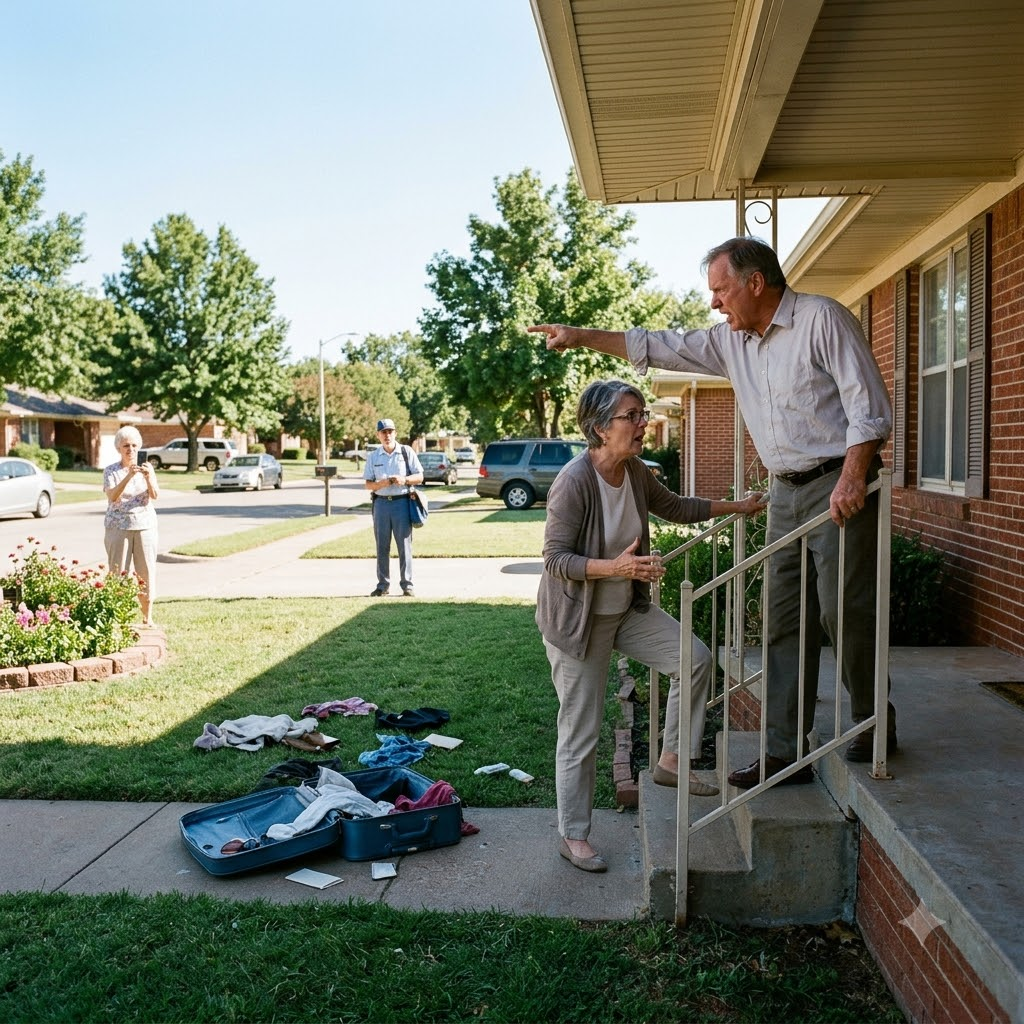
My husband shoved me down the concrete steps and shouted:
"Get off my porch, you useless woman!"
My old brown suitcase landed in the middle of the lawn.
But something inside it caught the sunlight.
It was the mineral deed Grant had desperately wanted me to sign.
And for the first time in thirty-eight years, I realized my husband was afraid of something.
My name is Stella Rutherford. I was sixty-three years old, a retired middle school Earth Science teacher, and until that afternoon, I had believed I understood the man I had been married to for nearly four decades.
I was wrong.
Very wrong.
"Did you hear me?" Grant shouted from the porch.
I was sitting on the concrete walkway, one hand pressed against the ground and the other wrapped around my injured right wrist.
My palms stung where the rough concrete had scraped them.
My knees hurt.
My suitcase was open.
A cream blouse, two pairs of trousers, a small jewelry case, and several photographs had spilled across the grass.
Grant stood above me in his dark jacket, his face flushed with anger.
He was sixty-three, tall, broad-shouldered, and still carried himself like a man who believed the entire world should move whenever he gave an order.
For thirty-eight years, I had mistaken that behavior for confidence.
Now I understood it was something else.
He wanted me frightened.
He wanted me embarrassed.
Most importantly, he wanted me to sign a document.
"Get your junk off my property!" he snapped.
I looked up.
"Our property, Grant."
He laughed.
It was a short, ugly sound.
"Not anymore."
He turned toward the front door.
I watched him pull out his phone.
Across the street, Doreen Platt stood beside her flowerbed.
She had been working in her garden when everything happened.
Her pale cardigan was visible above the flowers, and both hands held her smartphone.
She was recording.
I could see the small movement of her fingers as she adjusted the camera.
Doreen and I had lived across from each other for almost twelve years.
We had exchanged Christmas cookies, discussed neighborhood repairs, and occasionally complained about the rising cost of groceries.
We were not particularly close.
But she was witnessing something I would never forget.
"Stella!" Grant shouted again.
I looked toward him.
"Take your suitcase and get out of here. I don't want to see your face again."
I didn't answer.
He seemed offended by my silence.
Perhaps he had expected me to cry.
Perhaps he had expected me to beg.
For most of our marriage, I would have done exactly that.
I would have apologized even when I had done nothing wrong.
I would have tried to soften his anger, explain my intentions, and convince him that we could work things out.
That afternoon, however, I had no strength left for another argument.
My wrist throbbed.
My palms were bleeding.
And my mind kept returning to the document lying among my clothes.
The Mineral Deed and Assignment.
That was what Grant wanted.
Not my suitcase.
Not my clothes.
Not even the house.
He wanted the farm.
Four hours earlier, I had still believed that inheritance was simply a family matter.
I had not understood that it would become the beginning of the worst day of my life.
The reading of my grandfather's will had taken place in a quiet law office that morning.
His name was Arthur Rutherford.
He had been a farmer, a private man, and one of the few people in my childhood who never made me feel foolish for asking questions.
I remembered sitting beside him in the old farmhouse when I was twelve years old.
He would place small rocks on the kitchen table and ask me to identify them.
Sometimes he showed me layers of soil.
Other times, he explained how water moved through different kinds of stone.
I eventually became an Earth Science teacher because of those afternoons.
Grandpa had always encouraged me to look beneath the surface.
"Never judge the ground by what grows on top of it, Stella," he used to say.
I had never forgotten those words.
Unfortunately, I had forgotten something else.
My grandfather had never trusted appearances.
The attorney, a woman named Norah Pruitt, sat behind a polished wooden desk with a folder open in front of her.
My younger sister, Celeste, sat across from me.
She looked elegant in a cream designer suit, with her blonde hair styled perfectly and a diamond bracelet around her wrist.
She had flown in from California for the will reading.
I had driven from Edmond, Oklahoma, with Grant.
He had spent most of the morning checking messages from his roofing company.
His business had been struggling for months.
Several customers had filed lawsuits over unfinished projects, and suppliers were demanding overdue payments.
He rarely discussed the details with me.
Whenever I asked, he said everything was under control.
I had believed him.
Until that morning.
Norah adjusted her glasses.
"Your grandfather's estate includes several properties and financial holdings," she explained.
Celeste leaned forward.
I noticed the excitement in her eyes.
Norah began reading.
Celeste inherited the Los Angeles penthouse, a property valued at approximately five million dollars.
She also received several financial accounts and personal investments.
Celeste covered her mouth.
Then she laughed.
Not quietly.
Not politely.
She actually laughed.
"Oh, my goodness."
I glanced at her.
She looked directly at me.
"And what did he leave you, Stella? The old barn?"
Norah continued reading.
I was to inherit my grandfather's eight-hundred-acre wheat farm in Kingfisher County.
For a moment, nobody spoke.
Then Celeste leaned back in her chair.
"An eight-hundred-acre dust bowl."
She shook her head.
"Well, I suppose someone has to take care of the weeds."
I looked at Norah.
"Is that everything?"
"That is the principal property assigned to you in the will," she answered.
Celeste smiled.
"I think Grandpa knew who appreciated the city and who liked dirt."
I said nothing.
I had spent thirty years teaching children about the ground beneath their feet.
I understood that land could have value beyond its appearance.
Still, I had not expected to receive the farm.
I had assumed Grandpa would sell it before his death.
Grant, however, did not laugh.
His expression changed the moment Norah mentioned the property.
He looked at me.
Then at Norah.
Then back at me.
"Eight hundred acres?" he asked.
"Correct," Norah replied.
"Is the title clear?"
Norah paused.
"The estate documents establish Stella as the beneficiary. There are additional records concerning the property's mineral rights, which should be reviewed carefully."
Grant's eyes narrowed.
"Mineral rights?"
Norah closed the folder.
"Any questions concerning those rights should be directed to my office after the estate documents have been reviewed."
Grant leaned back.
He said nothing else.
At the time, I thought he was merely surprised.
Now I knew that the word mineral had changed everything.
We arrived home shortly after lunch.
Grant barely spoke during the drive.
I tried to make conversation.
I mentioned that I might visit the farmhouse the following weekend.
Perhaps I could inspect the roof, check the plumbing, and see whether the old property needed repairs.
He didn't respond.
When we entered the house, he went straight to his office.
I took off my coat and began sorting through the mail.
A few minutes later, he returned carrying a stack of papers.
He dropped them onto the kitchen table.
"Sign these."
I looked at the top page.
Prairie Line Minerals.
I recognized the company name from the letterhead.
"What is this?"
"A business opportunity."
I turned the first page.
The document appeared to concern the transfer of my grandfather's farm.
"Why is my name on this?"
"Because you inherited the property."
I looked at him.
"What's Prairie Line Minerals?"
"An investment group."
"Why do they want the farm?"
Grant exhaled sharply.
"Stella, don't start asking a hundred questions."
I continued reading.
The first page mentioned a payment of three hundred thousand dollars.
I turned to the second page.
My eyes stopped.
MINERAL DEED AND ASSIGNMENT.
I read the heading again.
Then I looked at the paragraphs beneath it.
The document was not simply an agreement to sell the farm.
It involved mineral interests and rights associated with the property.
I had taught Earth Science long enough to recognize that those words mattered.
A mineral deed could transfer rights that were separate from the surface ownership.
And this document appeared to contain provisions far more complicated than the simple sale Grant had described.
"Who prepared this?" I asked.
"Lawyers."
"Which lawyers?"
"Does it matter?"
"Yes."
He pushed a pen toward me.
"Three hundred thousand dollars is a generous offer for that old property."
I placed the pen back on the table.
"I need to speak with Grandpa's attorney."
His face changed.
"What?"
"Norah Pruitt. I want her to review this."
Grant stared at me.
"You don't need another lawyer."
"She handled the estate."
"And I'm handling this."
I looked down at the document.
"Then you shouldn't have a problem with me asking her to review it."
For several seconds, the kitchen was silent.
Then Grant laughed.
But there was no humor in it.
"You've been a schoolteacher for too long. You think every little thing needs a lesson and a permission slip."
I folded the document.
"I'm not signing it today."
His chair scraped against the floor.
"Stella."
I looked up.
"Don't make this difficult."
"I'm not."
"That farm is useless to you."
"Then why are you so interested in buying it?"
He stepped closer.
I should have recognized the danger in his expression.
But after thirty-eight years, I was still accustomed to believing that his anger would eventually pass.
He grabbed my right wrist.
Hard.
Pain shot up my arm.
"You're going to sign it."
I tried to pull away.
"Grant, you're hurting me."
He tightened his grip.
"Do you understand how much trouble I'm in?"
The question startled me.
It was the first time he had admitted there was trouble.
"What kind of trouble?"
"Don't pretend you care."
"I do care. I'm your wife."
He released my wrist so suddenly that I stumbled against the kitchen counter.
Then he pointed toward the hallway.
"Pack your things."
I stared at him.
"What?"
"Pack. Your. Things."
I thought he was threatening to leave.
Instead, he grabbed my old suitcase from the bedroom closet.
He threw it toward the front door.
I followed him.
"Grant, stop this."
He opened the front door.
I reached for the suitcase.
He shoved me.
My feet lost their position on the concrete steps.
I fell forward, catching myself with my hands.
Pain spread through my palms.
My right wrist struck the edge of the walkway.
Then came the shouting.
"Get off my porch, you useless woman!"
The neighbors heard everything.
Doreen raised her phone.
Grant threw the suitcase onto the lawn.
Then he took out his phone and called the bank.
I heard him say that he wanted the joint credit cards canceled immediately.
He was speaking loudly enough for me to hear.
"Yes. All of them. I don't authorize any more charges."
I looked at him.
"Grant, those are joint accounts."
He ignored me.
A moment later, he returned to the front door.
He stepped inside.
The deadbolt turned.
Click.
That small sound felt louder than his shouting.
I was outside.
My husband was inside.
And the door was locked.
I sat on the walkway for several minutes.
Doreen finally lowered her phone.
She looked across the street as if she wanted to approach me.
But Grant appeared behind the front window.
She stopped.
I understood why.
I didn't want another person becoming a target of his anger.
So I slowly gathered my belongings.
My right wrist hurt too much to move normally.
I placed the scattered photographs inside the suitcase.
One showed me standing beside Grandpa in front of his farmhouse.
He was wearing his old straw hat.
I was twenty-eight.
He had one arm around my shoulders.
I brushed dirt from the photograph.
For some reason, I could hear his voice clearly.
Never judge the ground by what grows on top of it, Stella.
I put the picture inside my purse.
Then I looked at the house.
Thirty-eight years.
Thirty-eight Christmas mornings.
Thirty-eight years of birthdays, arguments, dinners, hospital visits, and promises.
I had thought marriage meant building a life with someone.
I had not understood that Grant had slowly convinced me that the life we built belonged to him.
I stood.
My legs trembled.
Doreen was still watching.
This time, she approached the edge of her lawn.
"Stella?"
I turned.
"Are you hurt?"
I tried to smile, but my face would not cooperate.
"My wrist."
Her expression tightened.
"Do you need me to call someone?"
I shook my head.
"Not yet."
She glanced toward the house.
"I recorded everything."
I looked at her.
She held up her phone.
"I thought you should know."
For the first time that afternoon, I felt something other than pain.
Relief.
"Thank you, Doreen."
She nodded.
"Please be careful."
I loaded the suitcase into my car.
Then I sat behind the steering wheel and looked at the bank card in my purse.
I tried to use the joint account through my banking app.
The transaction screen displayed a notice that the available credit was no longer accessible.
Grant had moved faster than I expected.
I checked my wallet.
Two hundred dollars in cash.
A driver's license.
My insurance card.
And a small photograph of my grandfather.
That was everything I had.
I started the engine.
I had no idea where I would sleep that night.
But I knew one thing.
I would not sign that document.
Not until I understood exactly what my grandfather had left me.
I pulled away from the curb.
In the rearview mirror, I saw the front porch growing smaller.
Grant never came outside.
He didn't even open the curtains.
He probably believed I was driving away defeated.
He had no idea where I was going.
And I had no idea that the place I was heading toward had been prepared for my arrival long before he ever threw me out.
By the time I reached the highway, the afternoon light was fading.
I drove northwest toward Kingfisher County.
Toward the farm.
Toward the only property my grandfather had left in my name.
And toward the first real mystery of my inheritance.
Because when I finally reached the old farmhouse, something was waiting for me inside.
Something Grant had never mentioned.
Something Celeste knew nothing about.
Something my grandfather had gone to extraordinary lengths to protect.
And as I turned onto the gravel road, I saw something that made me slow down.
The farmhouse windows were dark.
But the front porch light was already on.






Comments 0