The woman standing outside the farmhouse was holding a photograph of my mother.
I recognized her immediately.
Norah Pruitt.
Her silver hair was neatly arranged, and her dark coat looked almost identical to the one she had worn when she visited Doreen.
Behind her, the black SUV remained parked beside the gate.
"Don't open that door," Caleb shouted from the security room.
I stood in the kitchen, gripping my phone.
My father's voice was still echoing in my mind.
Don't let Norah reach the farmhouse. She knows where I am.
Samuel approached me.
"Stella, call the police."
Caleb had already activated the exterior lights and locked the electronic gate.
I called emergency services and explained that an individual connected to an ongoing property dispute had arrived at my residence despite previous confrontations.
Then I looked at the security monitor.
Norah was no longer standing alone.
A second person had stepped out of the SUV.
A man.
He was older, slightly stooped, with silver hair and a dark jacket.
I leaned toward the screen.
My heart stopped.
It was the man from the hospital record.
It was the man who had called me.
My father.
Thomas Rutherford.
I pressed my hand against my mouth.
"That's him."
Caleb turned.
"What?"
"My father."
Celeste rushed into the room.
She looked at the monitor.
Then she began crying.
For several seconds, none of us moved.
My father looked directly toward the camera.
He raised one hand.
Then he pointed toward Norah.
She turned toward him.
Their conversation was heated, but the cameras had no audio.
Samuel stepped closer.
"Stella, we need to keep everyone safe. Let the officers handle this."
I nodded.
I wanted to run outside.
I wanted to embrace my father.
I wanted to ask him why he had allowed us to believe he was dead for more than twenty years.
But I remained inside.
A few minutes later, two police vehicles entered the property.
Officers approached the gate.
Norah immediately stepped away from my father.
The man I had spent my entire childhood mourning remained beside the SUV.
When the officers asked everyone to identify themselves, he gave his name.
Thomas Rutherford.
And when one of the officers asked whether he was willing to speak with his daughters, he looked toward the farmhouse.
Then he nodded.
I opened the front door only after the officers confirmed that the immediate situation was secure.
My father stood on the porch.
He looked older than the photographs I remembered.
His hair had turned almost completely gray.
His face was thinner.
But his eyes were the same.
I knew those eyes.
I had seen them every time I looked at my childhood photographs.
"Stella," he whispered.
I couldn't move.
He took one cautious step forward.
"Sweetheart."
That was all it took.
I crossed the porch and threw my arms around him.
He held me tightly.
For the first time in more than twenty years, I was in my father's arms.
I cried against his shoulder.
He cried too.
"I'm sorry," he whispered repeatedly.
"I'm so sorry."
I pulled away enough to look at his face.
"Why?"
He lowered his eyes.
"Because I let you believe I was dead."
I shook my head.
"You were at my funeral."
"I know."
"You let us bury an empty coffin?"
He closed his eyes.
"Yes."
I felt a fresh wave of pain.
Celeste came outside.
She stood several feet away, trembling.
My father looked at her.
"Celeste."
She began crying.
"Dad?"
He opened his arms.
She ran toward him.
The three of us stood together on the porch, holding each other.
For a moment, there was no Grant.
No Norah.
No Blue Horizon.
No mineral agreement.
There were only three members of a family that had lost more than two decades together.
But the questions remained.
And they deserved answers.
The officers separated Norah from my father and took statements from everyone involved.
Norah insisted she had come to retrieve confidential family documents.
She claimed that Thomas was confused and that his sudden appearance was part of an elaborate attempt to interfere with the Blue Horizon negotiations.
Samuel immediately objected.
He explained that the original documents were protected by existing legal agreements and that no one had authorized Norah to remove them.
The officers allowed her to leave after recording her statement, but they instructed her not to interfere with the investigation or approach the farmhouse again.
My father remained with us.
We sat around the kitchen table.
The same table where I had first discovered the original mineral agreement.
He looked at the refrigerator.
His eyes stopped at Grandpa's warning.
STELLA, IF GRANT COMES, DO NOT OPEN THIS DOOR.
He shook his head.
"Arthur."
I sat opposite him.
"Tell us everything."
My father looked at Celeste.
Then at me.
He took a long breath.
"Twenty-four years ago, your grandfather, Edward Hayes, Robert Cross, and I established Blue Horizon Holdings. We wanted to protect the mineral interests beneath the family properties."
He explained that the original agreement had been designed to prevent any single person from selling or transferring the rights without the consent of all participating families.
The fourth family's interest had been created through a separate contribution.
Robert Cross and Eleanor Cross had agreed to hold that interest for their son, Daniel.
Norah had given birth to Daniel, but Eleanor and Robert had raised him.
The arrangement had been legal, although it had created a complicated family relationship.
"Your mother knew about Daniel," my father continued. "She believed every child deserved the security promised under the original agreement."
Celeste nodded.
"Mom wrote about him."
My father looked surprised.
"You found her letters?"
"Yes."
He lowered his head.
"Then you know how hard she fought."
I looked at him.
"What happened eleven years ago?"
His expression changed.
"Grant."
He explained that Grant had approached him through Norah, offering to manage certain company operations.
At the time, Grant's roofing business appeared successful.
He claimed he could help organize the mineral development negotiations.
My father initially rejected the proposal.
But Norah insisted that the company needed professional management.
Eventually, Margaret agreed to a temporary authorization.
The authorization gave Grant limited administrative powers.
It did not transfer ownership.
"Then Grant began moving money," my father said. "At first, the transactions were small. Consulting fees. Administrative expenses. Payments to companies we had never approved."
I remembered the bank statements.
The three hundred thousand dollars.
The missing invoices.
"Did Mom confront him?"
"Yes. She discovered that he had altered the corporate records."
My father looked at me.
"She wanted to tell you and Celeste, but Grant threatened to expose private financial information and make it appear that Margaret had approved everything."
I felt anger rising.
"So she was protecting us."
"She was trying to."
He continued.
"Arthur began investigating. Robert Cross became involved. And I discovered that the original transfer documents had been altered."
"What happened on October seventeenth?" I asked.
My father looked toward Samuel.
"The day Grant claimed Arthur had authorized the transfer?"
Samuel nodded.
My father sighed.
"Arthur was in the hospital. He had no idea what Grant was doing with the documents. Norah presented him with a different set of papers several weeks later, claiming they were routine corrections."
"Did he sign them?"
"No. He refused."
Samuel placed the hospital record on the table.
My father examined it.
"That's the record."
He looked at me.
"Arthur never authorized the transfer."
I felt a weight lift from my chest.
For years, Grant had claimed my grandfather had approved the arrangement.
Now we had the medical record, the original agreement, the correspondence, and my father's testimony.
The truth was finally becoming clear.
Then I asked the question that had been hurting me most.
"Why did everyone believe you were dead?"
My father looked down at his hands.
"Because Robert Cross arranged it."
Celeste stared.
"What?"
My father explained that after the corporate dispute escalated, he had agreed to meet Robert outside Oklahoma.
Robert claimed he had discovered evidence that Grant and Norah were preparing to seize control of the company.
He promised to help my father protect the original records.
But the meeting went wrong.
Robert warned him that someone had been monitoring their communications.
Later that evening, my father was involved in a serious vehicle accident.
He survived.
He was hospitalized under emergency circumstances.
But while he was unconscious, Robert arranged for a false report to circulate that Thomas Rutherford had died.
"Why would he do that?" I whispered.
My father looked at Samuel.
"Because he believed the only way to stop the people pursuing the company was to make them think I was gone."
Samuel frowned.
"That was an extraordinary and dangerous decision."
"I know."
My father lowered his head.
"I was frightened. I was injured. And I believed my family would be safer if Grant thought I could no longer interfere."
I felt tears gather.
"You could have contacted us."
"I wanted to."
"Then why didn't you?"
He looked at me.
"Because Robert convinced me that Grant had already begun monitoring the family. He said that if I contacted you, Grant would use you to force me to surrender the original documents."
I shook my head.
"And you believed him?"
"At the time, yes."
My father explained that he had spent several years living under another identity while trying to establish what had happened to Blue Horizon.
He had eventually discovered that Robert Cross had been manipulating both sides.
Robert wanted to retain control of the fourth family's interest.
Norah wanted Daniel to inherit more than the agreement allowed.
Grant wanted control of the mineral development.
And my father had become the obstacle standing between them.
But the worst part came later.
My mother had refused to remain silent.
She had continued gathering evidence.
She had contacted Arthur.
She had spoken with Lydia.
And she had attempted to expose the fraudulent transactions.
Then she became seriously ill.
I looked at my father.
"Was her illness real?"
He nodded.
"Yes. She was sick."
I felt my throat tighten.
"But there was more."
He looked away.
"During her treatment, someone altered her medication records and interfered with communications between her doctors and the family."
Samuel immediately leaned forward.
"Do you have evidence?"
My father removed a sealed envelope from his jacket.
"These are copies of the records I managed to obtain."
He placed them on the table.
Samuel examined them.
They showed discrepancies in the medication administration records and several unexplained changes to hospital communications.
My father explained that the investigation had never established conclusively who was responsible.
There was no reliable proof that anyone had deliberately caused Margaret's death.
But the irregularities had been serious enough to justify a formal review.
I closed my eyes.
I had wanted an answer.
Instead, I had discovered another painful truth.
My mother had suffered.
She had fought to protect us.
And she had died before she could explain everything.
I took her letter from my folder.
I held it against my chest.
"I wish she had told me."
My father reached across the table.
"So do I."
Over the following weeks, everything changed.
Samuel and an independent legal team submitted the original Blue Horizon documents for review.
The hospital records, corporate ledgers, audio recordings, and correspondence were preserved.
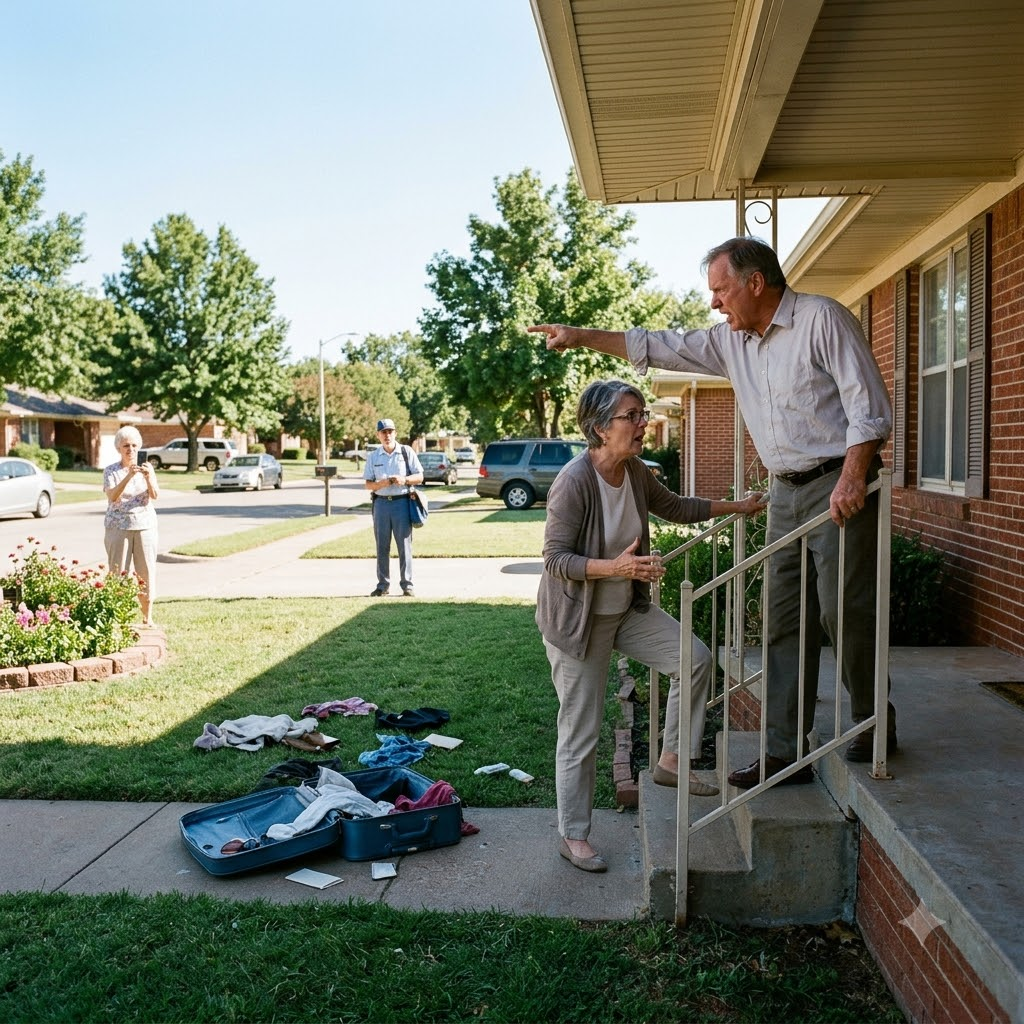
Doreen provided the original porch video showing Grant throwing my suitcase onto the lawn and pushing me down the steps.
Her recording became important evidence in the investigation into his conduct.
The forensic review also established that the disputed transfer authorization contained alterations that were not present in the original document.
The signature attributed to Arthur Rutherford was found to be inconsistent with verified samples.
The document purporting to transfer permanent control of Blue Horizon could not be relied upon as a valid authorization.
The financial investigation uncovered unauthorized payments involving Grant's roofing company and accounts connected to North Star Resources.
Grant was eventually charged in connection with the fraudulent corporate transactions and the financial misconduct supported by the evidence.
Norah was also investigated for her role in preparing and circulating the altered documents.
Her personal relationship to Daniel and her undisclosed financial interests became central issues in the proceedings.
Daniel cooperated with the investigation.
He admitted that he had initially supported Grant's proposed arrangement because he believed it would secure his family's future.
But he provided the original records showing that his mother's demands had exceeded the fourth family's legitimate interest.
Robert Cross was eventually located.
He was alive, living under another identity in a different state.
His statements helped establish the history of the original agreement and the circumstances surrounding my father's disappearance.
He also acknowledged that he had allowed the false report of Thomas's death to circulate.
His actions had caused enormous harm.
But he agreed to cooperate fully and return the records he had retained.
The court proceedings took months.
There were interviews, financial examinations, legal hearings, and difficult family conversations.
Grant eventually faced the consequences of his actions.
His claim to control Blue Horizon was rejected.
The fraudulent transfer was invalidated.
The unauthorized payments were addressed through the legal process.
And the court recognized the original ownership structure, subject to the verified terms of the family agreement.
My father's designated beneficiary arrangement was also confirmed.
The company belonged to the family interests established in the original agreement.
I became its controlling beneficiary under the succession provisions.
Celeste retained her protected interest.
Caleb represented the Hayes family's legitimate share.
Daniel retained the fourth family's rightful twenty-percent interest under the original North Star agreement.
Norah could no longer use her position as legal coordinator to influence the company's management.
For the first time in more than two decades, Blue Horizon had a transparent ownership structure.
And nobody could take it from us through a forged signature.
The settlement also allowed us to address the land itself.
Independent geological experts completed additional surveys.
Their findings confirmed the presence of commercially significant oil and gas resources beneath portions of the property.
The value was substantial.
But I remembered my father's letter.
The land was never supposed to become a weapon.
We established a family trust with independent oversight.
The development was managed through properly reviewed contracts.
The participating families received their agreed shares.
A portion of the proceeds was reserved for environmental restoration, local agricultural projects, and community investment.
We also made sure the farm remained a working agricultural property.
I refused to sell the entire estate.
The farmhouse was renovated further.
The old wheat fields continued to produce crops.
And the land that everyone had called a worthless dust bowl became a source of opportunity for the entire community.
I did not become interested in luxury cars or expensive jewelry.
Instead, I funded a scholarship program for students interested in geology, agriculture, and environmental science.
My father helped me establish it.
Caleb supervised the land management.
Celeste became involved in the charitable foundation.
And Samuel remained our independent legal adviser.
For the first time, the family was working together without fear or secrecy.
One afternoon, several months after the legal proceedings ended, I invited everyone to the farmhouse.
Doreen arrived carrying a homemade apple pie.
Lydia brought a photograph album.
Daniel came with his wife and their children.
Caleb brought his father Edward's old notebook.
Samuel arrived with a bottle of sparkling cider.
My father stood beside the porch.
He looked healthier.
His hair was still gray, and he walked with a slight stiffness from his old injuries.
But he was smiling.
Celeste approached him.
"Are you ready?"
He nodded.
"Ready for what?"
She pointed toward the garden.
We had planted a memorial tree for my mother.
Beside it was a small stone engraved with her name.
MARGARET RUTHERFORD.
Beloved mother.
Faithful daughter.
A woman who never stopped protecting her family.
I placed a bouquet of white flowers at its base.
My father stood beside me.
For several minutes, neither of us spoke.
Then he whispered, "She would have loved this."
I nodded.
"She would have loved seeing everyone together."
He took my hand.
"I wish I could give you back those years."
I looked at him.
"You can't."
His eyes filled.
"I know."
"But you can be here now."
He nodded.
And that was enough.
Later, we gathered around the dining table.
The same table where my grandfather's documents had first been spread out.
The same table where I had discovered that Grant's three-hundred-thousand-dollar offer was never what it seemed.
The same table where I had heard my mother's voice for the first time in eleven years.
Now it was covered with food.
There were fresh vegetables from the garden, roasted chicken, warm bread, and a large pie Doreen had brought.
Celeste raised her glass.
"To Grandpa."
Everyone raised theirs.
"To Mom."
My father closed his eyes.
"To Thomas and Margaret."
Caleb added, "And to the families who kept the original agreement."
We smiled.
I looked around the table.
Doreen.
Lydia.
Daniel.
Caleb.
Samuel.
Celeste.
And my father.
People who had once been separated by secrets were now sitting together.
I thought about the woman I had been on the day Grant threw me out.
I had been sixty-three years old.
My wrist was injured.
My suitcase had been thrown onto the lawn.
I had two hundred dollars in my purse and nowhere obvious to go.
I had believed that thirty-eight years of marriage had ended with humiliation.
But I had been wrong about one thing.
Losing Grant had not meant losing my life.
It had meant finally discovering what my family had tried to protect.
I looked at my father.
He was laughing at something Doreen had said.
Celeste was helping serve dessert.
Caleb was telling Samuel a story about Edward's old workshop.
For the first time in years, I felt completely at home.
A year later, I stood on the farmhouse porch watching the morning sunlight fall across the wheat fields.
The renovated house looked beautiful.
The old porch had been rebuilt with strong oak boards.
The kitchen windows were new.
The broken lock had been replaced.
And the refrigerator still carried my grandfather's warning.
STELLA, IF GRANT COMES, DO NOT OPEN THIS DOOR.
I had considered removing it.
But eventually, I decided to leave it there.
Not because I was afraid.
Because it reminded me that my grandfather had believed I deserved protection long before I understood why.
Inside, my father was preparing coffee.
Celeste was arranging flowers.
Doreen was expected for lunch.
And a group of students from the local high school would arrive that afternoon to visit the farm and learn about the geology beneath the land.
I walked to the refrigerator.
Beside Grandpa's warning, I placed a new photograph.
It showed all of us standing together beneath the memorial tree.
My father.
Celeste.
Caleb.
Daniel.
Lydia.
Doreen.
And me.
On the back, I wrote a sentence.
We kept what mattered.
Then I stepped outside.
The wheat moved gently in the morning breeze.
The farmhouse stood firm.
And for the first time in a very long time, nobody was coming to take anything from me.
I had my family.
I had my home.
I had the truth.
And I had finally learned that my worth had never depended on a man's permission to stay.
I was Stella Rutherford.
I was sixty-four years old.
And I was exactly where I belonged.






Comments 0