Daniel slammed his palm onto the kitchen table.
"You're going to that nursing home, or you're getting out tonight!"
My son had placed a glossy nursing home brochure beside a $3,000 deposit receipt.
On the receipt was the account number I recognized immediately.
My household account.
He had used my money to arrange my disappearance.
I looked at the receipt again.
Then I looked at my son.
And I understood that the argument had started long before he ever brought that brochure into my kitchen.
My name is Margaret Lawson. I was sixty-eight years old that Sunday afternoon, and until that moment, I had believed that no matter how badly my family treated one another, there were certain lines a son would never cross.
Apparently, I had been wrong.
I stood beside the kitchen sink with dishwater still clinging to my fingers. A white dish towel hung over my shoulder. The afternoon sunlight came through the window above the sink, illuminating the small water droplets on the countertop.
Across the kitchen, Daniel sat in my late husband's chair.
He had taken that seat four years earlier, shortly after his construction business collapsed.
At the time, he had looked exhausted, embarrassed, and frightened.
He had arrived with his wife, Melissa, their children, a moving truck, and a promise.
"Just until we get back on our feet, Mom."
I remembered those words clearly.
Four years later, he was still sitting in that chair.
And now he was telling me where I was allowed to live.
"Are you listening to me?" Daniel demanded.
I slowly turned off the faucet.
"I heard you."
He pushed the brochure closer to the edge of the table.
"Then why are you standing there looking at me like that?"
I glanced down at the glossy cover.
A smiling elderly couple sat beneath a tree in a beautifully landscaped courtyard. Beneath their photograph were the words:
Comfort. Security. A Better Tomorrow.
The brochure was expensive-looking. Thick paper. Professional photographs. A list of activities, medical services, meal plans, and recreational facilities.
Someone had taken considerable time selecting this place.
Someone had researched its prices.
Someone had made arrangements.
And apparently, that someone had never considered asking me what I wanted.
Melissa leaned against the doorway connecting the kitchen to the living room.
She wore a neatly fitted blue blouse and a beige skirt. Her long auburn hair fell straight over her shoulders.
Her arms were folded.
She had been unusually quiet since Daniel began speaking, but I noticed the small smile that appeared whenever he mentioned the nursing home.
It was not a smile of concern.
It was the expression of someone waiting for a difficult problem to disappear.
"It's actually a very nice facility," she said.
I looked at her.
"Have you been there?"
"Daniel showed me the website."
"So neither of you has visited it?"
She exchanged a quick glance with my son.
"We don't need to visit every place before making a sensible decision," Daniel answered.
A sensible decision.
I almost laughed.
Instead, I reached for the dish towel and dried my hands.
"For who?" I asked.
Daniel sighed dramatically.
"For everyone, Mom. Especially you."
He opened the brochure and turned it toward me.
"Look. They have trained caregivers, organized activities, transportation, medical supervision, and three meals a day. You wouldn't have to worry about anything."
"I don't worry about preparing meals."
"That's not what I mean."
"I know how to manage my medication."
"Mom."
"I still drive."
"You're missing the point."
I looked directly at him.
"Then explain it to me."
For several seconds, Daniel said nothing.
His finger tapped against the glossy paper.
Tap.
Tap.
Tap.
Finally, he leaned forward.
"This house is too much for you now."
I looked around my kitchen.
The cabinets were the same cream color my husband had chosen thirty-four years earlier. The wooden table had a small scratch near the corner where Daniel had once carved his initials as a boy.
A refrigerator stood against the opposite wall.
The back door opened toward the garden.
Nothing about the room felt unfamiliar.
I had cleaned it, painted it, repaired it, and paid the bills that kept it functioning.
I had watched my son grow up in this house.
I had cried at my husband's funeral in this house.
And I had spent countless nights sitting at this same kitchen table, trying to calculate whether my paycheck would cover the mortgage and the next month's expenses.
Now Daniel was telling me it was too much for me.
"Who decided that?" I asked.
He shrugged.
"We discussed it."
I turned toward Melissa.
"Who is we?"
She uncrossed her arms.
"Margaret, please don't make this difficult."
I noticed that she had stopped calling me Mom.
She had started doing that gradually over the past year.
At first, it was occasional.
Then it became normal.
"Margaret" was how she addressed me when she wanted something.
"Mom" was what she called me when she needed money.
I looked back at my son.
"What happens to the house after I leave?"
Daniel answered too quickly.
"We'll take care of it."
Melissa's face brightened.
She stepped away from the doorway and came closer to the table.
"Actually, we've been thinking about making a few improvements."
I said nothing.
"The kitchen could use a more modern layout," she continued. "We could remove some of these older cabinets, replace the countertops, and open up the space."
She gestured toward the dining area.
"The downstairs could become much more comfortable. The children would also have more room if we reorganized the bedrooms."
I watched her point toward the hallway.
She was already decorating rooms I had not agreed to surrender.
"And the sewing room?" I asked.
Melissa hesitated.
"Well, that room could become another bedroom."
I looked at her.
That sewing room had once belonged to me.
It was where I had spent thirty-two years working behind an industrial sewing machine.
The room where I had repaired clothes late at night, completed orders on weekends, and pushed through swollen fingers because the mortgage did not care whether my hands hurt.
Four years ago, I had given it up so Melissa could have a quiet office and the children could spread their school supplies across the larger bedrooms.
I had never asked for it back.
Now she wanted to take the remaining rooms, too.
"I see," I said.
Daniel leaned back in his chair.
"See? This is exactly why we've been trying to talk to you. Everyone benefits."
Everyone.
I wondered whether that included me.
For four years, I had paid for the groceries.
I had covered the electricity, water, heating, homeowners insurance, property taxes, landscaping, and countless household repairs.
When Daniel's construction business closed, I helped him and Melissa pay for their SUV.
When the children needed school supplies, I bought them.
When the refrigerator stopped working, I paid for the replacement.
When the furnace broke during winter, I used money I had saved for myself.
I had never presented them with a bill.
I had never asked them to repay every dollar.
They were family.
At least, that was what I had believed.
But sitting there, listening to Melissa describe my kitchen as though it were already hers, I began to recognize something I had avoided admitting.
They had stopped seeing me as the owner of the house.
They had started seeing me as an obstacle.
"Daniel," I said quietly.
He looked irritated.
"What?"
"Who has been paying the property taxes?"
He frowned.
"Why are you bringing that up?"
"Who pays the homeowners insurance?"
"Mom, that's irrelevant."
"And the electricity?"
He pushed the brochure away.
"We live here. We all contribute."
I waited.
He did not provide an amount.
He did not mention a single payment.
Melissa suddenly looked toward the window.
I understood.
She knew the answer.
They both did.
But neither wanted to say it aloud.
I returned my attention to the brochure.
There was a photograph of a cheerful common room with comfortable chairs and a television.
A paragraph promised residents opportunities to socialize and enjoy a fulfilling lifestyle.
I wondered whether they had bothered to ask whether I wanted to socialize with strangers.
Whether I wanted to leave the garden my husband planted.
Whether I wanted to abandon the porch where I used to sit with him on summer evenings.
Whether I wanted to spend the remaining years of my life in a place selected by people who had used my money without telling me.
"How much does it cost?" I asked.
Daniel looked relieved.
"That's the thing. We found a really good arrangement."
"How much?"
He glanced at Melissa.
She answered.
"The monthly rate depends on the level of care."
"I asked how much."
Daniel exhaled.
"We can discuss the financial details later."
I looked at him.
"Why later?"
"Because the important thing is getting you settled."
There it was again.
Getting me settled.
As though I were a piece of furniture that needed to be moved out of the way.
I picked up the brochure.
A small paper receipt slipped from beneath it.
I caught it before it reached the floor.
It was folded once.
I opened it.
The nursing facility's name appeared at the top, followed by the amount of the deposit.
Three thousand dollars.
I read the payment date.
Then I read the payment method.
My household account.
For a moment, the kitchen seemed unusually quiet.
I checked the number again.
There was no mistake.
I knew that account.
I had opened it years earlier to manage household expenses and keep the family's bills organized.
Daniel had access to certain payments because I had trusted him to help with online transactions when I was busy.
That trust had apparently become permission in his mind.
I looked at him.
"You paid this already?"
He shifted in his chair.
"Yes."
"With whose money?"
He rubbed his forehead.
"Don't start."
"Daniel, I asked you a question."
"It was household money."
"Whose household account?"
He looked toward Melissa.
She suddenly became interested in the brochure.
Daniel's voice grew louder.
"We're all living here, aren't we?"
"That doesn't answer my question."
He stood.
"Mom, this is exactly the problem. Every little thing becomes an argument with you."
I placed the receipt on the table.
"You used my money to pay for a place I never agreed to enter."
"It was a deposit. We can work out the rest."
"Did you ask me?"
He said nothing.
"Did you even tell me before you paid it?"
"Because we knew you'd react like this!"
His answer came so quickly that I almost admired the honesty.
He had not asked because he expected me to refuse.
He had not discussed it because he wanted the decision made before I could object.
Melissa finally spoke.
"We were trying to help you."
I turned toward her.
"Then why did you use my money without asking?"
Her smile disappeared.
She straightened.
"We have been doing a lot for you, too."
I looked at her.
"What have you been doing?"
She opened her mouth, then closed it.
Daniel stepped between us.
"Enough."
He pointed toward the staircase.
"You need to pack."
I remained where I was.
"What?"
"If you're not going to cooperate, then pack your things and leave."
His finger stayed pointed toward the stairs.
I looked at the hand that had once held mine when he was a little boy crossing the street.
The same hand I had bandaged after he fell from his bicycle.
The same hand I had held at his father's funeral.
Now it was pointing me out of my own home.
Melissa did not intervene.
She did not tell him to calm down.
She did not remind him that I was his mother.
Instead, she folded her arms again.
I understood then that this was not an impulsive argument.
They had already imagined the house without me.
They had already discussed the rooms.
They had already selected the nursing facility.
They had already paid the deposit.
The only thing they had not arranged was my agreement.
And now they were angry because I had refused to provide it.
I looked at Daniel.
"Get the deposit refunded."
He stared at me.
"What?"
"Call the facility. Tell them the reservation is canceled."
"You can't be serious."
"I am."
He laughed once, without humor.
"Mom, you're not in a position to make demands."
I studied his face.
He was thirty-nine years old.
He had lived through a failed business, financial embarrassment, and four years of dependence on the woman standing in front of him.
I had never thrown those failures in his face.
I had never reminded him that his children ate food I purchased.
I had never told him that the roof above his bedroom had been paid for with money I earned sewing other people's clothes.
But apparently, kindness had taught him the wrong lesson.
He believed I would tolerate anything.
He believed I would eventually surrender.
And he believed my age made me powerless.
"Daniel," I said, "this is my final answer."
His face hardened.
"Then get out."
The words hung between us.
For a moment, I could hear the refrigerator humming.
Somewhere upstairs, a floorboard creaked.
The house seemed to be listening.
I looked at Melissa.
She did not look away.
Her expression had changed from satisfaction to impatience.
She wanted me to cry.
She wanted me to argue.
She wanted me to make the scene that would allow her to tell everyone how unreasonable I had become.
But I had spent too many years working with people who believed that the loudest person in the room was automatically right.
I knew better.
I picked up the folded receipt and placed it inside my blouse pocket.
Then I folded the brochure neatly.
"Fine," I said.
Daniel blinked.
"What?"
"I'll pack."
For the first time that afternoon, neither of them seemed to know what to say.
I turned toward the staircase.
My knees felt heavier than usual, but my steps remained steady.
I could hear Melissa whispering something to Daniel.
He answered quietly.
Then they both laughed.
I did not turn around.
Upstairs, I entered the bedroom I had shared with my husband for more than three decades.
His side of the closet was still empty.
I had never moved his old clothes.
His photograph sat on the bedside table, beside a small wooden clock that had stopped working several months earlier.
I picked up the photograph.
It showed us standing together on the front porch shortly after we had bought the house.
My husband wore a light-colored shirt and held one arm around my shoulders.
I was smiling.
We had been younger then.
We had believed that if we worked hard enough, loved each other enough, and remained patient through difficult years, we could build a life that would give our family security.
I placed the photograph carefully inside my suitcase.
Then I began packing.
My medication went into a small toiletry bag.
My jewelry went into its original velvet case.
I folded my clothes carefully, placing the heavier items at the bottom.
Finally, I removed a thick beige folder from the bottom drawer of my dresser.
It contained the property records, insurance documents, tax statements, mortgage paperwork, and other important papers I had kept over the years.
I ran my fingers along the folder's edge.
Thirty-four years of records.
Thirty-four years of responsibility.
Thirty-four years of proof that the house had never been a gift from my son.
It was mine.
I placed the folder inside my suitcase.
Then I returned to the dresser and opened the small drawer where I kept my husband's old watch.
I held it for a moment.
I could almost hear his voice.
Margaret, don't let anyone make you feel like a stranger in your own home.
I closed my fingers around the watch.
For the first time that afternoon, my eyes became warm.
But I did not cry.
I placed it beside his photograph.
Downstairs, I heard Daniel laughing again.
I zipped the suitcase.
The sound was small.
Final.
And strangely satisfying.
When I reached the staircase, I could hear Melissa speaking.
"She'll probably call someone to come get her."
Daniel chuckled.
"Where's she going to go? She doesn't have anywhere."
I stopped for a moment.
Then I continued down.
They were standing near the dining table.
The brochure remained open.
The receipt was gone from the table, but I knew exactly where it was.
Daniel looked at my suitcase.
"You're actually leaving?"
I adjusted the folder under my arm.
"You told me to."
He shrugged.
"Good. Then we can finally move forward."
Melissa stepped aside to give me room.
She looked at the suitcase.
"Did you pack everything?"
I looked at her.
"Everything that belongs to me."
She seemed satisfied with that answer.
Neither of them offered to carry the suitcase.
Neither asked where I intended to stay.
Neither asked whether I had somewhere safe to go.
I walked through the living room.
The family photographs on the cabinet caught my attention.
There was Daniel as a toddler.
Daniel on his first day of school.
Daniel standing beside his father at a fishing lake.
Daniel holding his children when they were babies.
I had kept every one of those photographs.
I wondered whether he would remember any of them when he eventually looked at that cabinet.
At the front door, I paused.
My hand rested on the brass handle.
For thirty-four years, I had opened that door for friends, neighbors, relatives, delivery drivers, and my son's family.
I had never imagined that one day I would leave it carrying a suitcase because my own child had ordered me out.
I turned the handle.
The afternoon air reached my face.
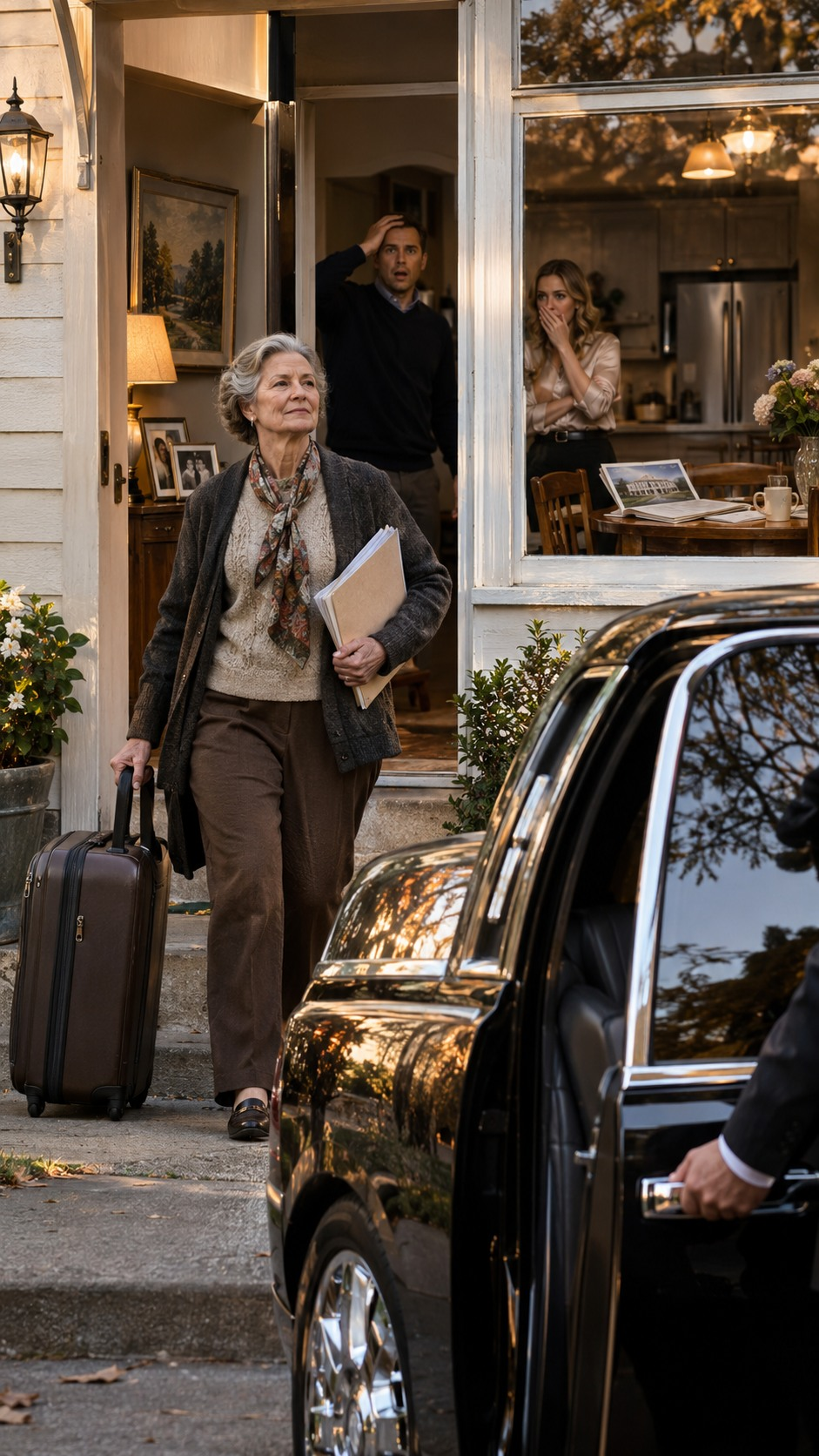
I stepped onto the porch and carefully lowered my suitcase onto the stone landing.
Behind me, Daniel spoke.
"Don't expect us to come looking for you."
I looked straight ahead.
"I wouldn't."
Then I heard a car approaching.
At first, I assumed it was a neighbor.
But the sound was deeper than an ordinary vehicle.
I glanced toward the street.
A long black limousine was turning onto our quiet road.
It moved slowly beneath the trees.
Its polished exterior reflected the houses and afternoon sunlight.
The vehicle approached my driveway.
Then it stopped.
Directly in front of my house.
I noticed the chauffeur's silhouette behind the windshield.
The engine continued running.
For several seconds, nobody moved.
Then I heard Daniel's footsteps behind me.
"What the hell is that?"
Melissa appeared beside him.
She looked past my shoulder.
Her expression changed.
The limousine's rear passenger window lowered slightly.
A hand moved inside.
Then the chauffeur stepped out.
He walked around the back of the vehicle.
And as he reached for the rear passenger door, I heard him say a name I had not expected to hear again.
"Mrs. Lawson..."






Comments 0