"Daniel Lawson, we need to talk to you about the disappearance of Henry Lawson's original business records."
The officer stood in my kitchen, his badge catching the morning sunlight.
My son looked as though the floor had vanished beneath him.
"I haven't taken anything," Daniel said.
The officer studied him.
"Then I suggest you help us understand what's happening."
I stood beside the open laundry room cabinet, gripping the small brass key Henry had left me.
Below us, Richard Hale and Arthur Bennett were still inside the hidden storage chamber. Somewhere beyond them, a man had escaped through a second entrance carrying a metal case.
And in my kitchen stood a stranger claiming to have a court order concerning my home.
I was sixty-eight years old.
I had raised a child, buried a husband, survived difficult winters, and worked more hours than I could count.
But nothing had prepared me for that morning.
"Before anyone says another word," I said, "I want to know who you are."
The officer turned toward me.
"Detective Michael Grant, county financial crimes unit."
He showed me his identification.
Then he gestured toward the other man.
"This is Mr. Collins, a process server. He was delivering documents related to a civil proceeding."
I looked at the folded papers in Collins's hand.
"What court order?"
He hesitated.
Richard appeared at the laundry room entrance.
"May I see it?"
Collins handed him the papers.
Richard read them carefully.
Then he looked at me.
"Margaret, this is an application for emergency relief filed by a company claiming a contractual interest in the property. There's a temporary preservation order attached. It doesn't transfer ownership, and it doesn't authorize anyone to remove you."
I released a breath.
"Then why did he come into my house?"
Collins looked uncomfortable.
"The front door was open. I heard shouting and thought someone needed help."
Richard folded the documents.
"We'll address the filing through the court."
Detective Grant turned toward the open hatch.
"Where did the man go?"
Arthur emerged from below.
"Through an old service passage leading toward the rear foundation."
"Did you recognize him?"
Arthur shook his head.
"I saw only his back."
Richard spoke.
"He was carrying a metal document case."
Detective Grant touched the radio at his shoulder.
"We have officers checking the property perimeter."
I looked at Daniel.
His face had turned gray.
"Daniel," I whispered, "do you know who that man was?"
He swallowed.
"I think so."
Everyone turned toward him.
He looked at the floor.
"Thomas Reed."
Detective Grant asked us to sit in the dining room while officers secured the rear entrance.
I insisted that Richard remain with me.
Arthur sat beside the black briefcase.
Melissa stood near the window, her arms wrapped tightly around herself.
Daniel looked exhausted.
The detective opened a notebook.
"We've been reviewing complaints involving Thomas Reed and several property financing transactions," he explained. "Mr. Hale's office provided information yesterday concerning possible identity misuse and an unauthorized property filing."
I looked at Richard.
He nodded.
"We made the appropriate reports after discovering the documents."
Detective Grant continued.
"Mr. Reed appears to have approached people under financial pressure, offering financing arrangements that involved questionable property documents."
I turned toward Daniel.
"Is that how you met him?"
My son nodded.
"Melissa introduced us."
Melissa began crying.
"He said he could help us."
I closed my eyes.
Those words again.
I had heard them so often that they had almost lost their meaning.
But this time, something was different.
There was nowhere left for either of them to hide.
Detective Grant asked Daniel to explain what he knew.
My son looked at me.
Then he took a long breath.
"After my construction business failed, I still owed money. I thought I'd worked out payment arrangements, but some of the obligations came due again."
"How much?" the detective asked.
Daniel looked down.
"More than seventy thousand dollars."
I felt my chest tighten.
He continued.
"Melissa started Lawson Property Solutions because we thought renovating and reselling a small property could help us recover."
Melissa wiped her eyes.
"We had a contract opportunity. But we needed money to complete it."
Daniel nodded.
"Thomas told us he could arrange financing using Mom's house."
I looked at him.
"You knew the house wasn't yours."
He closed his eyes.
"Yes."
"Then why did you agree?"
His voice broke.
"Because I thought I could pay everything back before you found out."
The words hurt more than I expected.
Not because they were surprising.
But because they were so terribly simple.
He had gambled with my security because he believed success would erase the betrayal.
Detective Grant continued questioning him.
Daniel admitted that he had knowingly presented the power of attorney to the bank, despite having misrepresented the documents to me when I signed them.
He admitted that he had approved unauthorized transfers from my household account.
He admitted that he knew Melissa was arranging a nursing home placement.
But he insisted he had never authorized Patricia Wells to impersonate me or Thomas Reed to forge my signature.
Melissa confirmed that she had provided Patricia with my identification and had sent Thomas copies of my property records.
She admitted that she knew the proposed medical assessment was intended to support Daniel's financial authority.
When the detective asked whether she understood that Patricia would pretend to be me, Melissa began shaking.
"Yes," she whispered.
I stared at her.
For years, I had defended Melissa when Daniel complained about her.
I had helped her with the children.
I had cooked meals when she was tired.
I had treated her like a daughter.
Now she sat at my table admitting that she had helped someone steal my identity.
I turned away.
There were some things a person could hear only once.
By noon, officers had located Thomas Reed near a service road behind the neighboring properties.
He had abandoned the metal case beside a drainage ditch.
The case was recovered unopened.
Detective Grant told us that Thomas had been detained for questioning and that the documents would be handled as potential evidence.
I did not celebrate.
I was too tired.
But when Richard told me the case appeared to contain old business records, I felt something loosen inside my chest.
Henry's papers had not disappeared forever.
Arthur examined the photographs the detective permitted us to see.
He recognized the metal case immediately.
"Henry kept archived partnership documents in that box."
I looked at him.
"Why would Thomas want them?"
Arthur took a moment before answering.
"Some of those records document property investments Henry and I made decades ago. They also establish which assets belonged to the partnership and which belonged to us personally."
Richard nodded.
"Thomas may have believed he could use or conceal those records to support false claims concerning the house."
I looked at Arthur.
"And the house?"
He met my eyes.
"Margaret, the house was never partnership property."
I stared at him.
"Never?"
"Never. Henry and I used that storage chamber temporarily while renovating our business offices. He later retained copies of important records there, but the property itself belonged to you and Henry, and afterward to you alone."
I felt tears rise.
For days, I had been afraid that some forgotten agreement would suddenly take away everything Henry and I had built.
Arthur reached into his briefcase.
He removed the sealed envelope we had found in Henry's desk.
The one addressed to me.
For Margaret. Only to be opened when Arthur returns.
Arthur placed it in front of me.
"Henry wanted me present when you read this."
My hands trembled.
Richard sat quietly beside me.
I opened the envelope.
Inside was a letter written in Henry's familiar handwriting.
My dearest Margaret,
If you are reading this, I am no longer there to explain everything myself.
I know you have always trusted me to handle the paperwork. Perhaps too much. I should have told you more while I had the chance.
The storage chamber beneath the house contains old business records and copies of the agreements Arthur and I made. None of them gives anyone ownership of our home.
I kept those papers because I wanted you to have proof if anyone ever tried to use my business history against you.
I also established the reserve account so you would never have to depend on Daniel or anyone else for your security.
Our son has a good heart, but he sometimes mistakes hope for a plan. I pray he learns the difference.
And Margaret, please remember something.
You were never merely the woman who lived in this house.
You built it with me.
Every payment, every sacrifice, every ordinary day mattered.
Don't let anyone make you feel like a guest in your own life.
All my love,
Henry.
I pressed the letter against my chest.
For several minutes, I couldn't speak.
I remembered the way Henry used to warm his hands around a coffee mug.
The way he hummed while fixing things.
The way he kissed my forehead before leaving for work.
I had missed him every day since he died.
But sitting at that table, I felt as though he had reached across the years to remind me of something I had forgotten.
I was allowed to protect myself.
Even from people I loved.
The following weeks were difficult.
There was no sudden miracle.
No single document that repaired the damage.
But slowly, the confusion gave way to facts.
The disputed property transfer was rejected, and the proposed sale to Briarwood Residential Holdings was formally terminated.
The purchaser's attorney confirmed that no valid closing had occurred.
Richard obtained updated title records showing that I remained the sole legal owner of the house.
He also helped me revoke the questionable power of attorney, notify the appropriate institutions, and establish safeguards against further unauthorized transactions.
My bank replaced the compromised account credentials and reviewed every disputed payment.
The attempted transfers of eighteen thousand five hundred dollars and seven thousand two hundred dollars had been blocked.
The three-thousand-dollar nursing home deposit was returned after the facility confirmed that I had never authorized the reservation.
Other transactions required more work.
Daniel and Melissa provided records showing where the money had gone.
The confirmed unauthorized withdrawals totaled eleven thousand dollars, excluding the blocked attempts and avoiding double-counting the nursing home deposit.
Richard arranged a written repayment agreement.
Daniel and Melissa would be responsible for returning the money they had taken.
The repayment terms were realistic, documented, and enforceable.
I refused to accept another promise scribbled on a piece of paper.
I had accepted enough promises.
The separate account opened in my name with Patricia Wells listed on it was frozen and closed following the investigation.
No property settlement proceeds had reached it.
The large transfer Daniel had shown me was a scheduled, conditional payment that depended on a closing which never happened.
Patricia's role in the false medical appointment and identity documents became part of the investigation.
Thomas Reed's activities were also referred for prosecution.
I did not pretend to know how every legal proceeding would end.
But I knew the evidence was preserved, the immediate danger to my home had been stopped, and the people involved could no longer hide behind vague explanations.
The hidden storage chamber was inspected and secured.
The recovered business records confirmed what Arthur had told me.
Henry's partnership had no ownership interest in our house.
The old reserve account was legitimate, properly documented, and intended for my benefit.
Richard helped me arrange independent management of the funds so I could use them when needed without surrendering control.
For the first time in years, I knew exactly what I owned.
And exactly who had authority over it.
Me.
Daniel and Melissa moved out six weeks later.
I gave them time to arrange housing for the children, but I did not change my decision.
They found a modest rental house across town.
It was smaller than mine.
The kitchen was narrow.
The backyard was barely large enough for a picnic table.
But it was a place they could afford without using my money.
On moving day, I stood on the porch while Daniel carried the last box to his car.
He looked thinner.
Older.
For a moment, I saw Henry in the shape of his shoulders.
"Mom?"
I turned.
"Yes?"
He set the box down.
"I know saying I'm sorry doesn't fix anything."
I nodded.
"No, it doesn't."
He looked toward the garden.
"I used to think Dad was too hard on me."
I waited.
"He always wanted me to think about what could go wrong."
I smiled sadly.
"He was good at that."
Daniel nodded.
"I thought he didn't believe in me."
"He believed in you enough to tell you the truth."
My son wiped his eyes.
"I understand that now."
I looked at him.
"Daniel, I never needed you to be rich."
He lowered his head.
"I know."
"I never needed you to own a successful company."
He nodded.
"I only wanted you to become a man who could be trusted."
He began crying.
This time, I stepped forward.
I placed my arms around him.
He held me tightly.
For a moment, he was my little boy again.
The child who had scraped his knees in the driveway.
The teenager who had come home heartbroken after his first girlfriend left him.
The young man who had stood beside Henry at his funeral.
But when I stepped back, I did not take back my decision.
Love could survive a boundary.
Trust would have to be rebuilt.
Daniel understood.
"I've started working for a construction company," he said.
I nodded.
"Arthur told me."
"It's not much."
"It's honest work."
He looked at me.
"Yes."
"Then it's a beginning."
He picked up the box.
Before leaving, he turned once more.
"Mom, will you ever forgive me?"
I looked at him for a long moment.
"I hope so, Daniel. But forgiveness isn't something you can demand because you're ready to receive it."
He nodded.
"I understand."
"And even when I forgive you, the house will still be mine."
A faint, sad smile crossed his face.
"I know, Mom."
Then he carried the box to his car.
Melissa apologized in a letter.
It arrived two weeks after they moved.
She admitted that she had resented living in a house she could not control.
She had convinced herself that because she and Daniel were raising children there, they deserved to make the decisions.
She wrote that Thomas Reed had offered a way out of their financial problems, and she had ignored every warning sign because she wanted the opportunity to be real.
She did not ask me to forget what she had done.
She asked whether, someday, I might allow her to earn back a small measure of trust.
I read the letter twice.
Then I placed it in a drawer.
I wasn't ready to answer.
But I didn't throw it away.
The children visited me regularly.
Daniel brought them on Sunday afternoons.
At first, the visits were awkward.
He waited at the door until I invited him inside.
He asked before opening the refrigerator.
He offered to help with repairs rather than announcing what he planned to change.
One afternoon, my youngest grandson asked why Daddy no longer lived with Grandma.
I sat beside him on the porch swing.
"Because sometimes grown-ups need to learn how to take care of their own homes."
He considered that.
"Does Daddy still love you?"
I smiled.
"Yes, sweetheart."
"Do you still love Daddy?"
I kissed his forehead.
"Always."
He seemed satisfied.
Then he asked for another cookie.
I laughed so hard that I nearly cried.
By autumn, the house looked different.
Not because Daniel and Melissa had renovated it.
Because I had.
I hired a local carpenter to repair the porch steps.
I had the front door painted a deep blue.
I replaced the old kitchen curtains with bright white ones.
And I moved my sewing supplies back into the sunny upstairs room where I had worked before Daniel's family moved in.
Eleanor came over one afternoon carrying a basket of muffins.
She stood in the doorway and looked around.
"Margaret, the house feels like you again."
I smiled.
"It does, doesn't it?"
We sat at the kitchen table.
The same table where so much had happened.
But now there were flowers in the center.
Fresh coffee.
And sunlight across the polished wood.
Eleanor took a bite of her muffin.
"Are you happy?"
I thought about the question.
There had been a time when I would have answered automatically.
Of course.
I'm fine.
Everything is fine.
But I had learned to tell the truth.
"I'm getting there," I said.
She smiled.
"That's a good answer."
I looked toward the garden.
Henry's roses were still blooming.
I had begun taking better care of them.
I had also begun taking better care of myself.
I joined a local walking group.
I started having lunch with friends again.
I accepted an invitation to teach a beginner's sewing class at the community center.
For years, I had arranged my days around everyone else's needs.
Now I was discovering that I had needs of my own.
And that meeting them did not make me selfish.
One Sunday in December, Daniel came over alone.
He carried a small envelope.
I invited him into the kitchen.
He sat across from me.
"Mom, I wanted to give you this."
He placed the envelope on the table.
Inside was a payment receipt.
The first substantial installment toward the money he owed me.
I looked at him.
"You didn't have to bring it in person."
"I know."
He hesitated.
"But I wanted you to see that I'm doing what I promised."
I nodded.
"Thank you."
He looked around the kitchen.
"I like the curtains."
I smiled.
"So do I."
He studied the blue vase on the windowsill.
The one Melissa had packed into a box marked KEEP.
"That was Grandma's, wasn't it?"
"Yes."
He nodded.
"I remember."
For a while, we sat quietly.
Then he looked at me.
"Mom, I've been going to counseling."
I looked up.
"Have you?"
He nodded.
"I'm trying to understand why I kept making the same mistakes."
I felt something soften inside me.
"That's important, Daniel."
He looked down.
"I thought being a good son meant becoming successful."
I shook my head.
"No."
He looked at me.
"What did it mean?"
I reached across the table and touched his hand.
"It meant being honest with me. Respecting me. Remembering that I was a person, not just someone who could rescue you."
His eyes filled with tears.
"I wish I'd understood sooner."
"So do I."
He squeezed my hand.
Then he whispered, "I love you, Mom."
I smiled through my tears.
"I love you too."
It was not the end of the work he needed to do.
But it was the beginning of something better.
And this time, I was not doing the work for him.
Christmas came quietly that year.
I decorated the living room with the old ornaments Henry and I had collected.
I placed his photograph on the mantel.
I invited Eleanor and Arthur for dinner.
Richard stopped by with his wife and brought a beautiful poinsettia.
Daniel and the children came in the afternoon.
Melissa arrived with them.
She stood uncertainly on the porch.
I looked at her for a moment.
Then I opened the door wider.
"Come in, Melissa."
Her eyes filled with tears.
"Thank you, Margaret."
We did not pretend everything was forgotten.
We did not make speeches.
We simply shared a meal.
The children laughed.
Arthur told an old story about Henry accidentally locking himself inside a storage shed.
Richard nearly spilled his coffee laughing.
And for the first time in a long while, the sound of happiness filled my house without making me afraid of what would happen afterward.
That evening, after everyone had gone, I stood alone in the living room.
The Christmas lights glowed softly.
The grandfather clock ticked in the hallway.
Henry's photograph rested on the mantel.
I walked toward it.
"Well, Henry," I whispered, "we made it."
I smiled.
Then I shook my head.
"No. I made it."
The distinction mattered.
I had loved my husband deeply.
I always would.
But I was still here.
Still capable.
Still deserving of a life that belonged to me.
I looked around the room.
The furniture was where I wanted it.
The photographs were back on the walls.
The kitchen was mine.
The garden was mine.
The house was mine.
But the greatest thing I had recovered was not the property.
It was the woman I had been before I started believing that keeping everyone else happy was the price of being loved.
I turned off the Christmas lights.
Then I walked upstairs.
At the bedroom door, I paused beside Henry's old desk.
The small brass key lay in a wooden dish.
The hidden compartment had been emptied, inspected, and closed.
The business records were secured.
The property questions were resolved.
There were no more mysterious documents waiting to change my life.
I touched the desk gently.
"Thank you," I whispered.
Then I went to bed.
The following morning, I woke to sunlight streaming through the curtains.
I made coffee.
I opened the kitchen window.
A cool breeze carried the scent of winter roses into the room.
I took my favorite cup to the porch.
The street was quiet.
Eleanor waved from across the road.
I waved back.
Then I sat in the chair Henry had built for me years earlier.
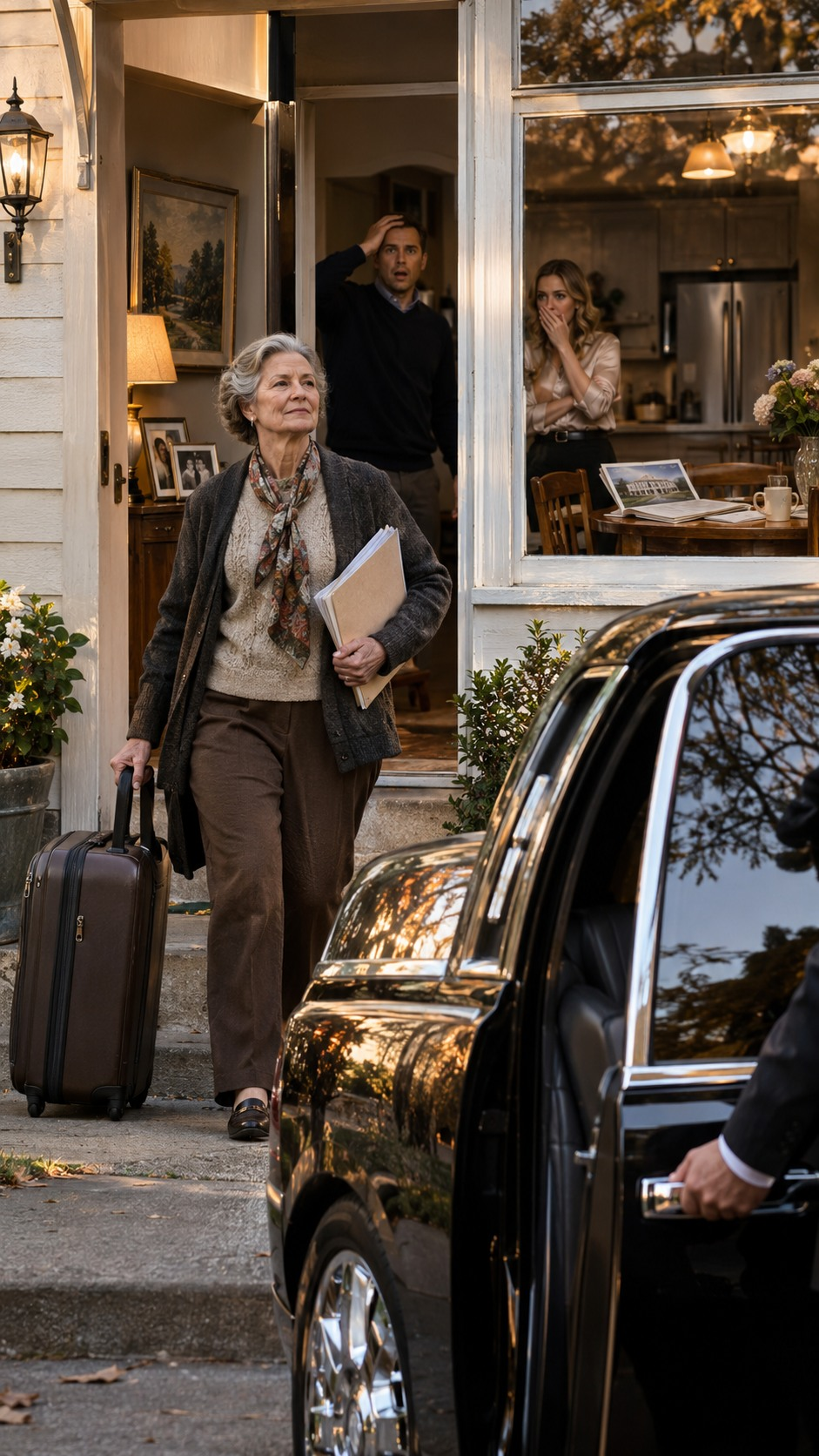
I thought about the night Daniel had ordered me out.
I remembered standing in the hallway with my suitcase, believing that the family I had given everything to no longer wanted me.
I remembered how small I had felt.
How frightened.
How alone.
If I could have spoken to that woman, I knew exactly what I would have told her.
You are not finished.
You are not helpless.
And you do not have to surrender your dignity to prove your love.
I took a sip of coffee.
Inside, the grandfather clock began striking nine.
I listened to its familiar chime.
Then I smiled.
There was nowhere I needed to run.
No one I needed to appease.
No permission I needed to ask.
I was Margaret Ellen Lawson.
Sixty-eight years old.
A mother.
A grandmother.
A widow.
A woman who had loved, sacrificed, grieved, and survived.
And at last, I was a woman who understood that her own life mattered too.
I leaned back in my chair and watched the sunlight spread across the garden.
For the first time in years, I wasn't waiting for someone else to decide what happened next.
I had my home.
I had my peace.
And I had myself.






Comments 0