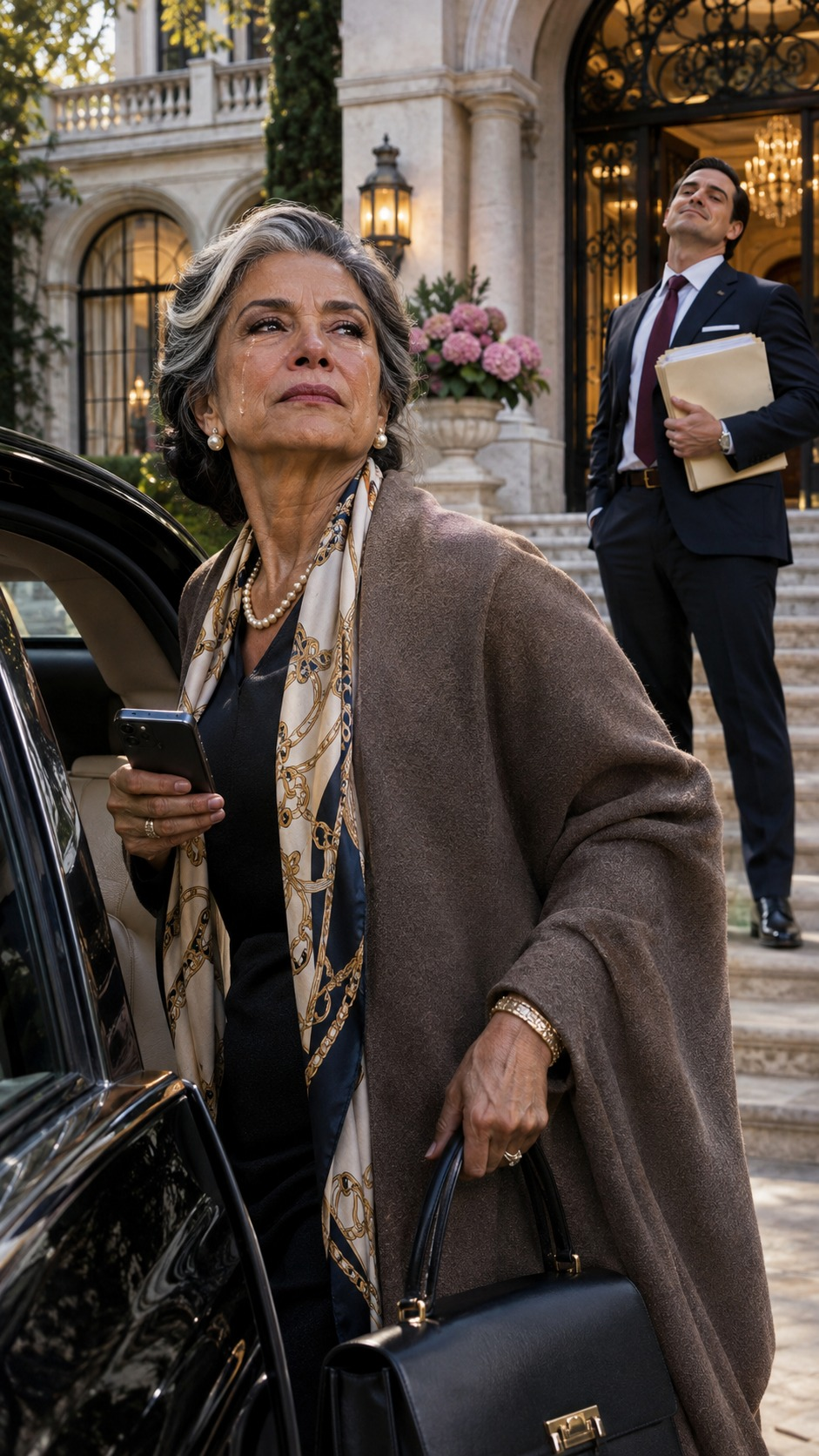
"Get in the car, Mom. You're not welcome here anymore!"
Roberto shoved the thick folder against his chest as I stood beside the open door of the black sedan.
A small gold seal glimmered beneath the final signature.
He hadn't noticed that the seal was different.
Neither had he understood what he had signed.
My name is Carmen Delgado. I was seventy-six years old when my only son decided I was no longer useful to him.
He didn't tell me that in those exact words.
He didn't have to.
The look on his face said everything.
I stood on the driveway of the mansion I had built, holding a burgundy leather handbag in one hand and my phone in the other. My emerald-green coat was buttoned neatly over a cream blouse. I had dressed carefully that morning, as I always did, because my late husband used to say that dignity was something nobody could take away unless you surrendered it yourself.
I had never imagined I would need to remember those words while being thrown out of my own home.
Roberto stood several feet away, at the bottom of the marble steps.
He wore an expensive gray suit and the expression of a man who had just won a championship.
In his left hand was a thick cream-colored folder.
Inside were the documents he believed had transferred my entire fortune into his name.
The mansion.
The apartment buildings.
The commercial properties.
The land I had purchased when nobody else saw its value.
Forty years of sacrifice, reduced to a stack of papers held by the son I had raised.
"Are you going to stand there all afternoon?" he asked.
I looked at him.
"Roberto, please."
He sighed dramatically.
"Mom, we already discussed this."
"No," I said softly. "You discussed it. I listened."
His jaw tightened.
"Don't start."
I glanced toward the mansion.
The enormous black wrought-iron doors stood open behind him. Beyond them, I could see the chandelier hanging in the entrance hall.
I remembered the day that chandelier had been installed.
Roberto had been twelve.
He had stood beneath it, staring upward, and asked whether we were rich.
I had laughed.
"Not rich enough to stop working," I told him.
He had wrapped his arms around my waist.
"Then I'll work with you when I grow up, Mama."
I had believed him.
That memory hurt more than anything he said that morning.
"Where am I supposed to go?" I asked.
He glanced at the black sedan.
"The nursing home. I've paid for the first month."
"The first month?"
"Yes."
"And after that?"
He shrugged.
"Your pension should cover some of it. You'll figure something out."
I stared at him.
This was the boy whose fever I had monitored through countless sleepless nights.
The child I had carried into emergency rooms.
The teenager whose mistakes I had quietly repaired.
The young man whose education had cost more than my first apartment building.
He was looking at me as though I were an inconvenient tenant.
"Roberto," I whispered, "I'm your mother."
His expression hardened.
"And I'm your son. Which is why I'm making sure you're taken care of."
"By removing me from my home?"
"By putting you somewhere appropriate for your age."
I felt something tighten inside my chest.
For months, he had been telling me I was becoming forgetful.
At first, the comments were small.
"Mom, you already told me that."
"Mom, are you sure you remember the appointment?"
"Mom, maybe you shouldn't be handling those accounts anymore."
Sometimes he said these things in front of employees.
Sometimes in front of family friends.
Sometimes he said them with such convincing concern that I almost wondered whether he was right.
But I knew my mind.
I knew my properties.
And I knew the difference between forgetting where I had placed my reading glasses and forgetting who owned a twelve-million-dollar building.
Roberto had begun treating those two things as though they were the same.
I didn't understand the full reason until several weeks before that morning.
By then, I had already started preparing.
But standing beside that car, watching my only child smile at my humiliation, I discovered that preparation did not make betrayal painless.
"You promised your father," I said.
Roberto looked away.
"Don't bring Dad into this."
"You promised him you would look after me."
"That was years ago."
"He died believing you would."
"Mom."
His voice sharpened.
"Enough."
I fell silent.
My husband, Gabriel, had been gone for eleven years.
He was a good man.
Not perfect, but good.
He had never pretended that my business achievements belonged to him. When people congratulated him on our real estate empire, he would smile and point toward me.
"Ask the woman who actually built it."
Gabriel had been a schoolteacher.
He loved books, gardening, and Sunday breakfasts.
I loved contracts, construction sites, and discovering value in places other people overlooked.
We had been different in nearly every way.
But he understood me.
And he loved Roberto without reservation.
When Gabriel became ill, Roberto was thirty-one.
I still remembered the hospital room where my husband held our son's hand.
"Take care of your mother," Gabriel whispered.
Roberto had cried.
"I promise, Dad."
Now that same son was standing outside our home, telling me to leave.
I looked at the folder in his hand.
"Are you certain this is what you want?"
He laughed.
"Mom, you signed the papers."
"Yes."
"Then there's nothing left to discuss."
I nodded.
He mistook the gesture for surrender.
That was understandable.
For most of his life, I had made surrender look like love.
When he wanted a sports car at seventeen, I bought him a safer car instead.
When he wrecked it six months later, I paid for the repairs.
When he failed two college courses, I arranged tutoring.
When he wanted to start a business without a plan, I helped him write one.
When that business collapsed, I covered its debts.
Every time Roberto made a mistake, I stood between him and the consequences.
I told myself that was what mothers did.
I didn't realize that I was teaching him something dangerous.
I was teaching him that my resources had no limits.
And that his actions had no price.
"Give me the house keys," he said.
I looked down at the ring in my hand.
There were four keys.
The front entrance.
The side entrance.
My private office.
And the small garden gate Gabriel had insisted we install because he liked walking among the roses before breakfast.
I removed the house keys from the ring.
Roberto extended his palm.
I placed them there.
His fingers closed around them immediately.
"Thank you," he said.
The words sounded almost cheerful.
I wondered whether he had rehearsed this moment.
Whether he had imagined taking those keys.
Whether he had pictured himself walking through the mansion as its new master.
"Will you keep your father's garden?" I asked.
He frowned.
"What?"
"The roses. Will you keep them?"
He looked toward the side of the house.
"I haven't decided what I'm doing with the landscaping."
"Your father planted those himself."
"Mom, it's a garden."
I lowered my eyes.
"Yes," I said. "Of course."
He glanced at his watch.
"The driver is waiting."
There was no driver standing outside the car. Roberto had arranged for someone to remain behind the wheel, separated from us by dark glass.
I was grateful.
I did not want a stranger witnessing every word.
But I knew the stranger could probably hear enough.
I stepped toward the rear passenger door.
Roberto called after me.
"One more thing."
I turned.
He held up the folder.
"I don't want you calling the property managers and confusing everyone."
I said nothing.
"I've already informed the office that I'm taking over."
"Have you?"
"Yes. And I've told them you're retiring."
"Retiring."
"That's right."
I looked at the mansion again.
I had been twenty-nine when I bought my first property.
It was a narrow, neglected duplex in a neighborhood most investors avoided.
The roof leaked.
The plumbing was unreliable.
One of the upstairs windows had been boarded shut.
The bank manager had looked at my application and asked whether my husband would be signing.
I told him my husband wasn't purchasing the property.
I was.
He laughed.
Not cruelly, perhaps.
But he laughed.
I went to another bank.
Then another.
By the time someone approved the loan, I had learned an important lesson.
People who underestimate you sometimes give you the advantage of seeing exactly what they think you're incapable of doing.
I renovated that duplex myself, with help from two contractors who agreed to accept partial payment after the first tenants moved in.
I painted walls.
Scrubbed floors.
Replaced broken fixtures.
Collected rent.
Balanced accounts at the kitchen table after Roberto fell asleep.
The duplex became profitable.
Then I bought a second property.
Then a third.
By the time Roberto graduated from high school, I owned eleven buildings.
By the time Gabriel retired, I owned thirty-seven.
And by the morning my son threw me out, the Delgado property portfolio was worth more than I had ever dared imagine when I was young.
Yet there I stood.
A seventy-six-year-old woman being told she had no place in the house she had paid for.
"Mom?"
Roberto's impatient voice pulled me back.
"Did you hear what I said?"
"Yes."
"Then stop looking at the house."
I turned toward him.
"May God forgive you, my son."
For the first time that morning, something flickered across his face.
Not guilt.
I would have recognized guilt.
It was irritation.
As though my grief were spoiling a celebration.
"Don't make this dramatic."
I nodded again.
Then I placed my handbag inside the sedan.
The leather seat was soft beneath my fingers.
I remembered choosing the car years earlier because Gabriel had complained that our previous vehicle hurt his back.
After his death, I kept it.
It was one of the few things I couldn't bring myself to replace.
Roberto had arranged to use that very car to send me away.
I wondered whether he understood the cruelty of that choice.
Perhaps he did.
Perhaps that was why he chose it.
I lowered myself into the rear seat.
My knees ached slightly.
I had spent too many years climbing unfinished staircases and walking construction sites to expect otherwise.
But my hands were steady.
My mind was clear.
And my phone was resting in my lap.
Roberto leaned toward the open doorway.
"Try to enjoy yourself, Mom."
I looked at him.
"At the nursing home?"
"They have activities. People your age."
I almost laughed.
Instead, I asked, "Will you visit?"
He hesitated.
"We'll see."
Those two words told me everything.
He straightened.
"Anyway, I have meetings."
"Of course."
He looked relieved.
"Goodbye, Mom."
I watched him step away.
The sunlight caught the silver watch on his wrist.
I had given him that watch for his fortieth birthday.
On the back, I had engraved four words.
Always make me proud.
I wondered whether he remembered.
The car door began to close.
For one brief moment, I saw Roberto framed between the door and the mansion.
He was smiling.
Not the smile of a son relieved that his elderly mother would be safe.
The smile of a man admiring something he believed he had stolen successfully.
Then the door shut.
The sound was quiet.
Final.
I looked straight ahead.
The driver adjusted his mirror.
"Are you comfortable, Mrs. Delgado?"
"Yes, thank you."
"Shall we go?"
"In a moment."
He nodded.
I waited.
Outside, Roberto climbed the marble steps.
He stopped beneath the enormous stone archway and turned toward the car.
He raised the folder slightly.
A gesture of triumph.
Then he disappeared through the entrance.
Only then did I let myself cry.
Not loudly.
Not dramatically.
Two tears rolled down my cheeks.
I wiped them away with the edge of my hand.
I had expected his cruelty.
I had documented it.
I had prepared for it.
But there is a difference between knowing your child is capable of betrayal and watching him enjoy it.
For a moment, I wanted Gabriel beside me.
I wanted him to tell me I had done enough.
That I didn't need to keep protecting a son who no longer recognized the difference between love and entitlement.
I looked at the empty space beside me.
"Gabriel," I whispered, "I tried."
My phone vibrated.
I glanced at the screen.
Daniel Mercer.
My attorney.
I answered.
"Hello, Daniel."
"Mrs. Delgado."
His voice was unusually serious.
"Are you alone?"
"I'm in the car."
"Has Roberto taken possession of the documents?"
I looked toward the mansion.
"He's holding them like a trophy."
Daniel exhaled.
"Then I need you to listen carefully."
I straightened.
"Go ahead."
"We've received confirmation from the independent witness. Every required signature is in place."
I closed my eyes briefly.
"All of them?"
"All of them."
"And the original instruments?"
"Secured."
I looked down at my hands.
The slight trembling had stopped.
Daniel continued.
"Roberto believes he has acquired the properties under the transfer package. But the operative documents are not what he thinks they are."
"I know."
"The protective provisions are now effective. The transaction records are preserved. His attempted unauthorized transfers can be challenged immediately."
I glanced toward the mansion again.
"Does he suspect anything?"
"No."
"Are you certain?"
"As certain as I can be. He asked his own attorney to confirm that the folder contained the final documents. The attorney reviewed the cover summary Roberto supplied, not the full executed package."
I shook my head.
My son had spent months trying to outsmart me.
And in his eagerness to claim victory, he had overlooked the one thing I had taught him since childhood.
Never sign a document you haven't read.
"Mrs. Delgado?"
"I'm here."
Daniel lowered his voice.
"There's something else."
I waited.
"The bank's compliance department contacted us this morning."
My eyes opened.
"About what?"
"A transaction Roberto attempted yesterday."
I frowned.
"Yesterday?"
"Yes."
"Before I signed anything?"
"Before you signed anything."
For several seconds, I heard only the faint hum of the car's engine.
I had known Roberto was preparing to steal my properties.
I had known he was manipulating my reputation.
I had known he was trying to remove me from the business.
But Daniel's tone told me this was something different.
Something worse.
"What transaction?" I asked.
Daniel hesitated.
"An attempted transfer involving one of the commercial accounts."
"How much?"
"Mrs. Delgado, I think you should come to my office before we discuss the details."
"Daniel."
My voice remained quiet.
"How much?"
He told me.
I stared through the windshield.
The number was large enough to purchase several houses.
And it was money Roberto had no authority to touch.
I felt the last fragile part of my hope for him begin to break.
"Was the transfer completed?"
"No. It was flagged."
"Good."
"But there's a complication."
I waited.
Daniel spoke more slowly.
"The authorization request contained a signature that appears to be yours."
My fingers tightened around the phone.
"I signed nothing yesterday."
"I know."
"And you have the document?"
"Yes."
"Send it to me."
"Mrs. Delgado—"
"Please."
A moment later, my phone vibrated again.
An attachment appeared.
I opened it.
At the bottom of the authorization form was my name.
Carmen Elena Delgado.
The signature looked convincing.
The curve of the C.
The long stroke beneath the surname.
Even the small upward flourish I had used for decades.
But there was one detail Roberto didn't know.
Three years earlier, after a minor injury to my right hand, I had changed the way I signed certain financial documents.
My attorney knew.
My bank knew.
My son did not.
The signature on the authorization was an imitation of the old one.
I stared at it.
Then I enlarged the image.
And saw something that made my blood run cold.
The document wasn't merely requesting a transfer.
It identified a second authorized party.
A name I had not expected to see.
I brought the phone closer.
Read the name once.
Then again.
Because Roberto had not been working alone.
And the person listed beside him was someone I had trusted with the most private details of my empire.
My phone rang again.
Daniel's name appeared.
I answered immediately.
"Daniel," I whispered, "tell me why that name is on this document."
He didn't answer at once.
Then he said, "Carmen, there's something you need to know about the person who helped your son."
At that exact moment, another message appeared on my screen.
It contained a photograph.
The photograph showed someone entering my private office at the mansion.
And the timestamp was from the night before.






Comments 0