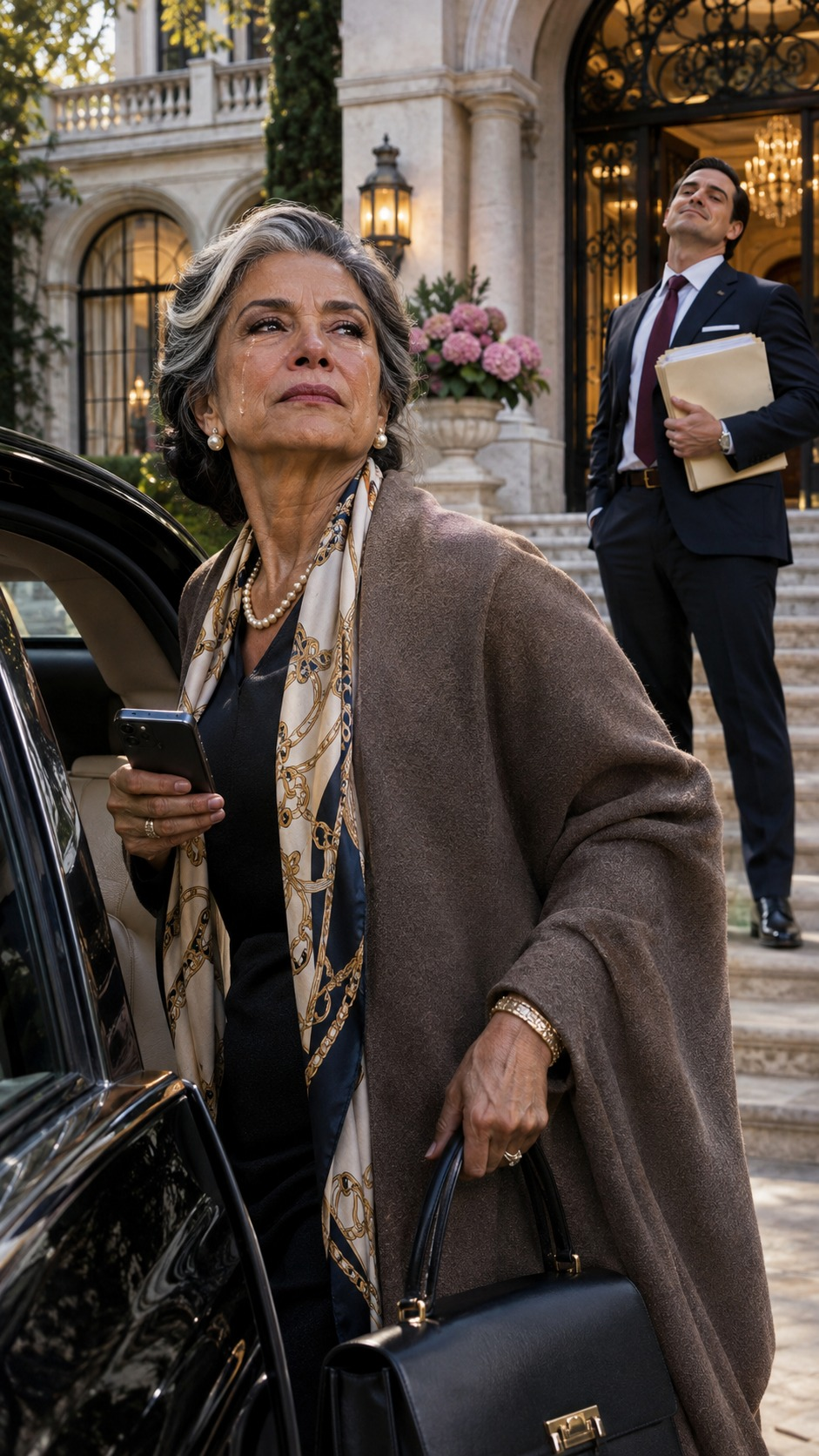
"He's coming back tonight, Mrs. Delgado. Please don't let him find out I called you."
The woman's voice trembled through Daniel's phone.
I sat perfectly still.
"Marisa?"
"Yes."
"This is Carmen Delgado."
There was a long silence.
Then I heard a small, frightened breath.
"I know who you are."
I looked at the birth certificate lying open on my phone.
For eight years, a little boy had been living somewhere in my city.
A boy who carried my son's name.
A boy whose existence had been kept from me.
And now his mother was speaking to me as though I were someone she had spent years trying to avoid.
"Marisa," I said gently, "Daniel told me you wanted to meet."
"I did. But I'm not sure anymore."
"Why?"
"Because Roberto called me twenty minutes ago."
My fingers tightened around the phone.
"What did he say?"
"He asked whether I'd spoken to anyone from your company."
I glanced toward the window of my small apartment.
Outside, the streetlights had begun to glow.
"And what did you tell him?"
"Nothing."
"Did he believe you?"
"I don't know."
Her voice cracked.
"Mrs. Delgado, I don't want trouble. I just want to protect my son."
Something inside me softened.
"Then we want the same thing."
She didn't answer.
I continued.
"Whatever Roberto told you about me, I promise you one thing. I would never deliberately hurt a child."
A faint sound came through the phone.
It might have been a sob.
Or perhaps she had simply covered her mouth.
"I wish I'd known that eight years ago," she whispered.
I closed my eyes.
Eight years.
Eight birthdays.
Eight Christmas mornings.
Eight years of school photographs, scraped knees, bedtime stories, and small victories.
All the ordinary moments that make a childhood.
All the moments I had missed.
"May I ask you something?" I said.
"Yes."
"Does your son know about me?"
Another silence.
Then she answered.
"He knows he has a grandmother."
My heart lifted slightly.
"But he thinks you don't want him."
The words struck harder than I expected.
I had been thrown out of my mansion that morning.
My son had stolen my peace, humiliated me, and tried to take control of everything I owned.
But hearing that an innocent child believed I had rejected him was a different kind of pain.
It was the kind that settled deep inside your chest.
And stayed there.
"Marisa," I whispered, "I didn't know he existed."
"I know that now."
"How?"
"Because I found something."
I straightened.
"What did you find?"
She hesitated.
"Something Roberto left here years ago. I didn't understand what it meant until recently."
"Can you tell me?"
"Not over the phone."
"All right."
"I need you to see it yourself."
I glanced at the clock.
It was almost seven.
"Where are you?"
She gave me an address.
I recognized the neighborhood.
It was a quiet residential area on the eastern side of the city, not far from one of my older apartment buildings.
"Can you come tonight?" she asked.
"Yes."
"Please don't bring Roberto."
"I wouldn't dream of it."
"And Mrs. Delgado?"
"Yes?"
"If you come, please don't tell my son anything about what his father has done."
I took a slow breath.
"Marisa, I won't ask you to make any decisions tonight. And I won't involve your boy in an argument between adults."
Her voice softened.
"Thank you."
Then she ended the call.
I sat quietly for several seconds.
My tea had gone cold.
Gabriel's photograph stood on the shelf across from me.
I looked at his familiar smile.
"You have a grandson," I whispered.
The words sounded strange.
Wonderful.
Terrible.
I had always imagined becoming a grandmother.
When Roberto was younger, he used to tease me about it.
"Mom, you'll spoil my kids worse than you spoiled me."
I would laugh.
"Only if you give me some."
He would roll his eyes.
"One day."
Apparently, that day had come eight years earlier.
And nobody had told me.
I called Daniel.
He answered immediately.
"Did you speak with her?"
"Yes."
"And?"
"I'm going to see her."
"Carmen, I don't think you should go alone."
"I wasn't planning to."
"I can accompany you."
"No. I want you working on the documents."
He hesitated.
"Then let me arrange someone trustworthy to drive you."
"I already know someone."
I found Mr. Harris's business card in my handbag.
Daniel sighed.
"At least let me know when you arrive."
"I will."
"And don't take possession of anything without documenting where it came from. If Marisa has evidence, we need to preserve it properly."
"I understand."
"One more thing."
I waited.
"Roberto has started calling people."
"Who?"
"Two property managers and someone in accounting."
I frowned.
"Why?"
"He wants immediate access to the main operating accounts."
I looked down at the copy of the birth certificate.
"He's moving quickly."
"Yes. But the account restrictions are holding."
"Good."
Daniel lowered his voice.
"Carmen, he also called my office."
I looked up.
"What did he want?"
"He demanded to know whether you had contacted me."
"What did you tell him?"
"That I couldn't discuss a client's private affairs."
I almost smiled.
"I imagine he enjoyed that."
"Not particularly."
"Did he threaten you?"
"He suggested I should reconsider my professional relationship with you."
I shook my head.
My son had spent years watching me work with Daniel.
He knew how much I trusted him.
Yet he still believed a few angry words could frighten my attorney into abandoning me.
"Daniel, be careful."
"I will."
"And please make sure Evelyn doesn't have access to anything else."
"We've already suspended her credentials pending the investigation."
"Has she been notified?"
"Not yet. The technical restrictions are in place, and formal notice is being prepared."
I nodded.
"Thank you."
After ending the call, I stood and walked into the bedroom.
I opened the wardrobe.
A few clothes hung neatly inside.
I had kept them there for years.
Not because I expected to be thrown out of my home.
Because Gabriel had always insisted that a second home should feel like a home, not a storage unit.
I changed into comfortable shoes but kept my emerald-green coat.
Then I looked in the mirror.
My face showed the strain of the day.
The skin around my eyes was swollen.
My silver-and-auburn hair had lost some of its careful shape.
I looked every one of my seventy-six years.
And for once, I didn't mind.
I had earned those years.
Every wrinkle had a history.
Every line had survived something.
I wasn't ashamed of growing old.
I was ashamed that my son had tried to use my age as a weapon.
My phone rang again.
Roberto.
I let it ring.
He called a second time.
Then a third.
Finally, a message appeared.
Mom, stop being stubborn. Tell me where you are.
I read it without replying.
Another message followed.
You are making this harder than it needs to be.
I placed the phone in my handbag.
Then I called Mr. Harris.
He answered after two rings.
"Mrs. Delgado?"
"Good evening, Mr. Harris. I hope I'm not disturbing you."
"Not at all, ma'am."
"Would you be available to drive me somewhere?"
"Of course."
I gave him the address.
He paused.
"That's not far from where my sister lives."
"Is it a safe neighborhood?"
"Yes, ma'am. Quiet. Mostly families."
"Good."
"I can be there in twenty minutes."
"Thank you."
When I hung up, I returned to Gabriel's photograph.
I picked it up.
For years, I had believed the worst thing about losing my husband was the silence he left behind.
But that evening, I realized there was something worse.
Having no one beside you who remembered the person your child used to be.
Gabriel would have understood why I was hurting.
He would have known that I wasn't mourning the mansion.
I was mourning the little boy who had once promised to take care of me.
I touched the frame.
"I wish you were here."
Then I put it back.
Twenty minutes later, Mr. Harris arrived.
He didn't ask questions when I entered the car.
He simply greeted me warmly and drove.
The city looked different at night.
Office towers glowed against the darkening sky.
Restaurants filled with families.
Couples walked beneath streetlights.
At one intersection, I saw a father carrying a sleeping child against his shoulder.
The boy's arms hung loosely around his neck.
I watched them until the light changed.
Then I looked away.
"Mrs. Delgado?" Mr. Harris asked.
"Yes?"
"Are you all right?"
I considered the question.
"No," I said.
He nodded.
"Would you like to talk?"
I looked at his reflection in the mirror.
"Do you have children?"
"Two daughters."
"How old?"
"Twenty-six and twenty-three."
"Do they still live at home?"
"The youngest does. The oldest is married."
I smiled faintly.
"Do they visit?"
"Every Sunday, if they can."
"That's lovely."
He was quiet for a moment.
Then he said, "My oldest daughter and I didn't speak for almost a year once."
I looked up.
"Why?"
"She wanted to marry someone I didn't approve of."
"And?"
"I thought I knew better."
"Did you?"
He laughed softly.
"No, ma'am."
"What happened?"
"My wife told me something I'll never forget."
I waited.
"She said, 'You can be right, or you can have a daughter. Sometimes you don't get both.'"
I considered that.
"Did you apologize?"
"Eventually."
"And now?"
"Now I have a wonderful son-in-law and a granddaughter who thinks I'm the funniest man alive."
I smiled.
"Then you were fortunate."
"Very."
He glanced at me.
"Families can surprise us, Mrs. Delgado."
I looked out the window.
"Yes," I said quietly. "They certainly can."
We reached Marisa's neighborhood shortly afterward.
The houses were modest but well maintained.
Small front gardens.
Porch lights.
Children's bicycles near driveways.
It was the kind of neighborhood I had dreamed of living in when I was young.
Mr. Harris stopped outside a pale yellow house.
A porch light illuminated the front steps.
A small blue bicycle leaned against the railing.
I stared at it.
There was a helmet hanging from one handlebar.
A child's helmet.
For some reason, that ordinary object made my eyes fill with tears.
My grandson rode a bicycle.
Such a simple fact.
Yet I had never known it.
"Would you like me to wait?" Mr. Harris asked.
"Yes, please."
"Of course."
I stepped out of the car.
The evening air was cool.
I walked toward the house.
Each step felt strangely important.
I had negotiated multimillion-dollar contracts without hesitation.
I had stood before bank executives who doubted me.
I had faced contractors who threatened to abandon projects.
But walking toward that small front door frightened me more than any business meeting ever had.
Because money wasn't at stake.
A child was.
I rang the bell.
Footsteps sounded inside.
Then the door opened.
Marisa Bennett stood before me.
She was younger than I had expected.
Perhaps thirty-eight.
Her dark hair was tied loosely behind her head.
She wore a blue sweater and black pants.
Her face was tired.
But her eyes were alert.
"Mrs. Delgado?"
"Yes."
She looked past me toward the street.
"Did anyone follow you?"
"I don't believe so."
She hesitated.
Then stepped aside.
"Please come in."
I entered.
The house smelled of dinner.
Tomato sauce.
Fresh bread.
Something sweet baking in the oven.
There were children's drawings on the refrigerator.
A pair of small sneakers near the door.
A school backpack hanging from a hook.
I felt an ache in my chest.
This was a home.
Not an expensive home.
Not a grand home.
But a real one.
The kind where someone cooked dinner and reminded a child to finish his homework.
Marisa closed the door.
"Thank you for coming."
"Thank you for inviting me."
She led me into a small living room.
A framed photograph stood on a side table.
The little boy from the earlier picture was smiling at the camera.
He had lost one of his front teeth.
I couldn't stop looking at him.
Marisa noticed.
"His name is Lucas."
I repeated it softly.
"Lucas."
"Lucas Gabriel Bennett."
My breath caught.
"Gabriel?"
She nodded.
"Roberto chose the middle name."
I looked at her.
"After his father?"
"Yes."
I sat down slowly.
My husband had never known he had a grandson named after him.
That realization nearly broke me.
Marisa sat across from me.
For several seconds, neither of us spoke.
Then she said, "I don't know where to begin."
"Begin wherever you feel comfortable."
She twisted her hands together.
"I met Roberto nine years ago."
I nodded.
"He was charming. Confident. He told me he worked in real estate."
"That part was true."
"He said his mother was a powerful businesswoman."
I smiled sadly.
"That part was true, too."
Marisa looked down.
"He also said you controlled every part of his life."
I remained silent.
"He said you decided who he could date, where he could live, and what he could do with his money."
I felt a familiar pain.
Roberto had always disliked being reminded that financial help came with responsibilities.
Apparently, he had turned that resentment into a story about me.
"Did you believe him?" I asked.
"At first."
"And later?"
She hesitated.
"When I became pregnant, everything changed."
I leaned forward.
"How?"
"He was happy for about a week."
I waited.
"Then he started talking about his inheritance."
My stomach tightened.
"He said if you found out he was having a child with someone who wasn't wealthy, you'd cut him off."
I closed my eyes.
Of course.
Money.
Always money.
"He told me you would never accept me," Marisa continued. "He said you would take the baby away if you thought I wasn't good enough."
I opened my eyes.
"Marisa, I would never have done that."
"I know."
"How?"
"Because I started looking into you."
She glanced toward a small bookshelf.
"I found interviews. Articles about your company. Stories about the housing assistance programs you supported."
I nodded.
"I read about the scholarship fund you created after your husband died."
My throat tightened.
Gabriel's scholarship fund.
It had helped hundreds of students attend college.
"Then I found an old interview where you talked about family."
"What did I say?"
Marisa smiled faintly.
"You said children should never have to earn the right to be loved."
I remembered the interview.
It had been conducted shortly after Gabriel's death.
I had been asked what I hoped my legacy would be.
I had said I wanted people to remember that wealth was useful only when it made life better for someone.
And that children deserved love before they deserved anything else.
Marisa looked at me.
"That didn't sound like the woman Roberto described."
I swallowed.
"No."
"But I was scared. I was young. And he was very convincing."
I nodded.
"Then Lucas was born."
Her face softened.
"He was beautiful."
I looked at the photograph.
"He still is."
She smiled.
"Thank you."
"Did Roberto visit?"
"Sometimes."
"How often?"
"At first, every week. Then every month. Then less."
I looked down.
"He paid some expenses," she continued. "But he always made it sound like a favor."
I knew that tone.
I had heard it earlier that day.
The nursing home.
One month paid.
As though basic responsibility were an act of extraordinary generosity.
"Did Lucas ask about his father?"
"All the time."
Her eyes filled.
"Children notice absence, Mrs. Delgado. Even when adults pretend they don't."
I nodded slowly.
"Yes," I whispered. "They do."
Marisa wiped her eyes.
"Last year, Lucas asked why his grandmother never visited."
My heart tightened.
"What did you tell him?"
"I told him I didn't know."
She looked at me.
"That was the truth. By then, I wasn't sure what to believe."
I reached across the table.
Not far enough to touch her.
Just enough to show that I wasn't angry.
"Marisa, you were trying to protect your child."
She nodded.
"I know."
"And I don't blame you."
Her face crumpled slightly.
For the first time, she began to cry.
Quietly.
Without embarrassment.
I waited.
After a moment, she wiped her cheeks.
"I'm sorry."
"Please don't apologize."
She took a breath.
"There's something else."
I looked at her.
"Roberto came here three nights ago."
My body went still.
"What did he want?"
"He was nervous."
"About what?"
"He wouldn't tell me."
She glanced toward the hallway.
"He asked whether I still had a box of his old papers."
"What papers?"
"Documents he left here years ago. He said they weren't important."
"Where are they?"
"In my bedroom closet."
I leaned forward.
"Did you give them to him?"
"No."
"Why not?"
"Because I had already looked inside."
I waited.
Marisa's hands began trembling again.
"There were copies of company records. Letters. Some financial documents."
"Did you recognize any of them?"
"Not really."
"Then what frightened you?"
She looked directly at me.
"Your name was on several of them."
I felt my pulse quicken.
"And?"
"Some were dated years before Roberto claimed you had started losing your memory."
I said nothing.
She continued.
"One document looked like a plan."
"A plan?"
"Yes."
"For what?"
She swallowed.
"For removing you from the company."
The room seemed to become very quiet.
I thought of Evelyn's memorandum.
The false reports.
The forged signatures.
The months of manipulation.
Had Roberto been preparing this for years?
"Marisa," I said carefully, "may I see the box?"
She nodded.
"Of course."
She stood.
Then stopped.
"There's something I need to tell you first."
I waited.
"Roberto doesn't know I found the box."
"All right."
"But he knows it exists."
I nodded.
"And he told me that if anyone ever saw those papers, it could ruin his life."
I looked toward the hallway.
"Then perhaps we should examine them."
Marisa hesitated.
"Mrs. Delgado, I'm afraid."
"Of Roberto?"
She didn't answer.
That was answer enough.
I stood.
"Marisa, listen to me. You don't have to face him alone."
She looked at me with wet eyes.
"I don't have your money."
"This isn't about money."
"I don't have lawyers."
"I do."
"And I don't have anyone powerful protecting me."
I stepped closer.
"You have someone now."
Her lips trembled.
For a moment, I thought she might embrace me.
Instead, she nodded.
"Thank you."
She led me down the hallway.
Family photographs lined the walls.
Lucas at the beach.
Lucas holding a birthday cake.
Lucas wearing a school uniform.
I slowed beside one photograph.
He was standing in front of a Christmas tree, holding a small toy train.
He looked about four.
I remembered Roberto at that age.
He had loved trains.
He used to line them up across the living room floor and announce that he was building a city.
I touched the edge of the frame.
"Does he like trains?"
Marisa smiled.
"He loves them."
I felt tears rise again.
Some things traveled through families in ways nobody could explain.
Marisa opened the bedroom door.
The room was neat.
A small desk stood beneath the window.
There were folded clothes on a chair.
She walked toward the closet and reached up to the highest shelf.
After moving two blankets, she pulled down a cardboard storage box.
It was sealed with old packing tape.
She placed it on the bed.
"Here."
I approached.
The box was ordinary.
Brown cardboard.
Faded corners.
A handwritten label.
R. Delgado — Personal
I recognized Roberto's handwriting.
He had written his name the same way since high school.
Marisa carefully removed the tape.
Inside were folders, envelopes, and a small black notebook.
My eyes went immediately to the notebook.
It looked familiar.
Too familiar.
I picked it up.
The cover was worn.
One corner had been bent.
On the first page, written in blue ink, were two words.
Carmen Delgado.
My name.
In my handwriting.
I stared at it.
I hadn't seen that notebook in years.
It was one of my old business journals.
I had used it to record early property negotiations, financing ideas, and personal notes.
I thought it had been lost during an office renovation.
But here it was.
In a box my son had hidden at the home of a woman he had forbidden me to meet.
I opened the notebook.
The first pages were mine.
Property addresses.
Renovation estimates.
Meeting notes.
Then, halfway through, the handwriting changed.
Roberto's.
I turned another page.
There were names.
Dates.
Amounts.
And a heading written in capital letters.
CONTROL TRANSITION PLAN.
My mouth went dry.
Marisa watched me.
"Is that important?"
I looked up.
"Very."
I turned the next page.
There were references to my company.
To Evelyn.
To several properties.
And to a proposed strategy for persuading employees that I was no longer capable of managing the business.
I felt a chill.
This wasn't a misunderstanding.
It wasn't an impulsive decision.
Someone had been planning my removal for a long time.
I took out my phone.
"Marisa, I need to call Daniel."
She nodded.
I dialed.
He answered immediately.
"Carmen?"
"I'm with Marisa."
"Are you safe?"
"Yes."
"What did you find?"
"A notebook."
"What kind?"
"An old business journal of mine. Roberto has been using it to record plans."
There was a pause.
"Plans for what?"
"For taking control of the company."
Daniel's voice sharpened.
"Don't alter anything. Photograph the cover and the pages you're viewing, and keep the original where it is until we can arrange proper collection."
"I understand."
"Does it mention Evelyn?"
"Yes."
"Anyone else?"
I turned another page.
There was a list of names.
Some familiar.
Some not.
I read them silently.
Then I stopped.
One name had been circled twice.
Thomas Vale.
The man associated with Northbridge Advisory Group.
I felt my stomach tighten.
"Daniel?"
"Yes?"
"Thomas Vale is in the notebook."
He exhaled.
"That connects another piece."
I continued turning pages.
Then I found something that made my hands go cold.
A date.
An appointment.
And beneath it, a short instruction.
Obtain updated signature samples before final transfer.
I stared at the words.
My signature.
The forged documents.
The hidden bank account.
Everything was connected.
"Daniel," I whispered, "I think we found the planning records."
"Then we need to secure them immediately."
I nodded.
But before I could answer, a sound came from the front of the house.
Three sharp knocks.
Marisa froze.
Her face drained of color.
"That's him."
I looked toward the hallway.
"Are you sure?"
She nodded.
"He knocks like that when he's angry."
The knocks came again.
Louder.
Then Roberto's voice sounded through the front door.
"Marisa! Open up!"
My heart began to pound.
Marisa grabbed my arm.
"Mrs. Delgado, he can't know you're here."
I looked at the notebook.
Then at the open box.
Then toward the hallway.
Daniel was still speaking through my phone.
"Carmen? What's happening?"
I lowered my voice.
"Roberto is here."
"Do not confront him. Stay somewhere safe. I'm arranging help."
Marisa hurried toward the bedroom door.
"There's a back entrance through the kitchen," she whispered.
I shook my head.
"I'm not leaving you alone with him."
"Please."
Another knock shook the front door.
"Marisa! I know you're home!"
Then came a smaller voice.
A child's voice.
"Mom?"
Marisa stopped breathing.
Lucas.
He was home.
And he had heard his father.
"Mom, why is Dad yelling?"
I looked at Marisa.
Her eyes filled with terror.
Roberto knocked again.
Then his voice changed.
It became soft.
Almost pleasant.
"Lucas, buddy, open the door for Daddy."
Marisa rushed toward the hallway.
"No, sweetheart! Don't touch the door!"
But we were too late.
A lock clicked.
The front door began to open.
And from the other side, Roberto said something that made my blood run cold.
"Good boy. Now tell me where your grandmother is."






Comments 0