"John Green wasn't the only person I was ordered to poison. Jedediah Boone was supposed to die in that hospital too."
Dr. Samuel Hargrove's confession left the courtroom silent.
Meadow stared at the physician.
Jedediah gripped the wooden arms of his platform.
For three years, he had believed the logging accident had destroyed his life. Now he was learning that someone had intended to make sure he never left the hospital alive.
Judge Nathaniel Reed leaned forward.
"Doctor, are you accusing Governor Whitmore of ordering these deaths?"
Hargrove swallowed.
"Yes, Your Honor."
The courtroom erupted in whispers.
The governor's chair remained empty.
But everyone knew who the doctor meant.
Judge Reed raised his hand.
"Silence!"
He looked directly at Hargrove.
"You will explain everything. And you will do so under oath."
The physician nodded.
Then he opened his medical case and removed a collection of sealed documents.
"I have kept these records for four years. I was afraid to reveal them. But I cannot carry this secret any longer."
He placed the first document on the table.
It contained the original treatment instructions for Jedediah Boone.
Clara Whitcomb immediately recognized the handwriting.
"That's Dr. Hargrove's original prescription."
The physician nodded.
"I prepared the treatment. But I was instructed to administer something different."
Jedediah looked at him.
"By whom?"
Hargrove lowered his eyes.
"Nathaniel Cross delivered the instructions. He told me the governor had approved them."
Meadow looked toward Jedediah.
His face remained controlled, but his fingers had tightened around the wooden handles.
"What was in the medicine?" he asked.
Hargrove hesitated.
"A substance intended to suppress your breathing and weaken your heart. The dosage was supposed to appear consistent with complications from your spinal injuries."
Thomas stood.
"You were going to murder him?"
Hargrove nodded.
"Yes."
"And John?"
The physician closed his eyes.
"John Green had discovered the financial accounts. He had also identified the people who had approved the inferior timber shipments. The governor believed that if John survived, the entire operation would be exposed."
Meadow's voice trembled.
"Then you deliberately gave my husband something that would kill him?"
Hargrove looked at her.
"I did."
She stared at him.
"Why?"
"Because I was afraid."
Meadow slowly shook her head.
"My husband was afraid too. But he didn't use that fear as an excuse to murder anyone."
Hargrove lowered his head.
"I know."
The physician continued his testimony.
He explained that the Black Ridge company had been operating a fraudulent supply arrangement for several years.
Governor Malcolm Whitmore had approved government construction contracts.
Horace Abernathy had arranged local financial transfers.
Warren Cole had supervised the replacement timber deliveries.
Nathaniel Cross had coordinated the concealment of records, intimidated witnesses, and controlled the payments.
The accident had not been an isolated failure.
It had been the predictable result of deliberate cost-cutting.
When Jedediah and the other workers discovered that the support beams were unsafe, the company had refused to stop operations.
The accident followed.
Afterward, the governor's administration needed someone to blame.
Jedediah became the convenient target.
John Green began investigating the financial records.
Thomas Bell witnessed the false timber deliveries.
And Evelyn had already discovered the original accounting scheme.
One by one, they had become threats.
Judge Reed examined the documents.
"Doctor, why did you keep these records?"
Hargrove reached into his case.
"Because I eventually realized what I had done."
He removed a small notebook.
"I recorded every instruction I received. Every payment. Every prescription."
He opened it.
The final pages contained a series of signatures.
One belonged to Cross.
Another belonged to Horace Abernathy.
And the final signature was unmistakable.
Malcolm Whitmore.
Judge Reed studied it.
"Is this authentic?"
Hargrove nodded.
"I watched the governor sign it."
The courtroom became completely silent.
The judge ordered an immediate recess.
He instructed the court officers to secure the documents and summoned federal authorities from the neighboring jurisdiction.
Governor Whitmore arrived twenty minutes later.
He entered the courthouse surrounded by two assistants.
His expression was confident.
He wore a dark formal coat and carried a polished walking stick.
When he saw Hargrove, his expression changed.
"What is this?"
Judge Reed remained seated.
"Governor Whitmore, you have been named in testimony concerning the Black Ridge accident and several related deaths."
The governor laughed.
"By a disgraced physician?"
Hargrove stood.
"I treated those men. I followed your orders."
Whitmore turned toward him.
"You are lying."
Hargrove reached for the notebook.
"Then explain your signature."
The governor looked at the document.
For a moment, his confidence disappeared.
Then he turned toward the judge.
"I demand to see the original."
Judge Reed nodded.
The clerk brought it forward.
Whitmore examined the page.
He recognized his signature.
And he understood that the evidence could no longer be dismissed as rumor.
"This document was stolen."
Evelyn stepped forward.
"No. It was preserved."
Whitmore glared at her.
"You should have stayed dead."
The courtroom erupted.
Judge Reed struck his gavel.
"Governor Whitmore!"
But Evelyn remained calm.
"I spent eleven years being afraid of men like you. I'm finished."
Whitmore turned toward the judge.
"This is a political conspiracy."
Judge Reed removed his glasses.
"No, Governor. It is an investigation into the deaths of innocent people."
He looked toward the federal officers who had just entered.
"Take Governor Whitmore into custody pending a full examination of these charges."
The governor attempted to protest.
But the officers approached.
For the first time, the man who had controlled the territory's most powerful institutions was unable to command anyone.
He was escorted from the courtroom.
Meadow watched him leave.
She felt no satisfaction in seeing a man humiliated.
She felt something quieter.
Relief.
The truth had finally reached someone who could act on it.
The investigation continued for several weeks.
Cross was charged with conspiracy, evidence tampering, and obstruction.
Horace Abernathy faced charges connected to fraudulent financial transfers and witness intimidation.
Warren Cole was arrested after investigators recovered the original timber delivery orders.
Dr. Hargrove agreed to cooperate fully with the authorities.
His testimony was supported by the medical records, payment documents, and statements from former employees.
He admitted his responsibility for the deaths he had helped conceal.
He did not ask Meadow to forgive him.
And she did not.
The court later determined that John Green's death had resulted from deliberate poisoning carried out under the direction of the conspiracy.
The original medical report was restored to the official record.
The same investigation confirmed that Jedediah had not caused the Black Ridge accident.
The timber supports had been knowingly replaced with inferior materials.
His actions before the collapse had been consistent with the safety procedures he had followed throughout his career.
The accusation against him was formally withdrawn.
The governor's contracts were suspended.
The company lost its government privileges.
And the families of the workers who had died received compensation from the recovered funds.
But the most important victory came when the court cleared the names of the men who had been blamed for the accident.
Jedediah Boone was no longer remembered as the mountain man whose carelessness had caused a disaster.
He was recognized as one of the people who had tried to prevent it.
On the morning of the final public hearing, the courthouse square was crowded.
Farmers, merchants, former workers, and families had gathered.
The governor's administration had been dismantled.
The mayor's office was under new management.
The recovered money had been placed under independent supervision.
Judge Reed stepped onto the courthouse balcony.
He carried a written statement.
"Today, the record of the Black Ridge accident is corrected."
The crowd fell silent.
He read the names of the workers who had died.
He read the names of those who had been injured.
Then he read Jedediah Boone's name.
"Mr. Boone was wrongly accused. His testimony and the evidence presented before this court establish that he acted in good faith and attempted to protect his fellow workers."
For several seconds, nobody moved.
Then a man in the crowd began clapping.
Another joined.
Then another.
Soon the entire square erupted in applause.
Jedediah sat beside Meadow.
He looked uncomfortable.
He had never wanted a public celebration.
He had wanted the truth.
Meadow placed her hand over his.
"You deserve this."
He looked at the crowd.
"They're not applauding because I can stand."
She smiled.
"No. They're applauding because you refused to surrender."
His eyes softened.
For the first time in years, he allowed himself to accept their respect.
The compensation settlement changed the lives of many families.
John's records helped identify twenty-three households that had received money through his private arrangement.
The court confirmed that those payments had been intended to restore funds stolen from the workers.
The families were allowed to keep the assistance they had received.
Additional compensation was provided to those affected by the accident.
Thomas Bell received enough money to settle his debts and purchase a small property near Oak Haven.
He and Margaret decided to open a repair shop.
Thomas would handle the accounts.
Margaret would manage the business.
Their children would finally grow up without the fear that their father might disappear again.
One afternoon, Thomas visited Jedediah's ranch.
He stood beside the workshop.
"I've been thinking."
Jedediah looked up from a wooden mechanism.
"That sounds dangerous."
Thomas laughed.
"I want to work with you."
"Doing what?"
"Building things."
Jedediah examined him.
"You know anything about machinery?"
"Enough to break it."
"Then you're qualified."
They laughed.
Thomas extended his hand.
Jedediah shook it.
Their partnership began with a simple agreement.
They would build equipment that made difficult work safer and easier.
No dishonest contracts.
No hidden accounts.
No promises they couldn't keep.
And every worker would receive a fair share of the profits.
Eleanor and Clara also began rebuilding their lives.
Eleanor returned to the county office under a new administration.
She was asked to help establish an independent records department.
Her experience with the Black Ridge accounts made her an important part of the reforms.
Clara returned to nursing.
She worked at a small medical clinic outside Oak Haven.
She refused to hide the truth about her involvement in the events surrounding John Green.
Instead, she used her experience to help establish stricter procedures for medical prescriptions and patient records.
The sisters gradually repaired their relationship.
One Sunday afternoon, Meadow found them sitting together beneath the porch.
They were laughing.
Something Meadow hadn't seen in years.
Evelyn had also begun a new life.
She chose to remain near Oak Haven.
She purchased a modest cottage and began helping families who had lost their homes because of the logging company's fraud.
She never tried to reclaim John's place in Meadow's life.
She understood that their marriage had belonged to a different time.
But she and Meadow developed a friendship neither had expected.
Sometimes they spoke about John.
Sometimes they disagreed.
Sometimes they laughed at stories about his stubbornness.
And sometimes they simply sat together.
They had lost different pieces of the same man.
But neither needed to lose herself in that grief.
Jedediah's workshop became famous.
At first, he built repaired wagon wheels and harnesses.
Then he began developing specialized equipment for farms and timber operations.
His wheeled platform inspired a new design for transporting heavy materials.
He built lifting mechanisms that allowed injured workers to continue earning a living.
He also designed a safer logging support system using stronger joints and replaceable beams.
Farmers traveled from neighboring counties to see his work.
A merchant offered to buy the designs.
Jedediah refused to sell the rights outright.
Instead, he arranged for local workshops to manufacture them under fair agreements.
The workers received training.
The businesses paid reasonable prices.
And every design included clear safety instructions.
He became respected not because he had regained the physical strength he once possessed.
He became respected because he had learned to use the strength he still had.
One afternoon, a young man arrived at the ranch.
He had lost the use of his legs after a wagon accident.
He looked at Jedediah's platform.
"Do you think I could build something like that?"
Jedediah studied him.
"Why?"
The young man looked down.
"Because I don't want to spend the rest of my life waiting for someone to carry me."
Jedediah smiled faintly.
"Then come inside."
He moved toward the workshop.
"I'll show you where to begin."
Spring returned to Meadow's ranch.
The old fences had been repaired.
The barn roof had been replaced.
The fields were producing again.
A small orchard had been planted near the creek.
Meadow had once believed her life was finished after losing John.
She had watched her crops fail.
She had endured the laughter of neighbors.
She had accepted that her home might remain empty forever.
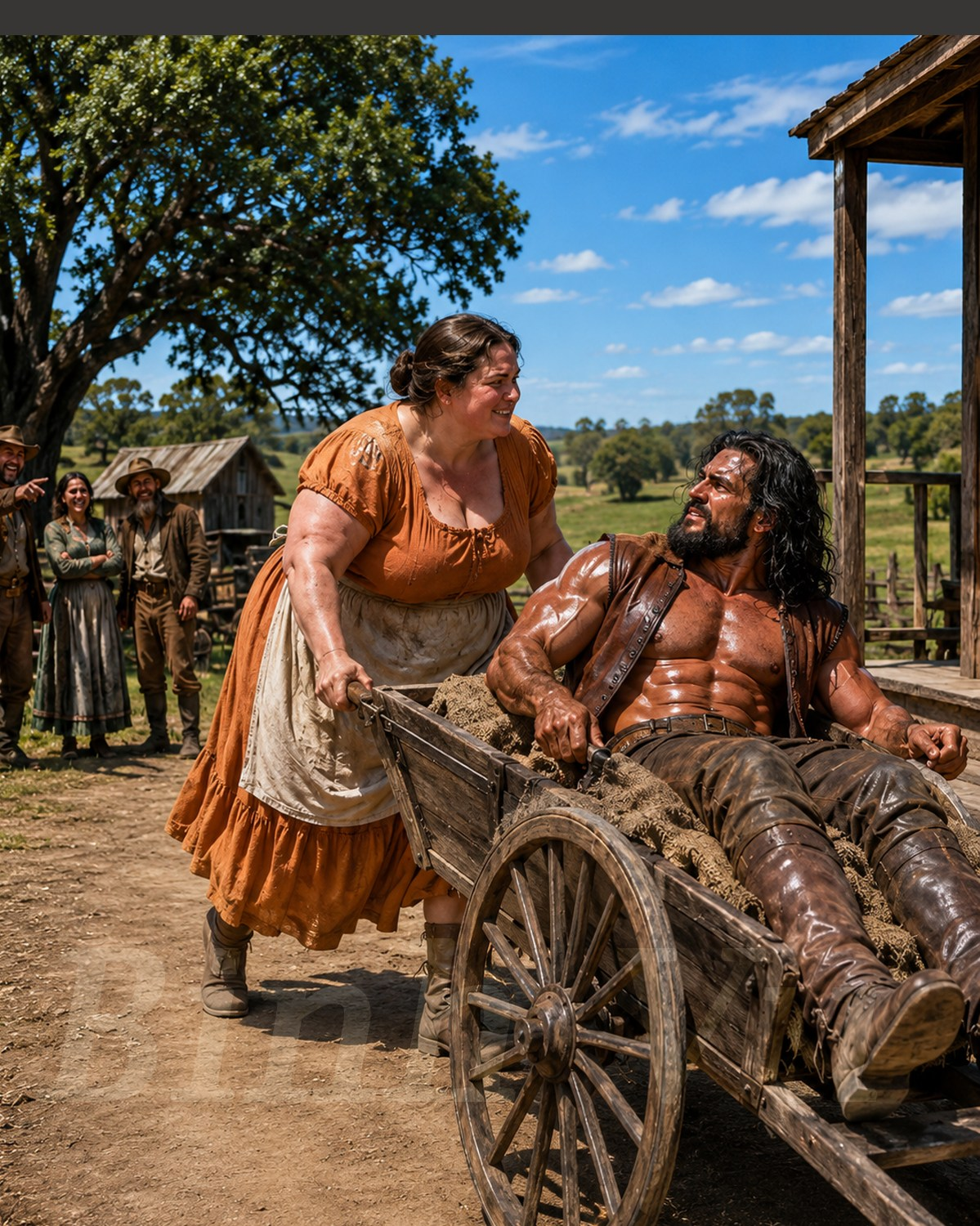
Then the mayor had placed a paralyzed giant on a wooden wagon and offered him to her as a cruel joke.
She remembered that day.
The laughter.
The staring faces.
The way Jedediah had looked at her.
He hadn't asked her to save him.
He had simply looked exhausted.
And she had recognized the wounded dignity in his eyes.
Now, years later, the ranch was full of people.
Workers came to learn.
Families visited.
Children played near the barn.
And Jedediah's workshop never seemed quiet.
One evening, Meadow found him sitting on the porch.
He was looking toward the mountains.
She brought two cups of coffee.
"Thinking about Black Ridge?"
He accepted the cup.
"Sometimes."
"Does it still hurt?"
He considered the question.
"Some days."
She sat beside him.
"Me too."
He looked at her.
Then he reached for her hand.
"I used to think my life ended on that mountain."
Meadow listened.
"I thought losing my legs meant losing everything that made me a man."
She squeezed his fingers.
"And now?"
He looked toward the workshop.
"Now I think I was wrong."
Meadow smiled.
"You were wrong about several things."
He laughed.
"Such as?"
"Your first design for the wagon."
"It worked."
"It nearly threw me into the fence."
"That was a minor engineering problem."
She laughed.
He looked at her for a long moment.
"Meadow."
"Yes?"
"I don't know how to thank you for bringing me home."
She placed her cup on the porch.
"You don't have to."
"I want to."
She turned toward him.
"Then stay."
He looked into her eyes.
"I intend to."
Several months later, Jedediah surprised Meadow with a small wooden box.
She found it on the kitchen table.
"What is this?"
"Open it."
Inside was a simple silver ring.
It wasn't expensive.
It had no large stone or elaborate decoration.
But it had been carefully made by a local craftsman.
Meadow looked at him.
"What does this mean?"
Jedediah took a breath.
"I've spent enough of my life believing that everything good can be taken away."
He paused.
"Then you came along."
Meadow's eyes filled.
"I don't need someone to rescue me. I know that. And I don't want you to think I'm asking you to replace anyone."
He looked at her.
"I'm asking whether you'd like to build the rest of your life with me."
Meadow looked at the ring.
Then she looked at the man who had once arrived at her ranch unable to move his legs.
She remembered the first bowl of stew she had given him.
His stubborn refusal to surrender.
The storm.
The charging horse.
The courtroom.
The countless evenings spent building something together.
She reached for his hand.
"Yes."
Jedediah smiled.
For the first time, Meadow saw him smile without pain behind it.
He placed the ring on her finger.
And she kissed him.
Their wedding was held the following spring.
It took place beneath the old oak tree near the ranch house.
There were no grand speeches.
No expensive decorations.
Just friends, neighbors, workers, and families who had become part of their lives.
Thomas served as Jedediah's best man.
Margaret stood beside Meadow.
Eleanor and Clara helped arrange the flowers.
Evelyn attended as a close friend.
Caleb brought his children.
Elias Turner prepared the food.
Even Samuel Price arrived early to help build the seating.
When the ceremony began, Jedediah rolled forward on his own platform.
Meadow wore a beautiful ivory dress.
She looked at him and smiled.
The minister spoke about loyalty, patience, and partnership.
Then he asked whether they wished to share their lives.
Jedediah answered first.
"I do."
Meadow took his hand.
"I do."
The crowd applauded.
Thomas wiped his eyes.
Elias pretended something had gotten into his.
And Evelyn smiled quietly.
For the first time in many years, the past no longer felt like something chasing them.
It had become something they could remember without being controlled by it.
Years later, travelers passing through Oak Haven would hear stories about the mountain man who had rebuilt a life after a terrible accident.
They would hear about the widow who had taken him home when the entire town laughed.
They would hear about the storm, the charging horse, the hidden accounts, and the governor who had fallen because he believed ordinary people would remain silent forever.
But the people who knew Meadow and Jedediah understood that their greatest achievement was not the trial.
It was the ranch.
It was the workshop.
It was the families who had found work again.
It was the injured workers who discovered that their lives were not over.
And it was the friendship between two people who had once believed they had nothing left to offer the world.
One summer afternoon, a group of children gathered around Jedediah in the workshop.
One little boy pointed toward the wooden platform.
"Mr. Boone, does it bother you that you can't walk?"
Jedediah looked at the boy.
"Sometimes."
"Then how do you do all these things?"
Jedediah smiled.
"I stopped measuring my life by the things I couldn't do."
The boy considered that.
Then he pointed toward the machinery.
"Can you teach me to build that?"
Jedediah laughed.
"Come back tomorrow."
The children ran outside.
Meadow stood in the doorway, watching him.
He looked up.
"What?"
She shook her head.
"Nothing."
He smiled.
"You're looking at me strangely."
"I'm just thinking."
"About what?"
She walked over and kissed his forehead.
"About how the whole town once laughed when they thought I had been given a broken man."
Jedediah raised an eyebrow.
"And?"
Meadow looked around the workshop.
At the machines.
The tools.
The photographs of their friends.
The small silver ring on her finger.
Then she looked into his eyes.
"They were wrong."
He reached for her hand.
"Yes."
Outside, the children were laughing beneath the oak tree.
The horses grazed peacefully.
The ranch was alive with work and conversation.
And the man once left helpless on a wooden wagon had become one of the most respected men on the frontier.
Not because he had learned to walk again.
Not because he had defeated his enemies.
But because he had refused to let tragedy decide what his life was worth.
Meadow leaned against his shoulder.
For the first time, neither of them needed to prove anything to anyone.
They had found a home in each other.
And that was more than enough.






Comments 0