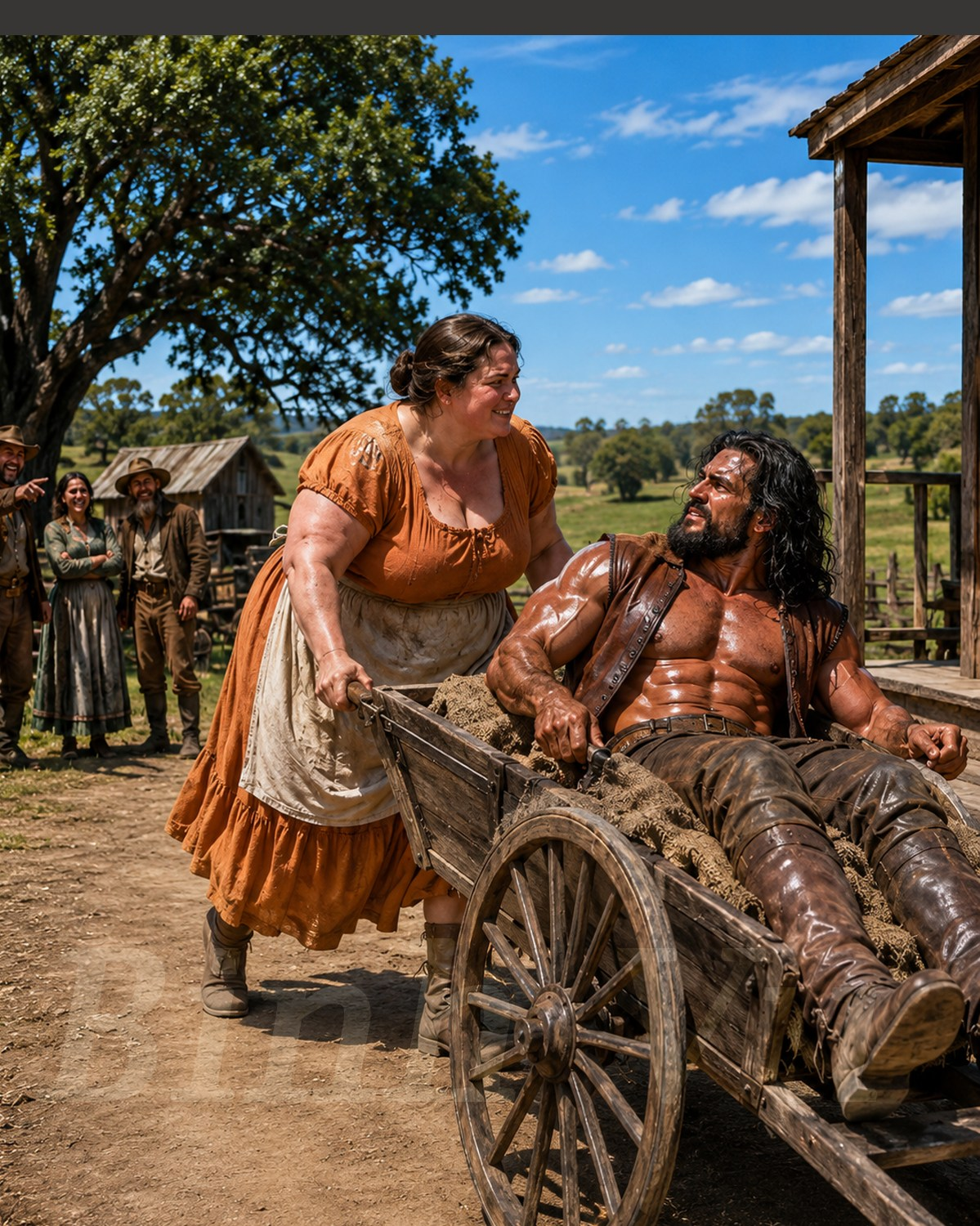
A massive man lay motionless in a wooden wagon as the townspeople laughed.
"Look at him! The mighty mountain giant can't even stand!"
Mayor Horace Abernathy stepped forward and placed a polished boot against the wagon wheel.
Then he held up a folded document.
There was a name written across the top.
Jedediah Boone.
And four words beneath it.
PROPERTY TRANSFERRED TO WIDOW.
The laughter grew louder.
But one woman wasn't laughing.
Meadow Green stood among the crowd, her hands folded against the front of her faded blue dress. Her auburn hair was pinned into a loose braid, and the afternoon sun revealed the exhaustion in her eyes.
She had come to Oak Haven that morning to purchase flour, lamp oil, and a few supplies for her ranch.
She hadn't expected to become the entertainment of the entire town.
And she certainly hadn't expected the mayor to make her the center of his cruelest joke.
"Well, Meadow?" Abernathy called. "What do you say?"
Someone behind her chuckled.
"Maybe she'll finally have someone to share her lonely little cabin with."
Another voice followed.
"At least the giant won't complain about her cooking. He can't get away!"
The crowd erupted.
Meadow lowered her eyes for a moment.
She knew these people.
She knew their jokes, their whispers, and the way their expressions changed whenever she entered a room.
They had mocked her ever since her husband died.
They called her too large to be attractive, too poor to be respected, and too stubborn to find another husband.
She had endured it because she had learned something important about Oak Haven.
People who had nothing meaningful to offer often found pleasure in taking dignity away from others.
But this time, their cruelty was directed at someone who couldn't defend himself.
Meadow looked toward the wagon.
The man inside was enormous.
Even lying down, his shoulders seemed wider than the wooden frame supporting him. His long sandy-blond hair was tied loosely behind his head, and a thick reddish-brown beard covered much of his weathered face.
A heavy blanket covered his legs.
His powerful hands rested against the sides of the wagon.
He wasn't looking at the mayor.
He wasn't looking at the crowd.
He stared toward the distant hills.
His gray eyes were cold.
Not because he was naturally cruel.
Because he had already heard every insult a human being could possibly offer.
His name was Jedediah Boone.
Three years earlier, no man in the western territories would have dared challenge him to a contest of strength.
He had hauled enormous logs from the Black Ridge forests, dragged broken wagons through muddy trails, and lifted loads that required two ordinary men.
People had called him the strongest mountain man west of the ridge.
Then came the logging accident.
A falling timber had struck him during a storm.
The injury shattered his spine.
The doctors had warned him that he might never walk again.
He had spent months fighting to regain movement.
Nothing worked.
Eventually, the men who had once depended on his strength stopped visiting.
The logging company stopped paying him.
The people who had praised his courage began calling him useless.
Now, he was lying in a wagon while a mayor treated him like an unwanted piece of furniture.
Abernathy tapped the folded document against his palm.
"Well, don't everyone look so serious. This is a generous arrangement!"
He turned toward the crowd.
"I have found a solution to two unfortunate problems in our community."
He pointed at Jedediah.
"One man who can no longer work."
Then he pointed at Meadow.
"One widow who has spent years complaining about how difficult life has become."
The mayor smiled.
"Now they can help each other."
A man near the general store laughed so hard he nearly dropped his hat.
Meadow felt heat rising in her chest.
Not embarrassment.
Anger.
But she kept it under control.
She looked at the document in the mayor's hand.
"Is that supposed to be a joke, Mayor?"
Abernathy raised his eyebrows.
"Why, Meadow, I thought you would appreciate it. You're always saying you need another pair of hands around that ranch."
"That doesn't mean I need someone to laugh at."
The mayor's smile narrowed.
"Careful. I am offering you something that nobody else wants."
He turned toward the wagon.
"Jedediah Boone. Once the strongest man in the territory. Now he can't even climb out of a wagon without assistance."
Jedediah's jaw tightened.
His fingers curled around the wooden frame.
But he said nothing.
Abernathy continued.
"His logging company has abandoned him. His money is gone. His property has been sold to settle his debts."
The mayor leaned closer.
"He's worth less than the wagon carrying him."
A sudden silence passed through the crowd.
For one brief moment, even the people who had been laughing seemed uncomfortable.
Jedediah slowly turned his head.
His gray eyes met the mayor's.
"Finished?" he asked.
His voice was deep and rough.
Abernathy laughed.
"Oh, he still has that voice! Listen to him. Perhaps we should give him a sermon platform."
The laughter returned.
Meadow watched Jedediah's expression.
He didn't plead.
He didn't argue.
He didn't ask anyone to defend him.
He simply looked away again.
Something about that silence troubled her more than the insults.
She remembered the last days of her own husband.
How he had struggled to hide his pain.
How he had pretended everything was fine because he didn't want her to worry.
She remembered the empty chair at her kitchen table.
The second cup she had stopped setting out.
The nights when the wind rattled the shutters and the cabin felt larger than it had any right to be.
She knew what it meant to become invisible after losing someone.
And she knew what it meant when people stopped seeing the person and started seeing only the tragedy.
The mayor unfolded the paper.
"Now, Meadow, I need a simple answer. Will you accept the arrangement?"
She stared at him.
"What arrangement?"
"He's yours. Take him home. Feed him. Give him a place to sleep. Perhaps he'll be useful one day."
Jedediah closed his eyes.
It was the final humiliation.
Not the laughter.
Not the insults.
The idea that his life could be handed over like an unwanted animal.
"Don't," he muttered.
Meadow looked at him.
"What?"
"Don't take me."
His voice was quiet.
But there was no weakness in it.
"I don't need your pity."
Meadow studied his face.
Then she stepped closer.
"I didn't offer you pity."
He looked at her again.
She reached for the wagon handle.
The mayor blinked.
"What are you doing?"
Meadow wrapped both hands around the rough wooden grip.
"I'm taking him home."
For a moment, nobody moved.
Then someone laughed nervously.
"She's serious?"
Abernathy stared at her.
"Meadow, think carefully. That man requires constant attention. He cannot work. He cannot walk. He cannot even take care of himself."
Meadow looked directly at him.
"Then it's fortunate I didn't ask you to take care of him."
A few people exchanged glances.
The mayor's face hardened.
"You're making a foolish decision."
"Perhaps."
"You'll regret it."
"Perhaps that too."
She leaned forward and began pulling.
The wagon shifted.
Its heavy wooden wheels creaked against the dusty road.
Jedediah stared at her.
He had expected laughter.
He had expected disgust.
He had expected someone to walk away.
He had never expected this.
"Stop," he said.
Meadow didn't release the handle.
"Why?"
"Because you don't understand what you're agreeing to."
She looked over her shoulder.
"Then explain it to me on the way home."
"I can't walk."
"I can see that."
"I can't work like I used to."
"I didn't ask you to."
"I may never get better."
Meadow paused.
For the first time, she looked directly into his gray eyes.
"Then we'll make a life with what you can do."
He had no answer.
The crowd had become strangely quiet.
The woman in the mustard-yellow dress lowered her gaze.
One of the older men removed his hat.
Even the mayor seemed uncertain how to respond.
Meadow began pulling again.
The wagon rolled slowly toward the road leading out of town.
Behind her, Abernathy called out.
"Don't come crying to me when you discover what you've taken!"
She didn't turn around.
Jedediah continued staring at her.
After several minutes, he finally spoke.
"Why?"
Meadow kept walking.
"Why what?"
"Why are you doing this?"
She glanced at the road ahead.
"Because someone should have."
Those words struck him harder than the mayor's insults.
He turned his face toward the countryside.
The wind moved through the trees.
For the first time in months, he allowed himself to consider that perhaps the world had not entirely forgotten him.
But he didn't trust hope.
Hope had become a dangerous thing.
It had promised him recovery.
It had promised him that the logging company would stand by him.
It had promised him that the people who once called him brother would return.
Every promise had eventually disappeared.
So he decided he would not trust Meadow either.
Not yet.
The journey to her ranch took several hours.
The wagon moved slowly over the uneven road, and each deep rut sent pain through Jedediah's injured back.
He clenched his teeth.
Meadow noticed.
"Do you need to stop?"
"No."
"You're hurting."
"I said no."
She nodded.
She didn't argue.
She simply adjusted the blanket beneath his shoulders at the next opportunity and continued walking.
That small gesture unsettled him.
Most people either ignored his discomfort or made a spectacle of it.
Meadow did neither.
As the sun began descending toward the distant hills, the roof of her farmhouse finally appeared.
It was a modest place.
A small wooden cabin with a narrow porch, a barn that needed repairs, and a fence that leaned dangerously toward the pasture.
The ranch looked tired.
So did its owner.
But it was clean.
And it was quiet.
Meadow stopped the wagon beside the porch.
"Here we are."
Jedediah examined the building.
"You're alone?"
"Most days."
"No children?"
"No."
"No family?"
"My husband died four years ago. My parents are gone."
He turned toward her.
"And you brought a stranger home?"
Meadow took a breath.
"Apparently."
For the first time, something almost resembling a smile crossed his face.
It disappeared quickly.
She walked toward the barn and returned with several lengths of rope, a pulley, and a sturdy wooden support.
Jedediah watched her arrange the equipment.
"What are you doing?"
"Getting you inside."
"I can manage."
She looked at his legs.
He looked at her.
Neither spoke.
Finally, he said, "You're going to need help."
Meadow glanced toward the empty road.
"Then we'll have to become very good at figuring things out ourselves."
She spent nearly two hours preparing the pulley system.
She worked carefully, checking every knot and support before transferring his weight.
Jedediah hated every second of it.
He hated being lifted.
Hated needing help.
Hated the feeling that his body had become something other people had to move.
But Meadow never rushed him.
When he winced, she stopped.
When he asked her to adjust the rope, she listened.
When the first attempt failed, she started again.
At last, they managed to lower him onto a sturdy bed near the cabin's front room.
Meadow covered him with a clean blanket.
Then she disappeared into the kitchen.
A few minutes later, she returned with a steaming bowl of beef stew.
She placed it on the small table beside him.
"Eat."
Jedediah looked at the bowl.
Then at her.
"Why?"
"Because you haven't eaten properly today."
"You don't even know me."
"No."
"Then why should you care?"
Meadow pulled a chair closer.
She looked tired.
But her voice remained steady.
"You'll work when you're ready."
She paused.
"And until then..."
She pushed the bowl a little closer.
"You'll eat."
Jedediah stared at her.
Something inside his chest tightened.
He picked up the spoon.
His hand trembled slightly.
Not from weakness.
From the effort of accepting something he had convinced himself he would never receive again.
Meadow turned toward the kitchen.
She didn't watch him eat.
She didn't wait for gratitude.
She simply began preparing the room for the night.
Outside, the wind moved through the pasture.
Inside, the giant slowly finished his stew.
For the first time since the accident, nobody had asked him to prove that he deserved to be alive.
But just as Meadow was preparing to close the shutters, a sound came from outside.
A horse.
Then another.
Hooves stopped near the front gate.
Meadow frowned.
Nobody visited her ranch after sunset.
She moved toward the window and looked through the narrow gap in the curtains.
A rider sat beneath the oak tree.
His face was hidden beneath a dark hat.
He was carrying something.
A leather envelope.
Jedediah noticed the change in her expression.
"Who is it?"
Meadow didn't answer immediately.
The rider dismounted.
Then he walked toward the porch and called her name.
"Meadow Green?"
She opened the door a few inches.
The stranger held out the envelope.
"I was told to deliver this personally."
Meadow looked at the seal.
Her expression changed.
It was the official mark of the Black Ridge Logging Company.
And underneath it was a name she hadn't heard anyone mention since the accident.
Horace Abernathy.






Comments 0