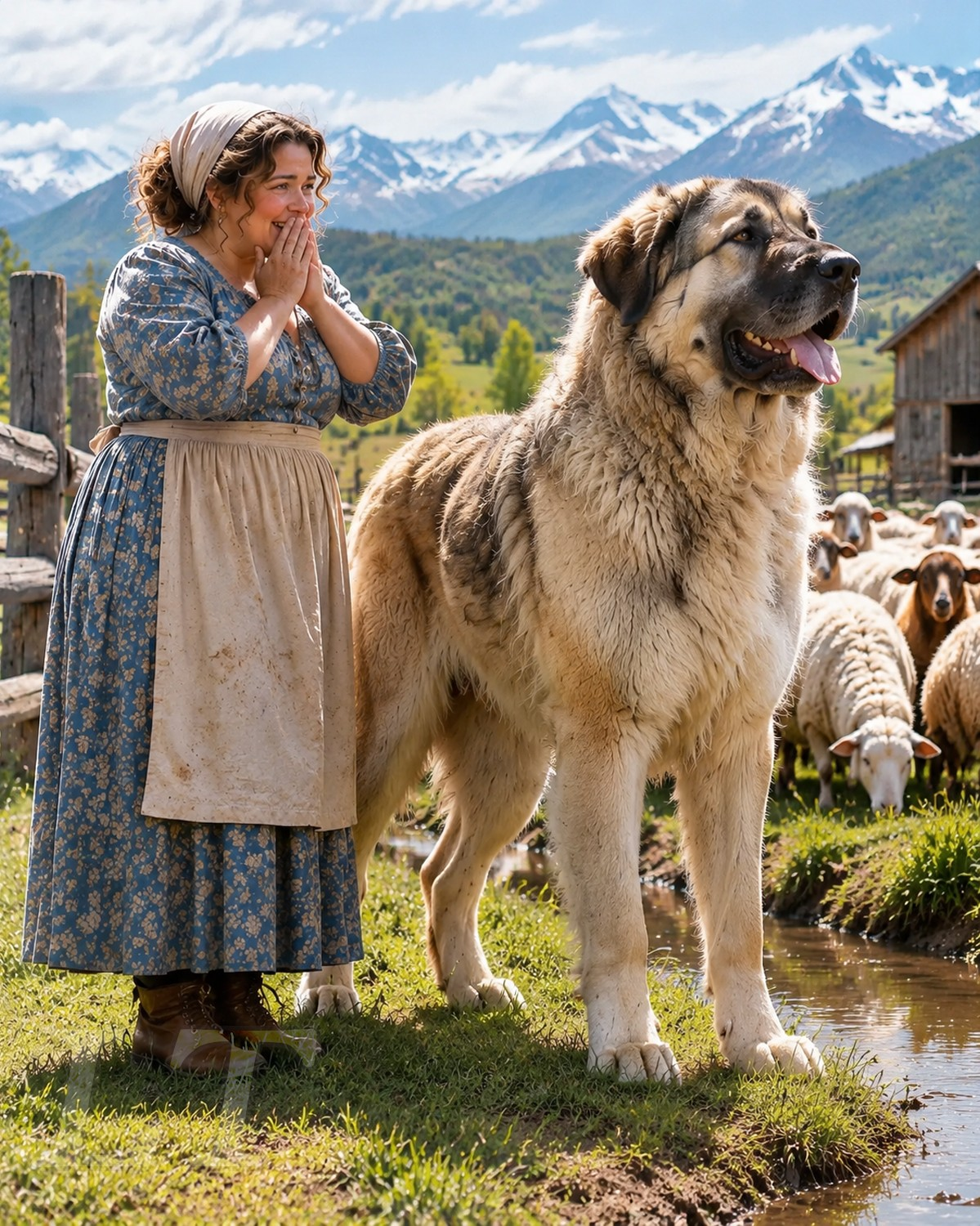
A massive dog dragged himself through the freezing mud beneath a broken cedar plank.
"Please... don't leave me here."
Ruth Bellamy dropped the reins and jumped from her mare.
The last stagecoach was already disappearing down the road.
And she had only seconds to make a decision.
Inside her coat was a leather envelope containing the documents that could protect the sixty-two acres her late husband had left her. She had spent three weeks gathering signatures, traveling between neighboring farms, and preparing the paperwork for the county clerk.
The filing deadline was that afternoon.
If she missed it, the spring pasture could become part of a land dispute that Vernon Pike had been quietly arranging for months.
Without that pasture, her forty-three sheep would have no reliable water when winter came.
She had calculated everything.
The travel time.
The clerk's closing hour.
The condition of her mare.
Even the money she would need to pay the filing fee.
But she hadn't calculated the possibility of finding a dying animal in a ditch.
The scratching came again.
Ruth turned.
A broken cedar plank lay across a narrow drainage ditch beside the road. Beneath it, something enormous was moving weakly in the muddy water.
She approached carefully.
Two gray eyes appeared beneath the timber.
A dog.
An enormous dog.
His pale cream coat was almost completely covered in mud. His ribs showed sharply beneath his fur, and one front paw was twisted at an unnatural angle.
An old reddish scar circled his neck.
Ruth immediately understood that the scar wasn't an ordinary injury.
Someone had kept this animal tied too tightly.
For how long, she couldn't imagine.
The dog attempted to lift his head.
Then it fell back into the water.
"Oh, sweetheart."
Ruth looked toward the road.
The stagecoach horn sounded.
One long blast.
It was getting farther away.
She could still catch it if she mounted her mare and rode hard enough.
The county clerk's office would close at five.
There might not be another opportunity.
Her husband's land documents were inside her coat.
She could almost hear his voice telling her to protect what they had built.
Then the dog moved again.
His front legs scraped helplessly against the muddy bank.
Ruth dismounted.
She tied her mare to a fence post and searched the roadside for something she could use to lift the timber.
There was nothing.
She tried pushing the plank with both hands.
It didn't move.
The cedar was too heavy.
She glanced toward the road once more.
The stagecoach was almost gone.
"All right," she whispered.
She hurried to her wagon and examined the wooden tongue attached to its front.
It was old, but strong.
With considerable effort, she unhitched it and dragged it toward the ditch.
She slid one end beneath the cedar plank.
Then she pressed down.
Nothing happened.
She adjusted her position.
Her injured shoulder protested.
She pressed harder.
The wood shifted.
Two inches.
The dog attempted to pull himself forward, but his trapped hindquarters remained pinned beneath the timber.
"Come on," Ruth muttered.
She planted both boots against the muddy ground.
Her shoulder burned.
The wooden lever creaked.
Three inches.
Then the timber lifted enough for the mud to release the dog's body.
He dragged himself forward and collapsed beside her boots.
Ruth dropped the lever.
A sharp pain shot through her shoulder.
She barely noticed.
The dog was breathing.
That was all that mattered.
She knelt beside him and examined his injuries.
His paw was swollen.
His coat was filthy.
His body trembled uncontrollably.
But when she placed a hand near his neck, he didn't snap.
He didn't growl.
He simply looked at her.
There was something unsettling about those gray eyes.
Not because they were frightening.
Because they looked exhausted.
As though the animal had already learned that expecting kindness was dangerous.
Ruth swallowed.
"Well," she whispered, "I suppose we're both having a terrible day."
The stagecoach horn sounded again.
This time, it was barely audible.
She looked toward the road.
The clerk's office was now out of reach.
Her husband's final chance to protect their land had just slipped away.
For a moment, she remained perfectly still.
Then she removed her coat and wrapped it around the dog's body.
She would figure out the rest later.
Getting him onto the saddle was another problem.
The animal was enormous.
Ruth tried lifting his front half first, but his weight nearly pulled her off balance.
She repositioned herself, pulled the saddle blanket loose, and carefully maneuvered him across the mare's back.
The dog made a faint sound.
Not a bark.
Almost a sigh.
"Easy. I've got you."
She held him in place with one hand and walked her mare home.
It took nearly two hours.
By the time she reached the farm, the sun was low behind the mountains.
Her shoulder throbbed.
Her boots were soaked.
The documents inside her coat were ruined at the edges.
And the enormous dog had not moved once.
Ruth called him nothing that evening.
She was too busy trying to keep him alive.
She carried a bucket of warm water into the barn and placed it beside a dry bed of straw.
The dog barely opened his eyes.
She cleaned the mud from his face with a damp cloth.
When she reached the old rope scar around his neck, she stopped.
The skin beneath it was badly irritated.
Someone had hurt him deliberately.
Ruth knew enough about farm animals to recognize the difference between an accident and prolonged neglect.
She had seen horses with rope burns.
She had treated sheep injured by poorly fitted restraints.
This was different.
The scar was deep.
The dog had probably spent weeks, perhaps months, chained somewhere.
She looked at him.
"You're safe here."
He didn't respond.
Ruth returned to the farmhouse.
There were unpaid tax notices on the kitchen table.
A half-empty flour tin beside the stove.
And a letter from the county clerk reminding her that the deadline concerning her husband's pasture was approaching.
She sat down.
Her injured shoulder pulsed painfully.
She opened the envelope.
The papers were wet.
Some of the ink had begun to run.
She stared at them for a long time.
Then she folded them carefully and placed them beside the lamp.
Tomorrow, she would find another way.
She had to.
The farm was already struggling.
She had forty-three sheep to feed, a mare that needed new shoes, a leaking barn roof, and barely enough money to get through the coming winter.
Now she had an enormous injured dog.
She leaned back in her chair.
For the first time since her husband's death, she felt completely overwhelmed.
A faint scratching came from the barn.
Ruth stood immediately.
She crossed the yard and opened the door.
The dog had managed to lift his head.
His gray eyes followed her.
She knelt beside him.
"Still with us?"
His tail moved once against the straw.
It was barely noticeable.
But Ruth saw it.
She smiled faintly.
"Good. That's a start."
By dawn, the dog was still alive.
Ruth brought him water one spoonful at a time.
He swallowed slowly.
When she offered him a little softened food, he initially turned his head away.
She waited.
Then she tried again.
This time, he ate.
Not much.
But enough.
She changed the cloth around his injured paw and examined the swelling.
The animal needed proper treatment.
Ruth knew that.
Unfortunately, the nearest veterinarian was several miles away, and she couldn't afford an expensive visit.
There was one person she could ask.
Daniel Mercer.
Daniel had worked with horses for most of his life. He had served with cavalry units when he was younger and later settled in Bitterroot Valley, where he repaired farm equipment and handled difficult animals.
He wasn't a veterinarian.
But he knew more about livestock injuries than most people in the county.
Ruth hoped he might at least help her understand what needed to be done.
Three days later, Daniel arrived to shoe her mare.
He noticed her injured shoulder before he even entered the barn.
"That's not looking good."
"I've had worse."
"That's what people say right before making it worse."
Ruth gave him a tired look.
Daniel smiled faintly.
Then he noticed the enormous dog lying in the straw.
He stopped.
For several seconds, he said nothing.
"Where did you find him?"
"In a ditch beside the eastern road."
Daniel crouched several feet away.
"How long was he trapped?"
"I don't know."
He examined the dog's coat, body condition, and injured paw without touching him.
"That's no ordinary stray."
"What is he?"
"Livestock guardian dog. Probably a Great Pyrenees cross. Big one, too."
He leaned slightly closer.
The dog watched him.
Daniel kept his movements slow.
"Easy, boy."
The animal didn't growl.
Daniel examined the old scar around his neck.
His expression changed.
"Someone kept him tied up."
"I noticed."
"Not for a day or two, either."
Ruth folded her arms.
"Can you fix the paw?"
"I can try. But he needs time. He's badly starved, and that injury could be serious."
"How long?"
"Several weeks at least. Maybe longer."
Ruth nodded.
Daniel looked around the barn.
Then at the dog.
Then back at Ruth.
"You're keeping him?"
"I haven't decided."
Daniel raised an eyebrow.
"You carried him all the way here."
"He was dying."
"That's usually how these things begin."
Ruth looked down at the dog.
"He doesn't have anywhere else to go."
Daniel didn't argue.
He fetched his equipment and began examining the injured paw more carefully.
The dog pressed himself into the straw.
He was frightened.
But he never attempted to bite.
Daniel worked slowly, speaking in a low, reassuring voice.
When he finished, he wrapped the paw and gave Ruth instructions for keeping it clean.
"He'll need regular food, water, and somewhere dry. Don't push him too hard. Let him recover."
"I can do that."
Daniel stood.
He looked at the dog again.
"One more thing."
"What?"
"Don't expect him to trust you immediately."
Ruth glanced at the scar.
"I wasn't planning to."
Daniel gave her a thoughtful look.
"Good. Animals remember things."
After he left, Ruth sat beside the dog.
She considered the name Daniel had used.
Livestock guardian.
A dog bred to protect sheep.
Perhaps that explained his enormous size.
Perhaps it explained the way he watched the barn door.
She studied his gray eyes.
"Flint," she said.
The dog tilted his head slightly.
"That's your name now. Flint."
He didn't move.
But he continued watching her.
Ruth smiled faintly.
"Well, you'll have to get used to it."
The first week was difficult.
Flint ate small meals and slept for long periods.
His injured paw remained painful, and he refused to walk farther than a few steps.
Ruth never forced him.
She cleaned his bedding, kept fresh water nearby, and spoke to him whenever she entered the barn.
Sometimes he watched her.
Sometimes he closed his eyes.
He still wouldn't take food directly from her hand.
But he no longer moved away when she approached.
Daniel returned twice to check his progress.
During his second visit, he suggested allowing Flint to observe the sheep through the fence.
"Guardian dogs need to know what they're protecting," he explained.
"Even if he's injured?"
"Especially while he's recovering. Let him become familiar with them."
Ruth followed his advice.
She opened the small gate separating the barnyard from the sheep enclosure.
Flint remained several yards away.
The sheep noticed him immediately.
A few moved toward the opposite fence.
Others simply stared.
Flint didn't chase them.
He didn't bark.
He lay down in the grass and watched.
For the next several days, the same thing happened.
The sheep gradually became less interested in him.
Eventually, they began grazing within sight of his resting place.
Ruth found herself watching them more often.
There was something peaceful about the arrangement.
The dog seemed content.
The sheep seemed comfortable.
And for the first time in months, the farm felt a little less lonely.
But not everyone appreciated the new arrival.
Vernon Pike rode onto the property one afternoon.
He was a wealthy land buyer with polished boots, expensive riding equipment, and a habit of speaking as though every conversation had already been decided in his favor.
Ruth was repairing a fence when he approached.
"Mrs. Bellamy."
"Mr. Pike."
He looked toward the barn.
"I hear you've acquired a rather large animal."
"He's recovering."
"Looks expensive to feed."
Ruth returned to her work.
"He's managing."
Pike dismounted.
"I've been thinking about our previous conversation."
"I haven't changed my mind."
"You haven't even heard the revised offer."
"I heard the first one."
He smiled.
The offer had concerned her spring pasture and its water rights.
Pike wanted the land for a cattle route he planned to develop through North Pass.
He had offered to pay her outstanding taxes in exchange for an option to purchase the property.
Ruth had refused.
Her husband had worked for years to improve that pasture.
She wasn't going to surrender it simply because someone with more money wanted it.
Pike adjusted his gloves.
"Think carefully, Mrs. Bellamy. You may not have another opportunity."
Ruth looked directly at him.
"I'll take my chances."
His smile faded.
Then he glanced toward the sheep.
"That dog of yours doesn't look particularly useful."
Ruth didn't answer.
Pike mounted his horse.
"Good day."
He rode away without another word.
Ruth watched him disappear beyond the fence.
Then she turned toward the barn.
Flint was standing at the entrance.
His gray eyes were fixed on the road.
For a moment, she wondered whether he recognized something about the stranger.
Then the dog lowered his head and returned to his straw.
Ruth continued repairing the fence.
She didn't know that Pike had already begun making inquiries about her farm.
She didn't know that two of his hired men had recently been seen near the eastern boundary.
And she certainly didn't know that someone had started spreading rumors about the enormous dog living in her barn.
The first autumn storm arrived three weeks later.
It came suddenly.
Dark clouds gathered over the mountains, and strong winds swept across the pasture.
Ruth was inside the barn checking the feed when a metallic crash echoed through the yard.
She turned.
The old iron brace securing the sheep pen gate had torn loose.
The gate swung open.
Forty-three frightened sheep rushed toward the opening.
Ruth dropped the feed bucket.
"Stop!"
She ran outside.
The animals were moving too quickly.
The wind pushed against them, and the loose metal gate clanged violently against the fence.
Ruth grabbed the gate with both hands.
The sheep continued pressing forward.
She couldn't hold them.
Then something enormous emerged from the darkness.
Flint.
He moved toward the opening.
His injured paw was no longer dragging.
He placed his massive body directly in front of the sheep.
He didn't bark.
He didn't charge.
He simply stood there.
The first sheep stopped.
The second turned sideways.
Within seconds, the pressure of the flock began to ease.
Ruth stared.
Flint slowly shifted his position, guiding the animals away from the open gate.
The sheep followed.
One by one, they moved toward the safer side of the enclosure.
Ruth seized the opportunity.
She pulled the gate closed and secured it with a length of rope.
Her hands were shaking.
The storm continued.
But the flock was safe.
She turned toward Flint.
The enormous dog was already walking back toward the barn.
"Flint!"
He stopped.
Ruth approached and rested one hand against his thick neck.
"Thank you."
The dog looked at her.
Then he turned toward the sheep again.
He remained there until the storm passed.
That night, he didn't sleep in the barn.
He settled beside the sheep enclosure.
And Ruth understood that something had changed.
The dog she had rescued was no longer simply recovering.
He had found something worth protecting.
But the following morning, Daniel arrived with news that would change everything.
He had heard that Vernon Pike was telling people Flint had attacked a neighbor's calf.
And he had something else to say.
Something that made Ruth's stomach tighten.
"Ruth," Daniel said quietly, "I think someone is deliberately trying to make you lose that farm."
Before she could answer, a horse appeared at the eastern fence.
A rider dismounted.
He carried a folded piece of paper.
And on the outside, written in thick black ink, was Ruth's name.






Comments 0