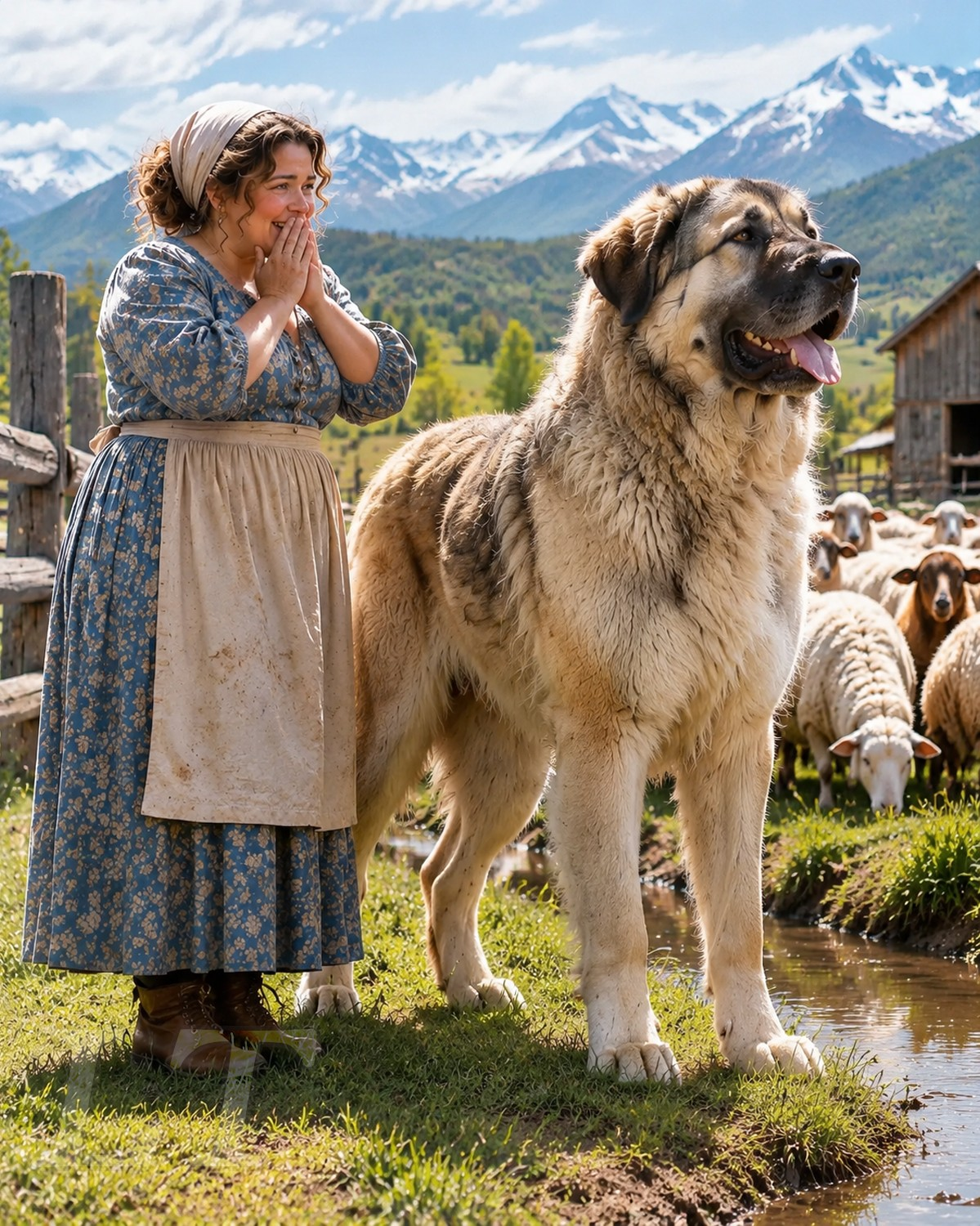
Ruth stared at the photograph.
Six handwritten words.
Cole knows where the body is buried.
For several seconds, the sounds around her seemed to disappear.
The fire had been extinguished. The sheep were safe. Daniel was repairing the damaged gate, and Walter stood beside the barn holding the photograph.
But Ruth could see only one thing.
The sheriff's face.
Martin Cole had attended Thomas's funeral. He had stood beside Ruth when she buried her husband. He had shaken her hand and promised that the county would help her whenever she needed it.
Now she was looking at evidence suggesting he knew something about Thomas's death that he had never revealed.
"Where did you get this?" she whispered.
Walter looked toward the eastern pasture.
"George Whitaker gave it to me. He found it inside an old survey office after Pike closed the building."
"Does he know what it means?"
"He believes Thomas discovered something beneath the old spring channel. Something Pike and Cole wanted to keep hidden."
Ruth looked at Daniel.
"Could my husband have been murdered?"
Daniel's expression became serious.
"I don't know. But we cannot ignore this."
Walter nodded.
"We need to go to the authorities."
Ruth looked at him.
"Which authorities?"
Nobody answered.
The sheriff had been involved in the original investigation.
The county clerk had lost important documents.
And Pike had enough influence to make witnesses afraid.
For the first time, Ruth understood that simply presenting the evidence might not be enough.
They needed someone Pike couldn't intimidate.
Someone outside the valley.
Daniel looked toward the road.
"I know a state investigator who handled a land fraud case several years ago. His name is Robert Hayes."
Walter considered the suggestion.
"Would he listen?"
"If we bring him the original documents, he will have to."
Ruth folded the photograph and placed it inside her coat.
"Then we leave at sunrise."
The following morning, Daniel stayed at the farm while Ruth and Walter traveled to the county seat.
They carried Thomas's notebook, the original map, the photograph, the forged authorization, and the copy of the letter.
Ruth also brought her own records.
The dates of the flooding.
The damaged hay.
The broken fencing.
The iron trap.
And the public notice accusing Flint of attacking livestock.
She had spent months documenting everything.
Now those notes might finally matter.
Robert Hayes received them in a small office above the state agricultural administration building.
He was a serious-looking man in his early fifties, with dark hair beginning to turn gray.
He listened without interrupting.
When Ruth finished, he examined the map.
Then he looked at Walter.
"Are you willing to testify?"
Walter nodded.
"I've been waiting seven years."
Hayes examined the photograph of Thomas and Pike.
Then he studied the image of Martin Cole.
"Do you know whether the sheriff still has access to the original investigation records?"
Walter nodded.
"He does."
Hayes closed the folder.
"Then we'll need to move carefully."
Ruth leaned forward.
"Can you protect my property?"
"I can arrange an independent inspection and request an emergency order preventing further interference with the spring."
"What about the men who damaged it?"
"That will depend on the evidence."
She placed the notebook on his desk.
"Then please read everything."
Hayes opened it.
He studied the measurements.
The dates.
The diagrams.
The original flow calculations.
After several minutes, he looked up.
"Mrs. Bellamy, your husband documented a much larger problem than a simple property dispute."
Ruth felt her heart beating faster.
"What did he find?"
Hayes pointed toward the red circle on the map.
"This appears to be a natural underground water reservoir. If the measurements are accurate, the spring system supplies several agricultural properties."
Walter nodded.
"That's what Thomas discovered."
Hayes looked at the forged authorization.
"And someone used his signature to make an unauthorized diversion appear legitimate."
Ruth thought of the document she had found at the county office.
"Can you prove it was forged?"
Hayes closed the folder.
"We can investigate the handwriting, the original filing, and the chain of custody."
He paused.
"But there's another question."
Ruth looked at him.
"What's that?"
"Where is the original diversion equipment?"
Walter answered quietly.
"Near the old spring channel."
Hayes stood.
"Then I want to see it."
They returned to Bitterroot Valley with two state investigators and a survey specialist.
The inspection began the following morning.
Daniel met them at the farm.
He showed them the spring box, the altered drainage channel, and the damaged fencing.
The investigators photographed everything.
They measured the water flow.
They collected soil samples from the newly dug trench.
And they examined the iron trap.
One investigator found a small manufacturer's mark on its metal frame.
The serial number had been partially filed away.
But enough remained to trace its original sale.
The trap had been purchased by a company owned by Vernon Pike.
Ruth watched as the evidence was recorded.
For months, she had been told that she was imagining things.
Now every damaged section of her property was being documented by independent officials.
Flint followed the investigators from a distance.
He remained near the sheep.
At one point, the survey specialist approached Ruth.
"That's an impressive guardian dog."
Ruth smiled faintly.
"He's better at his job than most people."
The man laughed.
"Looks that way."
The most important discovery came that afternoon.
The survey specialist found an old drainage opening beneath the eastern foundation of the barn.
It had been covered with wooden boards and packed earth.
Daniel helped remove the obstruction.
Beneath it was a narrow stone passage.
The opening was barely large enough for a person to enter.
Walter examined it.
"Thomas told me there was another channel."
Ruth looked at him.
"Did you know it was here?"
"I knew he had found something. I didn't know the exact location."
The investigators brought in additional equipment.
They followed the passage for several yards until they reached a small chamber.
Inside were several metal containers.
Most were empty.
One contained rolled documents.
Another held an old leather pouch.
Ruth recognized the handwriting on the first paper immediately.
Thomas.
She took a step forward.
An investigator stopped her gently.
"Let us examine it first."
She nodded.
The documents were carefully removed.
There were original water measurements.
Copies of correspondence.
A list of payments.
And several signed statements from former workers.
One letter was addressed to the state agricultural authority.
It had never been delivered.
Ruth stared at the date.
Thomas had written it only a few weeks before his death.
The letter described how Pike had pressured him to sign an authorization transferring control of the spring system.
Thomas had refused.
He also explained that Martin Cole had warned him not to pursue the complaint because it could damage several influential business relationships.
The letter ended with a sentence that made Ruth's eyes fill.
If I cannot protect this land myself, I hope Ruth will understand that I never stopped trying.
She held the paper against her chest.
For the first time in years, she felt as though her husband had finally spoken to her.
Not through memory.
Through the truth.
The investigation moved quickly after the discovery.
The handwriting on the authorization was examined by an independent specialist.
The signature attributed to Daniel Mercer had been forged.
The signature attributed to Thomas on the original diversion agreement had also been altered.
Financial records revealed payments from Pike's company to several intermediaries.
One payment had been made to Caleb Morris.
Another had gone to a company connected to Edwin Shaw.
And a third had been deposited into an account controlled by someone close to Sheriff Cole.
When Robert Hayes presented the findings, Cole refused to cooperate.
But the evidence was already too extensive to suppress.
The state investigators obtained a warrant for the sheriff's office.
They found missing correspondence.
Altered property records.
And an old report concerning Thomas's final days.
One page was particularly important.
It contained a statement from a witness who had seen Thomas arguing with Caleb Morris near North Pass.
The statement had been removed from the original investigation file.
Its author was Walter Hensley.
Walter had never been told that his testimony had been included.
He had signed it years earlier.
The signature was genuine.
The report established that Thomas had been threatened shortly before his death.
It did not prove that he had been murdered.
But it proved that the original investigation had been deliberately compromised.
For the first time, Martin Cole could no longer control the narrative.
He was suspended pending a formal inquiry.
Vernon Pike was ordered to surrender his business records.
Caleb Morris was questioned about the diversion work.
Edwin Shaw was placed under investigation for the missing survey documents.
And the county suspended all activity connected to Pike's proposed cattle route.
Ruth watched the news spread through the valley.
People who had once avoided her began stopping by.
Some apologized.
Others simply asked how she was doing.
She accepted their kindness, but she did not forget how quickly they had believed the rumors.
She had learned that trust was something that had to be earned.
Three weeks later, Robert Hayes returned to the farm.
He carried a thick folder.
Ruth was repairing a section of fencing when she saw his vehicle.
Daniel was working near the barn.
Flint lay beside the sheep.
Ruth wiped her hands and approached.
"Have you found something?"
Hayes nodded.
"We have enough evidence to file formal charges against Pike and several people connected to the diversion."
Ruth exhaled.
"What about the spring?"
"The independent survey confirms that the underground water system originates beneath your property and follows the historical agricultural route documented by your husband."
He opened the folder.
"Your husband's original declaration is valid. The altered agreement cannot legally transfer the water rights."
Ruth looked at him.
"So the spring is mine?"
"The property rights remain with you, subject to the established water protections. Pike cannot claim ownership through the documents we examined."
She closed her eyes.
For months, she had lived with the possibility of losing everything.
Now the law had finally recognized what her husband had protected.
"What about the other ranches?"
Hayes smiled slightly.
"The reservoir has enough capacity to support a community agricultural water agreement. The state is prepared to establish a protected distribution plan, provided the landowners agree."
Ruth looked toward the pasture.
"Would the other families still receive water?"
"Yes. The system can be managed without transferring ownership of your property."
She nodded.
"Then I want them to have access."
Hayes looked surprised.
"Even after everything?"
"Those families have sheep and cattle, too. Their children need the same things mine would have needed if Thomas and I had been fortunate enough to have them."
She paused.
"But nobody will be allowed to alter the spring without permission again."
Hayes smiled.
"I think that's a reasonable condition."
The legal proceedings continued into the winter.
Vernon Pike's business records revealed that he had been trying to secure control of the reservoir for years.
His proposed cattle route depended on access to the spring.
Without it, several of his development agreements became financially impossible.
He had used forged documents, false complaints, and intimidation to pressure neighboring landowners.
The attempt to frame Flint was also investigated.
The pale dog Ruth had seen near the northern road was identified as an injured livestock guardian that had belonged to Walter Hensley.
It had been taken from an abandoned holding pen.
Caleb had arranged for the animal to be left near the road to strengthen the false reports about aggressive guardian dogs.
The dog survived.
Walter eventually reclaimed him and arranged veterinary treatment.
His name was Ash.
He had been injured and neglected, but he recovered.
Flint had never attacked the missing calf.
The calf had been moved to a Pike-owned grazing property as part of an effort to manufacture evidence against Ruth.
It was found alive during the investigation.
The iron trap, the altered spring box, and the fire damage were all connected to Pike's hired men.
The evidence was presented in court.
Pike was convicted of fraud, unlawful interference with water rights, property destruction, and conspiracy.
Caleb and Edwin were also held accountable for their roles.
Martin Cole faced separate charges related to the suppression of evidence and misuse of public office.
The investigation into Thomas's death was reopened.
The medical records confirmed that he had died from a severe illness.
There was no reliable evidence that he had been murdered.
However, investigators established that his final complaint had been deliberately suppressed and that he had received repeated threats before his death.
For Ruth, that distinction mattered.
She had spent months fearing that someone had taken her husband from her.
Now she knew the truth.
Thomas had fought to protect the farm until the end.
He had not abandoned her.
And he had left behind enough evidence to finish what he had started.
Spring arrived slowly in Bitterroot Valley.
The snow melted along the mountains.
The grass returned to the pasture.
The spring flowed through its original channel again.
The damaged hay barn was repaired.
Ruth purchased additional feed with help from a small agricultural assistance program established after the investigation.
The forty-three sheep survived the winter.
Not all of them were in perfect condition, but every animal remained on the farm.
The old ewe with the torn ear still walked at the back of the flock.
The stubborn ewe still refused to leave the feeding area until everyone else had finished.
And Flint still slept beside the enclosure.
His coat had grown thick and healthy.
The reddish scar around his neck remained, but Ruth no longer looked at it with sadness.
It reminded her of the life he had survived.
Daniel continued helping with the farm.
Their friendship grew stronger.
He never tried to replace Thomas.
He never treated Ruth as someone who needed rescuing.
Instead, he became the person she could rely on when the work became too heavy or the decisions became difficult.
One afternoon, he arrived carrying a new gate hinge.
Ruth was standing beside the spring.
"You're early," she said.
Daniel smiled.
"Finished the other job sooner than expected."
He looked toward the pasture.
"Everything seems to be growing back."
Ruth nodded.
"Slowly."
"That's how farms work."
They stood together for a moment.
Then Daniel looked toward Flint.
"He's watching the sheep again."
Ruth smiled.
"He never stops."
A month later, the county held a small public meeting to announce the new agricultural water agreement.
Ruth attended with Walter, Daniel, and Elsie.
Several neighboring ranchers were present.
Harold Jenkins approached her before the meeting began.
He removed his hat.
"Ruth, I'd like to apologize."
She looked at him.
"For what?"
"For signing Pike's petition. I knew the accusations against Flint weren't right. I should have spoken up."
Ruth remained quiet.
Harold continued.
"I was afraid of losing my property."
"I understand."
"But I made things harder for you."
She nodded.
"Yes, you did."
He lowered his eyes.
"I'm sorry."
Ruth looked at him for a moment.
Then she extended her hand.
"I hope we can do better from here."
Harold shook it.
It wasn't an instant return to friendship.
But it was a beginning.
When the meeting started, the county representative explained the new protections.
The spring would remain under Ruth's ownership.
The neighboring ranches would receive regulated access.
The original underground reservoir would be protected from commercial diversion.
And any future changes would require independent approval.
When the agreement was presented, Ruth signed her name.
Her hand trembled slightly.
She thought of Thomas.
She wished he could have stood beside her.
She wished he could have seen the spring flowing again.
But she knew what he would have said.
Protect the water.
Protect the animals.
Protect the home.
She signed the final page.
Walter placed a hand on her shoulder.
"Thomas would be proud."
Ruth smiled through tears.
"I hope so."
That summer, the farm began to prosper again.
Ruth rebuilt the eastern fence.
She repaired the spring box.
She planted new grass along the lower pasture.
Daniel helped construct a stronger shelter for the sheep.
Elsie brought food whenever she visited.
And Walter began spending more time in the valley.
He had sold the remaining equipment from his closed ranch and decided to stay near the people who had helped him finally bring the truth into the open.
Flint became something of a local legend.
People who had once called him dangerous now watched him work with admiration.
Children from neighboring farms occasionally came to see him.
Ruth allowed them to stand outside the enclosure while she supervised.
Flint never frightened them.
He simply watched the sheep.
One afternoon, a little boy asked Ruth whether the dog had always been so gentle.
She looked down at Flint.
"No," she said softly. "He had a difficult beginning."
The boy tilted his head.
"Was he scared?"
Ruth thought for a moment.
"Probably."
"Then how did he become brave?"
She smiled.
"Someone gave him a chance."
The boy looked at Flint.
Then he gently waved.
Flint lifted his head.
His gray eyes followed the child.
And the boy laughed.
Seven months after Ruth had first found him in the freezing ditch, Flint stood at the center of the pasture.
Forty-three sheep grazed around him.
The spring ran cleanly through the restored channel.
The barn was full of dry hay.
And the farm was finally free from the threats that had nearly destroyed it.
Ruth stood near the fence with Daniel.
She carried Thomas's old notebook beneath her arm.
The final page contained one sentence she had not noticed before.
The strongest things are not always the loudest.
She read it again.
Then she looked toward Flint.
The dog had never needed to bark constantly.
He had never needed to prove his strength.
He simply watched.
He learned.
And when danger came, he stood between the flock and the threat.
Ruth reached into her pocket and touched the small brass key that had opened the hidden compartment beneath the barn.
She had decided to keep it.
Not as a reminder of the secrets that had nearly destroyed her family.
But as a reminder that the truth had survived.
Daniel approached.
"Thinking about Thomas?"
"Always."
He nodded.
"Would you like me to help you put the notebook away?"
Ruth looked toward the farmhouse.
"No. I think I'll keep it in the kitchen."
Daniel smiled.
"Where you can see it?"
"Where I can remember what he built."
They walked back toward the barn.
Flint followed them for a few steps before returning to the sheep.
Ruth stopped and watched him.
For a moment, she remembered the day she had found him.
The brown water.
The broken cedar plank.
The stagecoach disappearing down the road.
She remembered the pain in her shoulder and the crushing disappointment of missing the filing deadline.
She had believed she was sacrificing the last chance to save her farm.
She hadn't known that the starving animal beneath the timber would eventually help her protect everything her husband had left behind.
But Flint had not saved the farm alone.
Ruth had refused to surrender.
Daniel had stood beside her.
Walter had finally spoken.
Elsie had helped gather the evidence.
And Thomas's careful records had survived long enough to expose the truth.
Together, they had rebuilt something stronger than the farm had been before.
On the first morning of autumn, Ruth walked to the spring before sunrise.
The water was clear.
She knelt and let it run over her fingers.
Behind her, Flint approached quietly.
He stood beside her and looked toward the pasture.
Ruth rested a hand against his broad neck.
"Remember that terrible day?"
Flint looked at her.
She smiled.
"I do."
The dog leaned gently against her.
Ruth stood and looked across the land.
The same pasture that Pike had tried to steal.
The same spring he had tried to divert.
The same barn beneath which Thomas had hidden the evidence.
Everything was still there.
But the fear was gone.
Daniel called from the farmhouse.
"Coffee's ready!"
Ruth turned.
"Coming!"
She walked toward the house.
Flint followed at her side.
Behind them, forty-three sheep moved peacefully through the morning grass.
The spring continued flowing.
And for the first time in years, Ruth no longer had to wonder whether someone would arrive to take it away.
She had saved the farm.
She had protected the flock.
She had uncovered the truth about her husband.
And the dog she had once rescued from a ditch had become the guardian of the home they had both learned to love.






Comments 0