Adam reached for the door handle.
I heard the soft metallic click.
Then the door opened.
For one terrible second, nobody moved.
My former husband stood in the entrance to Susan's office, wearing the same dark coat he'd worn when he came to my house before dawn. His hair was disheveled. His eyes were red.
And beside him stood a little girl in a yellow sweater.
Grace.
Eleven years old.
The daughter I had been told was dead.
She looked from Adam to me, then down at her shoes.
"Is that her?" she whispered.
Adam tightened his hand around her shoulder.
"That's Nora."
Not your mother.
Not the woman who gave birth to you.
Just Nora.
I felt something break inside my chest.
"Take your hand off her," I said.
Adam smiled.
"Still giving orders."
Susan stepped between us.
"Adam, you need to leave."
He ignored her.
His eyes remained fixed on me.
"Well?" he asked. "Aren't you going to say hello?"
I looked at the girl.
Her brown hair was pulled into a loose braid. She had a small scar above her left eyebrow and a nervous habit of rubbing her thumb against her fingers.
She looked frightened.
Not of me.
Of what might happen next.
I crouched slowly.
"Hi, Grace."
Her eyes met mine.
"Hi."
My throat tightened.
"I'm Nora."
"I know."
Her voice was small.
"Grandma Helen told me about you."
I couldn't breathe.
Adam's expression changed.
"Grace, that's enough."
The girl flinched.
I saw it.
Susan saw it too.
"Adam," Susan said firmly, "step away from the child."
He laughed.
"She's my daughter."
My heart stopped.
"She's mine too," I whispered.
He looked at me.
For the first time, his smile disappeared.
Then he reached into his coat.
Susan immediately raised her hand.
"Keep your hands where we can see them."
Adam stopped.
"It's a letter."
"Leave it where it is."
Outside, a police car pulled into the parking lot.
Adam looked through the glass.
His face changed.
I saw the exact moment he understood.
He wasn't controlling this room anymore.
"Who called them?" he demanded.
Susan didn't answer.
She didn't have to.
Two officers entered.
One was Officer Ramirez.
The same woman who had spoken gently to Ellie.
"Mr. Bennett," she said, "we need you to step outside."
Adam's face hardened.
"This is a family matter."
"No," I said.
My voice surprised me.
It was steady.
"This stopped being a family matter when you took children without permission, submitted false documents, and tried to frighten everyone into silence."
Adam turned toward me.
"You have no idea what I've done for this family."
I looked at Grace.
Then toward the conference room where Ellie was sleeping.
"I know what you've done to it."
He opened his mouth.
But Officer Ramirez stepped closer.
"Sir. Outside."
Adam looked at Grace.
"Come on."
She didn't move.
He reached for her hand.
I stood.
"Don't."
He glared at me.
"She's coming with me."
Officer Ramirez positioned herself between them.
"Not until we establish the child's circumstances and safety."
Adam stared at her.
Then at Susan.
Then at me.
And for the first time in all the years I'd known him, he had nothing to say that made anyone move.
The officers escorted him outside.
Grace remained in the reception area.
She watched him through the glass.
Her lower lip trembled.
"Am I in trouble?"
I knelt in front of her.
"No, sweetheart."
She looked at me.
"Adam said you might be angry."
My eyes filled.
"Not with you."
"He said I wasn't supposed to come here."
I swallowed.
"Why?"
She looked down.
"Because it would make everything complicated."
I almost laughed through my tears.
Complicated.
That was what Adam called the lives he'd stolen from us.
I reached out my hand.
Grace stared at it.
Then slowly placed her fingers in mine.
Her hand was warm.
Real.
Eleven years.
And she was real.
The next several hours were filled with police interviews, medical checks, and questions that seemed to have no end.
Susan stayed beside me.
Margaret gave the investigators Helen's original letter and the records she'd preserved.
Grace spoke with a child protection specialist in a quiet room, away from Adam and away from the confusion.
I wasn't allowed to take her home immediately.
That hurt more than I expected.
But I understood.
No one was going to decide where Grace belonged based on a photograph, a frightening story, or Adam's word.
Not anymore.
The investigators needed to verify her identity, her birth records, and her legal circumstances.
And Grace needed to be heard.
She had already lost enough control over her own life.
I sat in Susan's office while the letter lay open in front of me.
Helen's handwriting covered three pages.
My hands shook as I began reading.
Dear Nora,
There is no forgiveness large enough for what I allowed to happen.
I stopped.
My eyes blurred.
Susan sat quietly beside me.
I continued.
Helen wrote that eleven years earlier, during my first pregnancy, I had been admitted to St. Catherine's with severe complications.
I remembered the hospital.
The pain.
The frightened faces.
What I didn't remember was the emergency delivery.
My daughter had been born prematurely.
Alive.
Small.
Fragile.
She had needed specialized neonatal care.
While I was sedated and recovering, Adam had taken control of the paperwork.
Helen had arrived at the hospital later that night.
She'd found him frightened and furious.
Not because the baby was sick.
Because he believed a child with possible long-term medical needs would ruin the future he'd planned.
I pressed my hand against my mouth.
The letter continued.
Adam had told Helen that I was too unstable to care for a medically fragile baby.
He claimed doctors had warned him that the child might never develop normally.
He said he had arranged a private placement.
He said it was temporary.
Helen believed him.
At first.
But the transfer paperwork was irregular.
The receiving address was Helen's house.
And the people who eventually took the baby were Richard and Eleanor Ashford.
Adam's relatives in England.
Helen wrote that she had allowed Grace to remain with them because Adam told her I had agreed.
Then she discovered I hadn't.
By that time, Adam had told me the pregnancy had ended.
And Helen had already helped him conceal the truth.
I lowered the letter.
"She knew," I whispered.
Susan didn't answer.
"She knew I was mourning a baby who was alive."
My chest tightened.
I kept reading.
Helen had tried to persuade Adam to tell me.
He refused.
He threatened to expose her involvement in the unauthorized transfer.
He told her she would lose her home, her reputation, and any chance of seeing her grandchildren.
She was afraid.
And she stayed silent.
Then, years later, when Ellie was born, Helen began writing the letter.
She wanted to tell me everything.
She wanted to find Grace.
But she died before she could put things right.
Margaret had received the letter and supporting papers shortly before Helen's death, with instructions to protect them and help locate Grace.
Margaret admitted that she'd been afraid to act.
She had also believed, wrongly, that the Ashfords had obtained lawful custody and that exposing the truth without locating Grace might endanger the child.
Her silence had lasted eleven years.
Eleven years too long.
I looked at Margaret.
She stood near the window.
"I should have come to you," she whispered.
"Yes," I said.
She lowered her eyes.
"I know."
I didn't tell her it was all right.
It wasn't.
But I was grateful she'd finally brought the evidence.
Both things could be true.
The investigation that followed did not produce every answer overnight.
Some came from hospital archives.
Some from financial records.
Some from people who had spent years telling themselves they were only following instructions.
The most important answers came from Grace.
She had grown up in England with the Ashfords.
For years, she'd believed they were her parents.
When she was seven, Eleanor told her she had been adopted.
But there were no lawful adoption records that could support the story.
There were altered documents.
False declarations.
And a trail of payments.
The Ashfords had provided Grace with a comfortable home.
She had attended school.
She had friends.
She had photographs of birthdays and Christmas mornings.
But she had also grown up wondering why her parents became angry whenever she asked about the woman who had given birth to her.
Helen had visited her twice.
Grace remembered her.
"She smelled like lavender," Grace told me during one of our supervised meetings.
I smiled through my tears.
"She always wore lavender perfume."
Grace looked at me.
"She said my mother loved me."
I couldn't speak.
"She said you didn't know where I was."
I took a shaky breath.
"That's true."
Grace studied my face.
"Did you look for me?"
The question nearly destroyed me.
"I didn't know you were alive, sweetheart."
Her eyes filled.
"Adam said you gave me away."
I shook my head.
"No."
My voice broke.
"I never would have given you away."
She looked down.
Then whispered, "I wanted that to be true."
I reached across the table.
"Would it be okay if I held your hand?"
She nodded.
I held it.
And for the first time, Grace cried in front of me.
The medical scheme became clearer too.
Evelyn had been ill for years.
She needed a kidney transplant.
But she had never asked Adam to obtain an organ from a child.
The report bearing Claire's name had been deliberately mislabeled.
The real patient was Evelyn.
The laboratory had performed limited compatibility testing on samples submitted under disputed authorizations.
The findings did not establish that Ellie could or should donate anything.
They certainly didn't give Adam permission to make medical decisions for her.
Dr. Samuel Price provided the investigators with the original records and explained the irregularities he'd discovered.
Ellie's sample had been collected during the appointment Adam arranged without telling me its purpose.
Mason's information had also been used.
Adam had wanted to identify a possible biological match.
But the investigators found something else in the financial records.
The Ashfords had been sending money to Adam for years.
Some payments were connected to Grace's care.
Others were disguised as consulting fees.
And the one hundred and eighty thousand dollars wasn't simply a payment for relocation services.
It was part of an arrangement to move Grace and conceal the truth about her identity before an investigation into the old transfer could reach England.
Adam had used Evelyn's illness as a reason to gather medical records and move family members across borders.
He had used Victoria's relocation business to make the travel plans appear legitimate.
He had promised the Ashfords that Grace's history would remain hidden.
And when the arrangements began falling apart, he tried to use Ellie and Mason as leverage.
The note Claire found finally made sense.
ELLIE — PRIMARY.
MASON — SUBSTITUTE.
It wasn't a lawful medical instruction.
It was Adam's private contingency plan for the travel documents and the pressure he intended to put on us.
He wanted whichever child he could control to make the other adults cooperate.
The passport application bearing Ellie's name and Mason's photograph was another attempted deception.
No valid passport had been issued from that application.
The authorities intercepted the travel arrangements before any child left the country.
Victoria cooperated with investigators after admitting she'd ignored warning signs.
Her company faced scrutiny, and she was required to answer for her own conduct.
But the evidence also showed Adam had lied to her about my consent, Grace's status, and the purpose of the trip.
The anonymous messages came from Daniel Mercer.
When Susan told me, I stared at her.
"Mercer?"
She nodded.
"He says he discovered discrepancies in the documents Adam gave him."
Mercer had initially accepted Adam's explanation that the family was arranging a lawful international move.
Then he found copied signatures.
Conflicting dates.
A child's name attached to financial transfers.
He photographed documents and sent warnings instead of immediately reporting everything.
He also came to Susan's office with paperwork he should have questioned more carefully.
His choices were investigated.
He wasn't a hero.
But his photographs helped establish what Adam had been planning.
The unidentified man carrying Ellie's boxes had been Mercer too.
And the box marked DON— had been intended for donation.
Ellie's drawings, clothes, and keepsakes had been packed away to make her absence look permanent.
Adam had been preparing that room for Mason long before Rebecca's surgery.
Not because Mason needed a place to sleep.
Because Adam needed a story.
A story in which Ellie was difficult.
A story in which I was unreasonable.
A story in which he was the patient father making necessary changes.
The false custody documents were part of that story.
The signature supposedly belonging to me had been copied.
The handwritten clause in the old divorce document had been added later.
The supporting statement attributed to Ellie had been fabricated.
And the mysterious second signature belonged to a former administrative employee who later admitted she'd helped Adam assemble the false paperwork.
The supposed emergency hearing had never been granted.
The court notification had been manipulated to make the situation appear more urgent and official than it was.
Susan verified the actual docket and filed the necessary responses.
The court did not treat Adam's private papers as permission to change custody.
Instead, the evidence became part of a much larger investigation.
Three weeks later, I stood outside a courtroom holding Susan's hand.
Adam had been arrested.
The charges included offenses connected to forged documents, financial fraud, and the unlawful removal and concealment of a child.
Other allegations were still being investigated.
He had pleaded not guilty.
I knew the criminal proceedings could take months, perhaps longer.
But the immediate custody orders were clear.
Ellie would remain with me.
Adam's contact with her was suspended pending further court review and safety assessments.
Grace's case was more complicated because of the years she'd spent overseas and the disputed documents surrounding her placement.
A judge appointed independent representation for her interests.
The court ordered the relevant records examined and arranged for her to remain in a safe, supervised placement while her circumstances were resolved.
I hated every night she wasn't under my roof.
But I didn't want anyone rushing another decision about her life.
Not even me.
Especially not me.
I wanted Grace to come home because it was safe and right.
Not because I could prove I had the strongest claim.
Susan squeezed my hand.
"You're doing the right thing."
I looked at her.
"Why does it hurt so much?"
"Because you're her mother."
I closed my eyes.
"And because you lost eleven years."
I nodded.
Eleven birthdays.
Eleven Christmas mornings.
First steps.
First words.
First days of school.
I couldn't get those moments back.
But I could stop letting Adam steal the ones still ahead of us.
Evelyn recovered from the immediate crisis and continued receiving treatment through her own medical team.
She remained on the transplant waiting list.
No one asked Ellie or Mason to become donors.
No one treated either child as a solution to an adult's illness.
When I visited Evelyn at the hospital, she was sitting beside the window.
Her face was pale.
But she smiled when she saw me.
"How's Ellie?"
"Better."
"And Grace?"
"She asked about you."
Evelyn's eyes filled.
"Really?"
I nodded.
"She wants to meet her aunt."
Evelyn covered her mouth.
For a moment, she couldn't speak.
Then she whispered, "I'd like that."
I sat beside her.
We talked for nearly an hour.
About Helen.
About Adam.
About the years we'd lost.
Evelyn told me she'd spent most of her adult life believing her brother was the only person who could help her.
Now she was learning how to ask other people.
How to accept care without surrendering control.
Before I left, she touched my hand.
"Nora?"
"Yes?"
"Thank you for believing me."
I smiled sadly.
"I know what it's like when Adam makes everyone doubt you."
She nodded.
And for the first time, we didn't need to explain anything else.
Claire filed for divorce.
She moved into a small apartment near her sister.
When I asked how she was doing, she laughed softly.
"Some days I cry in the grocery store."
I smiled.
"I've done that."
"Some days I feel free."
"That too."
She looked at me.
"Do you think Ellie will ever forgive me?"
I shook my head.
"Claire, Ellie doesn't blame you."
Her eyes filled.
"She shouldn't have had to leave that house with a trash bag."
"No," I said.
"She shouldn't."
Claire looked down.
"I keep thinking about that night."
I remembered it too.
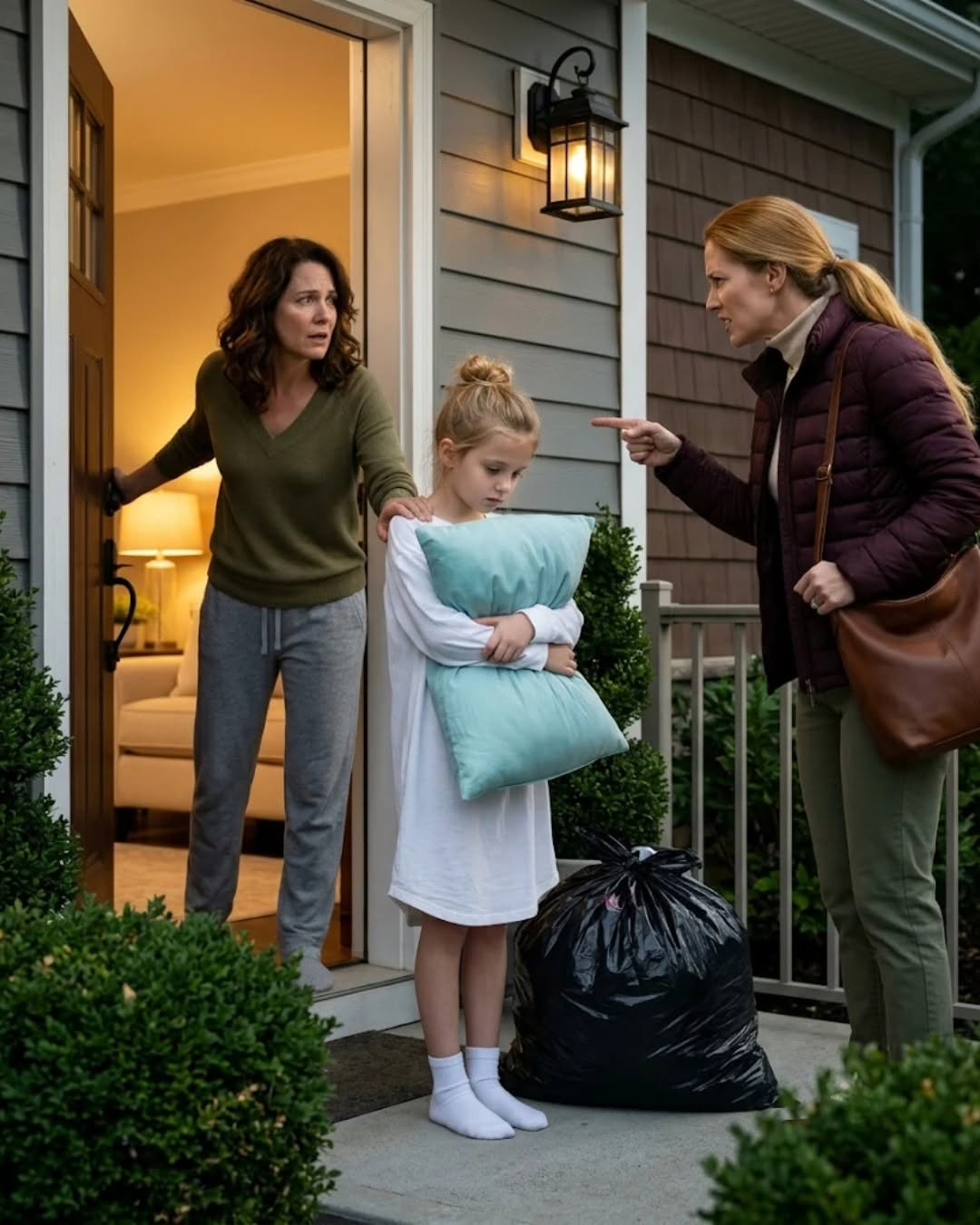
11:43 p.m.
The porch light.
Ellie's bare feet.
The black garbage bag.
Claire's trembling voice.
She's never coming back to our house, Nora.
At the time, I'd thought Claire was rejecting my daughter.
Now I understood.
She'd been drawing a line Adam could no longer cross.
"Claire," I said, "you brought her home."
She looked at me.
"You believed her when Adam wouldn't."
A tear slipped down her cheek.
"And you refused to make her responsible for his choices."
Claire began crying.
I hugged her.
We weren't going to become best friends overnight.
There was too much history.
Too much pain.
But we were no longer standing on opposite sides of Adam's lies.
That mattered.
Mason returned to Rebecca.
The first time Ellie saw him afterward, she ran across the park.
"Mason!"
He looked up.
Then ran toward her.
They hugged so tightly that Rebecca and I both started crying.
"I'm sorry about your room," Mason whispered.
Ellie shook her head.
"It wasn't your fault."
He looked down.
"Dad said you hated me."
Ellie pulled back.
"I don't."
Mason's eyes filled.
"I didn't want your room."
"I know."
He wiped his face.
"I missed my mom."
Ellie nodded.
"I know that too."
Then she reached into her backpack.
She pulled out a small drawing.
Two children sitting beneath a tree.
A raccoon between them.
At the top, she'd written:
YOU CAN BE MY BROTHER WITHOUT TAKING MY ROOM.
Mason stared at it.
Then smiled.
It was the first real smile I'd seen on his face.
Rebecca stood beside me.
"Thank you," she whispered.
I shook my head.
"They figured that out themselves."
She laughed through her tears.
We watched the children walk toward the swings.
For once, neither of them was being asked to solve an adult problem.
They were just children.
And that was enough.
The day Grace finally came home, it was raining.
Not heavily.
Just a soft November rain that made the sidewalks shine.
The court had approved a carefully supported transition after the records confirmed my maternity and the specialists determined that living with me was in Grace's best interests.
Grace had participated in the process.
She'd asked questions.
She'd visited the house.
She'd spent afternoons with Ellie.
And finally, she said she wanted to stay.
I stood in the doorway as the car pulled up.
Grace stepped out carrying a blue suitcase.
She wore her yellow sweater.
The same one she'd worn the day Adam brought her to Susan's office.
I walked toward her.
"Hi, sweetheart."
She smiled shyly.
"Hi, Mom."
I stopped.
The word hit me so hard I almost couldn't breathe.
Mom.
She looked frightened.
"Is that okay?"
I dropped to my knees.
"Oh, Grace."
I held out my arms.
She ran into them.
I hugged her tightly.
And for the first time in eleven years, I held my daughter without someone telling me she was gone.
I cried.
Grace cried.
Even the woman who had helped coordinate her transition wiped her eyes.
Then Ellie appeared on the porch.
"GRACE!"
Grace laughed.
"ELLIE!"
They ran toward each other.
Bandit the raccoon was tucked beneath Ellie's arm.
She held him out.
"You can borrow him tonight."
Grace smiled.
"Really?"
Ellie nodded.
"But he snores."
Grace laughed.
And just like that, the house sounded different.
Fuller.
Warmer.
Alive.
We didn't pretend everything was perfect.
Grace had nightmares.
Sometimes she woke up frightened that someone would take her away again.
Ellie struggled with the idea that she had a sister she'd never known.
Sometimes they argued.
Over bathroom time.
Over music.
Over whose turn it was to choose a movie.
Sometimes Grace missed England.
Sometimes she missed the Ashfords, despite everything that had happened.
I never told her those feelings were wrong.
She had loved people who had lied to her.
That didn't mean the love she'd felt was imaginary.
We worked with a family therapist.
We learned how to listen.
How to give each other space.
How to build trust without demanding it.
I changed the locks.
I replaced the porch light.
I painted the spare bedroom a soft green because Grace said it reminded her of the garden outside her old school.
Ellie helped choose the curtains.
Grace helped Ellie arrange her stuffed animals.
And one Saturday afternoon, they stood in the hallway arguing over where to hang a photograph.
It showed the two of them at the park.
Mason stood between them.
All three were smiling.
"Here," Ellie said.
"No, higher," Grace insisted.
I watched them.
Then I laughed.
Both girls turned.
"What?" Ellie asked.
"Nothing."
Grace narrowed her eyes.
"You're doing that mom thing."
"What mom thing?"
"Smiling when we're arguing."
I laughed harder.
Ellie rolled her eyes.
"She does it all the time."
Grace grinned.
Then she climbed down from the little step stool and wrapped her arms around me.
Ellie joined us.
For a moment, we stood in the hallway holding each other.
Three people.
Three different kinds of grief.
One family.
Months later, the criminal case against Adam was still moving through the courts.
The investigation had exposed the fraudulent transfer of Grace, the false custody papers, the financial arrangements, and the misuse of medical information.
Some people accepted responsibility.
Others fought the allegations.
The legal consequences would unfold through the courts.
But Adam no longer controlled our daily lives.
He couldn't walk into my house.
He couldn't decide where Ellie slept.
He couldn't tell Grace who her mother was.
And he couldn't make either girl responsible for keeping his secrets.
One evening, after dinner, Ellie found me standing beside the front door.
She was wearing pajamas.
Bandit hung from one hand.
"Mommy?"
I turned.
"Yes, sweetheart?"
"Do you remember the night Claire brought me home?"
My chest tightened.
"Of course."
She looked down.
"I thought nobody wanted me."
I knelt in front of her.
"Oh, Ellie."
She swallowed.
"I thought I was bad because I wanted my room."
I took her hands.
"You were never bad."
She looked at me.
"Not even when I got upset?"
"Especially not then."
Her eyes filled.
"Can I ask you something?"
"Anything."
She hesitated.
"Will you ever make me leave?"
I pulled her into my arms.
"No, sweetheart."
She held me tightly.
"Promise?"
I kissed her hair.
"I promise that this is your home, and I will always work to keep you safe."
She nodded against my shoulder.
Then she whispered, "Grace can stay too, right?"
I smiled through my tears.
"Yes."
Ellie pulled back.
"Good."
She looked toward the stairs.
"Because she keeps stealing my socks."
I laughed.
"Then we'll have to buy more socks."
Ellie grinned.
And ran upstairs.
I stayed by the door for a moment.
The porch light glowed through the glass.
I remembered that first night.
The knock.
The garbage bag.
My daughter standing outside as though she didn't belong anywhere.
I remembered how frightened I'd been.
How angry.
How certain that everything was falling apart.
And in a way, it had.
The marriage I'd once trusted.
The family history I'd believed.
The stories Adam had told.
They had all broken apart.
But the truth had given us something his lies never could.
A chance to choose what came next.
I heard footsteps behind me.
Grace appeared in the hallway.
She was holding a small envelope.
"Mom?"
I turned.
"Yes?"
She handed it to me.
"What's this?"
I opened it.
Inside was a photograph of Helen.
She was sitting in a garden, smiling.
On the back, in Grace's handwriting, were four words.
SHE WANTED US TOGETHER.
My eyes filled.
Grace looked at me.
"Do you think she did?"
I took a slow breath.
"I think she wanted to make things right."
Grace nodded.
"She didn't, though."
I looked at her.
"No," I said gently.
"She didn't."
Grace was quiet.
Then she slipped her hand into mine.
"But we did."
I smiled through my tears.
"We're trying."
She leaned against me.
And for the first time, I didn't feel the need to fix every part of the past.
Some things would always hurt.
Some questions had answers that were difficult to live with.
Some years could never be returned.
But my daughters were upstairs.
They were safe.
They were laughing.
And tomorrow morning, they would wake up in their own rooms.
No garbage bags.
No whispered threats.
No one telling them they had to earn their place in the family.
I walked to the front door.
Turned the lock.
And switched off the porch light.
From upstairs, Ellie shouted, "Mom! Grace took my blanket!"
Grace shouted back, "You took my pillow!"
I laughed.
"I'm coming!"
Then I climbed the stairs toward my daughters.
Toward the noise.
Toward the ordinary, beautiful life we were finally allowed to have.
And when I reached the top, both girls ran into my arms.
I held them close.
Exactly where they belonged.
Home.






Comments 0