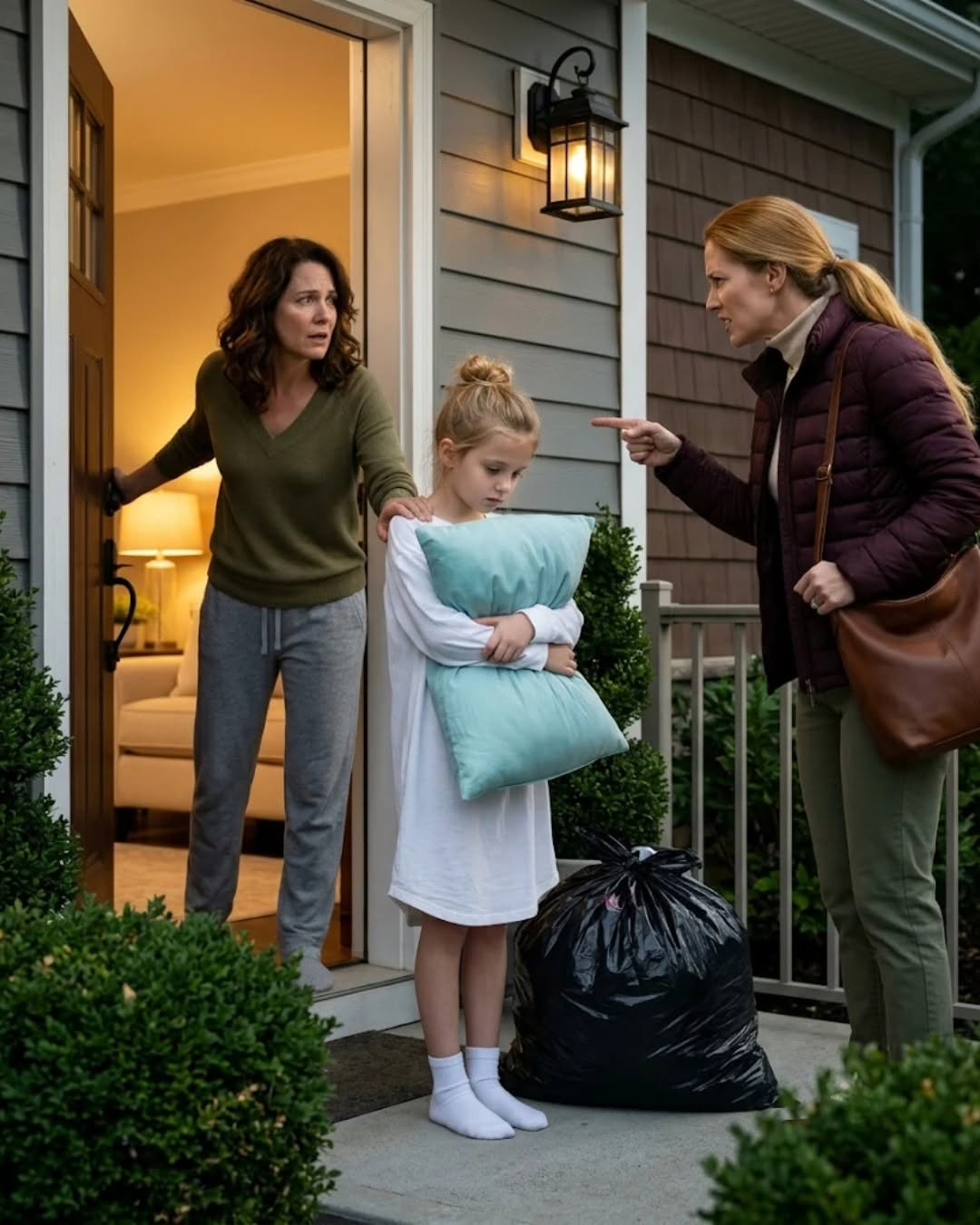
"Mommy, don't let her take me."
Ellie's fingers tightened around my hand as the woman stepped out of the car.
I looked down at my daughter.
"Sweetheart, nobody is taking you anywhere."
But Ellie wasn't listening.
Her eyes were fixed on the woman approaching our front porch.
She was carrying a thick brown folder.
And she was looking directly at our house.
"That's Mrs. Whitmore," Ellie whispered again.
I had never heard that name before.
But the way my daughter said it made my stomach tighten.
"Who is Mrs. Whitmore?"
Ellie shook her head.
"She's the lady Daddy told me to be nice to."
I crouched in front of her.
"Where did you meet her?"
"At Daddy's house."
"When?"
"Yesterday."
I felt a chill move down my spine.
Yesterday.
The same day my daughter had lost her bedroom.
The same day Adam had told her she might have to speak to a judge.
And now, before sunrise, a woman Ellie recognized was standing in my driveway.
I looked toward the window.
Mrs. Whitmore appeared to be in her late fifties.
She had short silver hair, a navy coat, and the kind of composed expression that made it difficult to guess what she was thinking.
She wasn't rushing.
She wasn't looking around nervously.
She walked toward my front door as though she had every reason to be there.
That unsettled me.
I turned back to Ellie.
"Go into the living room, sweetheart."
"Mommy—"
"I'm not letting anybody take you. I promise."
She hesitated.
Then she walked toward the couch, dragging her pillow behind her.
I waited until she was out of sight before approaching the door.
The woman knocked three times.
Not loudly.
Not aggressively.
Just three measured knocks.
I kept the chain in place.
"Can I help you?"
The woman looked directly at me through the narrow opening.
"Mrs. Bennett?"
"Who's asking?"
"My name is Margaret Whitmore."
I didn't respond.
She continued.
"I'm sorry to come at such an unusual hour."
I glanced at the clock.
4:39 a.m.
Unusual was an understatement.
"What do you want?"
She lifted the folder slightly.
"I believe we need to discuss your daughter."
My hand tightened around the edge of the door.
"Who sent you?"
Mrs. Whitmore hesitated.
"Adam Bennett contacted me."
Of course he had.
I almost laughed.
Adam had tried to enter my house with an old key less than two hours earlier.
Now he had apparently sent someone else.
"Then you can tell Adam to call my attorney."
The woman's expression changed.
Not dramatically.
Just enough for me to notice.
"Mrs. Bennett, I'm not here to represent your former husband."
I stared at her.
"Then who are you?"
She reached into her coat pocket and removed a business card.
She held it toward the opening.
I took it carefully.
Margaret Whitmore, LCSW
Licensed Clinical Social Worker
Family Counseling and Child Advocacy
I read the card twice.
Then I looked up.
"Are you with the court?"
"No."
"Child Protective Services?"
"No."
"Then why are you here?"
She took a slow breath.
"Because I became concerned about something your daughter said yesterday."
I felt my pulse quicken.
"What did she say?"
Mrs. Whitmore glanced toward the interior of the house.
"May we speak privately?"
I almost refused.
Every instinct I had was telling me to close the door.
But Ellie had recognized this woman.
Adam had apparently involved her in something connected to the custody papers.
And I needed to understand why.
"You can speak from there," I said.
Mrs. Whitmore nodded.
"That's perfectly fine."
Her willingness to respect the boundary surprised me.
She opened the folder.
"I want to be clear about something first. I am not conducting a custody evaluation. I have not been appointed by a judge, and I cannot make decisions about where Ellie lives."
I waited.
"Adam contacted me yesterday afternoon. He said his daughter was struggling with changes in the household and needed help adjusting."
My jaw tightened.
"Adjusting to what?"
"He described the arrival of an older half-brother."
I stared at her.
"Did he mention that he'd given away her bedroom?"
Mrs. Whitmore paused.
"He said the sleeping arrangements were being reorganized."
I felt anger rise.
"That's a very convenient description."
She didn't argue.
Instead, she looked down at her notes.
"When I arrived, Ellie was sitting at the dining table."
My heart began pounding.
"Was Adam there?"
"Yes."
"Claire?"
"She joined us briefly."
"And Mason?"
"He was upstairs."
I gripped the door.
"What happened?"
Mrs. Whitmore closed the folder slightly.
"Adam wanted me to speak with Ellie about accepting family changes."
I shook my head.
"She's ten."
"I understand."
"He took her bedroom and wanted a social worker to explain why she shouldn't be upset?"
Mrs. Whitmore's expression became more serious.
"That's not how he presented the situation to me."
"How did he present it?"
"He said Ellie had become unusually possessive of her belongings and was refusing to cooperate with reasonable household arrangements."
For several seconds, I couldn't speak.
Possessive.
My daughter had been described as possessive because she wanted to keep the bedroom her father had promised her.
I looked toward the living room.
Ellie was sitting on the couch.
Her pillow rested in her lap.
She was watching the doorway.
"Mrs. Whitmore," I said quietly, "my daughter came home last night with her belongings in a garbage bag."
The woman nodded.
"I became aware of that."
"She was wearing pajamas."
"I understand."
"She thought she'd done something wrong."
Mrs. Whitmore lowered her eyes.
"That is part of why I'm here."
I studied her face.
She looked genuinely troubled.
But I had learned something important during the past several hours.
People could sound sincere while withholding critical information.
"Why did Adam contact you?" I asked.
"Initially, he requested a consultation."
"About Ellie?"
"Yes."
"Did he mention a custody case?"
Mrs. Whitmore hesitated.
"He mentioned that he was considering changes to the parenting arrangement."
My stomach tightened.
"Changes that would give him more custody?"
"He didn't provide a complete proposal."
I looked at the folder.
"Did he ask you to write something?"
She was quiet.
Then she said, "He asked whether I could provide a letter."
I felt my pulse in my throat.
"What kind of letter?"
"One describing Ellie's emotional adjustment."
I stared at her.
"And what did you tell him?"
"That I couldn't provide a meaningful professional opinion after a brief conversation with a child."
For the first time, I felt a small amount of relief.
But it didn't last.
"Did you speak to Ellie alone?"
Mrs. Whitmore's expression tightened.
"I requested that."
"Did Adam allow it?"
"Not immediately."
I closed my eyes.
Of course.
"He said Ellie was shy around strangers and preferred having him present."
I almost laughed.
My daughter was not shy.
She could strike up a conversation with a cashier, a neighbor, or a complete stranger at a birthday party.
She loved people.
She loved talking.
And until yesterday, she had never been afraid to express an opinion.
"What happened when you asked him to leave?" I said.
Mrs. Whitmore looked down at her notes.
"He eventually agreed."
I waited.
"Ellie became noticeably more comfortable once we were alone."
My throat tightened.
"What did she say?"
Mrs. Whitmore hesitated.
"I don't want to repeat every detail of a private conversation without considering Ellie's comfort."
I understood the principle.
But I was her mother.
And something had happened to my child.
"Can you at least tell me whether she was safe?"
The woman's expression softened.
"She did not describe anyone physically hurting her."
I exhaled.
"But she did express significant distress."
I closed my eyes.
"What kind of distress?"
Mrs. Whitmore looked directly at me.
"She seemed to believe that her feelings were causing problems for the adults around her."
I felt tears sting my eyes.
That was exactly what Ellie had told me.
I think I made everybody upset.
Mrs. Whitmore continued.
"She repeatedly apologized for being sad."
I pressed my lips together.
"She asked whether being unhappy about losing her room meant she was selfish."
I looked toward the couch.
Ellie was tracing the edge of her pillow with one finger.
"Did you tell her she wasn't?"
"Yes."
I swallowed.
"Thank you."
Mrs. Whitmore nodded.
Then her expression changed.
"Mrs. Bennett, there was something else."
My stomach tightened.
"What?"
"Ellie seemed very concerned about saying the wrong thing."
I stared at her.
"Wrong according to whom?"
"She didn't say."
I thought about Adam's words.
She needs to remember what I told her.
I felt a cold sensation spread through my chest.
"Did she mention a judge?"
Mrs. Whitmore looked surprised.
"Yes."
My heart began pounding.
"What did she say?"
"She asked whether a judge could make her father stop loving her."
I closed my eyes.
For a moment, I couldn't speak.
My daughter was ten years old.
She should have been worried about homework.
Birthday parties.
Whether her favorite cartoon would have another season.
Instead, she was worried that a judge might somehow determine whether her father loved her.
I leaned against the doorframe.
Mrs. Whitmore waited.
Then she said gently, "Mrs. Bennett, may I ask you something?"
I nodded.
"Has Ellie ever expressed fear about losing her father's affection before?"
I thought carefully.
"No."
"Has she ever been reluctant to visit him?"
"Not until recently."
"Recently when?"
I hesitated.
Then I remembered something.
Two weekends earlier, Ellie had come home unusually quiet.
I had asked whether she'd had fun.
She'd said yes.
But later, while brushing her teeth, she'd asked me a strange question.
"Mommy, if somebody has two kids, do they have to love one more?"
At the time, I'd assumed she was talking about a classmate.
I had told her that love wasn't something parents needed to divide into equal pieces.
I'd said that a parent's heart could make room for more than one child.
She had nodded.
Then she'd changed the subject.
Now I wondered whether Adam had already been preparing her for Mason's arrival.
"Two weeks ago," I told Mrs. Whitmore, "she asked me whether parents had to love one child more than another."
The woman's expression became thoughtful.
"Did she explain why?"
"No."
I looked toward Ellie.
"I wish I'd asked."
Mrs. Whitmore shook her head gently.
"You couldn't have known what the question meant."
I didn't answer.
I was beginning to understand how many small signs I'd missed.
Not because I didn't care.
Because I had trusted that Ellie was safe and loved in her father's home.
I had never imagined that she would need to compete for a place there.
"Mrs. Whitmore," I said, "why are you here at four-thirty in the morning?"
She looked at me for a long moment.
Then she closed the folder.
"Because Adam called me after midnight."
I felt my pulse jump.
"What did he say?"
"He was upset."
"About what?"
"He said you were refusing to cooperate with him."
I stared at her.
"Cooperate with what?"
"He wanted me to confirm that Ellie needed to return to his home immediately."
My jaw tightened.
"Did you?"
"No."
"Then why come here?"
Mrs. Whitmore took a breath.
"Because during that conversation, Adam said something that concerned me."
I waited.
"He said Ellie had been told what would happen if she continued making accusations."
My blood ran cold.
"Accusations?"
"That was his word."
I gripped the door.
"What accusations?"
"He wouldn't explain."
I stared at her.
"Did you ask?"
"Several times."
"And?"
"He said it was a private family matter."
I almost laughed.
There it was again.
Private family matters.
The phrase Adam used whenever he wanted a conversation to end.
I looked at Mrs. Whitmore.
"Do you believe him?"
She chose her words carefully.
"I believe I don't have enough information to accept his version of events."
That was the first answer she'd given that made me trust her.
Not because she agreed with me.
Because she wasn't pretending to know more than she did.
I opened the door a little wider, leaving the chain in place.
"There's something you should know."
She waited.
"Adam has another son."
"I know."
"Mason."
"Yes."
"He's eleven."
She nodded.
"And Adam knew about him while we were married."
Mrs. Whitmore's expression changed.
"I wasn't aware of the timeline."
"Neither was I until tonight."
I took a breath.
"He gave Mason Ellie's bedroom. He packed her belongings. He told her she could sleep on the living room couch."
Mrs. Whitmore listened without interrupting.
"Then he told her she might have to speak to a judge."
I felt my voice tighten.
"And now you're telling me he wanted a letter about her emotional adjustment."
The woman looked down at her folder.
For several seconds, she said nothing.
Then she asked, "Do you have documentation of the bedroom arrangements?"
"Yes."
"Photographs?"
"Yes."
"Messages?"
"Several."
She nodded slowly.
"I would strongly recommend preserving them."
"I already have."
"Good."
I studied her face.
"Do you think Adam is trying to use Ellie in a custody dispute?"
Mrs. Whitmore hesitated.
"I can't determine his intentions."
"But?"
She looked directly at me.
"But I am concerned that Ellie may be experiencing pressure to manage adult expectations."
I nodded.
That was the most careful way anyone could have described what was happening.
Pressure.
Expectations.
Adult decisions.
Words that sounded manageable until you remembered the child at the center of them.
I glanced toward the living room.
Ellie had fallen asleep again.
Her pillow was pressed against her chest.
I turned back.
"Can I ask you something?"
"Of course."
"Why didn't you tell Adam you were coming here?"
Mrs. Whitmore looked surprised.
"I didn't say I hadn't."
My stomach tightened.
"Does he know?"
"He knows I intended to contact you."
"Did he ask you to come?"
"No."
"Then why did you?"
She opened the folder again.
"Because I wanted to correct something before it became part of any formal dispute."
I frowned.
"What?"
She removed a sheet of paper.
It had a letterhead.
Her name.
Her credentials.
A date.
I recognized the general format of a professional consultation summary.
Mrs. Whitmore held it where I could see.
"Adam requested a written statement yesterday."
I stared at the page.
"I declined to provide the letter he wanted."
"What did he want it to say?"
She looked uncomfortable.
"He wanted me to describe Ellie as emotionally unstable and resistant to reasonable family changes."
For several seconds, I couldn't breathe.
Emotionally unstable.
My daughter.
The little girl who had offered to sleep on the floor so another child could have a bed.
The child who had apologized for being sad.
The child who was worried Mason might think she hated him.
Adam wanted a professional to describe her as unstable.
I felt anger rise so sharply that I had to grip the doorframe.
"Did you write that?"
"No."
"Then what did you write?"
Mrs. Whitmore looked down.
"I documented the limited observations I could responsibly make."
She held up the paper.
"I noted that Ellie appeared distressed by changes to her living arrangements and expressed concern about disappointing adults."
I swallowed.
"And?"
"I recommended that the adults involved avoid placing responsibility for household decisions on the child."
I closed my eyes.
That was exactly what Ellie needed someone to say.
"Thank you," I whispered.
Mrs. Whitmore nodded.
Then she hesitated.
"There's a problem."
My stomach tightened.
"What problem?"
"Adam became angry when I refused to change the wording."
I stared at her.
"He asked me to remove the reference to adult responsibility."
"Why?"
"He said it made him look bad."
I almost laughed.
Of course it did.
Because it was true.
Mrs. Whitmore continued.
"He then asked whether I would sign a different statement that he'd prepared."
I froze.
"A statement he wrote?"
"Yes."
"What did it say?"
She opened the folder and removed another page.
"I didn't sign it."
I looked at the paper.
At the top was a heading.
PARENTAL OBSERVATION SUMMARY.
Below it were several paragraphs.
I couldn't read everything through the narrow opening.
But one sentence stood out.
The minor child has demonstrated persistent emotional resistance to paternal household integration.
I stared at the words.
My daughter had been reduced to a problem in a document.
A problem that apparently needed correcting.
"Mrs. Whitmore," I said quietly, "can I have a copy?"
She hesitated.
"I can provide a copy of the unsigned draft Adam gave me, with appropriate context."
"Please."
She nodded.
Then she reached into the folder again.
"There's something else."
I felt my stomach tighten.
"What?"
She removed a small envelope.
"Ellie gave me this yesterday."
I stared at it.
The envelope was pale yellow.
There was a little heart drawn in one corner.
My daughter's handwriting covered the front.
FOR MOMMY.
My throat tightened.
"Why didn't she give it to me herself?"
Mrs. Whitmore looked sad.
"She said she was afraid she'd get someone in trouble."
I closed my eyes.
"Did you read it?"
"No."
"Then why do you have it?"
"She asked me to keep it until she knew whether it was okay to give it to you."
I stared at the envelope.
My daughter had written me a letter.
A letter she was afraid to deliver.
I reached for it.
Mrs. Whitmore handed it through the opening.
The paper felt warm from her hand.
I looked at the little heart.
Ellie had always drawn hearts that leaned slightly to the left.
This one was no different.
For some reason, that tiny familiar detail nearly made me cry.
"Thank you," I whispered.
Mrs. Whitmore nodded.
Then she said, "Mrs. Bennett, I think you should speak with your attorney before discussing any of this with Adam."
"I already contacted her."
"Good."
She looked toward the driveway.
"And I would recommend changing your locks."
I felt my cheeks grow hot.
"How did you know?"
"Adam mentioned he still had a key."
I stared at her.
"He told you that?"
"Yes."
"What exactly did he say?"
Mrs. Whitmore hesitated.
"He said he might need to enter your home if you refused to cooperate."
I felt a cold sensation spread through my chest.
My former husband had apparently discussed entering my house without permission.
With a social worker.
As though it were a reasonable parenting strategy.
I took a slow breath.
"Thank you for telling me."
Mrs. Whitmore nodded.
Then she stepped back.
"I'll send you my contact information and a copy of the consultation summary."
"Okay."
"And Mrs. Bennett?"
"Yes?"
"Please tell Ellie she didn't do anything wrong."
My throat tightened.
"I have."
"Tell her again."
I nodded.
"I will."
She walked toward her car.
I watched until she drove away.
Then I closed the door.
Locked it.
Checked the chain.
And stood in the hallway holding the yellow envelope.
FOR MOMMY.
I wanted to open it immediately.
But something stopped me.
Ellie had given it to Mrs. Whitmore because she was afraid.
She had trusted an adult to keep it safe.
I didn't want to turn that trust into another thing she couldn't control.
So I walked into the living room.
Ellie was awake.
She was sitting on the couch, watching me.
"Did she leave?" she asked.
"Yes."
"Was she mad?"
"No."
Ellie looked at the envelope in my hand.
Her face changed.
"She gave it to you?"
I nodded.
"Yes, sweetheart."
Ellie swallowed.
"Did you read it?"
"Not yet."
She stared at me.
"Why?"
"Because I wanted to ask you first."
Her eyes filled.
For a moment, she looked as though she might cry.
Then she whispered, "You can read it."
I sat beside her.
"Are you sure?"
She nodded.
"But don't be mad."
I put my arm around her.
"Ellie, I'm not going to be mad at you for telling me the truth."
She looked down.
"Even if Daddy said I shouldn't?"
I felt my chest tighten.
"Even then."
She leaned against me.
I opened the envelope carefully.
Inside was a single sheet of notebook paper.
Folded twice.
The writing was uneven.
Some words had been crossed out.
Others had been written over.
I recognized Ellie's handwriting immediately.
At the top, she'd written:
Dear Mommy,
I took a breath.
Then I began reading.
I don't know if I'm allowed to tell you this.
My heart started pounding.
Daddy said grown-up things are private and kids shouldn't make trouble.
I swallowed.
I tried to be good.
My eyes burned.
I told Mason he could have my room because he looked sad.
I looked at Ellie.
She was staring at her hands.
I continued.
But then Daddy said I couldn't change my mind.
My throat tightened.
I didn't know I was making a promise.
I closed my eyes.
For a moment, I couldn't keep reading.
Ellie shifted beside me.
"Mommy?"
"I'm okay, sweetheart."
I kissed her forehead.
Then I looked back at the page.
Claire said it wasn't fair.
Daddy got mad at her.
He said everybody had to stop acting like I was the only kid who mattered.
I felt anger rise.
But I forced myself to keep breathing.
I don't think I'm the only kid who matters.
I think Mason matters too.
I just wanted my pictures.
A tear slipped down my cheek.
I wiped it away before Ellie could see.
Then I reached the final paragraph.
The handwriting became smaller.
More crowded.
As though Ellie had been trying to fit too many thoughts into too little space.
Daddy said I might have to talk to a judge.
He said I should tell the judge that Mommy gets upset a lot and that I don't always feel happy at her house.
I stopped breathing.
I read the sentence again.
Then again.
My daughter had been told to say something about me.
Something that wasn't true.
I looked at Ellie.
"Sweetheart," I whispered, "did Daddy tell you to say that?"
She nodded.
Her eyes filled.
"He said it would make things easier."
I felt my stomach turn.
"Easier for who?"
She shrugged.
"I don't know."
I hugged her.
"You don't have to say anything that isn't true."
She began crying.
"I didn't want to lie."
"I know, baby."
"I told him I like being here."
My throat tightened.
"What did he say?"
She wiped her nose.
"He said I didn't understand."
I held her closer.
"You understand more than he thinks."
She shook her head.
"No, Mommy."
I pulled back slightly.
"What do you mean?"
She looked frightened.
"There's another part."
I glanced at the letter.
I had stopped before the bottom.
There were three more lines.
I looked down.
Daddy said if I helped him, everything would be fixed.
He said Mommy wouldn't have to worry about money anymore.
And he said nobody would find out about the other papers.
I froze.
Other papers.
I looked at Ellie.
"What other papers, sweetheart?"
She shook her head.
"I don't know."
"Did you see them?"
She nodded.
"Where?"
"In Daddy's office."
My heart began pounding.
"What did they look like?"
She thought for a moment.
"White papers in a blue folder."
I remembered Claire's message.
He took the folder from his office.
I swallowed.
"Did Daddy tell you what they were?"
Ellie hesitated.
Then whispered, "He said they were about where I was going to live."
I felt my stomach tighten.
"Did he say anything else?"
She nodded slowly.
"He said if everything went right, you wouldn't be able to say no."
I stared at her.
My daughter looked terrified.
I pulled her into my arms.
"Listen to me, Ellie. No matter what happens, you are not responsible for fixing anything between me and Daddy."
She nodded against my shoulder.
"And you never have to lie for either of us."
She began crying again.
I held her until she calmed down.
Then I helped her lie back on the couch.
I covered her with the blanket.
She kept one hand wrapped around mine.
"Mommy?"
"Yes?"
"Are you going to tell Daddy about the letter?"
I thought carefully.
"Not right now."
She looked relieved.
"Okay."
I stayed beside her until her eyes closed.
Then I gently slipped my hand free.
I carried the letter into the kitchen.
Placed it on the table.
And took photographs of every page.
I sent copies to my attorney.
Then I opened the email from Rebecca again.
Twelve attachments.
The residence plan.
The old correspondence.
The promises.
The lies.
I looked at the clock.
5:27 a.m.
The sky outside was beginning to lighten.
I had been awake all night.
But I wasn't tired anymore.
I was afraid.
Not of Adam himself.
Of what he had been planning while everyone else believed they were dealing with an ordinary family disagreement.
I opened the residence plan one more time.
At the bottom was the reference number I'd noticed earlier.
I copied it into a message to my attorney.
Then I checked my inbox.
A new email had arrived.
Not from Rebecca.
Not from Claire.
Not from my attorney.
The sender was an unfamiliar legal office.
The subject line read:
URGENT: BENNETT FAMILY MATTER — CONFIDENTIAL DOCUMENTS
I stared at it.
My hands went cold.
I opened the email.
There was no greeting.
Only one sentence.
Mrs. Bennett, please review the attached document before your former husband contacts you again.
Below it was a PDF attachment.
I clicked.
The document opened.
The first page contained Adam's name.
My name.
Ellie's name.
And a heading that made my stomach drop.
PROPOSED MODIFICATION OF PARENTING TIME AND RESIDENTIAL RESPONSIBILITY.
I scrolled down.
There were several paragraphs describing concerns about Ellie's emotional well-being.
Some were exaggerated.
Others were completely false.
I recognized phrases from the unsigned statement Mrs. Whitmore had shown me.
But there was something worse.
Near the bottom of the document was a section labeled:
SUPPORTING STATEMENT OF MINOR CHILD.
I stared at it.
A statement supposedly written by Ellie.
My daughter.
The child sleeping on my couch.
I opened the attached page.
The handwriting looked like hers.
The words did not.
At the bottom was a signature.
Ellie Bennett.
I felt the blood drain from my face.
Then I noticed the date beside it.
The statement had supposedly been signed three weeks earlier.
Before Ellie had even met Mason.
Before Adam had told Claire about his son.
Before my daughter had lost her bedroom.
I stared at the page.
Someone had prepared a statement in Ellie's name before the events it described had happened.
My phone vibrated.
A message from the unknown number.
Now you understand why Adam needed her room empty.
I couldn't move.
Then another message arrived.
Look at the last page.
I scrolled down.
There was one final attachment.
A scanned authorization form.
I opened it.
My name appeared near the top.
And at the bottom, beneath the words CONSENT OF BIOLOGICAL MOTHER, was a signature.
My signature.
Except I had never signed it.
I leaned closer to the screen.
The handwriting was familiar.
The shape of the letters.
The long curve beneath the final word.
It looked exactly like the signature I had used on our divorce agreement four years earlier.
I reached for my phone.
Before I could call my attorney, a new email appeared.
This one came from the county court's automated notification system.
The subject line contained a case number.
The same number printed on Adam's residence plan.
I opened it.
The message confirmed that a document had been submitted for filing.
Then I saw the scheduled date.
TODAY.
And beneath it, in bold letters, was a single line:
EMERGENCY HEARING REQUESTED — 9:00 A.M.
I looked at the clock.
5:41 a.m.
Less than four hours.
My phone began ringing.
My attorney.
I answered immediately.
"Hello?"
"Nora," she said, her voice unusually serious. "I just reviewed what you sent me."
I gripped the counter.
"Tell me what to do."
She took a breath.
"First, I need you to answer one question."
"What?"
"Have you ever given Adam written permission to submit documents on your behalf?"
"No."
"Are you absolutely certain?"
"Yes."
There was a pause.
Then she said, "Because the court has a document that says otherwise."
I felt my stomach turn.
"What document?"
She hesitated.
"Nora, I'm going to send you a copy."
My phone vibrated.
A new email appeared.
I opened it.
There was a single attachment.
A scanned legal form.
At the top were my name and Adam's.
But this wasn't the authorization I'd just seen.
It was something else.
Something dated four years earlier.
The same week our divorce had been finalized.
I scrolled toward the bottom.
There were two signatures.
Adam's.
And mine.
Then I saw a handwritten addition beneath them.
A sentence I had never seen before.
My attorney spoke quietly.
"Nora, I need you to look at the clause on page three."
I scrolled up.
Found the paragraph.
And stopped breathing.
Because according to that document, I had agreed to something about Ellie's future that I had never even been asked to consider.
My attorney's voice came through the phone.
"Nora, whatever you do, don't contact Adam yet."
I stared at the screen.
Then she said five words that made my hands go numb.
"There's another signature we need to discuss."






Comments 0