"Don't lock us out! My sister's still crying!"
Eight-year-old Leo slammed his small fist against the farmhouse door.
Behind it, Marcus stood holding a folded legal document and the only key to the house.
A handwritten number appeared beneath the attorney's signature.
74.
Elara recognized it immediately.
The man who had taken everything from her had made one terrible mistake.
The lock clicked.
It was such a small sound.
One sharp, metallic snap.
Yet Elara knew she would remember it for the rest of her life.
For eleven years, that door had opened whenever she came home carrying groceries, muddy boots, a sleeping child, or another burden she had been too exhausted to name.
Now it would never open for her again.
"Mom?"
Leo's voice pulled her back.
Her son stood beside the porch railing, his cheeks red from the cold. He had inherited David's dark, serious eyes and the stubborn set of his chin.
He was trying not to cry.
That hurt worse than if he had simply broken down.
Six-year-old Mia had already surrendered to her tears. She pressed her face against Elara's coat, clutching a small stuffed rabbit whose left ear had been sewn back on so many times that the stitching looked like a crooked scar.
"Why can't we go inside?" Mia whispered.
Elara looked at the closed door.
There were still pencil marks on the kitchen wall measuring the children's heights.
David had made the first one when Leo turned two.
Every birthday afterward, he had insisted on adding another.
Even when money was tight.
Even when harvest season left him too tired to stand.
Even during the terrible final months when the illness had begun stealing his strength.
The marks were still there.
And Marcus had just locked them away.
"Because we have somewhere else to go, sweetheart," Elara said.
It was the first lie she told her daughter that morning.
She hoped it would be the last.
Behind the door, footsteps approached.
The lock turned again.
Marcus stepped onto the porch.
He was forty-seven, broad through the shoulders, with the same dark hair David had possessed before illness had thinned it.
But the resemblance ended there.
David's eyes had always softened when he looked at his family.
Marcus's eyes moved over them as though he were inspecting equipment left behind after a sale.
"You're still here?"
Elara said nothing.
Marcus glanced toward the two suitcases.
"I told you to be gone by noon."
"It's eleven forty."
"Then you have twenty minutes."
Leo moved forward.
"This is our house."
Marcus looked down at him.
"No, son. It isn't."
"Don't call me son."
"Leo," Elara said quietly.
The boy stepped back.
Marcus gave a humorless smile.
"At least one of you understands how things work."
He reached into his coat and removed a thin envelope.
"This is a final settlement, Elara."
She looked at it.
"Settlement for what?"
"For your inconvenience."
For a moment, she thought she had misheard him.
Her inconvenience.
Eleven years of marriage.
Two children.
Thousands of meals cooked.
Fields planted.
Animals fed.
Bills paid.
Winter nights spent repairing frozen pipes while David worked until his hands cracked.
And the last year, when she had watched her husband slowly disappear inside a body that no longer obeyed him.
All of it reduced to an inconvenience.
Marcus extended the envelope.
"Five hundred dollars. More than the law requires. More than you deserve, some might say."
Elara took it.
She did not open it.
"Thank you for explaining your position."
Marcus frowned.
He had expected anger.
He had expected pleading.
Perhaps he had even expected her to collapse onto the porch and beg him to reconsider.
Instead, she stood perfectly still.
That seemed to irritate him.
"You should go south," he continued. "Somewhere warmer. Somewhere a woman alone might have a chance."
"We'll manage."
"With two children?"
"Yes."
"You have no income."
"I know."
"No property."
"I know."
"And no husband to protect you."
The words struck with surgical precision.
Elara felt Leo stiffen beside her.
She placed one hand on his shoulder.
"Don't speak about David that way."
Marcus's expression hardened.
"My brother is dead, Elara. Sentiment won't change the will."
There it was.
The document that had destroyed their lives.
David had signed it nearly twelve years earlier, before their wedding, when he and Marcus were still business partners.
At the time, the farm had been heavily mortgaged.
The brothers had agreed that if either died, the other would inherit the property and its obligations.
David had intended to revise the arrangement after Leo was born.
Then after Mia.
Then after the mortgage was paid.
There had always been another harvest.
Another repair.
Another emergency.
And eventually, there had been no more time.
Elara had learned about the will two weeks after David's funeral.
Marcus had arrived with an attorney.
The document was valid.
The farmhouse and land belonged to him.
She had asked for time.
He had given her thirty days.
Then he had shortened it to seven.
That morning, he had given her one hour.
"Your brother trusted you," Elara said.
Marcus's jaw tightened.
"He trusted me to keep the farm running."
"He trusted you with his family."
"Don't confuse business with charity."
Elara looked at him for a long moment.
Then she turned toward her children.
"Come on."
Mia lifted her arms.
Elara picked her up.
The little girl was getting too heavy to carry for long distances, but Elara held her anyway.
Leo took the smaller suitcase.
"I can carry this."
"I know you can."
Marcus stepped aside.
"Leave the key."
Elara reached into her pocket.
The brass key was warm from her hand.
David had given it to her the day they returned from their honeymoon.
He had placed it on her palm and said, "Now you'll never have to knock."
She set it on the porch railing.
Marcus reached for it immediately.
Elara noticed something then.
His hand trembled.
Only slightly.
But enough.
She had seen that same tremor at the attorney's office when the lawyer mentioned old county property records.
And again when Marcus discovered that David had kept a locked wooden box in the barn.
The box had disappeared before the funeral.
Elara had never asked about it.
There had been too much grief.
Too many decisions.
Too many nights when getting the children to sleep felt like climbing a mountain.
Now, standing on the porch, she remembered.
Marcus pocketed the key.
"Goodbye, Elara."
She started down the steps.
Behind her, the door closed.
This time, it did not reopen.
They walked for nearly two miles before Leo asked the question.
"Where are we going?"
Elara shifted the suitcase in her hand.
"Into town."
"To Grandma's?"
"Grandma Ruth lives six hours away, honey."
"Could we call her?"
Elara looked down at him.
Her mother had died four years earlier.
Leo knew that.
But grief had made the boy reach for impossible solutions.
"No, sweetheart."
He lowered his eyes.
"Right."
Mia was asleep against Elara's shoulder.
The road stretched ahead between empty fields.
November had stripped the trees bare.
The last leaves collected in the ditches, damp and brown.
A truck passed without slowing.
Elara kept walking.
She had forty-three dollars in her checking account.
The envelope held five hundred.
Their suitcases contained clothing, David's wedding photograph, the children's birth certificates, a few schoolbooks, and the stuffed rabbit.
Everything else was gone.
She had tried calling rental offices the previous afternoon.
One landlord wanted two months' rent in advance.
Another required proof of employment.
A third refused to discuss the application after learning she had two children.
The cheapest motel in town charged seventy-eight dollars a night.
Even if she spent nothing on food, Marcus's money would barely last a week.
She needed something permanent.
Something nobody could take away.
The county courthouse stood at the end of Main Street, an aging brick building with broad stone steps.
Elara had passed it hundreds of times.
She had never imagined it might become the place where her family's future was decided.
Inside, the air smelled of paper, floor polish, and burnt coffee.
A woman behind the reception desk looked up.
"Can I help you?"
"I'm looking for properties."
"Real estate records?"
"Tax foreclosures."
The woman's expression changed.
"Those are handled downstairs."
"Thank you."
The basement office was small.
Metal filing cabinets lined the walls.
A fluorescent light flickered above a wooden counter.
Behind it sat a man in his late fifties wearing a stained tie and reading glasses.
He looked up as Elara entered with two exhausted children.
"County clerk's office."
"I'd like to see the tax foreclosure list."
The man studied her.
"Are you working with an investor?"
"No."
"A realtor?"
"No."
He glanced at the children.
"Ma'am, most of these properties aren't suitable for families."
"May I see the list?"
Something in her voice made him stop asking questions.
He opened a drawer and removed a thick folder.
"These are the properties currently available through the county's surplus disposition program. Some have outstanding conditions. Most need substantial work."
Elara placed Mia on a bench.
Leo sat beside her.
"Stay together."
Then she opened the folder.
There were seventeen properties.
The first cost twelve thousand dollars.
The second, nine thousand.
The third was a commercial lot.
She continued reading.
Seven thousand.
Five thousand.
Three thousand.
Her stomach sank.
Then she reached the final page.
One entry had been circled in faded blue ink.
LOT 74 — WHISPERWIND RIDGE.
Five acres.
Stone cottage.
No utilities.
Access by unimproved road.
Tax foreclosure.
County surplus sale price: $450.
Elara read the price twice.
Four hundred and fifty dollars.
She touched the paper.
"Is this still available?"
The clerk leaned forward.
His expression immediately darkened.
"Oh, no."
Elara looked up.
"What's wrong?"
"That place?"
"Yes."
He removed his glasses.
"People call it the Greave."
"Why?"
"Because nothing grows there worth harvesting. It's mostly granite, broken stone, and wind."
"Does the cottage have a roof?"
"Parts of one."
"Walls?"
"Technically."
"Is it structurally condemned?"
"No official condemnation."
"Then I'd like to buy it."
The clerk stared at her.
"Ma'am, no one's lived up there in fifty years."
"Why not?"
"Too isolated. Too difficult to maintain. The road becomes almost impassable in winter."
"Is there water?"
"An old spring, half a mile downhill. I don't know whether it's still usable."
"How far from town?"
"About nine miles by road. Less if you cut across the ridge, but I wouldn't recommend it."
Elara looked at the price again.
Four hundred and fifty dollars.
It would leave her fifty dollars from Marcus's envelope.
Fifty dollars for food.
Fifty dollars for blankets.
Fifty dollars for everything.
She felt sick.
But the alternative was worse.
"Can I see the deed?"
The clerk hesitated.
Then he reached into another drawer.
"Before you make a decision, you should know something."
Elara waited.
"That property has a strange history."
"What kind?"
"Ownership records going back more than a century. Several transfers. A long period of unpaid taxes. Nobody ever seemed interested in keeping it."
"Was there a crime?"
"Not that I know of."
"Then why is it strange?"
He rubbed his forehead.
"Because the records don't quite match."
Elara frowned.
"What do you mean?"
"The original parcel was larger. Much larger. But at some point, the county maps changed. Roads were rerouted. Boundaries were redrawn."
"Does that affect the five acres?"
"No. Those are legally defined."
"Then I'll take it."
"Please think about your children."
Elara glanced toward the bench.
Leo had taken off his coat and wrapped it around Mia.
He was sitting very straight, pretending he wasn't cold.
Her heart tightened.
"I am thinking about my children."
The clerk was silent.
Then he pushed the paperwork toward her.
"All right."
The transaction took forty minutes.
Elara signed her name six times.
She showed her identification.
She counted out four hundred and fifty dollars.
The clerk checked every bill.
When he handed her the deed, she held it carefully between both hands.
It was a single piece of paper.
But it was hers.
Nobody could demand the key.
Nobody could tell her to leave in an hour.
Nobody could stand on a porch and decide whether her children deserved shelter.
"There's something else," the clerk said.
He opened an old ledger.
"Lot 74 used to have another designation."
Elara looked up.
"What designation?"
"Parcel G-17."
"Does that matter?"
"Probably not."
He turned the ledger toward her.
A hand-drawn map showed the ridge, an old access road, and a cluster of stone buildings.
Most were marked with small crosses.
But one symbol stood beside the cottage.
A circle.
Inside it was a smaller square.
"What is that?" Elara asked.
The clerk shook his head.
"I've never known."
"Could it be a well?"
"Possibly."
He turned the page.
"These maps are from the 1920s. They're not always reliable."
Elara leaned closer.
Under the symbol, someone had written three words.
The ink had faded almost beyond recognition.
She could make out only the first.
LOWER.
The clerk closed the ledger.
"Best not to build expectations around old drawings."
Elara nodded.
She was too tired to argue.
But as she gathered her documents, she noticed that the clerk had slipped a photocopy of the map beneath the deed.
She looked at him.
He gave a small shrug.
"Might help you find the property."
"Thank you."
"Good luck, Mrs. Hale."
She paused.
It had been weeks since anyone had called her that without sounding sorry for her.
"Thank you," she repeated.
Then she took her children's hands and walked outside.
They spent their first night in a small room above a closed hardware store.
The owner, a woman named Mrs. Bell, had known David since childhood.
When she heard what had happened, she offered them the room for free.
"Just tonight," Elara insisted.
"Just tonight," Mrs. Bell agreed.
But she also brought bread, soup, and three extra blankets.
Elara nearly cried when she saw the food.
She managed not to.
The children ate at a small wooden table.
Mia fell asleep before finishing her soup.
Leo remained awake.
"Mom?"
"Yes?"
"Did Uncle Marcus really own everything?"
Elara sat beside him.
"The will gave him the farm."
"But Dad built the chicken coop."
"I know."
"And you fixed the tractor."
"I know."
"And I helped paint the barn."
She smiled faintly.
"You did."
"Then how can it all be his?"
Elara had no answer that an eight-year-old could understand.
Sometimes legal documents were written before lives changed.
Sometimes people failed to correct mistakes.
Sometimes the people trusted to do the right thing chose not to.
But none of those explanations would help Leo sleep.
"Because the law and fairness aren't always the same thing," she said.
He considered that.
"Is Uncle Marcus a bad person?"
Elara looked toward the window.
She remembered David laughing with his brother during harvest.
The two of them had once been inseparable.
She remembered Marcus bringing gifts when Leo was born.
She remembered the way he had stood at David's funeral, silent and stiff, refusing to look at the coffin.
"I think your uncle has made some very cruel choices."
Leo nodded slowly.
Then he reached into his pocket.
"I took something."
Elara turned.
"What?"
He opened his hand.
A small brass compass rested in his palm.
David's compass.
It had belonged to their grandfather.
David carried it whenever he walked the far fields.
Elara stared at it.
"Where did you find that?"
"In Dad's desk."
"Leo—"
"I know Uncle Marcus said we couldn't take anything else."
His eyes filled.
"But Dad said it would be mine someday."
Elara pulled him into her arms.
"Then it is yours."
He pressed his face against her shoulder.
For the first time that day, he cried.
Quietly.
Like someone who had been trying to hold up a wall and finally realized he was only a child.
Elara held him until he fell asleep.
Then she sat alone at the table.
The deed lay in front of her.
Beside it was the photocopied map.
She studied the winding road.
The ridge.
The strange symbol.
And the old property designation.
G-17.
She traced the circle with her finger.
Something about it troubled her.
It looked less like a well than an entrance.
But that was impossible to know.
She folded the map.
Tomorrow, they would climb Whisperwind Ridge.
Tomorrow, she would discover whether she had bought a home or a ruin.
And tomorrow, she would have to tell her children that this was where their new life began.
She blew out the lamp.
They left before sunrise.
Mrs. Bell packed sandwiches and filled a small thermos with hot tea.
She also gave Elara a pair of wool gloves.
"These belonged to my husband," she said. "He'd want someone to use them."
Elara tried to refuse.
Mrs. Bell closed her hands around the gloves.
"Don't waste your strength arguing with an old woman."
So Elara thanked her.
They walked through town.
Past the school.
Past the church where David's funeral had been held.
Past the bakery where he used to buy cinnamon rolls on Sunday mornings.
Leo looked away from the church.
Mia asked for a cinnamon roll.
Elara promised they would have one again someday.
She didn't know when.
The paved road ended after five miles.
Gravel replaced asphalt.
Then gravel gave way to dirt.
By late morning, the wind had strengthened.
The path climbed steadily.
Loose stones shifted beneath their boots.
Elara carried both suitcases whenever the trail became too narrow for Leo.
Her shoulders burned.
Her legs trembled.
Twice, Mia stumbled.
Twice, Elara caught her.
When they reached the ridge, the landscape opened before them.
Mountains rose in every direction.
Dark pine forests clung to steep slopes.
A narrow valley stretched far below.
Snow covered the distant peaks.
The wind struck them so hard that Mia gasped.
Leo grabbed her hand.
"Stay close."
Elara looked at the map.
They were almost there.
The final stretch wound around a wall of exposed stone.
The path narrowed.
Then, beyond a cluster of twisted pines, the cottage appeared.
Elara stopped.
For several seconds, she could not move.
The clerk had called it a stone cottage.
That description had been generous.
The building seemed to have been assembled from the broken remains of a much older structure.
Gray stones leaned against one another.
Mortar had fallen from the walls.
The roof sagged beneath missing slate.
A dark opening marked where a window had once been.
Snow had gathered along the northern wall.
The front door hung crookedly from its hinges.
Leo stared.
"That's it?"
Elara swallowed.
"Yes."
Mia looked at the building.
Then at her mother.
"Is this our house?"
Elara forced herself to answer.
"Yes, sweetheart."
The little girl's face crumpled.
"But it's broken."
Elara felt something inside her give way.
She set down the suitcases.
Then she knelt and pulled both children into her arms.
"I'm sorry," she whispered.
Leo shook his head.
"You didn't do anything."
But Elara knew better.
She had made the decision.
She had spent nearly all their money.
She had brought her children to a mountain ruin with no electricity, no reliable heat, and no guarantee they could survive the winter.
She had been so desperate to own something that she had forgotten to ask whether it was worth owning.
Mia began crying.
Leo pressed his lips together.
Elara held them tighter.
For one terrible moment, she wanted to walk back down the mountain.
But there was nowhere to go.
No money for rent.
No family waiting.
No husband to tell her that everything would be all right.
She was the only adult left.
And her children were watching.
So she stood.
Wiped her face.
Picked up the suitcases.
And walked toward the cottage.
The front door opened with a long scrape.
Inside, the air smelled of damp stone, old ashes, and rotting wood.
The main room was small.
A narrow sleeping alcove opened from the far wall.
An enormous fireplace occupied one side of the room.
Its hearth was made from thick stone slabs, each one larger than a kitchen table.
Elara noticed immediately that the masonry around the fireplace looked different from the rest of the cottage.
The stones were smoother.
More carefully fitted.
Almost polished.
She touched one.
Cold.
Perfectly level.
Strange workmanship for such a ruined house.
"Mom!"
Leo's voice came from outside.
Elara hurried toward the doorway.
"What is it?"
He stood beside the cottage, pointing toward the hillside.
At first, she saw only rock.
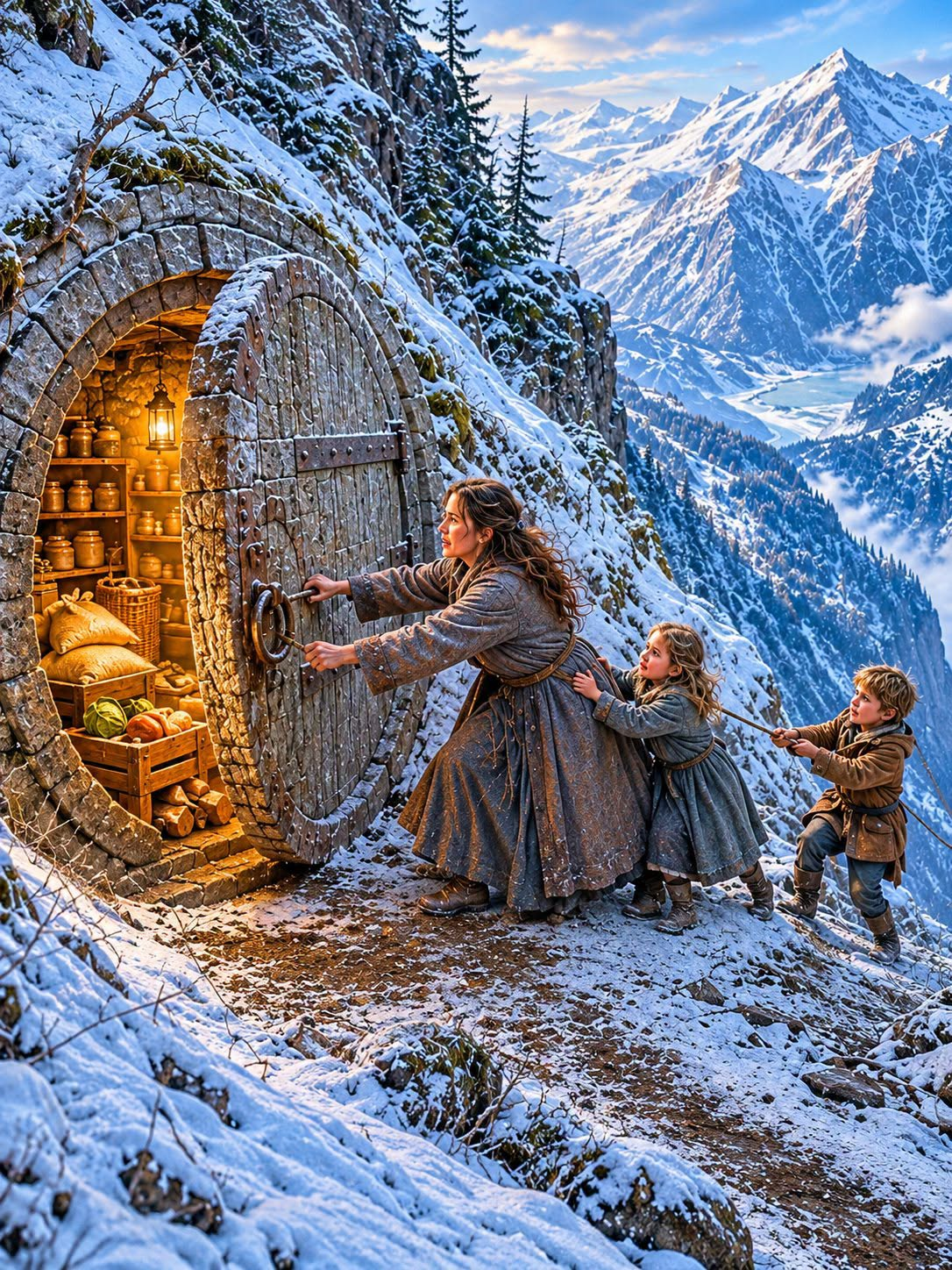
Then she noticed an old stone arch almost completely hidden beneath snow and tangled branches.
Its curve was too regular to be natural.
Something large had once been built into the mountain.
"Is that another house?" Leo asked.
Elara stepped closer.
She brushed snow from the stone.
Beneath it was a strip of black iron.
Then another.
And beneath the iron, a section of dark, weathered wood.
Her heart began to beat faster.
She cleared more snow.
A curved edge emerged.
Then part of an enormous circular door.
Elara stared.
It was built directly into the mountain.
She had never seen anything like it.
At its center was a heavy iron ring.
Leo moved beside her.
"Can we open it?"
Elara reached toward the ring.
Her fingers stopped an inch away.
Someone had scratched a number into the iron.
The marks were old.
Deep.
Deliberate.
She brushed away the remaining ice.
74.
Elara slowly looked back toward the cottage.
Then down at the deed in her coat pocket.
The same number.
The same strange circle from the county map.
She gripped the ring.
And from somewhere deep inside the mountain, she heard three slow knocks.






Comments 0